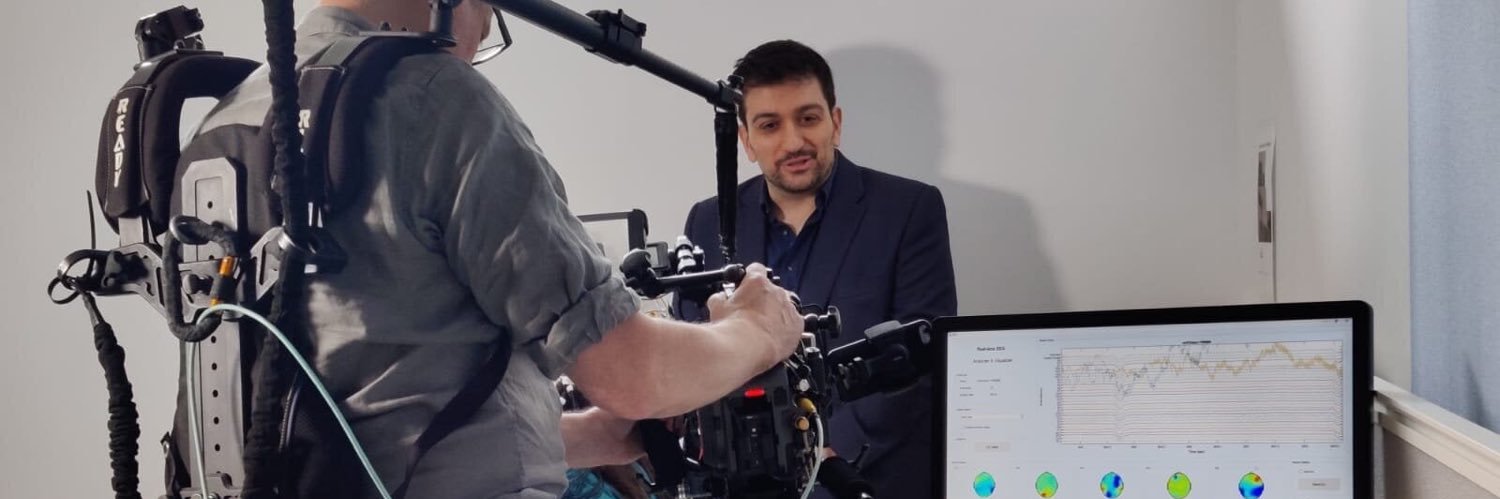
In #depression, electric fields diverging from the activity of neurons that generate them may signal a loss of coordinated control—much like an orchestra in which musicians gradually drift out of alignment with the conductor https://t.co/unA9A1Ofwz
Thanks Dimitris
By ‘reshaping’ you’re suggesting microtubules encode memory, which I believe to be true. Synaptic proteins last hours to days but memories can last lifetimes. There are about 10^8 tubulins per neuron, each with about 30 possible genetic or post translational states so that’s a lot of possible mosaics. Microtubules don’t divide so the lattice memory mosaic is preserved. When microtubules fall apart as they do in Alzheimer’s, memory is lost.
Right
@StuartHameroff
, microtubules could be the fastest to respond to field effects , e.g. once a memory is recalled, and balance out drift by being the first to reshape themselves so that they preserve the overall electric field after some neurons have dropped out.
Thanks Dimitris
So the neural activity correlating with shifting mental representation comes from charge movements in cytoskeleton, like the charged C-termini tails with ions from each tubulin. https://t.co/DfOPW63IpR
And in your previous paper you showed
that such activity sculpted information and memory into the cytoskeleton, e.g. in different neurons.
In this paper @anirbanbandyo ‘s group showed functional communication among neurons mediated by cytoskeletal megahertz and gigahertz https://t.co/xunarTaFk9
So it’s possible representational drift is mediated through microtubules in different neurons (and glia?) oscillating and entangling in megahertz and gigahertz. Microtubules are the most likely site for memory encoding in the brain. https://t.co/Y0YNmUYZSA
As Earl has been pointing out, it seems the brain has two modes.
1) A connectome-based computational modal mode, and
2) A distributed wave field-like, faster (?quantum) mode, possibly a collective time crystal.
Maybe 2) is for consciousness, and 1) is for it to interface with the external world.
And maybe we’re all like Steve Martin in his great film ‘The man with two brains’.
@lndriscoll
Thanks Dimitris
So the neural activity correlating with shifting mental representation comes from charge movements in cytoskeleton, like the charged C-termini tails with ions from each tubulin. https://t.co/DfOPW63IpR
And in your previous paper you showed
that such activity sculpted information and memory into the cytoskeleton, e.g. in different neurons.
In this paper @anirbanbandyo ‘s group showed functional communication among neurons mediated by cytoskeletal megahertz and gigahertz https://t.co/xunarTaFk9
So it’s possible representational drift is mediated through microtubules in different neurons (and glia?) oscillating and entangling in megahertz and gigahertz. Microtubules are the most likely site for memory encoding in the brain. https://t.co/Y0YNmUYZSA
As Earl has been pointing out, it seems the brain has two modes.
1) A connectome-based computational modal mode, and
2) A distributed wave field-like, faster (?quantum) mode, possibly a collective time crystal.
Maybe 2) is for consciousness, and 1) is for it to interface with the external world.
And maybe we’re all like Steve Martin in his great film ‘The man with two brains’.
@lndriscoll
@StuartHameroff Neural activity seems to be coordinated and constrained by the electric field arising from all charged structures in the cytoskeleton, including microtubules , and processes like mechanotransduction, resulting from cytoelectric coupling https://t.co/yH4UXWbpgT
@dimitrispp showed that electric fields carry info and have *little or no representational drift*
Beyond dimension reduction: Stable electric fields emerge from and allow representational drift
https://t.co/AE67R8B5CB
#neuroscience
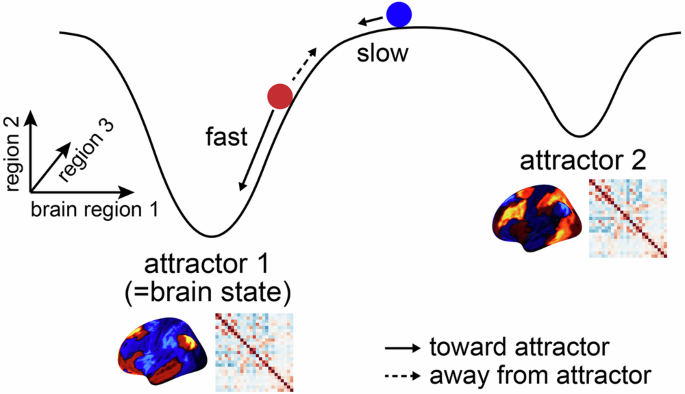
The geometry of neural dynamics along the cortical attractor landscape directly reflects changes in attention, as large-scale brain activity shifts across its hills and valleys depending on the state.
https://t.co/CG8zH3kx1V
Congratulations Dimitris, Andre and Earl
I think Predictive Coding/Recurrent Processing occurs at multiple scales including faster intracellular processing among mixed polarity networks of microtubules inside neuronal dendrites and soma (and ONLY there in all biology)!
Here’s a paper we wrote in 1990 modeling information processing with error correction between two adjacent anti-parallel microtubules connected by microtubule-associated proteins (‘MAPs). https://t.co/jvSJV6ejn4
They learned!
Why else would dendrites and soma have networks of mixed polarity, interrupted microtubules in anti-parallel arrays? Is this how unicellular organisms use PC/RP?
Is lower dimension actually slower frequency scales, e.g. through interference in faster microtubule oscillations?
@StuartHameroff Interesting. Has anyone tested this? BTW we recently tested predictive coding/recurrent processing at the LFP level see https://t.co/M0hUcbOJFS
How does the brain process information? We found evidence in favour of a hybrid predictive coding-routing model that combines top-down predictions with superficial-layer inhibition. Models are complementary,not competing-w/ @MillerLabMIT@BastosLabNeuro https://t.co/WbVYIGLvEv
New discovery! Spoiler alert: Neural dynamics are key.
Evidence for predictive computations in a brain hierarchy during a visual search task
https://t.co/WySKHmvqUp
Work led by @dimitrispp#neuroscience
Electric fields. Brains are awash in them and they have an influence. It would be weird if they didn't.
Ephaptic coupling and power fluctuations in depression
https://t.co/hCwNSFKHlV
#neuroscience
Thanks @StuartHameroff This is in my project wishlist. Just extend my models for electric fields generated from neurons to models for fields from microtubules, the math is similar, see e.g. https://t.co/6kFEJSdtqH
Congratulations Dimitris!
Are your cytoelectric fields both generated and detected/received by microtubules? Do they include megahertz and gigahertz oscillations?
Gotta keep those microtubules in tune!
Megahertz ultrasound good for depression and dementia.