@SoldierNationF1@Humpty_home Soldiers ko salary mil rahi hai isliye border par khade hai! Deshbhakti ja jumla apne paas rakhiye! Aur rahi baat "tu khade hokar dikha le" to dikha dege, there're lakhs of people who work in the harshest of harsh conditions like in mining fields in order to keep our economy goin
🚨 URGENT APPEAL – IMA Gujarat
In response to the mass casualty caused by the flight accident, *doctors from Orthopedics, Plastic Surgery, and Anesthesia from Ahmedabad and nearby are urgently requested to immediately report to Civil Hospital Ahmedabad* for voluntary medical service.
Your prompt presence is critical to manage emergency care and save lives.
IMA Gujarat doctors stand united in service during this crisis.
#MedTwitter
@theskindoctor13 It's not the Annadata, it's the outsiders like Biharis and Bengalis and parts of MP who came here and built these houses on the agreement. Don't you dare to say a word about these annadata, this is not Punjab orharyana where they'd be hoarding millions, they're extremely poor ffs
In these days of mega franchises like MI, CSK and KKR, I can never forget the first franchise team I read about!
It featured H G Wells, Rudyard Kipling, Arthur Conan Doyle, P. G. Wodehouse, G. K. Chesterton, Jerome K. Jerome and A. A. Milne and assorted professors, architects, big game hunters and painters.
Their captain and founder was the writer of Peter Pan, James Barrie.
The team's name was a portmanteau of Barrie's name and the mistaken belief that 'Allah akbar' meant 'Heaven help us' in Arabic, very apt, given that they were wonderful authors and terrible though hugely enthusiastic cricketers.
But Barrie always encouraged his players. He praised one teammate's performance by observing that "You scored a good single in the first innings but were not so successful in the second."
His selection policies were also unique. In his words, “with regard to the married men, it was because I liked their wives, with the regard to the single men, it was for the oddity of their personal appearance.”
He was a canny captain. He would never allow his players to practice on the ground just before a game as the sight would invariably boost the confidence of the opponents.
He would also remind his players that, “should you hit the ball, run at once. Do not stop to cheer."
It was tough captaining the Allahakbarries. As it was the easiest position to field, most of the fielders would go to long on, sometimes as many as seven would gather there with huge gaps in the rest of the field.
The team played all their matches in the magical pre-war era, and some of them lost their lives later in the great war of 1914.
But the story of the Allahakbarries remains an inspiration to all cricket enthusiasts, and Barrie's book about the team had a foreword by Sir Donald Bradman when it was re-released in 1950!
"Federico Fellini's 'I Vitelloni' (1953) was a great influence on me, & was one of the pictures that gave me the courage to make a film about my own friends & myself - 'Mean Streets' (1973)"
---Martin Scorsese
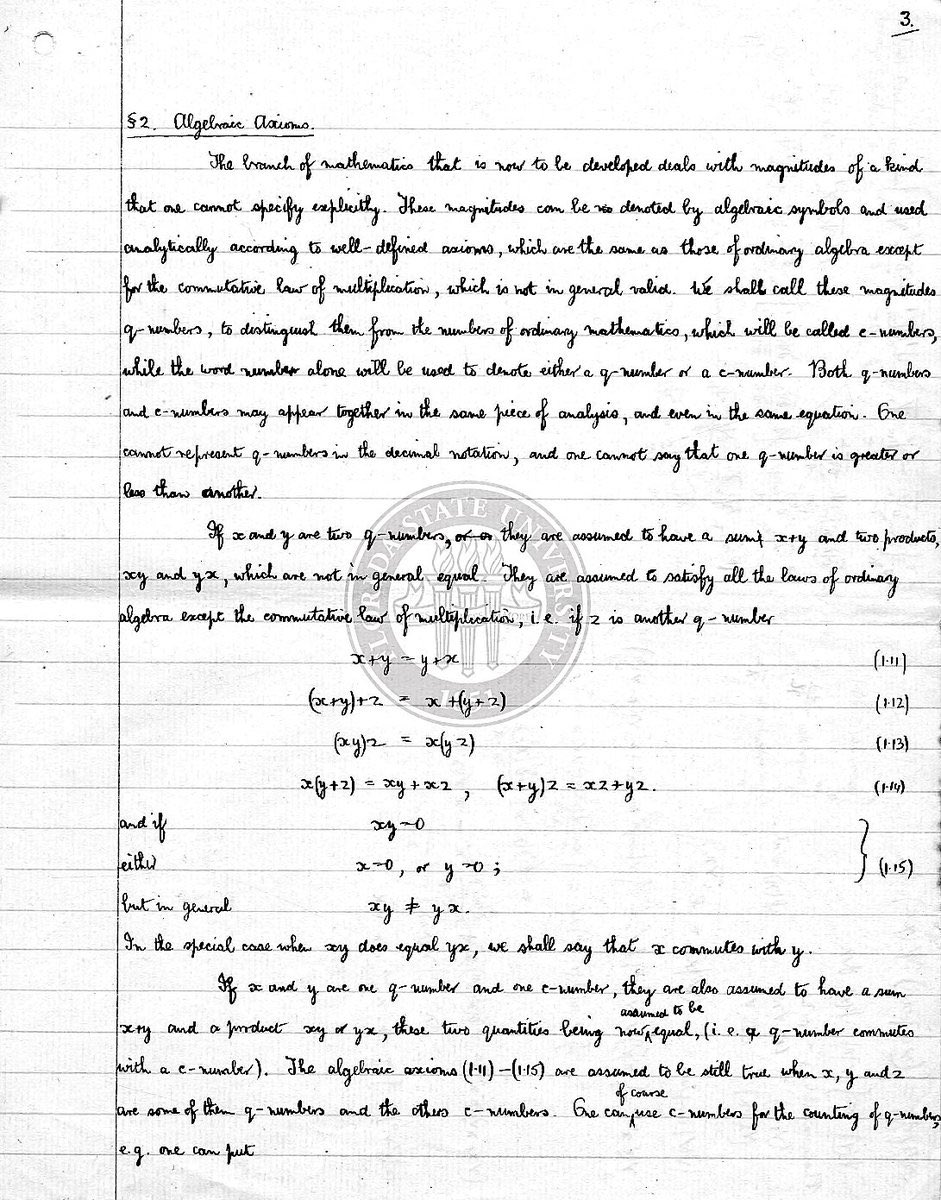
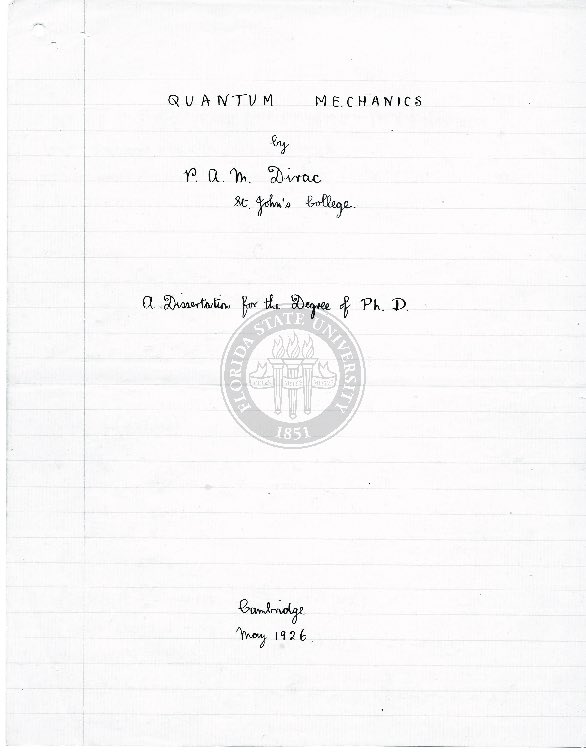
Paul Dirac's Ph.D thesis was not typed. It was handwritten and submitted in 1926. The title of the thesis was simply "Quantum Mechanics". Dirac is one of the founding fathers of Quantum Mechanics.
11 different interpretations of Quantum mechanics explained in brief ✍️
1. Copenhagen Interpretation: The "standard" interpretation where quantum systems exist in superpositions until measured, at which point they "collapse" to a definite state.
2. Many-Worlds Interpretation (MWI): Every quantum event spawns countless parallel universes, with each possible outcome actually occurring in a different universe.
3. De Broglie-Bohm (Pilot Wave) Theory: Quantum systems are guided by "pilot waves" that determine their behavior, implying that particles have definite positions at all times.
4. Objective Collapse Theories: Quantum systems spontaneously collapse to definite states over time, without requiring a measurement.
5. Quantum Bayesianism (QBism): Quantum states are subjective beliefs about the outcomes of experiments, emphasizing a Bayesian approach to probability.
6. Relational Quantum Mechanics: The properties of a quantum system are relative to the observer and do not exist absolutely.
7. Transactional Interpretation: Quantum events involve a time-symmetric exchange of "offer waves" and "confirmation waves" between source and detector.
8. Ensemble Interpretation: Quantum mechanics only applies to ensembles of systems, not individual systems, emphasizing statistical outcomes.
9. Consistent Histories: Focuses on establishing a consistent framework to discuss sequences or "histories" of quantum events over time.
10. Quantum Logic: Proposes a modification of classical logic to account for quantum phenomena.
11. Participatory Anthropic Principle (PAP): Observers play a role in bringing the universe into existence through quantum processes.
None of these interpretations alter the core mathematical formalism of quantum mechanics, but they provide different perspectives on what's "really" happening beneath the calculations. The debate over which interpretation, if any, correctly describes nature is ongoing and remains one of the central philosophical questions in the foundations of quantum theory.
Terrance Tao doing math using lean 4 is the content that I really want to see on my SM feed over the lame futile wars of ML > Haskell
https://t.co/cev0ApohfR
This semester, I have a lovely classroom for my Machine Learning for Physicists lecture. Look at that blackboard!!! A special bonus to those who recognize the t-shirt ;).
If you don’t understand calculus and differential equations , you should give up trading
This is what it takes to generate proprietary trading signals to live luxurious life
There is no substitute for hard work
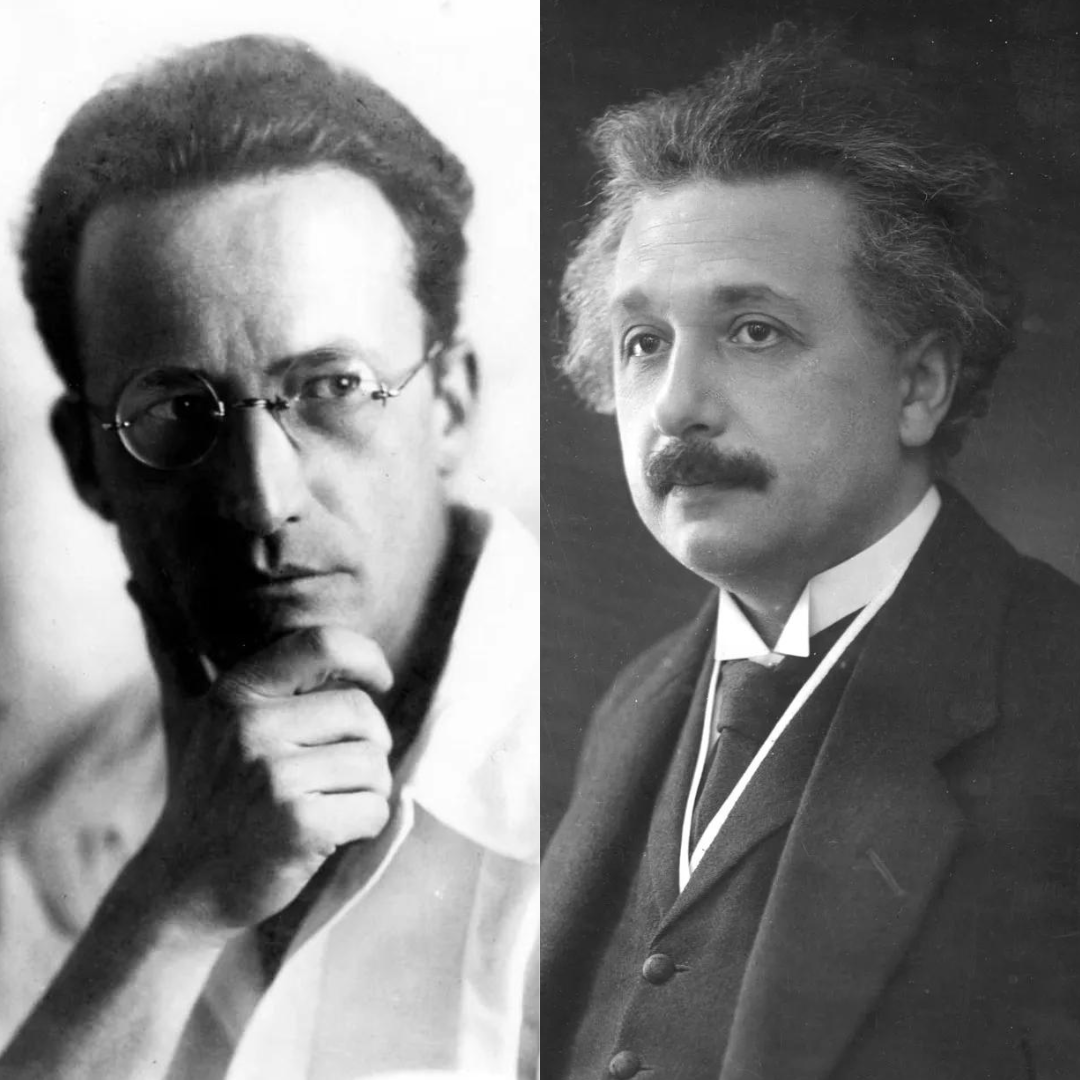
1950: A. Einstein's Letter to Erwin Schrödinger where he talks about the famous Schrödinger's cat thought experiment ✉️
Dear Schrödinger,
You are the only contemporary physicist, besides Laue, who sees that one cannot get around the assumption of reality—if only one is honest. Most of them simply do not see what sort of risky game they are playing with reality—reality as something independent of what is experimentally established. They somehow believe that the quantum theory provides a description of reality, and even a complete description; this interpretation is, however, refuted, most elegantly by your system of radioactive atom + Geiger counter + amplifier + charge of gun powder + cat in a box, in which the ψ-function of the system contains the cat both alive and blown to bits. Is the state of the cat to be created only when a physicist investigates the situation at some definite time? Nobody really doubts that the presence or absence of the cat is something independent of the act of observation. But then the description by means of the ψ-function is certainly incomplete, and there must be a more complete description. If one wants to consider the quantum theory as final (in principle), then one must believe that a more complete description would be useless because there would be no laws for it. If that were so then physics could only claim the interest of shopkeepers and engineers; the whole thing would be a wretched bungle.
You are completely right to emphasize that the complete description cannot be built on the concept of acceleration, nor, it seems to me, can it be built on the particle concept. Only one of the tools of our trade remains—the field concept, but God knows whether this will stand firm. I think it is worthwhile to hold on to this, i.e. the continuum, as long as one has no really sound arguments against it.
But it seems certain to me that the fundamentally statistical character of the theory is simply a consequence of the incompleteness of the description. This says nothing about the deterministic character of the theory; that is a thoroughly nebulous concept anyway, so long as one does not know how much has to be given in order to determine the initial state.
It is rather rough to see that we are still in the stage of our swaddling clothes, and it is not surprising that the fellows struggle against admitting it.
Best regards!
Yours,
A. Einstein