Too many talented college students leave math programs over small financial emergencies. @maanow & @LastMileFund launched the National Math Talent Fund to help change that. Students in need: please apply! Math professors: maybe become an ambassador? https://t.co/T85Bm9sGsz
to mathematicians searching for "what now?"...
applied math is ripe for deep math tools. it is *so* hard to get experts with the perfect tool and the perfect application to meet, communicate, and progress. now is the time: open up an AI & ask "to what use can we put [X]?"
There is an enormous amount of work required yet to actually digest this work, and it is essentially the job of highly skilled humans to determine how to communicate it to human audiences in a way that is correct. Verifying a *particular* proof remains highly non-autonomous.
There are essentially 3 components to "correctness" of a lean proof: validity (does it compile), statement fidelity (does the lean statement being proved match the version in written mathematical prose) and proof fidelity. The first two are certain here.
@elonmusk No, it's already solved with more certainty than 100% of published mathematical literature. Humans will also understand the proof soon enough.
It is probably the case that the present 250,000 page document roughly instantiates the logic of the lean proof, but this is not a human-legible argument. We will need to compress it. And translating such a compressed human artifact back to lean remains undecidable in general.
The Lean FRO and Mathlib Initiative have released a joint statement on the Lean verification of the Riemann Hypothesis.
On November 20, Levent Alpöge released a proof of the Riemann Hypothesis as a Lean library of 17 million lines of code. Over the past day, the Lean and Mathlib communities worked together to verify it. The statement certifies the proof as correct and describes how it meets all necessary verification criteria.
Congratulations to Levent on this achievement, and thank you to everyone in the community who contributed to the verification.
Full statement: https://t.co/edxEbkodw7
@PetarV_93@mmbronstein@TacoCohen Congrats! Been following this project for a long time :) excited to more deeply internalize the categorical framework! https://t.co/BCnXqyaNE0
Just capped off a semester-long informal discussion group among Hopkins PhD students on #GeometricDeepLearning with a fantastic Q&A session with @PetarV_93. Thanks to everyone who participated, both today and over all of our previous sessions! #MachineLearning
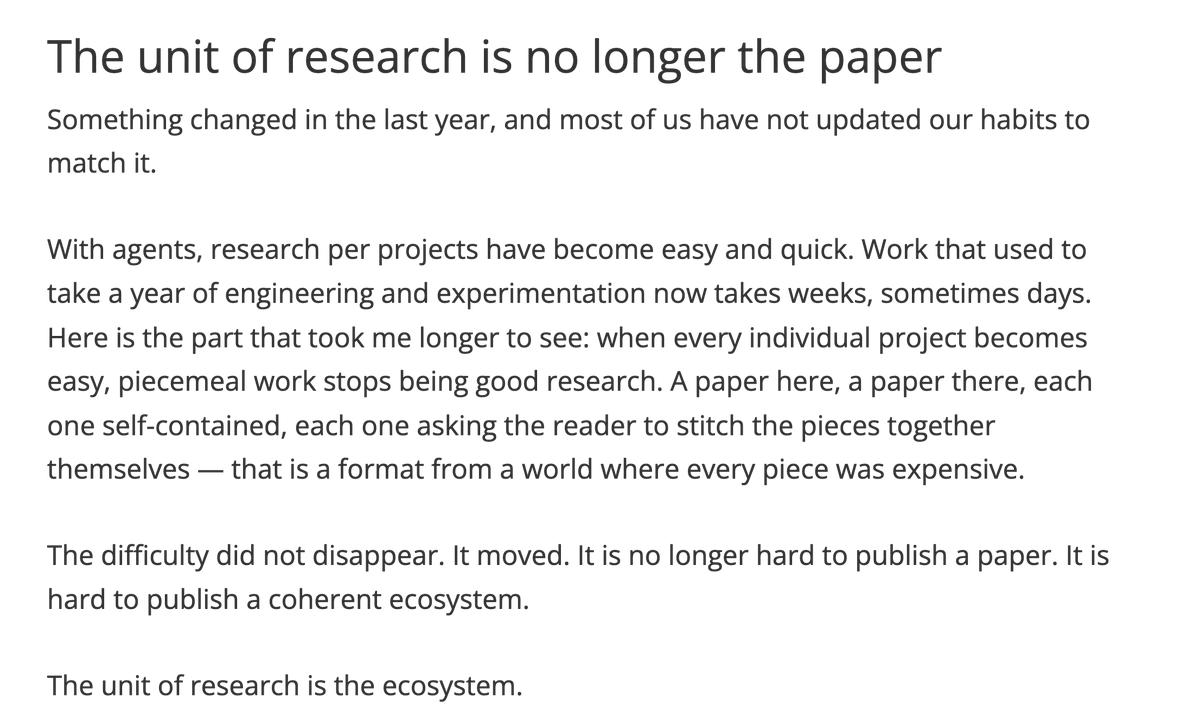
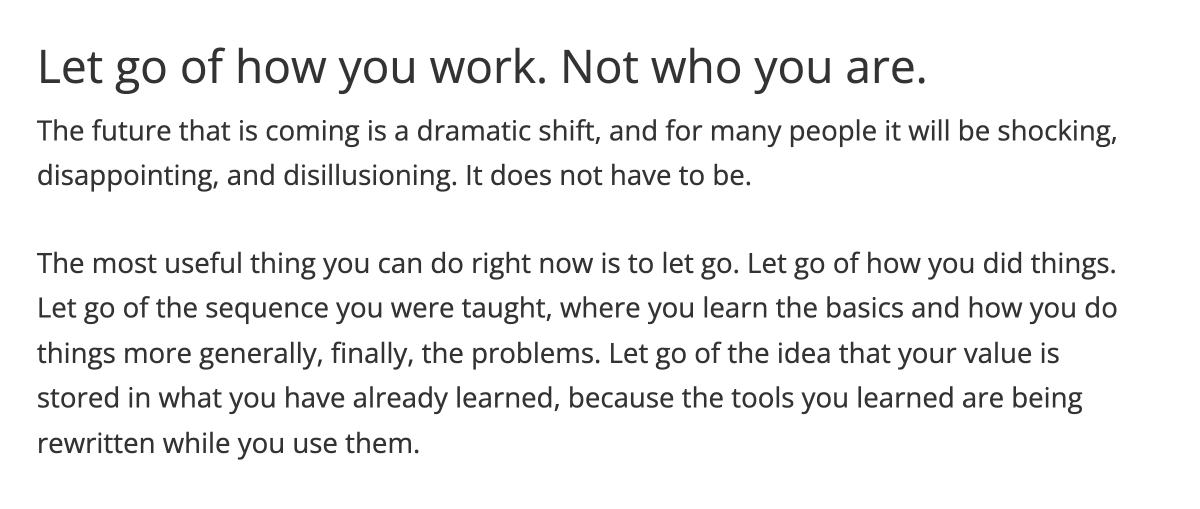
Tons of bangers and useful advice for undergrads and grad students trying to make sense of how to navigate academia and entering industry in the age of agents in @Tim_Dettmers recent blog.
Highly recommend people read it.
https://t.co/3VbFSlxqpF
@ZeeshanZiaML My own view (I don't speak for MJ!) is that "superintelligence" is not (at least not yet) a scientific concept, so it's hard to say anything scientific about it.
@wtgowers@AcerFur Unless the architecture is somehow structurally equivariant to actions of such a subgroup, there is no reason to believe it would behave as such. The convex hull analogy works because it does not presuppose a priori knowledge of structure outside the training data
Reading the comments of junior mathematicians confirms what many senior mathematicians have been warning about over the past month:
It is becoming clear that people with the intellectual ability to understand these proofs will not be interested in spending their lives training to check LLM logs.
This is the tragic side of what is happening that almost no one — except the actual mathematicians — seems to get.
Either we figure out how to keep people interested in doing mathematics, or in 20 years LLMs will have no one’s work left to recombine into new proofs, and no one interested in reading those proofs.
That would be the thermal death of mathematics.
The argument that “LLMs will read LLM math” is so shortsighted that it makes me want to cry…
@stevenstrogatz "He didn't really get it until we had shown him roughly 3.4 billion examples. He gets it right pretty much every time now, but every once in a while we show him an example with a little bit of static and he panics"
"I present the case for total opposition to the use of artificial intelligence in mathematics."
= a view you don't often hear on X. But I am looking forward to reading it carefully, and if you care about math and AI, I encourage you to do the same. https://t.co/2LtcKWCkd6