New article in @PNASNews:
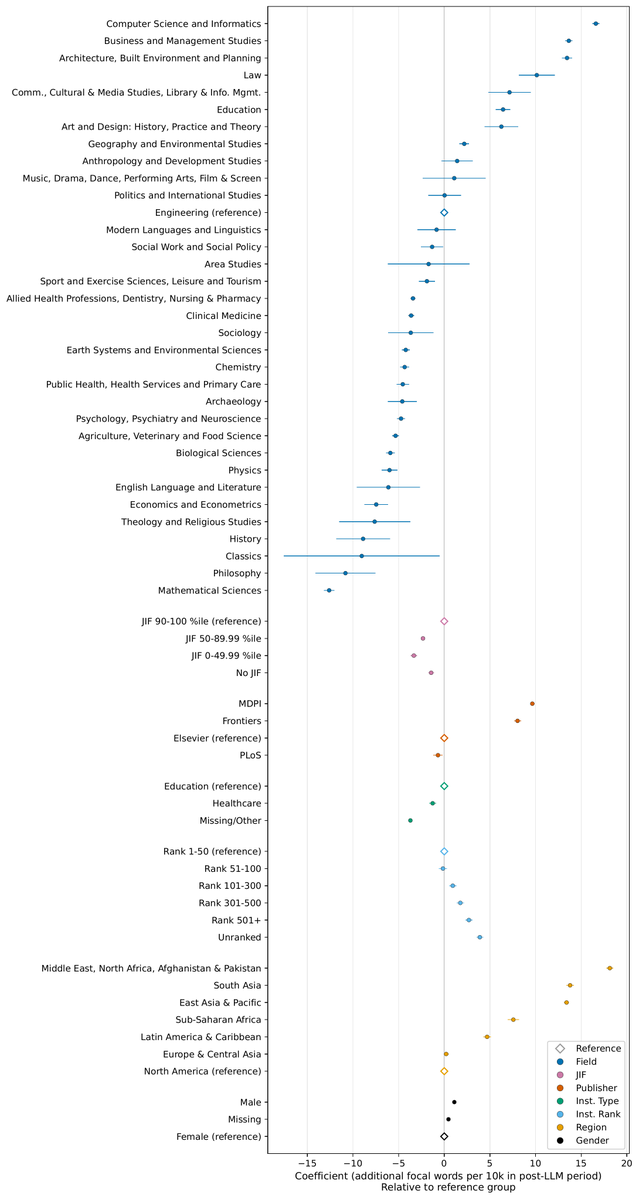
We all know that ChatGPT loves to delve, bolster, leverage, encompass, showcase, underscore, et cetera. I analyzed full text of 7.3 million journal articles published 2020-2025, hunting for 228 words that spiked after ChatGPT launched in late 2022.
@annastansbury If you're interested in the paradox of gender segregation in university fields of study in gender-equal countries, you might like this paper by Charles and Bradley: https://t.co/9UnUmahGwK
@f4t1h89@PNASNews Yes and no. The Open Access publishers (Frontiers, MDPI, PLOS) make their articles relatively easily available in .xml format, although you need to ask permission. Elsevier was the one major legacy publisher that also has a program that enables mass article text downloads.
New article in @PNASNews:
We all know that ChatGPT loves to delve, bolster, leverage, encompass, showcase, underscore, et cetera. I analyzed full text of 7.3 million journal articles published 2020-2025, hunting for 228 words that spiked after ChatGPT launched in late 2022.
@yasmeena_khan@PNASNews Thanks so much, Yasi! That's also a great idea to look at other data sources. As I wrote in the manuscript, the excess word methodology might be of ephemeral efficacy, as people use more/different models, and ChatGPT adjusts its own models to leave fewer lexical watermarks.
Generative AI is diffusing through science both as a productive tool and a threat to the integrity of the scholarly record at the same time. Where we draw the line between legitimate help and misconduct is now a question for authors, editors, and funders alike.
For a scholar writing in their second language, under real pressure to publish, a language model can (in theory) be a genuine equalizer. The same tool can also flood journals with fluent, hollow text.
In 2023, about 12% of papers showed signs of LLM influence. By 2025, an estimated 57%. Importantly, this 57% involves a great deal of heterogenity; ranging from scholars who don't use AI, but recycle text from other AI-influenced articles, to articles completely generated by AI.
Why are professors throwing their hands in the air instead of doing their jobs and facing the task at hand, which is rethinking pedagogy? Learning has changed and will keep changing. It has changed several times since technology came into the lives of humans.
This is not to say they must just accept AI. What they must do now is think of ways to make students think in spite of AI. It is possible and all serious professors must deal with this problem if they want to remain relevant as people imparting knowledge and teaching learners how to think critically. Complaining about AI does nothing. Attempting to outlaw AI is both impractical and a game they cannot win. I cannot see how you can enforce any of the rules I am seeing universities coming up with. In fact even professors themselves are now using AI -- academic journals are now also being flooded with AI generated papers. And as AI gets better, it will become even more difficult to stop anyone from using it for some learning related purpose.
🚨30% of Berkeley Calculus students are severely underprepared (half flunked), yet a whopping 321 Lowell students were rejected by Berkeley. Only 42 students (12%) were accepted from Lowell hs, while Mission hs had 45% acceptance rate (34 out of 76 applicants) @HarmeetKDhillon https://t.co/Gd0CZfb2ie
🧟♂️New article in Research Policy! 🧟
What happens to a journal that loses its people but keeps its name? Or, a journal that kept its people, but lost its name?