They used to document everything on facebook buana,They loved the attention because they were just young lads wamepoteza mwelekeo,vybz kartel is to blame
He has everything going for him!
The day they murdered that cop hapo Lang'ata is the day his days became numbered.
Cops even told the folks that hata wamtoe Nairobi bado watammaliza.
That weekend they dropped half his crew.
The next week they dropped his boy Dantez.
NJONJO IS DEAD
Because he was the son of a senior colonial official, Charles Njonjo never really experienced colonialism and was at best indifferent to the independence struggle
Afterwards, he was vehemently opposed to Africanisation, loudly announcing that certain /1
Nataka niongelee something very funny but sad. Campus students survival mode. From one particular faction. Those from humble background. Not poor, nor rich. These are the ones going through sana. The neglected ones.
A thread.
They really tried it on him yesterday. Walker and Bernardo doubled up on the right while Akanji stayed deep 1st half. He dealt with both. Cheat code in build, body feints, positioning and timing was insane.
Pep wanted to inflict a mental scar on him like with others in our squad.
He wasn't having it.
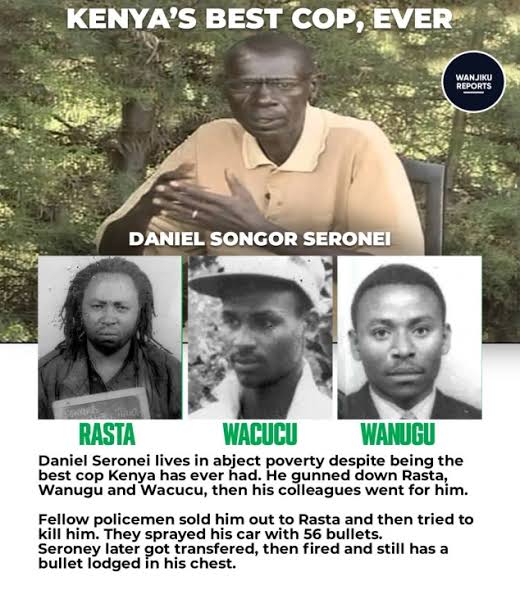
Heard of Wanugu, Wacucu and Rasta, Kenyas deadliest gangsters? Here is their STORY.
Wanugu, whose real name was Gerald Wambugu Munyeria, was one of the most notorious gangsters in Kenya during the 1990s. He was part of a gang of three, along with Anthony Ngugi Kanagi (alias Wacucu) and Bernard Matheri Thuo (alias Rasta), who terrorized the country with a series of robberies, murders, and carjackings.
Wanugu was born in Nyeri in 1970. He dropped out of school in his early teens and began a life of crime. He was first arrested in 1988 for robbery, but he was released on bail. He continued to commit crimes, and he was arrested again in 1993 for car theft. This time, he was sentenced to 10 years in prison.
Wanugu ESCAPED from prison in 1994 and reunited with Wacucu and Rasta. The three formed a gang that quickly became notorious for its violent crimes. They robbed banks, stole cars, and killed people without mercy. They were also known for their flamboyant lifestyle, and they often wore expensive clothes and drove flashy cars.
The police launched a massive manhunt for the gang, but they were able to evade capture for several months. A Ksh 100,000 price tag was placed on their heads, the bounty was later doubled to Kshs. 200,000 as they had become unstoppable.
In June 1996, two of them were finally cornered in Nakuru, Kenya.
On the day of the shootout, the police received a tip that Wanugu and Wacucu were hiding in a house in Nakuru. The police surrounded the house and demanded that the two gangsters surrender. Wanugu and Wacucu refused to surrender, and they opened fire on the police.
The police returned fire, and a shootout ensued. Over 100 bullets were fired, and the house where they were hiding was completely destroyed. The shootout also left several police officers injured. The deaths of Wanugu and Wacucu were a major blow to the Kenyan crime world.
RASTA
Rasta loved guns. He lived, loved and killed by them. A renown sharpshooter, he was said to have honed his shooting skills by having scampering chicken and human beings as targets for practice.
Rasta could, man solo, empty a whole magazine on cops who scampered for safety. He cared less for the GSU as well whom he countered with a grenade at the GSU headquarters after his henchmen were killed at the GSU Roundabout in 1996.
Rasta was said to bribe cops for info on how the Flying Squad was tracking him hence the 12 months of being on the run.
The breakthrough came on September 1, 1997, when Alpha Romeo and Flying squads received a tip from the public and finally caught up with him. They had located his hideout at a goat's pen in his mother's homestead in Kiria-ini, Murang'a County.
On this particular day, at around 5.00 p.m., the police trailed Rasta's sister, who entered the hideout to deliver tobacco to her addicted brother. A dry spell of the drug would make him sick.
Rasta, being the first one to spot the police, emerged from his hideout, jumped out of the compound's fence, and ran towards a nearby valley while firing at the cops.
In the ensuing gunshot exchange, Rasta was gunned down. He died on the spot from multiple bullet injuries.
The death of Rasta was also a significant victory kwa mambang'a. Hope imekua insightful na imekubamba pia.
Photo credits @WanjikuReports.
Watch NTV investigation on different crimes committed by British soldiers in Kenya nowadays and efforts to cover up the tragedies.
“The presence of British army in 🇰🇪 has left behind a trail of damage, some of which is irreversible.”
#CamouflagedCrimes
https://t.co/rXdyauPYKF