Thrilled to be talking about some of my PhD work at ASM Microbe this weekend in DC! Come see me on Saturday in the Rhizosphere to Pollinators section to learn how I’ve been characterizing the symbiotic plasmidome within legume nodules with HiC metagenomics! Can’t wait to see you!
Interested in joining the lab or collaborating? I’d love to hear from you! You can use my current website as a reference (https://t.co/KxUbKni3s9) - Caesar Lab version coming soon 😊
I am thrilled to share that this fall I’ll be joining the University of Oklahoma School of Biological Sciences as an Assistant Professor! The Caesar Lab will study the ecology and evolution of host-microbiome interactions in social bees (honey bees, stingless bees and more) 🦠🐝
Thank you so much for the recognition and opportunity @NikoMcCarty and @AsteraInstitute ! This was such a great chance to think more deeply about what could make work like mine more possible and impactful. Congrats to the other winners! Can't wait to read about everyone's ideas.
Announcing the winners for the "Fast Biology Bounties."
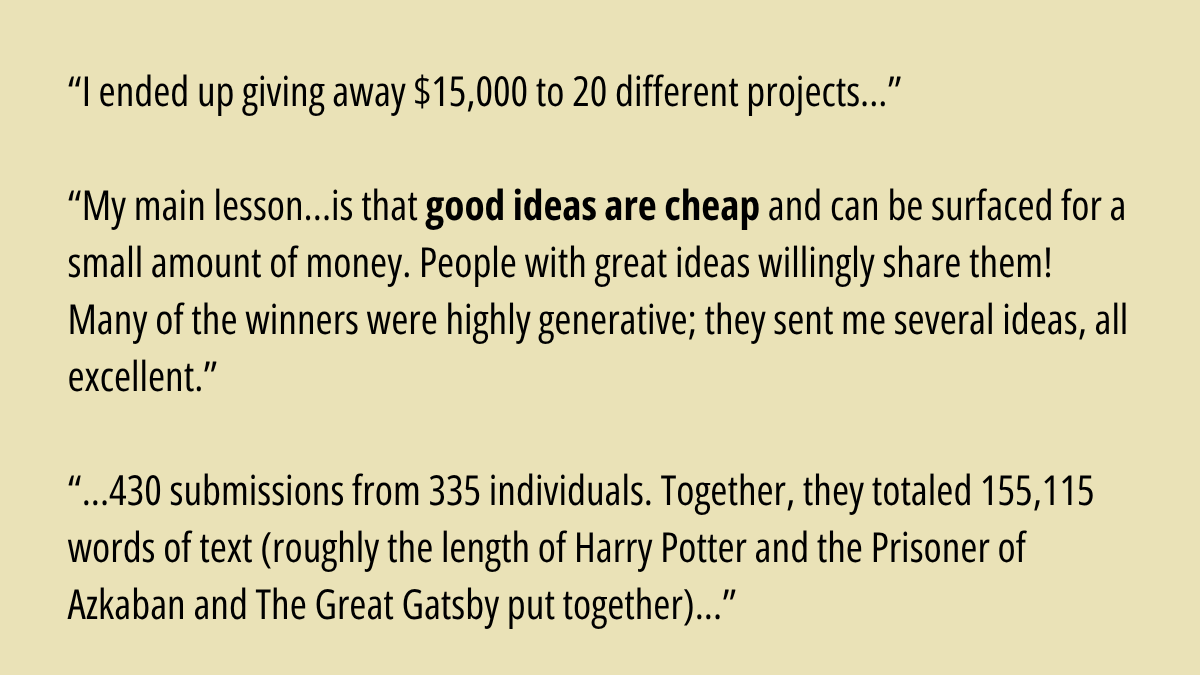
I ended up giving away ~$15,000 for 20 projects after reading 430 submissions from 335 individuals. Many winners were "highly generative," meaning they sent me 3-5 excellent ideas and were glad to have them shared freely and openly.
There were some major failure modes, too. Some ideas surfaced repeatedly, but I didn't do a good job of connecting "like-minded" people. I'll fix this next time.
Also, I managed everything manually using my personal email. This was tedious, and I'm working on building a platform that will automate a lot of this. I'd like to send feedback and scores for every submission in future contests.
Many more details in my blog post, which breaks down all the numbers, what I learned, and highlights some of the winners.
Some people who I gave money to:
- Sebastian Cocioba for a laser-based PCR thermocycler, in which infrared heating replaces aluminum blocks.
- Bryan Duoto for writing and publishing a colony-to-sequence cloning workflow that uses magnetic beads and Nanopore sequencers. Scientists can verify clones in 1–3 hours instead of waiting overnight.
- Jeff Nivala for an idea to synthesize proteins directly from DNA, without relying on any RNA intermediates.
- Sierra Bedwell for a clever automation system that uses off-the-shelf parts to screen thousands of environmental DNA samples in parallel.
- Xavier Bower for "IceCreamClone," an interactive cloning strategy ranker that looks at a scientist’s available “parts,” or sequences, and then determines whether they ought to use Gibson, Golden Gate, restriction digest, or another strategy to assemble them together. The software also catches likely cloning errors and estimates the cost and time required for each option.
- Andres Arango for multiple ideas, including using antifreeze to accelerate DNA ligation by 2-3 orders of magnitude, and an idea for computationally designed protein cradles for expressing membrane proteins in E. coli.
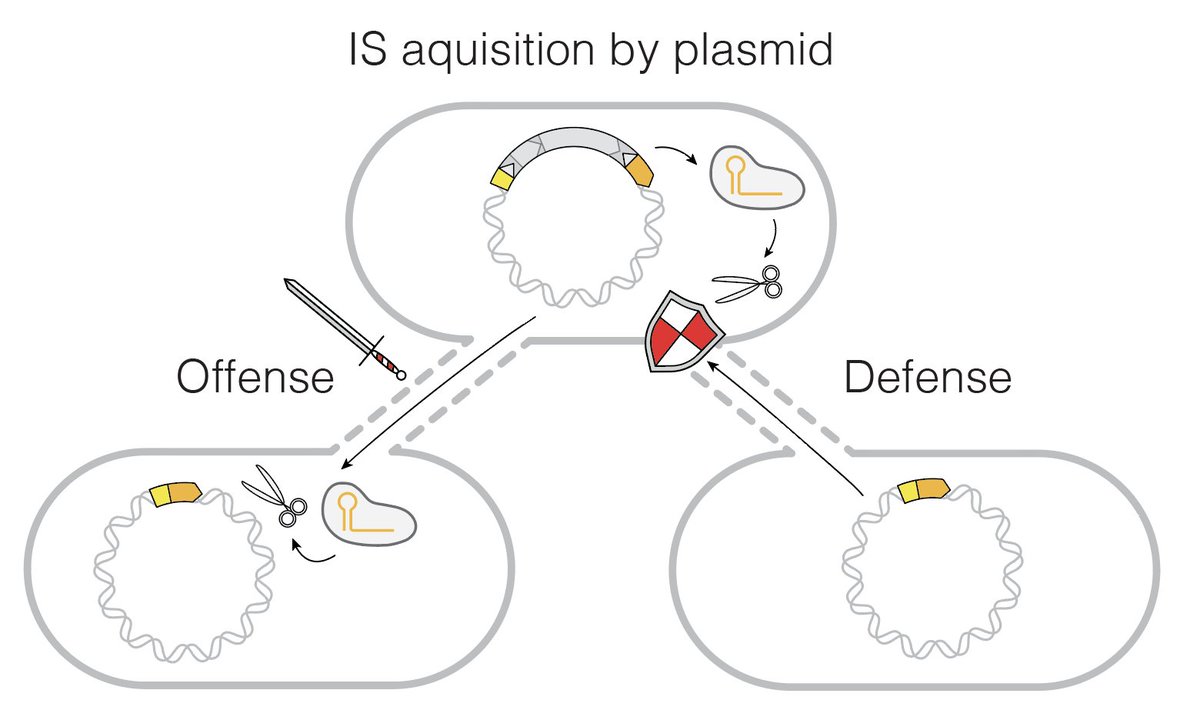
Brand new preprint from my lab, showing that TnpB, the ancestor of Cas12, acts as a gene drive in plasmids! And it turns out in conjugative plasmids that it acts as a primitive anti-self defense system, providing a potential link between its transposon effect and becoming CRISPR!
Of course thanks to @baym for giving me a home and the opportunity to do this work, my co-author @fernpizza who taught me the ropes of evolutionary biology, @TheShreyasPai, @wheezenfeld, @nquinoneso and @Celia_Sqe for the help along the way and the rest of the Baym lab crew
Link to the pre-print. In summary, In this work we have found a unique strategy where the IS605 gene TnpB, the ancestor to Cas12, enables a gene drive to spread the IS in plasmids.
https://t.co/mm8Ktiq0xg
What is the best strategy to win any contest?
Eliminate your opponents of course.
Recently, my colleague @fernpizza showed how plasmids compete intracellularly (check out his paper just published in Science today!). Together with @baym, we now know how they can fight.
(1/7) Very excited to share my first PhD preprint on the interactions of two of my favorite mobile genetic elements: phages and group II introns!
https://t.co/99pFYIYl4r
Clear and compelling interview with @baym on the harm of cutting funding to antibiotic research:
https://t.co/KehKBrDl51
This affects so much of modern medicine; many cancer treatments, including regimens with curative intent, are only safe because of effective antibiotics.
Just got news that all of my NIH and NSF grants were officially terminated today. Have been expecting this for some time, so it's not surprising, but still jarring to see the news.
Have heard similar news from dozens of colleagues. Will be hard, but we'll find a way forward.
Yesterday, the NIH R35 “Outstanding Investigator” grant to fund scientists in my lab studying antibiotic resistance was terminated for reasons not related to the content of the science, or any actions taken by me or members of my lab