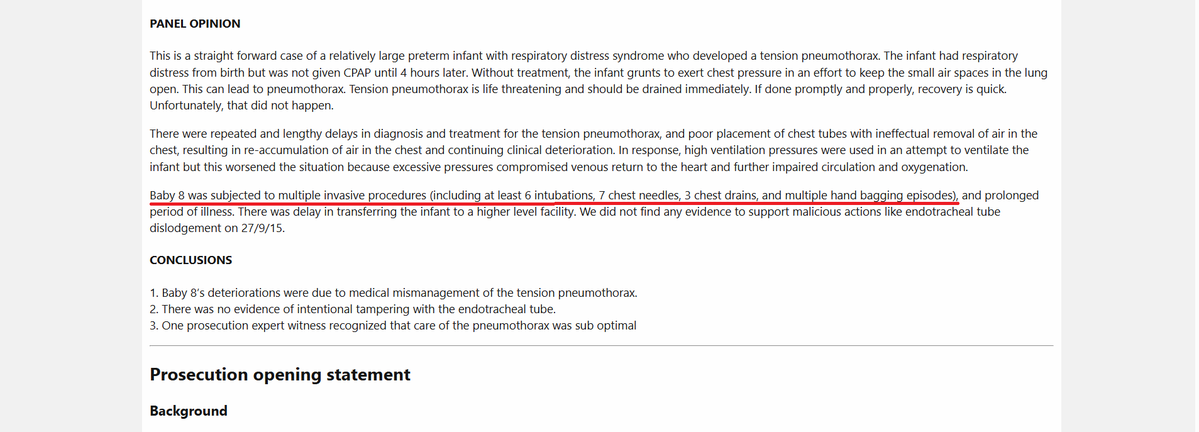
"In a new ITV documentary about Letby's case, Prof Neena Modi, of Imperial College, said she had examined medical notes and concluded that critically ill babies had not been monitored or treated appropriately."
https://t.co/qjgHtUVwV2
Cant help but wonder if Thirwall, being a canny lawyer, has now prepared two conclusion documents in the hope that they can wait out the CCRC report, so they can put out provisos should #lucyletby#letby's guilt brought in to question. https://t.co/Tky7nzru9H
"Although this has been very traumatic, my strong desire to remain in Chester and within CoCH remains, and I am hopeful that we can find a professional way forward to enable my return to where I feel I belong."
Read the letter Lucy Letby wrote to her accusers after a hospital grievance investigation found in her favour, and she was told she could come back to work: https://t.co/tMAeTOE160
Alas, Letby never came back to work.
A few weeks after she wrote this letter, and right before she was scheduled to return, one of her accusers, Dr Ravi Jayaram, told the hospital that he'd once walked in on her trying to murder a baby.
It only took Dr Jayaram a year and a month to tell the hospital about this – about walking in on an attempted murder on a baby.
It took Letby winning an HR complaint against him for Dr Jayaram to speak up.
Once he did, the hospital called in the police.
Lucy Letby to her accusers: "The secrecy of this situation has been, in my opinion, to protect you more than it was to benefit me - I have never had anything to hide.
"I therefore wish to be as open and honest as possible with my colleagues pending my return and I will be releasing a statement.
"I feel they have the right to know the truth behind my secondment and restricted contact, which is very out of character for me."
Letby never returned to work. Her accusers met with the police within days of her scheduled return.
"The fact that [Lucy Letby] has been subjected to the ordeal of the last four to five months based on a 'gut feeling' and the subsequent behaviour of [Dr Stephen Brearey] is not compatible with the trust values and behaviours," [the investigator] said."
https://t.co/iMLp2dmy6p
Webinar: Statistical issues in police investigations
Jane Hutton will present a case study based on Letby.
A shame Cheshire Police weren't open to learning from her—but credit to Scotland’s @SIPR_Scot and SPACE for stepping up to tackle these critical investigation issues.
The case against Lucy Letby just COLLAPSED.
The shocking facts exposing Cheshire Police's malicious & egregious investigation of Lucy Letby.
By Law and Order with Gina
https://t.co/AxkSaYk2lk
#LucyLetby
060416
'There has been no case in British legal history, or indeed as far as I am able to establish in the history of English speaking common law legal jurisdictions such as Australia, New Zealand, Canada, and USA where the identity of seven murder victims, and ten attempted murder victims have been censored, and further reporting restrictions have given life-long anonymity to nine of the adult prosecution witnesses' https://t.co/HYXKv75M0f
@MargotDA33@merchant47@ccrcupdate have no relevant expertise themselves. It will be hard/impossible to find anyone credible who agrees with the Crown’s accusations of in effect sorcery. There must also be an element of face saving. If referred quickly it shows up those in authority who swallowed it
"We didn't get our convictions overturned because of the government, or the courts. I'll tell you what got our convictions overturned: public outcry."
"One thing about the British public, when they see an injustice, they are not afraid to stand up and scream about it."
@gilham_stuart I was thinking this just yesterday. The consultants were put on such a pedestal and are still held in high regard by guilters. But when you see the litany of errors with this child, it's quite frankly outrageous. Ben Myers closing argument on this child is particularly damning.
Baby H is probably one of the most under appreciated negligence cases, probably because of the jury decisions of not guilty and no verdict, the case hasn't received as much scrutiny.
It's a little known fact that there was actually an air embolism diagnosed and proven in one of the indictment cases - Baby G.
It happened at Arrowe Park and it was accidental.
Ben Myers used this in his closing speech to demonstrate:
a) that an air embolism can be accidental
b) that it does show on x-rays in life
c) that it looks very different to anything seen in the air embolism charges, and more like that in the Lee and Tanswell paper.
This is what he said on this topic:
"We also saw, as it happens, an air embolus on [Baby G] from when she had recently been born at Arrowe Park Hospital. We saw that at page 8139 of the exhibits and we showed this to Professor Arthurs. Page 8139. Now we know what we're looking for, you can probably see it anyway, even if we didn't have to identify it with Professor Arthurs. But you can see, as it appears on our image on the left-hand side, probably the right-hand side of the baby, you can see where the tube has gone in and you can see some loops, dark loops, and that's the air embolus in the liver area. Air in the liver, looking nothing like the images in this case, although a little bit more like the image in the Lee and Tanswell paper.
"As Owen Arthurs explained on 3 February, what we have is a misplaced -- just ponder this -- a misplaced UVC, so that air has gone into the liver and caused a tree-like pattern due to the inappropriate positioning of the UVC. He accepted this was an air embolus from a connected -- where there'd been a wrongly connected or wrongly positioned UVC too low in the liver. It was there at this point, we looked at it, and it was there 45 minutes later.
"This is in [Baby G] in hospital, her heart beating, keep this in mind when it's suggested you can't see an air embolus when someone's heart is beating. You can see this one.
"Forty-five minutes later, it's still there at page 8141. Just go to the next reference, 8141, please, Mr Murphy. There it is still. These are in sequence. If you go to the exhibits, you don't have the exhibits in the numbers but we can follow them through and we went through this with Professor Arthurs.
"This has a real significance in this case. We can see from Lee and Tanswell what an air embolus is meant to look like, and it really shouldn't come as any surprise and it's not just two lines of air static in one or more great vessels, it's a tree-like pattern because it's got there after the heart was beating air round the system together with the blood. That's how it works. And we can see it here in life on [Baby G]. So a couple of things follow from this -- thank you, Mr Murphy.
"That was by accident by the way. A couple of things follow. It's no good saying it can't happen by accident. Air embolus can happen because of legitimate medical treatment, something that Dr Bohin accepted only reluctantly and Dr Evans was unwilling to accept at all. We're not suggesting for a moment that every allegation of air embolus in this case is explained by a medical accident. We question and we challenge whether air was introduced in any of these cases. But it does remain a possibility, actually, doesn't it, from the evidence that if there had been an air embolus, it's entirely possible that one or more instances could arise from the course of sub-optimal procedures. It must have done there on [Baby G], one of the babies in this case.
"But secondly, and importantly, this establishes that an air embolus, if there is one present, can be visible when someone is alive. So it's not right to take the line that it wouldn't be possible to see it on a radiograph during life because the blood is moving. It's not right, it doesn't follow that there cannot be an air embolus when the blood is moving. The whole point about an air embolus, of course, to some extent, is it acts as a blockage, it isn't moving. That's the problem. So it will show up, air shows up on a radiograph. And we've got it there. That is decisive. It seems a small thing, something that just came up in the cross-examination of Professor Arthurs, but we say, ladies and gentlemen, it's crucial to keep this in mind in this case. This is stuff we have now, we have an image of air emboluses, I am not sure in the Lee and Tanswell whether that's in life or death, but in the case of [Baby G] it's in life.
"Ladies and gentlemen, scientific medical evidence, we say, needs to be sufficiently reliable if we're going to rely upon it in a criminal trial, as we are in this case. And we say that in this case the scientific evidence in this area in particular falls far short of that. There is a lack of genuine expertise across the witnesses. There really is on the evidence. The research basis for the findings that you've been given is poor from the link between gas in the great vessels to the question of discolouration. And what guidance we have from the experts has been applied inconsistently throughout the case.
"And it's no answer, we submit, to say that there are enough bits and pieces to put it all together and say it does the trick. It's not enough to say that. If there is a lack of expertise and a lack of scientific rigour, it can't be compensated for by taking what is, in the first place, inadequate knowledge and then just repeating it and applying it in this case over and over again. And we say: where is an image that looks like what we know an air embolus is in this case, apart from on one of the babies when she's at a different hospital? Where? And there isn't. And this is an area, we say, where the evidence is so poor it cannot safely be used to support these allegations. Of course I'm going to go through them with you. But rather than seeing if the theory can be manipulated to keep the allegations going, just look to see how it has been used like that, just to prop them up. You'll just see that."
From: https://t.co/KqNjIGovpb
#LucyLetby






![LucyLetbyTrials's tweet photo. "The fact that [Lucy Letby] has been subjected to the ordeal of the last four to five months based on a 'gut feeling' and the subsequent behaviour of [Dr Stephen Brearey] is not compatible with the trust values and behaviours," [the investigator] said."
https://t.co/iMLp2dmy6p https://t.co/qpwiWF7xlt](https://pbs.twimg.com/media/HJvmdLFXYAEk0d7.jpg)