The R package 'hespdiv' is now in the CRAN! 🥳
https://t.co/uEhTLO7r8a
https://t.co/pBnqf8XWwr
Now automatic hierarchical and statistically testable contiguous bioregionalization is available for everyone!
#Bretskyan_hiearchy
CC: @niles_eldredge@svalver@PalaeoPhilo@CoelhoPre
Info on the hybrid symposium "Approaches to Mass Extinctions":
If you want to participate online and ask questions through Microsoft Teams, please register by sending e-mail (up to the March 31st) to the [email protected] with the title "Approaches to Mass Extinctions".
I’m glad to share our just published in “Lethaia” article first authored by my PhD student @SimonaRinkevii1 on the tempo of the Mulde Extinction Event (lower Silurian) where we, based on the ultra-high resolution record of ostracods https://t.co/nT06utTqrj 1/n
Interesting study showing results contradicting many previous studies, suggesting that there is no connection between origination and extinction rates and external drivers such as global temperatures, fragmentation of continents, sea level etc.
https://t.co/iG2fluiiZQ
1/n
I’m excited to share our new article published in “Palaeontology" @ThePalAss presenting HespDiv family of methods for the spatially constrained, contiguous and hierarchical subdivision and clustering developed by brilliant PhD candidate @LDaumantas
https://t.co/XETqHwXToq
1/9
hespdiv - a new R package for use in spatial studies in palaeontology & neontology https://t.co/6H0r946zqb @LDaumantas@AndrejSpiridon4@datadryad @PaleoDB
Bretskyan hiearchy (sensu https://t.co/ZfLhHUD32c ) matters! Glad to see the acknowledgement of the actual physical structure of landscapes in metapopulation biology.
cc: @niles_eldredge@svalver@CoelhoPre
This is fundamental for geology, and terrestrial habitability: climate caused cratons.
https://t.co/YN4B9GCfsd
"Generation of sedimentary rocks enriched in heat-producing elements...resolves a long-standing question of why many cratons were stabilized in the Neoarchaean period"
Nice try for comprehension of the biosphere:
"We suggest that the lag in the development of a more predictive science of the biosphere is ... because of unresolved tension between the three dominant scientific cultures that pervade the research community."
https://t.co/RGleuwWEx9
Interesting theoretical paper on the interaction of levels of evolution (somatic cell and organismal level fitnesses), when non-heritable somatic mutations increase the orgnaismal fitness. They call this kind of coupling “somatic genotypic exploration”:
https://t.co/NVE7imDgZv
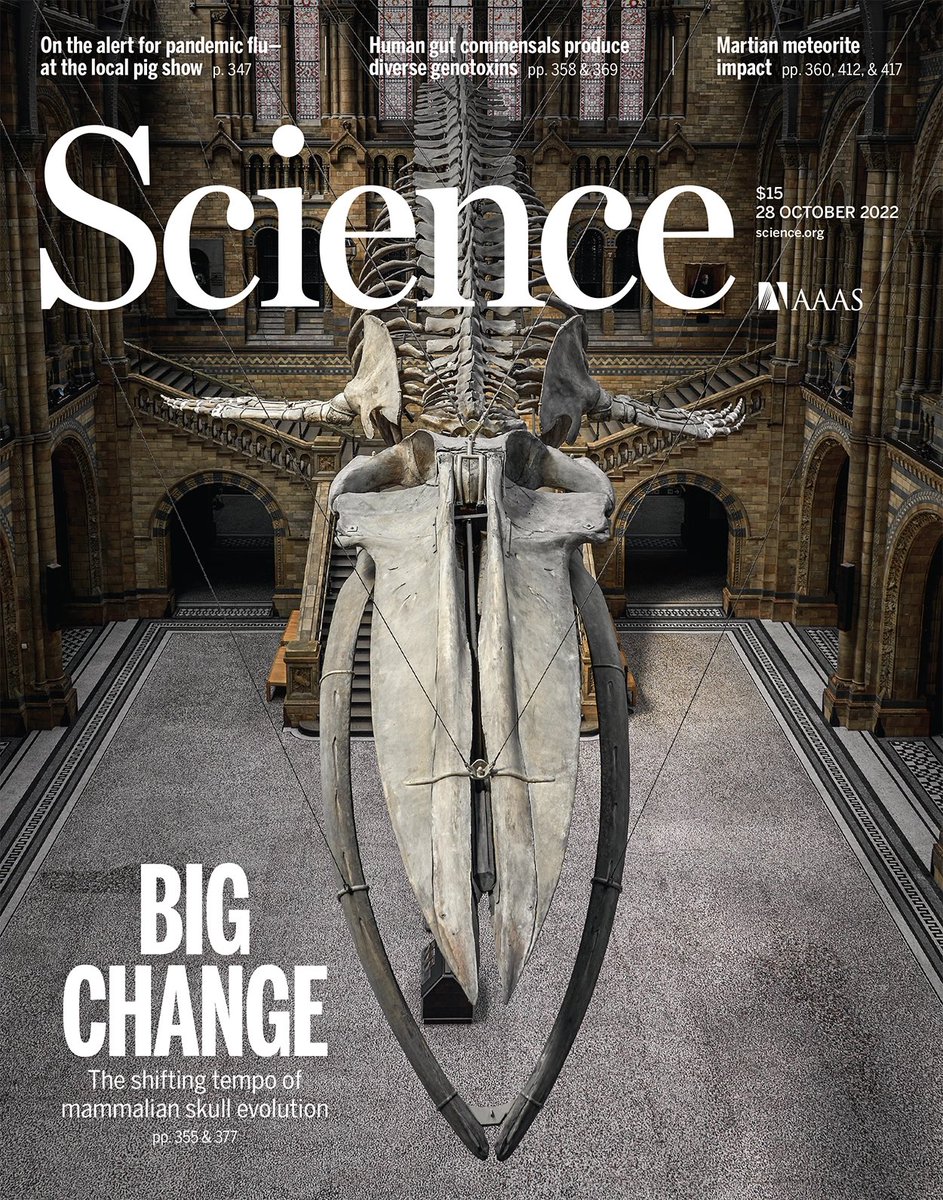
Ecstatic to share our new paper on skull evolution in placental mammals, highlighted on the cover of @ScienceMagazine! With a 3d dataset spanning the Cenozoic, we describe a new model of attenuated evolution & identify traits associated w/fast evolution https://t.co/n1ZIUVcuj2 1/
Get your dancing shoes on! A very cool new music video has dropped!
"The Ediacaran Shuffle" from the new "Creatures of the Slime Album".
https://t.co/JpGnvv8kHb
The code for this is part of the new version of @graph_tool — which is being prepared as I write this, and will be out over the weekend, so you can play with this on your own data!
https://t.co/PyuB1teEYn
N/N *end of transmission*
What kind of hysteresis is this!? It seems that the state of vegetation depends on the micro-relief which depends on the erosion, which depends on the plants...
I guess these systems also should be characterized by long-memory.
cc: @BlaiVidiella@svalver@niles_eldredge
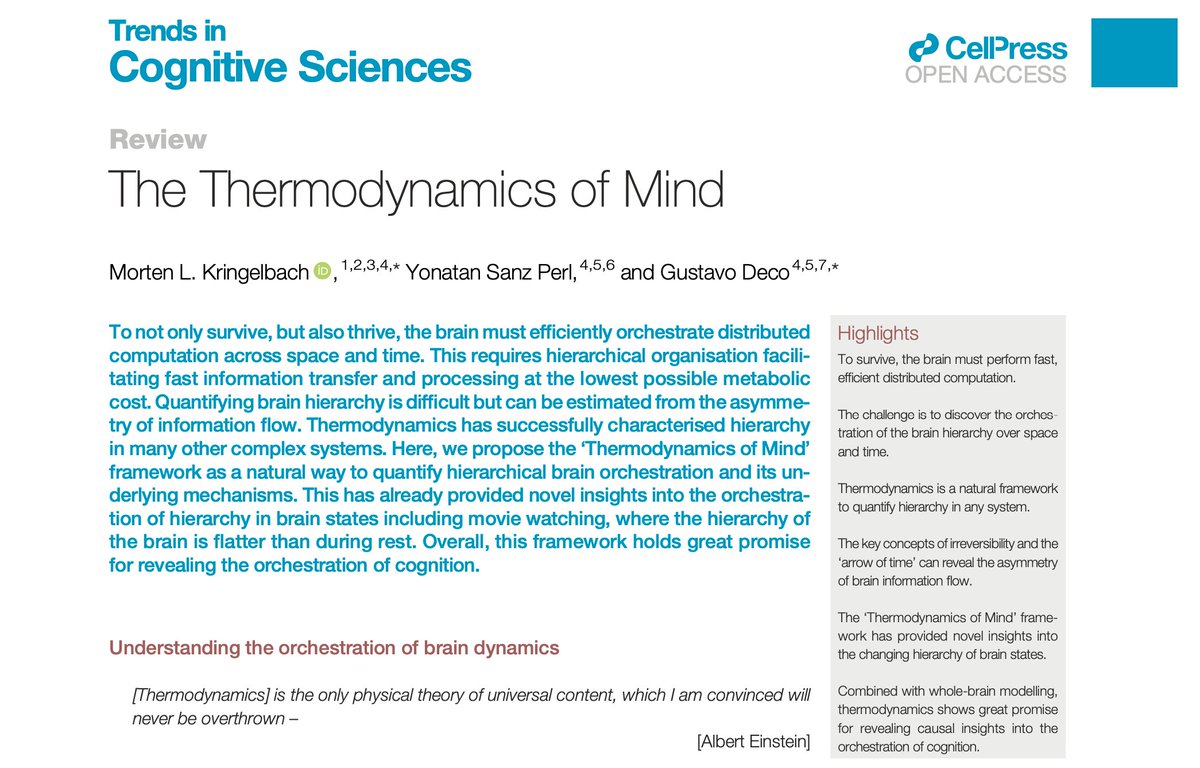
Watching movies leads to flatter hierarchies of cognitive processes than simple resting, contrary to the popular belief that movies are intellectually stimulating. This probably explains why some people more easily fall asleep with the TV on, despite its adversary sleep effects.
Is there an arrow of time in the brain? Can Boltzmann and Shannon's ideas be used to understand it? Check this paper by @icreacommunity Gustavo Deco, @ysanz6 Morten Kringelbach on how physics and information theory reveal how hierarchical cognition works https://t.co/scxj5tRduy
Possibly marks this decade as a 2nd paleobio revolution. The field has been stagnant again with organismal stamp collecting since the previous one 50 years ago.