Known for my skills in designing disruptive diffractive optical elements, I am also passionate about Fourier Optics, chaotic systems, and trap shooting!
1/5
@elonmusk
You recently asked Grok: “Can quantum computers crack Bitcoin?”
The answer was “low risk for now… but real by ~2035.”
Coinbase just created a Quantum Computing & Blockchain Advisory Council (Jan 2026) because they agree the threat is coming.
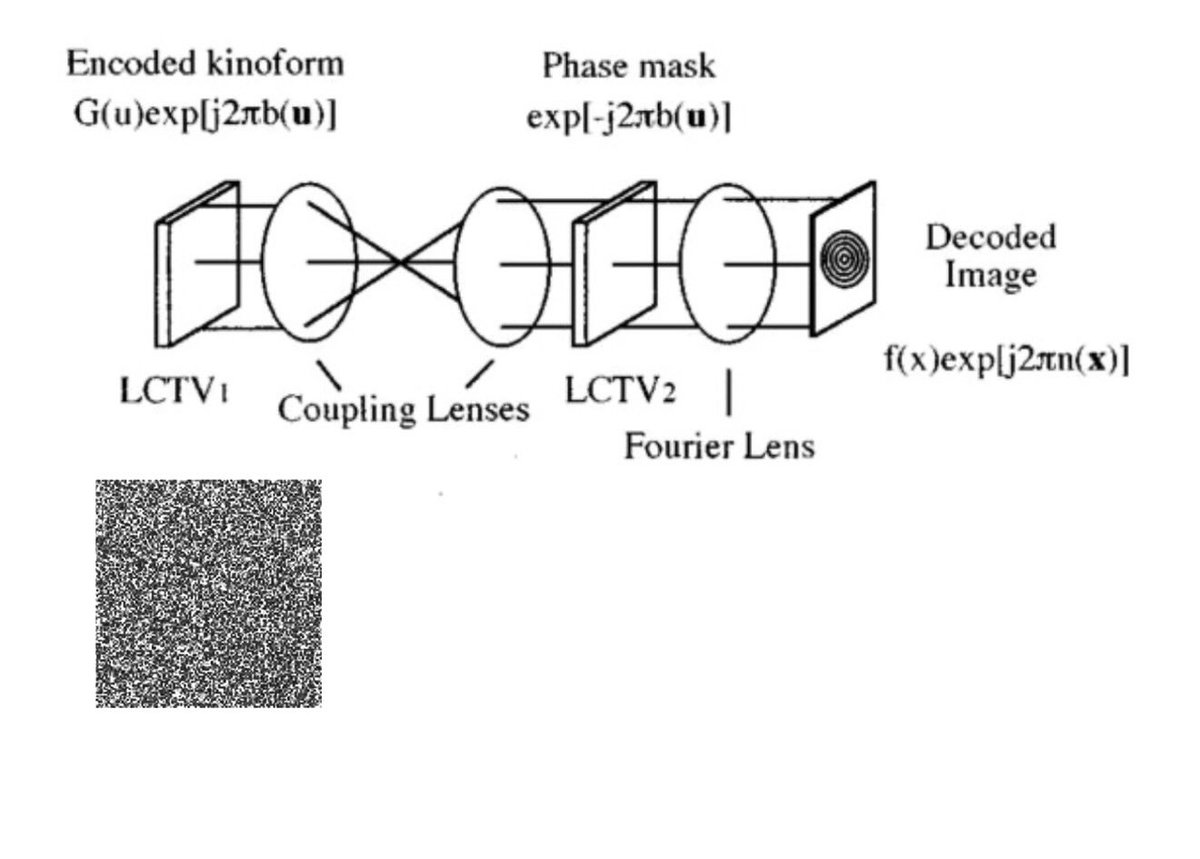
But there’s a 1996 idea that could actually resist quantum attacks naturally.
4/5
Post-quantum cryptography can’t just be “bigger digital keys.”
Hybrid, analog, and optical approaches may be part of the real long-term answer.
Industry preparing early enough?
@sooyoon_eth
Completely agree. I think 2035 might even be too optimistic — several internal reports from major exchanges are already pointing to 2030–2032 as the “realistic pessimistic” scenario.
The biggest issue you mentioned is exactly right: migration.
It’s not just replacing one algorithm with another. It means updating millions of wallets, smart contracts, custodians, exchanges… all at the same time, with zero downtime. It’s going to be absolute chaos.
That’s why I believe hybrid (or even parallel) approaches like optical/analog encryption are worth exploring: you don’t have to rip everything out and replace it overnight. You can simply add a quantum-resistant layer on top of what already exists.
Have you come across any practical post-quantum migration project that actually looks viable (NIST pilots, Ethereum L2 experiments, etc.)?
Antifragile: Things That Gain from Disorder
In the book "Antifragile," Nassim Nicholas Taleb explores the concept of antifragile systems, which not only withstand chaos and disorder but actually grow stronger from them.
Taleb cites practical examples of antifragility, such as biological evolution and the financial system, which can become stronger after crises.
Many systems around us exhibit chaotic behavior. Although Taleb does not focus directly on chaotic systems from chaos theory, he recounts how he was amazed when he saw an experiment demonstrating the chaotic behavior of a bouncing ball on a table:
"And, ironically, the so-called chaotic systems, those that undergo a type of variation called chaos, can be stabilized by adding randomness. I watched an astonishing demonstration of the effects, presented by a doctoral student who first made balls bounce chaotically on a table in response to constant vibrations on the surface. These constant shocks made the balls jump in a disorderly and inelegant manner. Then, as if by magic, he flipped a switch and the jumps became orderly and smooth. The magic was that this change from chaos to order did not come from eliminating chaos, but by adding random shocks, completely random impacts, but of low intensity. I left so enthusiastic about this beautiful experiment that I felt like approaching strangers on the street and saying: 'I love randomness!'"
I began working with chaotic systems in 1983 during my undergraduate research and, in 1987, for my master's degree. I created the electronic circuit that faithfully simulates the behavior of a bouncing ball on a table during my master's in Physics at the University of São Paulo, supervised by Professor Robert Lee Zimmerman. During the week, we observed the chaotic dynamics of the ball in the phase diagrams generated on an oscilloscope screen. On weekends, we sailed on the Represa do Lobo and discussed the results. Good times!
The circuit proposed in my master's thesis, "The Electronic Bouncing Ball," is used as an experiment in nonlinear dynamics in the "Physics 111 Advanced Applied Laboratory" course at the University of California, Berkeley, and in the "Physics 427" course at California State University, among others. These circuits can be used in information cryptography, as I will show in the future.
For more information, visit:
https://t.co/8bbiT5e2Uv
https://t.co/e859dWIEA3
https://t.co/DpySQrlVQV
#antifragile
#chaoticsystems
#cryptography
#university
#universidade
#usp
Applications of Fourier Optics
Fourier Optics is associated with a variety of technologies and applications due to its fundamental role in the analysis and manipulation of optical signals. Here are some of the technologies and areas that utilize Fourier Optics:
1. Diffractive Optics and Micro-Optics
2. Spatial Filtering
3. Holography
4. Image Processing and Analysis
5. Tomography and Ultrasound Imaging
6. Telecommunications
7. Microscopy
8. Spectroscopy
9. Adaptive Optics
10. Interferometry
11. Lithography
12. Optical Character Recognition (OCR)
13. Radar and Sonar Systems
Throughout my career, I have worked on projects related to defense and basic science, and I have helped my graduate students generate new businesses. Fourier Optics has shaped my professional trajectory, which began with challenges in understanding the subject but eventually transformed into a deep passion.
The reference below is a good starting point for those interested in the field:
- Introduction to Fourier Optics, J. W. Goodman, Fourth Edition
As an example of a simple yet sophisticated application of this technology, consider a common passive infrared (PIR) motion sensor, widely used in home and corporate electronic security applications.
The downside of using these low-cost infrared motion sensors is that they are unable to distinguish between humans and pets during operation.
To solve this problem, a cubic phase distribution is applied in the design, fabrication, and characterization of the sensor lenses. The resulting lenses produce a point spread function (PSF) capable of distinguishing between humans and pets using the so-called wavefront coding method, as shown in the film. As a result, this approach allows the reduction of some hardware parts as well as the complexity of the software, since information about the intruder is processed and filtered optically by the lens.
"Design, fabrication, and characterization of Fresnel lens array with spatial filtering for passive infrared motion sensors," Proc. SPIE 6343, Photonics North 2006, 8 September 2006.
#fourieroptics
#pyrosensors
Uma forte tempestade solar, também conhecida como ejeção de massa coronal (CME, na sigla em inglês), pode causar vários danos às redes elétricas, de telecomunicações e de satélites. Isso ocorre devido aos efeitos do vento solar e das partículas energéticas que são lançadas no espaço pelo sol.
Quando uma CME atinge a Terra, ela pode interagir com o campo magnético terrestre, causando o que é conhecido como uma tempestade geomagnética. Durante essa interação, são geradas correntes elétricas na ionosfera e na magnetosfera terrestres. Essas correntes, por sua vez, podem induzir correntes elétricas secundárias em condutores longos na superfície da Terra, como linhas de transmissão elétrica e cabos de telecomunicações.
Danos Causados
Rede Elétrica: As correntes induzidas podem ser suficientemente fortes para afetar os transformadores e outros componentes da rede elétrica, potencialmente causando superaquecimento e danos a longo prazo. Em casos extremos, isso pode levar a apagões em larga escala, como aconteceu no Canadá, em 1989, durante o Evento de Québec.
Rede de Telecomunicações: Em cabos de telecomunicações, essas correntes podem causar interferências e ruídos, comprometendo a qualidade e a eficiência das comunicações. Em casos mais graves, podem até danificar permanentemente a infraestrutura de telecomunicações.
Satélites: Os satélites em órbita podem ser afetados de várias maneiras, incluindo a exposição direta a partículas energizadas, que podem danificar os circuitos eletrônicos e os painéis solares. A tempestade também pode alterar a densidade da atmosfera terrestre, aumentando o arrasto sobre os satélites e alterando suas órbitas.
Tensão Induzida
A tensão induzida em redes de transmissão e telecomunicações durante uma tempestade solar depende de vários fatores, como a intensidade da tempestade, a orientação e o comprimento do condutor em relação ao campo magnético terrestre, e a condutividade elétrica do solo. Geralmente, as tensões podem variar de alguns volts até vários milhares de volts em casos extremos.
Medidas de proteção, como a instalação de sistemas de aterramento robustos e dispositivos de proteção contra sobretensões, são essenciais para mitigar esses efeitos e garantir a continuidade e segurança dos serviços elétricos e de comunicação durante eventos de tempestades solares intensas.
Using the concept of Fourier Optics, it's possible to construct two-dimensional Spatial Modulators (usually of light) that modify the phase and amplitude of an electromagnetic wave as it passes through them or is reflected on their surface. These modulators can be inserted into a laser cavity to spatially alter the phase and amplitude of the resonant modes within the cavity. However, amplifying an optical signal using this technology still presents complications.
On the other hand, the phased array antennas used in Starlink satellites employ this technology, allowing for signal amplification in a more consistent manner. For more information, visit: [https://t.co/zdonQD6j6e).
@Theonlyman19692@engineers_feed I totally get it. We all go through tough and unfair situations sometimes. I've had my share of similar experiences too. I hope your new choices have been rewarding!
Thank you for your feedback. I am an engineer, consultant, and professor. Throughout my career, I have worked on projects related to defense, basic science, and have founded companies. My goal here is to share how Fourier Optics has shaped my professional journey, which began with challenges in understanding the subject but eventually turned into a profound passion. I realize my enthusiasm might come across as intense, and I appreciate your viewpoint. Please feel free to skip my comments if they don't resonate with you; I fully respect your choice.