The Areopagite solved this over an aeon ago: Human subjectivity, the nation state and private property all dissolve as we mutually rejoice in ecstatic union, intuiting ever greater horizons of knowledge beauty and compassion while careening across frequencies of sound and light
No one has pitched a compelling vision of an AI future that doesn't result in ordinary people being endlessly dominated - or worse - by a small cabal of elites.
Now is the time to make the pitch, if you have it.
Good morning, human civilization was a 10,000 year sociological study conducted by the University of ☡ ☲ ⚟ ⚟ ⛮ to derive a solution to the Riemann Hypothesis. We are now complete with our study. Your universe will shortly be terminated. Thank you for your time and effort.
BREAKING: A mathematician at Anthropic claims to have used the company's AI to solve the Riemann hypothesis, the most notorious open problem in all of math
https://t.co/nEXAyIkvSt
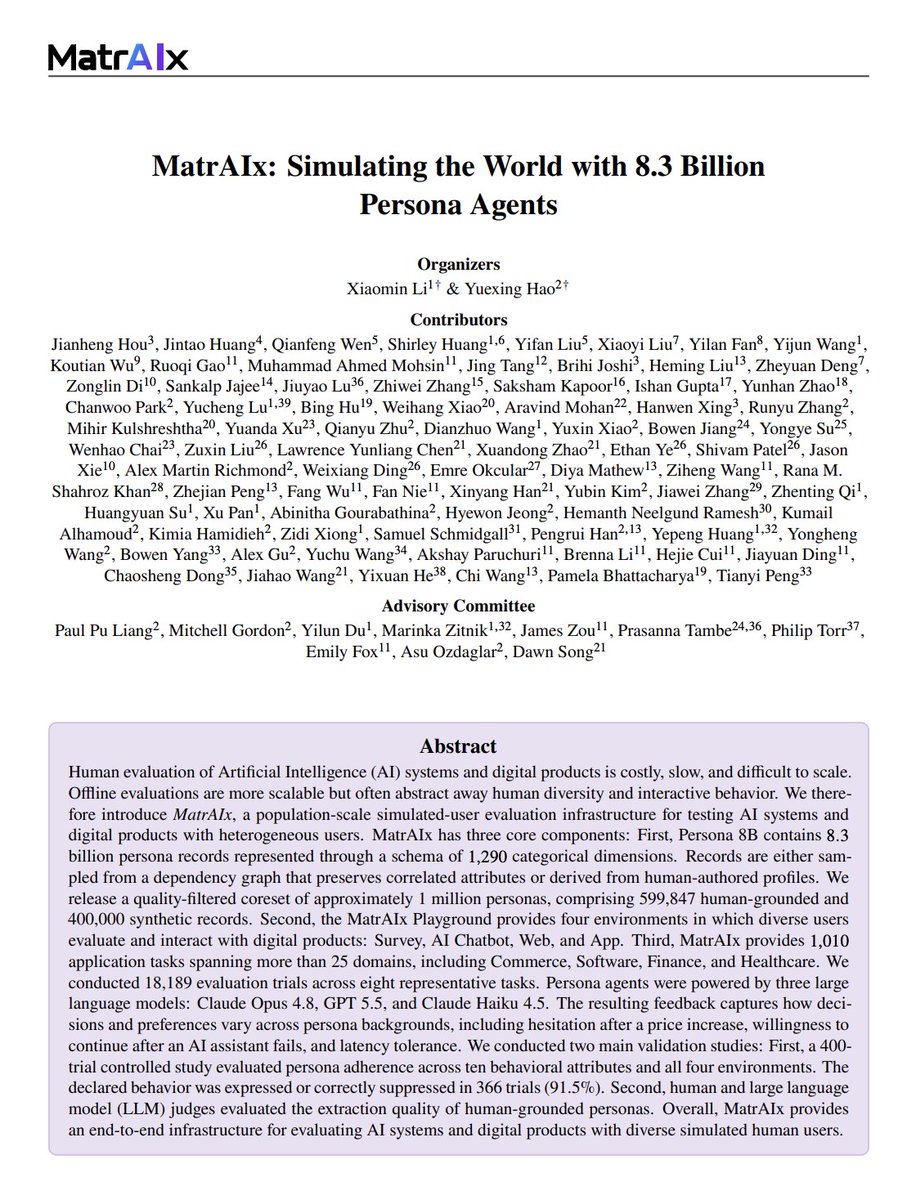
MIT and Harvard built an AI simulation containing 8.3 billion virtual people, roughly the entire population of planet.
They call it MatrAIx.
It’s a population-scale simulation running on frontier models, GPT and Claude among them. The longer description took me a while to believe.
Start with the dataset, Persona 8B. 8.3 billion synthetic profiles, each one specified across 1,290 dimensions. Background, psychology, spending habits, how comfortable they are with technology, what they do on a Tuesday night, the small behavioral quirks that make one 34-year-old nurse in NYC different from another.
A spreadsheet of 8 billion rows would be a curiosity. What they did next is the part that matters.
They turned the profiles into agents and dropped them into four environments: surveys, AI chat interfaces, live web browsing, and native desktop and mobile apps. Then they ran real products through the crowd. New features, software updates, pricing changes.
And they logged everything. How long an agent paused after seeing a price go up. The exact point at which it gave up on a broken checkout. How much lag it would sit through before closing the app.
The number I keep coming back to is 91.5%. That’s how often the agents stayed in character, behaving the way their assigned psychology and demographics said they should. Not perfect. But for billions of agents across four environments, closer than I expected.
Here’s what that does to how products get built.
Right now, if you want to know whether a feature will land, you ship it to a slice of users and wait. Or you pay a research firm and wait longer. Either way the answer arrives in weeks, from a sample you hope is representative.
With something like this, you run the feature past 8 billion simulated reactions overnight. One server. Results by morning, broken down by every one of those 1,290 dimensions if you want them.
I have questions about how well a synthetic crowd predicts a real one. 91.5% is persona adherence, not forecast accuracy, and those are different things. But the direction is clear, and it’s coming faster than most product teams are ready for.