The myth
"Quantum-safe cryptography is just a stronger version of what we have."
The reality
It’s a completely different foundation.
Different math. Different key behavior. Different tradeoffs.
You’re not upgrading a component.
You’re replacing the ground it stands on.
And most systems were never designed for that kind of swap.
$QANX over time has pursued and secured multiple paths to generate adoption, leading to a highly utilized chain. Quantum resistant innovation (creating many more opportunities while others just try to survive an upgrade), IBM, Signquantum, Multilanguage, hybrid, Government, Crowe, Ueno Bank, or any of the other use cases.
With each of these, people may point out reasons why a given path might not be fruitful.
But we don't need them all to be fruitful, only some need to succeed to start their adoption cycle.
Finding a flaw in one does not negate the overall prospects of success. Building these relationships and agreements is major work, and has led up to the product decisions thus far.
My bet is things have worked out for the better. Especially with AI advancements to evaluate the code and architecture. This rebasing is just another example of maturing the product to deliver what partners want and need.
Looking forward to an extraordinary launch 💥💥💥
When Q-Day arrives, most blockchains will be scrambling for a migration plan.
@QANplatform won't be.
Not because they got lucky. Because they made quantum resistance the foundation, not a feature.
BlackRock Quantum Whitepaper: The Threat & The Hard Truth
Key takeaways:
Quantum computers could break current encryption within years, not decades. BlackRock confirms the timeline has accelerated.
The quantum threat
Shor's Algorithm can break Elliptic Curve Cryptography (ECC), the exact math securing Bitcoin and Ethereum digital signatures. A sufficiently powerful quantum computer could derive private keys from public keys visible on-chain.
Bitcoin's vulnerability
Approximately 35% of the Bitcoin supply (~7M BTC) is currently exposed:
• 1.9M BTC in P2PK/P2TR/P2MS addresses
• 5M BTC in addresses with reused keys
This creates two distinct attack vectors:
At-Rest: CRQC (Cryptographically Relevant Quantum Computers) can steal coins from the 35% of supply even if never spent.
On-Spend: All Bitcoin addresses become vulnerable during the 10-minute mempool window of a transaction.
Quantum is advancing fast
• Google has moved its encryption migration deadline to 2029.
• IBM targets large-scale, fault-tolerant quantum systems by 2029–2033.
• Recent breakthroughs in error correction have pulled timelines forward significantly.
The migration crisis
Governments plan full migration by 2035, BlackRock notes that while technically feasible, coordination is the bottleneck. It requires multi-year timelines that legacy chains simply may not have.
Legacy chain problems
• Bitcoin: Development is relatively decentralized and there is no current consensus on PQ encryption/signature schemes, migration timelines, and the optimal specific implementation mechanisms.
• Ethereum: Requires seven upcoming network updates/hard forks (2026–2029) with massive complexity due to Proof-of-Stake and smart contracts.
• Ecosystem: Exchanges, custodians, and validators must simultaneously upgrade hardware, software, and policies.
Why QANplatform, the post-quantum blockchain wins
We built quantum-resistant cryptography as our foundation, not as a retrofit. No consensus chaos. No 35% of supply at risk. Already defended from day one.
The bottom line
BlackRock states that upgrading cryptographic systems is easier than building a quantum computer. However, they also admit migration is coordination-heavy and slow, while quantum timelines have accelerated to within years.
We don't face this dilemma. We are already secured.
Q-Day favors the future-proof.
9 minutes.
That is the estimated time a primed fast-clock quantum computer could take to solve ECDLP, the Elliptic Curve Discrete Logarithm Problem, the core mathematical problem behind the signature schemes that secure Bitcoin, Ethereum, and many other blockchains.
No buffer. No second chance.
That's fast enough to turn blockchain's security window into a race against time.
Google: Q-Day could hit by 2029.
→ Years ahead of NSA's 2031-33 target
→ RSA-2048 break threshold down to ~102K qubits
→ EU mandates PQC migration by 2030
The timelines are converging. Quantum-resistant infrastructure isn't optional anymore.
https://t.co/SxQghsOoqK
#QanX
What is lattice-based cryptography?
Most encryption today relies on problems that are hard to solve, but have a hidden shortcut. Quantum computers find that shortcut. Lattice-based cryptography is different, it is built on problems with no shortcut in the foreseeable future, even with accelerating technological development.
Think of it like this. Classical encryption is a combination lock: hard to crack by hand, but a fast enough machine can cycle through every combination. Lattice cryptography is more like a maze with millions of corridors added every second. Even knowing the rules of the maze does not help you navigate it faster.
The underlying problem - finding the shortest path between two points across millions of mathematical dimensions - has resisted attack for decades. No classical computer can brute-force it. No quantum algorithm is known to break it. That is not an assumption. That is a track record.
That is why CRYSTALS-Dilithium and CRYSTALS-Kyber are built on lattices. That is why post-quantum cryptography works.
And that is why we use the NIST-standardized ML-DSA, which is derived from CRYSTALS-Dilithium.
@AltcoinDaily They all had one thing in common:
They were ahead of the curve, as mentioned.
Check out @QANplatform and see what market problems they solve
@AltcoinDaily@QANplatform was early on the quantum narrative.
But is right on time with the explosion of demand as all systems need migration solutions.
Only chain that has come up with innovation.
Much more powerful than legacy chains just trying to convince holders they will upgrade
"QAN is not competing with Ethereum. QAN is extending Ethereum"
A community member created this visual from recent updates.
Innovation for Quantum migration solutions 💥
$QANX $QRL $ABEL $CELL $MCM $XX $NXS $ALGO $HBAR $TRX $USDC $BTC $ETH $ADA $SOL $XRP $IONQ $RGTI
@alpha_co qanplatform:native is going to be the winner. IBM partnership, Ueno Bank, ITTI, along with EU goverment use cases, Signquantum built on top of it, along with supporting ALL Dev coding languages, QR is just one of the catalysts. Price is at ICO levels so insanley undervalued.
Big move by qanplatform:native 👀
Rebuilding on ethereum:native proven foundation while pushing enterprise-grade performance and quantum-resistant innovation forward.
This could be a key step toward real-world adoption. Watching closely.
@QANplatform Rebasing to $ETH is a tell.
Custom stacks get expensive.
Enterprise buyers hate weird risk.
That is why teams simplify.
Boring wins the big deals.
QANplatform May Update: Accelerating Our Ethereum Rebase and Enterprise Readiness
May was a month of decisive action for QANplatform. Following our announcement of a controlled architectural rebase of QANplatform’s core features onto Ethereum’s official implementation we moved immediately from strategic planning to implementation.
With architectural risks mitigated and technical briefs finalized, we are now fully cleared to begin active construction on our next-generation implementation.
Behind the strategic shift lies significant engineering progress. This month, our team resolved complex architectural challenges to ensure a rock-solid runtime and a mature developer ecosystem.
Read the full recap on our blog, link in the comments 🔗👇
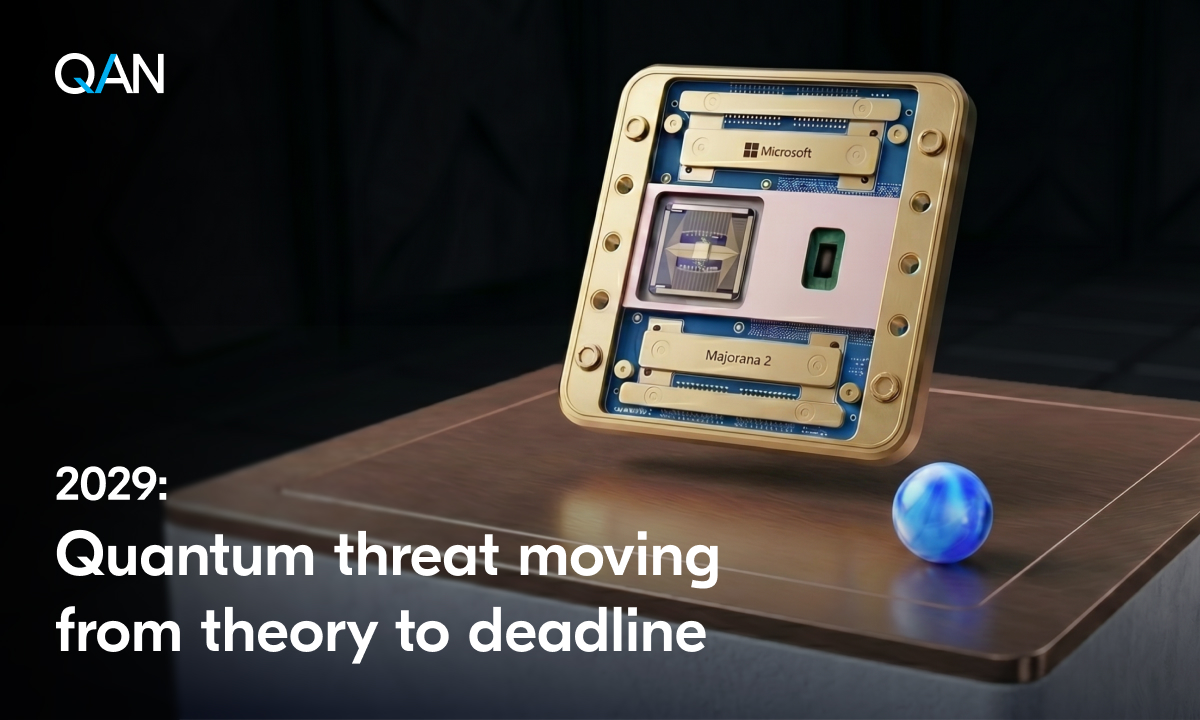
Two tech giants. One timeline: 2029.
Microsoft just unveiled Majorana 2: topological qubits that last 20 seconds (vs. 1-12 milliseconds in Majorana 1).
That improvement is roughly comparable to inventing a phone battery that instead of dying in a day could last for nearly three years on a single charge.
That's a 1,000x reliability leap, built with agentic AI.
Their practical quantum computer target? 2029, the original timeline cut in half.
Google independently set the same year as its internal deadline to complete PQC migration across all systems, warning that quantum computers could break current encryption before the decade ends.
When Microsoft AND Google converge on 2029, that's not a prediction. That's a countdown.
Every blockchain still running on legacy cryptography needs to ask: are you quantum-safe?
The migration window is closing.
@drakefjustin@VitalikButerin Google's Shor paper just changed the game. A co-author puts Q-Day odds at 50% by 2032.
Ethereum & Bitcoin? Still running on quantum-vulnerable cryptography.
@QANplatform has been building post-quantum resistance since day one.
Testnet live. Mainnet 2026. 🔐 #Qanx
There are two main positions on quantum risk to blockchain infrastructure.
One of them requires believing decentralized networks can coordinate a full cryptographic migration under time pressure with no central authority and no enforcement mechanism.
The other one requires starting earlier than feels necessary.
Both positions might seem defensible. But only one survives the reality of decentralized coordination.
Position A: The threat is already active.
"Harvest-now-decrypt-later" means data collected today is already compromised. Chains not building on post-quantum primitives are accumulating debt, not buying time.
Position B: The timeline is long enough for a retrofit.
"Hard forks happen. Ecosystems upgrade." Migration can wait. It is too expensive to over-engineer for a threat years away.
Here is the friction point:
Position B requires a massive bet on coordination.
It assumes that decentralized networks, which lack central authority, enforcement mechanisms, and contain millions of independent wallets, can execute a full cryptographic migration in a compressed window under pressure.
History suggests this is the hardest thing a decentralized network can do.
The industry has mostly let Position B win by default, simply because it is the path of least resistance.
So, a direct question for the builders:
If a protocol must be secure in 2030:
Is it a viable strategy to bet the project's survival on a forced hard fork that requires 100% of the community to coordinate perfectly at the last minute?
Or is the only safe path to build on infrastructure where quantum resistance is native, not retrofitted?