The evidence of history suggests the modern climate agenda is designed to reshape human society, weaken sovereignty and consolidate centralised global control.
The foundational flaw of the climate narrative is the omission of context. We were told current temperatures and CO₂ levels were unprecedented, yet geological history tells the exact opposite story. For the past 34 million years - since the glaciation of Antarctica, and driven by tectonic shifts and changing ocean currents - Earth has been locked in the Late Cenozoic Ice Age.
These conditions intensified 2.58 million years ago into the Quaternary glaciation, characterised by long, brutal glacial periods interrupted by temporary, warmer interglacials, like the Holocene we live in today.
During the past 541 million years of exploding biological diversity (the Phanerozoic Eon) the global temperature has averaged 24°C, ranging from 18°C to 34°C peaks. This is fully 9°C warmer than today’s calculated average of 15°C. We are living in unusually 'cold times' and there is no likelihood of an urgent global warming or climate change facing human society.
The other nemesis comes in the form of CO₂, which is the foundation for photosynthesis, agriculture and the rise of complex life on Earth. Rather than suffering from an excess of CO₂, Earth has been experiencing a long-term carbon decline.
Prior to the industrial era, low CO₂ levels contributed to global aridity, the retreat of biomass and loss of ancient rainforests. An increase in atmospheric CO₂ represents an opportunity for life's biological resurgence, as a fertiliser that stimulates biological growth and expands the planet's agricultural produce.
The natural world has endured genuine, cataclysmic upheavals - but this is not one of them. The great extinction events of the past - such as the Carnian Pluvial Episode or the End-Permian extinction - played out over tens of thousands to millions of years. Yet the biological world survived, adapted and survived.
When the planet experienced sustained, greenhouse conditions, life didn't collapse - it flourished. During the Eocene Epoch 56 million years ago, palm trees grew in the Arctic, ice disappeared from the poles and lush rainforests and endless biology blanketed 85% of the Earth's landmass.
Far from a wasteland, the Eocene was a time of astonishing biological abundance of food and a massive radiation of mammalian life. The lessons of history show us that warmer conditions are not to be feared; they are catalysts for biological resilience and growth.
The brief fluctuations of past decades do not constitute a climate crisis; they are evidence of a temporary, microscopic blip in geological time.
Award-winning physicist Will Happer:
"Let's talk about CO2. Number one, it's not a pollutant at all. We breathe out lots of CO2. Many people are surprised to learn that they exhale about two pounds, a little more than two pounds of CO2 a day.
So, you people in this room are putting out a lot of CO2. Our breath is not that different from the output of a power plant. Power plants take in normal air, and they burn, a fair amount of the oxygen out of the air in burning coal or natural gas or oil. And the result that comes out of the stack is mostly the nitrogen that was already there, a little bit of oxygen that wasn't used up, and water vapor and CO2.
And our breath, it's very similar to the power plant. It's about four percent CO2, six percent water. Power plant has a bit more CO2 and correspondingly less oxygen.
But our breath is definitely not a pollutant."
We live on a historically cold world, where the average planetary temperature currently sits at a chilly 15°C.
We are rarely reminded that Earth remains far colder in the current age than its long-term average of 22°C–25°C, maintained across the 541 million years of the Phanerozoic Eon. A planetary warming of two or three degrees is unlikely to trigger an existential crisis; historically, it never has under conditions comparable to today.
The blunt reality is that we are still living through the Late Cenozoic Ice Age—the most extensive global cooling event since the Karoo Glaciation, which lasted 105 million years across the Carboniferous and Permian periods. By contrast, our current ice age began 34 million years ago with the initial glaciation of Antarctica.
Humanity and our symbol-driven culture evolved against this cold, drying backdrop. We now inhabit its most intense phase: the Quaternary Glaciation, which has persisted for the last 2.58 million years. At the Last Glacial Maximum, roughly 26,000 to 20,000 years ago, massive continental ice sheets reached depths of 3 to 4 kilometers (10,000 to 13,000 feet).
Modern humanity is fortunate to exist during the Holocene interglacial—a 11,700-year warm period during which virtually every artifact of human civilisation, along with all historical empires, emerged.
This deep timeline reveals that while modern mammals are an ice-age-adapted lineage, human civilisation thrives in the warmth. Yet the present climate narrative relies on an institutional framework that largely disregards Earth's geological history.
Orbital mechanics dictate the macro-climatic epochs of our planet over millennia, yet contemporary debate focuses almost exclusively on micro-trends from recent decades. Earth continuously responds to these orbital variations, first mapped by Milutin Milankovitch.
On shorter timescales, climate behavior is driven by natural variability in solar irradiance, ocean circulation, atmospheric water vapor, and volcanic activity; over deep time, it is anchored by the slow movement of tectonic plates.
The global oceans, atmospheric water vapor, and cloud cover account for the vast majority of the planet's radiative warming. Furthermore, the geological record shows that deep ocean outgassing of dissolved CO₂ typically lags thermal changes by centuries, unfolding over millennia as ocean masses adjust.
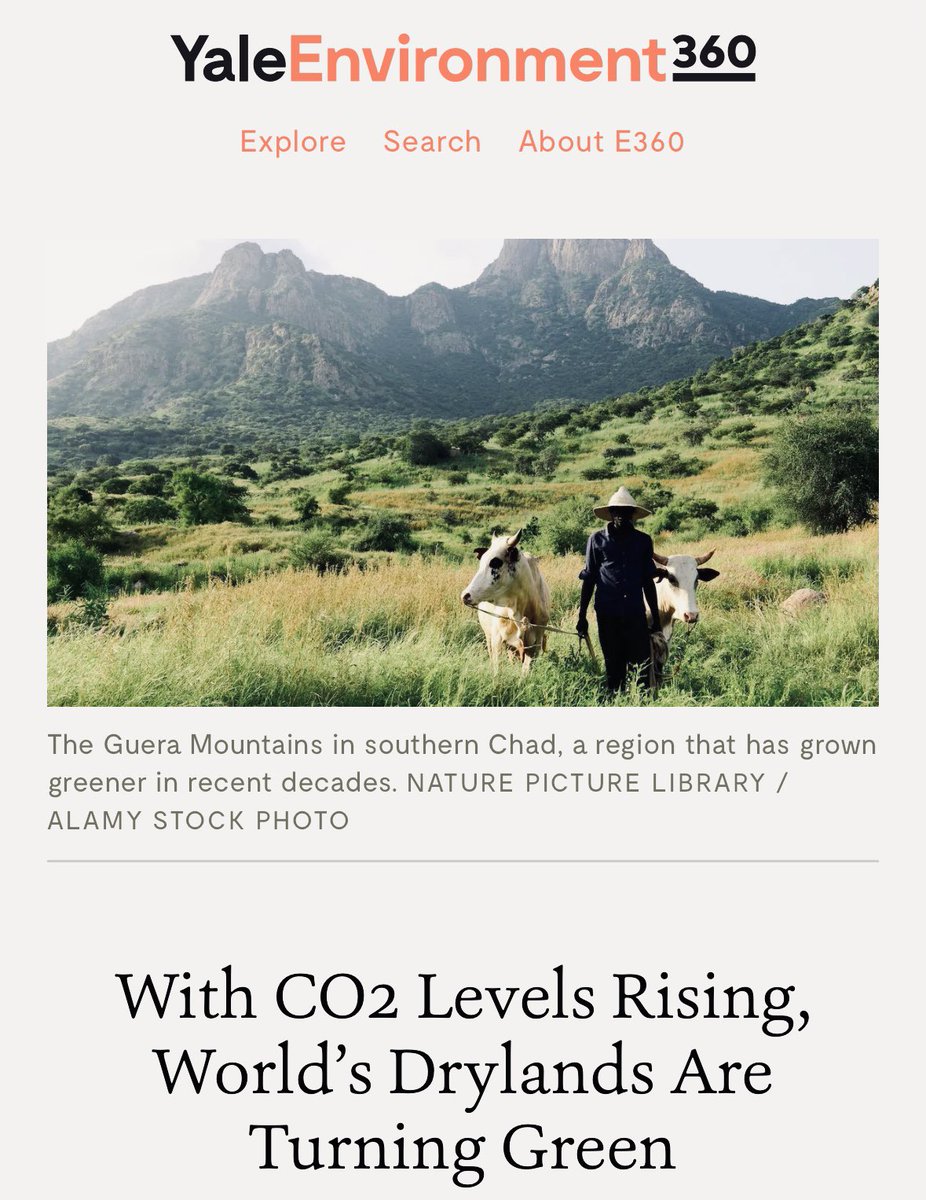
To focus entirely on a trace gas is to overlook the scale of these broader planetary systems. It also overlooks the gas's biological utility: NASA satellite records confirm a widespread expansion of global green foliage over recent decades, driven significantly by carbon dioxide acting as a plant nutrient.
Ultimately, the UN inspired climate agenda collides with thermodynamic reality. A modern industrial society requires the continuous high energy density provided only by conventional fuels—a baseload capability that intermittent sources cannot replace.
When we look at an oak, a sequoia, or a balsa tree in the Amazon rainforest, we're looking at solidified carbon and oxygen.
Trees do not obtain structural mass from the soil; it comes out of thin air. Plants are built almost entirely from atmospheric gases—living, complex architectures of carbon, oxygen and sunlight. No wonder that as children, we hug them, play and climb in them, or wander through their woods, hearing them sighing in the wind.
Around 90% to 95% of a tree's dry weight is carbon and oxygen, pulled directly from atmospheric carbon dioxide. Most people assume trees draw their body from the earth, yet the soil volume beneath a canopy remains unchanged as a sapling matures into a giant.
Roots do not consume dirt to build branches; large trees leave no gaping holes in the ground. Instead, the root network is a mechanical anchor to hold the heavy tree structure upright, while absorbing water and a tiny fraction of soil minerals—nitrogen, phosphorus, and potassium. These are their biological multivitamins, accounting for less than 5% of final dry mass.
Through photosynthesis, sunlight breaks apart carbon dioxide and water molecules. The plant releases oxygen back into the atmosphere and chains the remaining carbon and oxygen into glucose molecules, forming complex structural polymers like cellulose and lignin.
Across the globe, an estimated 3 trillion trees hold roughly 500 billion cubic meters of wood. Every forest on Earth is in reality solidified atmosphere—hundreds of billions of tons of air trapped, structured and given physical form by living plants.
Mankind owes its survival to these friendly giants of the natural world.
While the net zero sermon class were busy writing eulogies for a dying planet, Planet Earth has spent four decades quietly greening itself.
Satellite records stretching back more than 40 years show that 25%–50% of the world’s vegetated land has become noticeably greener. In 2025 that upward trend reached a new all-time high: effectively adding an amount of foliage equivalent to twice the continental United States.
This global greening expansion also serves as an important global carbon capture sink and has slightly slowed down land surface warming.
The same pesky molecule (CO2) that has been endlessly denounced as the end of days keeps acting like fertiliser. Just like many of us were told at school. How inconvenient for some.
Trees 🌳 have been running the most successful carbon capture program on Planet Earth for 350 million years. No corporate pitch deck. No taxpayer funded gigantic subsidy.
They run naturally on sunlight and rain. They look beautiful. They last for generations. They manufacture oxygen as a side hustle. They cool cities, reduce flooding, house wildlife, hold soil together and still somehow find time to capture carbon.
Yet, governments now spent £billions of our tax money on carbon capture machines. It costs a fortune. It needs a power plant. It often uses energy that came from burning the same stuff it’s supposed to clean up. It captures a rounding error of what a decent forest already does. And it still needs a press release so investors and governments feel like they’re saving the planet.
Nature has already built a machine that works. We keep cutting it down, paving it over, then acting shocked that the expensive metal replica isn’t quite as good.
Plant more of the original carbon capture machines. 🌳
Stop funding the unnatural cosplay machine version of carbon capture.
Stop treating the adult population like children and stop allowing adults who behave like despotic toddlers to decree what the rest of us are allowed to watch.
🚨BREAKING🚨
We've just installed giant billboards in London to stop the censorship crisis in Britain - pushing back censorial laws & speech policing.
@andyburnham launch a free speech reset now.
Join the fight to restore free speech in Britain⤵️
https://t.co/KxBZhkQBgK
The Canary has been ‘debanked’ once again.
The news site has announced that it will have to cease operations after Metro Bank followed in the footsteps of Barclays, which closed its account in June.
This is an alarming development – and one with which we at the FSU are all too familiar.
Debanking is one of the most pernicious forms of cancellation. Banks and other financial institutions must not be allowed to weaponise their power to suppress our fundamental right to free speech.
Greening Earth: An inconvenient truth for some people. Over recent decades, 25% to 50% of Earth’s vegetated land surface has become significantly greener. Not slightly. Significantly.
The dominant driver, according to the data and the models that match it: rising atmospheric CO₂. Roughly 70% of this greening is attributable to the fertilisation effect - plants using the extra carbon to grow more leaves, boost photosynthesis, and use water more efficiently. Follow the science. 🌱
This is absolutely outstanding and blows apart the myths surrounding “Climate Change” and Net Zero.
The UN, the EU, the UK Government — and even Obama — all get a mention. And wait until you hear about the deal that effectively gave China a free pass while the rest of the Western world was expected to pick up the bill.
Lord Christopher Monckton. 🔥
Trust me — set aside 15 minutes today and watch this.
It’ll be worth it.
And if you think it isn’t, I’ll buy you a pint. 🍺
We've been told that a trace gas controls Earth's climate, but the science simply doesn't add up.
New analyses show that climate models can't match real-world temperature and sea ice trends unless a strong solar influence is included.
Other recent studies from Scafetta, Connolly and Harde all reach the same conclusion:
CO2's effect is real but limited, already near saturation, meaning that even doubling it will add only a fraction of a degree to the global temperature.
The real drivers are solar variability, ocean dynamics and cloud feedbacks, not a trace gas.
China emits as much CO2 in 16 days as Canada emits in an entire year. Australia's annual total takes China just 12 days to emit. Britain's takes barely 9 days.
Combined, Canada, Australia and the UK emit about 1.23 billion tonnes a year. China emits that much in roughly 37 days.
So, even if all three countries eliminated every tonne of CO2--closing every factory, power station and banning every gas vehicle--China would replace the entire annual reduction in little more than five weeks.
Yet, Western governments are deliberately making energy scarcer and more expensive, by dismantling dependable sources, restricting oil and gas exploration and loading industry with carbon taxes and net zero mandates.
Steel, chemicals, fertilizers, refining and manufacturing are driven overseas -- often to countries burning more coal. So the emissions do not disappear. Only the jobs, tax revenues and energy security do.
The West impoverishes itself.
China profits.
The world has spent $7 trillion on wind and solar. That global fleet produces an average of around 630 GW.
The same $7 trillion could have built roughly 1,400 modern nuclear reactors, producing around 1,400 GW on average -- so more than twice the power.
Wind and solar generally last around 20 years (a lot less by some estimates), whereas nuclear plants can operate for 80 years or more.
Over 80 years, wind and solar must be built four times -- a cost of $28 trillion to maintain 630 gigawatts.
The same $28 trillion spent on nuclear would deliver roughly 5,600 gigawatts -- nearly nine times the power.
Also, nuclear produces this regardless of the weather, whereas wind and solar require 24-7 backup (usually gas, not included in these calculations).
What is going on with Labour and social media?
The Free Speech Union has been discussing internally whether Andy Burnham will be better or worse than Sir Keir Starmer when it comes to free speech.
We’ve concluded that he’ll be just as bad — if not worse.
Andy Burnham’s team has confirmed that he will push ahead with Starmer’s controversial social media ban for under-16s. We also know that the Technology Secretary, Liz Kendall, is looking into a potential ban on VPNs, which would put the UK in the same league as Iran, Iraq and North Korea.
The Department for Culture, Media and Sport, led by Burnham ally and constituency neighbour Lisa Nandy, has also published a Green Paper, Watch This Space, which proposes forcing social media companies to prioritise the promotion of what the Government deems to be “trustworthy” news sources — namely content from public service broadcasters such as the BBC.
There is no evidence that Andy Burnham would abandon these plans when he enters Downing Street in just 13 days’ time.
This is a deeply concerning proposal and an extraordinary interference with freedom of association and free speech on social media — one that the Free Speech Union opposes wholeheartedly.
In another full-frontal assault on free speech and our right to engage in open political debate online, Labour’s Deputy Leader and close Burnham ally Lucy Powell wants to impose new legal duties through the Representation of the People Bill that would effectively treat private citizens as broadcasters and censor social media platforms during election periods.
This raises serious practical questions. Would individuals be prevented from expressing political views on social media during elections? The Free Speech Union also cannot see how such restrictions could realistically apply only to UK citizens. Surely they would have to extend to overseas users as well? President Trump and JD Vance would almost certainly have something to say about that.
This all seems to be part of Labour’s explanation for why it is struggling in the polls. Rather than recognising that people are concerned about issues such as mass uncontrolled migration, higher taxes, unemployment and soaring energy bills, Labour ministers appear to believe that voters are simply being misled by misinformation and disinformation on platforms such as X.
Last Thursday, Lisa Nandy flounced off X, citing an increase in abuse and the spread of misinformation and disinformation.
If Government ministers — particularly those responsible for the media — are concerned about misinformation, they should remain on the platform and challenge it. Trying to suppress it is not the answer.
As Louis Brandeis famously said, “The remedy to harmful speech is more speech, not enforced silence.”
Watch Free Speech Union General Secretary Lord Young below 👇
So many people—myself included—are drawn to the climate movement because they want to help people. They care, want to help the poor, and save the planet. But what they don't understand is that the climate movement is doing the exact opposite of what these well-meaning activists want to accomplish.
The movement vilifies reliable energy—the single biggest driver of getting people out of poverty.
Over the past several decades, we’ve spent trillions on an energy transition away from fossil fuels. The result? We’ve made our energy system less reliable and more expensive.
Western countries have also practiced climate colonialism by preventing Africa from developing with natural gas, coal, and oil. (This goes against everything climate activists claim to stand for!)
This is the most morally inverted movement ever.
Right now, a billion people don't have access to reliable energy. That means women are spending their entire day figuring out how to get fuel to cook their food. Children in these settings are not going to school, they’re spending hours collecting wood or walking to get water. All of that is a symptom of energy poverty.
This is when climate activists will say “but the planet is burning!” Just no. The planet is not burning. Yes, we've added CO2 to the atmosphere and seen about ~1°C of warming over 150 years. But 95% of CO2 is naturally occurring and historically, warming periods are when humans flourish. The Medieval Warm Period (900–1300 AD) is a great example. It was 0.7-1°C warmer and populations boomed. They then collapsed during the Little Ice Age.
Takeaway the climate hysteria and objectively you would choose to live during a warming period over a cooling period.
The rest of the data is reassuring:
✅Globally hurricanes rates are slightly declining
✅Tornadoes are down
✅Sea level rise is a manageable ~3mm/year
✅Global greening is up 15–40% since the 1980s
✅10x people still die from cold than from heat
In the West the first time students hear about our energy system is within the context of “fossil fuels are burning the planet.” They’re never taught that it’s an amazing technology that has lifted billions out of poverty. I considered this a huge injustice.
We need to pivot away from climate hysteria toward one goal: ending energy poverty and expanding access to energy.
If you’re still gripped by climate fear and anxiety, I’m sorry you are a victim of this fear narrative. But it's time to get out.
Hunga Tonga is still affecting the atmosphere.
On Jan 15, 2022, the underwater volcano erupted in the South Pacific. It blasted roughly 160 million metric tons of water vapor into the stratosphere, increasing levels by an unprecedented 10%.
Most major eruptions cool the planet by injecting reflective aerosols. Hunga Tonga erupted underwater and punched seawater high into the atmosphere.
Water vapor is the most dominant greenhouse gas.
NASA warned the eruption could have a temporary warming effect.
Then global temperatures spiked in 2023 and 2024. Predictably, the spike was sold as proof of accelerating CO2-driven warming, with activist-scientists downplayed any influence from the record Hunga Tonga eruption.
But now comes the next test. The excess water vapor is now declining, slowly, and with it, global temperatures are also falling. The accelerating crisis looks a lot like a temporary atmospheric pulse, now fading on schedule.
Here again, we have a natural driver dominating Earth's climate.