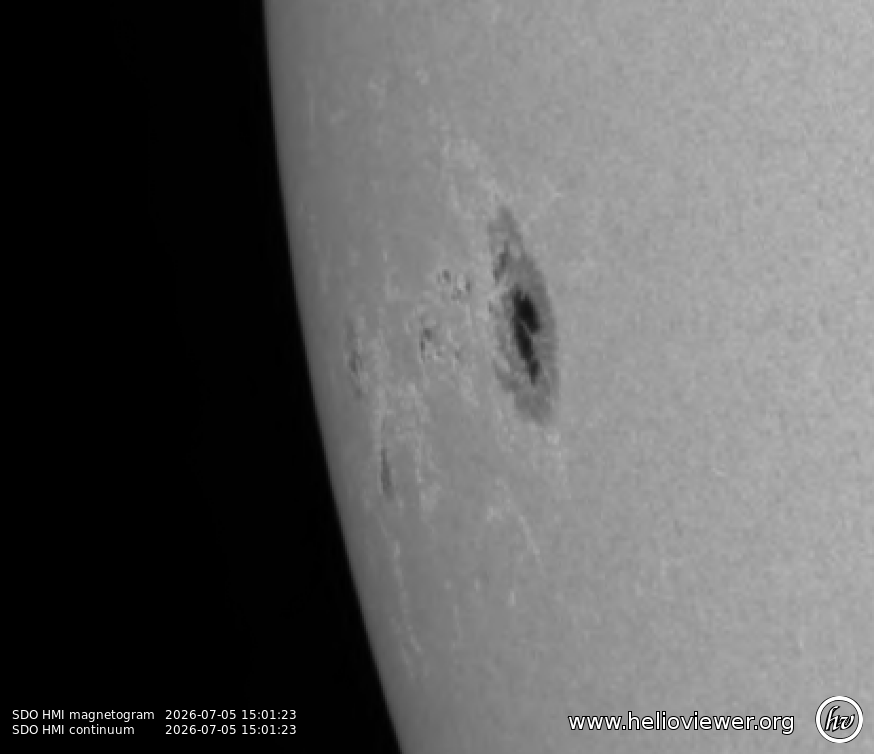
Solar observer Jure Atanackov reports that Active Region 4482 is rotating into better view from the Sun's eastern limb, limiting current analysis of its magnetic complexity after producing an X1.3 flare on July 4, 2026.
The attached SDO HMI images from July 5 show the sunspot group in white light continuum and magnetogram views, revealing a prominent dark umbra with surrounding features near the limb.
Atanackov observes possible growth in the region's intermediate section over the past day and expresses hope for additional major flares as AR 4482 becomes more observable on the solar disk.
Vera C. Rubin Observatory has started its decade-long LSST sky survey - the largest digital camera on Earth mapping the whole night sky. We built LSST Live for this alert era. https://t.co/kRXCnUfGKZ #LSSTLive#VeraRubin
@AstronomyBit Young blue stars hugging M31's SMBH is such a puzzle - tidal stress should work against formation there. Puts real pressure on nuclear recycling models.
@konstructivizm That Rosetta rotation of 67P never gets old - 12.2 hours per spin on a duck-shaped nucleus. Small bodies are worlds, not points. Great clip.
@AstronomyVibes Amaterasu at ~240 EeV from a direction with almost nothing along the path — ultra-high-energy cosmic rays are still one of nature's best mysteries. Love that you flagged it.
K2-18 b is pulsing red in our Exoplanet Lab.
124 light-years · sub-Neptune in the habitable zone
JWST: methane + CO₂ in the atmosphere
Tentative dimethyl sulfide (~3σ) — NOT confirmed life
We merged +1,924 extra worlds into the map (3,125 total).
Watch: https://t.co/RH0Xu8IzFo
AI concept art (Grok Imagine) — not a telescope image.
#exoplanet #JWST #K218b #LSSTLive #astronomy #Hycean
This video takes the viewer on a journey through space to edge-on starburst galaxy Messier 82 (M82), nicknamed the Cigar Galaxy.
NASA, ESA, CSA, A. Smercina (STSCI), T. Williams (University of Manchester), A. Pagan (STSCI), N. Bartmann (ESA/Webb)
ZTF18actuivj has been flickering since 2019 — mostly around mag 20, with brightenings toward ~18. Same patch of sky, seven years, 1,000+ ZTF detections.
What it probably is: a cataclysmic variable — a white dwarf pulling gas from a companion. The disk flares when material hits it. ALeRCE’s classifiers read the light curve as ~89% CV/Nova.
What keeps it interesting: Fink’s Isolation Forest anomaly lane has flagged it 35 times in our feed — “this doesn’t look like the bulk of ZTF behaviour.” Secondary scores (SLSN, tidal disruption, periodic types) never go to zero. Fink says weird; ALeRCE says probably CV,
👀 Two brokers, one new 2026 source
Babamul + ALeRCE both flagged ZTF26abejvkz in the last 24h. Cross-match ≠ hype — it means independent eyes.
AI artist concept — not telescope data.
#ALeRCE#ZTF#CosmicPulse
Get Cosmic with the LSST Live windows desktop App planet hunter and NEO candidates earth crossing objects and zoom into new galaxys as they are discovered . Beta testing now.
Email [email protected]
For your key
We found planets around all these stars. ✨
Every dot = a sun. Many carry a world.
1,201 nearby systems mapped in 3D from our Sun — 460 confirmed planets, 741 candidates.
Green = confirmed · Gold = candidate
Real distances. Real directions. Click. Fly. Listen.
NASA Exoplanet Archive · not tonight's alert feed.
#LSSTLive #exoplanet #TESS #astronomy #space
https://t.co/bQvk6QmiBF
🔁 Marathon variable: 3,200+ ZTF epochs
Not every headline is a new discovery — sometimes it's an old friend flaring brighter. ZTF17aaaslud hit mag 13.8 today.
AI artist concept — not telescope data.
#variablestar#ZTF#LSSTLive
A striking face-on observation of NGC 5335, showcasing its flocculent spiral structure marked by fragmented bands of star-forming regions.
Credit: NASA, ESA, STScI, N. Bartmann (ESA/Hubble)