“I will build a RAG system for my company in one week” - that is what I often hear nowadays from recently turned AI experts.
Unfortunately, building a 𝗽𝗿𝗼𝗱𝘂𝗰𝘁𝗶𝗼𝗻 𝗴𝗿𝗮𝗱𝗲 𝗥𝗲𝘁𝗿𝗶𝗲𝘃𝗮𝗹 𝗔𝘂𝗴𝗺𝗲𝗻𝘁𝗲𝗱 𝗚𝗲𝗻𝗲𝗿𝗮𝘁𝗶𝗼𝗻 (𝗥𝗔𝗚) 𝗯𝗮𝘀𝗲𝗱 𝗔𝗜 𝘀𝘆𝘀𝘁𝗲𝗺 is a challenging task.
Here are some of the moving parts in the RAG based systems that you will need to take care of and continuously tune in order to achieve desired results:
𝗥𝗲𝘁𝗿𝗶𝗲𝘃𝗮𝗹:
𝘍 ) Chunking - how do you chunk the data that you will use for external context.
- Small, Large chunks.
- Sliding or tumbling window for chunking.
- Retrieve parent or linked chunks when searching or just use originally retrieved data.
𝘊 ) Choosing the embedding model to embed and query and external context to/from the latent space. Considering Contextual embeddings.
𝘋 ) Vector Database.
- Which Database to choose.
- Where to host.
- What metadata to store together with embeddings.
- Indexing strategy.
𝘌 ) Vector Search
- Choice of similarity measure.
- Choosing the query path - metadata first vs. ANN first.
- Hybrid search.
𝘎 ) Heuristics - business rules applied to your retrieval procedure.
- Time importance.
- Reranking.
- Duplicate context (diversity ranking).
- Source retrieval.
- Conditional document preprocessing.
𝗚𝗲𝗻𝗲𝗿𝗮𝘁𝗶𝗼𝗻:
𝘈 ) LLM - Choosing the right Large Language Model to power your application.
✅ It is becoming less of a headache the further we are into the LLM craze. The performance of available LLMs are converging, both open source and proprietary. The main choice nowadays is around using a proprietary model or self-hosting.
𝘉 ) Prompt Engineering - having context available for usage in your prompts does not free you from the hard work of engineering the prompts. You will still need to align the system to produce outputs that you desire and prevent jailbreak scenarios.
And let’s not forget the less popular part:
𝘏) Observing, Evaluating, Monitoring and Securing your application in production!
What other pieces of the system am I missing? Let me know in the comments 👇
🚨 𝟔 𝐓𝐲𝐩𝐞𝐬 𝐨𝐟 𝐋𝐋𝐌𝐬 𝐩𝐨𝐰𝐞𝐫𝐢𝐧𝐠 𝐭𝐨𝐝𝐚𝐲’𝐬 𝐀𝐈 𝐚𝐠𝐞𝐧𝐭𝐬
1️⃣ 𝐆𝐏𝐓 – 𝐆𝐞𝐧𝐞𝐫𝐚𝐭𝐢𝐯𝐞 𝐏𝐫𝐞-𝐭𝐫𝐚𝐢𝐧𝐞𝐝 𝐓𝐫𝐚𝐧𝐬𝐟𝐨𝐫𝐦𝐞𝐫
(𝑇ℎ𝑒 𝐺𝑒𝑛𝑒𝑟𝑎𝑙𝑖𝑠𝑡)
Trained on massive datasets, these autoregressive models are the foundational engines for writing, reasoning, coding, and open-ended conversation.
➜ Highly versatile across diverse domains
➜ Excels at zero-shot and in-context learning
➜ The ultimate foundation for downstream fine-tuning
2️⃣ 𝐌𝐨𝐄 – 𝐌𝐢𝐱𝐭𝐮𝐫𝐞 𝐨𝐟 𝐄𝐱𝐩𝐞𝐫𝐭𝐬
(𝑇ℎ𝑒 𝑆𝑐𝑎𝑙𝑒𝑟)
Instead of activating the full neural network, MoE uses sparse routing to send each input only to the most relevant subset of "expert" sub-networks.
➜ Radically higher compute efficiency during inference
➜ Scales seamlessly to trillions of parameters
➜ Achieves deep specialization without sacrificing overall performance
3️⃣ 𝐕𝐋𝐌 – 𝐕𝐢𝐬𝐢𝐨𝐧-𝐋𝐚𝐧𝐠𝐮𝐚𝐠𝐞 𝐌𝐨𝐝𝐞𝐥
(𝑇ℎ𝑒 𝑀𝑢𝑙𝑡𝑖𝑚𝑜𝑑𝑎𝑙)
Combines advanced vision encoders with language models to natively process and reason over spatial data—like images, complex diagrams, and video streams.
➜ Understands deep visual and spatial context
➜ Perfectly aligns pixel data with semantic text
➜ Enables rich multimodal tasks (like visual QA and image-based telemetry)
4️⃣ 𝐋𝐑𝐌 – 𝐋𝐚𝐫𝐠𝐞 𝐑𝐞𝐚𝐬𝐨𝐧𝐢𝐧𝐠 𝐌𝐨𝐝𝐞𝐥
(𝑇ℎ𝑒 𝑇ℎ𝑖𝑛𝑘𝑒𝑟)
Built for "System 2" thinking. Optimized for multi-step reasoning, logical problem-solving, and planning through explicit verification and self-correction loops.
➜ Elite mathematical and logical planning
➜ Drastically reduced hallucinations through step-by-step verification
➜ Excels at complex, highly constrained problem-solving
5️⃣ 𝐒𝐋𝐌 – 𝐒𝐦𝐚𝐥𝐥 𝐋𝐚𝐧𝐠𝐮𝐚𝐠𝐞 𝐌𝐨𝐝𝐞𝐥
(𝑇ℎ𝑒 𝐿𝑖𝑔ℎ𝑡𝑤𝑒𝑖𝑔ℎ𝑡)
Compact, highly optimized models engineered specifically for edge devices, offline execution, or highly cost-sensitive environments.
➜ Ultra-low latency and blazing-fast inference
➜ Highly cost-effective to deploy and maintain
➜ Ensures data privacy through strictly on-device processing
6️⃣ 𝐋𝐀𝐌 – 𝐋𝐚𝐫𝐠𝐞 𝐀𝐜𝐭𝐢𝐨𝐧 𝐌𝐨𝐝𝐞𝐥
(𝑇ℎ𝑒 𝐷𝑜𝑒𝑟)
Designed not just to generate text, but to execute real-world tasks using tools, APIs, and external environments. It operates on a continuous agent loop:
🔄 Plan ➟ Action ➟ Observation ➟ Reflect ➟ Update Memory
➜ Autonomous real-world execution
➜ Native integration with external systems and software
➜ Dynamically adapts to environmental feedback
Agents aren’t just chatbots anymore. They see, act, reason, and run anywhere from cloud GPUs to edge devices. 𝐶ℎ𝑜𝑜𝑠𝑖𝑛𝑔 𝑡ℎ𝑒 𝑟𝑖𝑔ℎ𝑡 𝐿𝐿𝑀 𝑡𝑦𝑝𝑒 𝑑𝑖𝑟𝑒𝑐𝑡𝑙𝑦 𝑖𝑚𝑝𝑎𝑐𝑡𝑠 𝑐𝑜𝑠𝑡, 𝑙𝑎𝑡𝑒𝑛𝑐𝑦, 𝑟𝑒𝑙𝑖𝑎𝑏𝑖𝑙𝑖𝑡𝑦, 𝑎𝑛𝑑 𝑟𝑒𝑎𝑙‑𝑤𝑜𝑟𝑙𝑑 𝑐𝑎𝑝𝑎𝑏𝑖𝑙𝑖𝑡𝑖𝑒𝑠.
Cc : Author
Python becomes far easier when you understand the core commands behind loops, functions, file handling, data types, and list comprehensions. Strong fundamentals make debugging, automation, and data analysis much easier in real projects. #Python#Coding#DataAnalytics#Programming #DataScience
Most SQL problems that analysts solve with subqueries can be solved in one line.
Window functions do that. Here is how they work.
A window function performs a calculation across a set of rows without collapsing them into a single result the way GROUP BY does.
You keep every row. You just add a new column with the calculated value alongside it.
The syntax is always the same:
function() OVER (PARTITION BY ... ORDER BY ...)
PARTITION BY splits the data into groups.
ORDER BY sets the sequence within each group. Not every window function needs both — but that is the full structure.
Here are the 7 you will actually use:
𝗥𝗢𝗪_𝗡𝗨𝗠𝗕𝗘𝗥 Assigns a unique number to each row. No ties, ever.
𝗥𝗔𝗡𝗞 Ranks rows by value. Tied rows get the same rank and the next number is skipped.
𝗗𝗘𝗡𝗦𝗘_𝗥𝗔𝗡𝗞 Like RANK, but no numbers are skipped after a tie. The sequence stays continuous.
𝗟𝗔𝗚 Pulls the value from the previous row. Use it to compare this period to the last.
𝗟𝗘𝗔𝗗 Pulls the value from the next row. Use it to see what comes after the current row.
𝗥𝗨𝗡𝗡𝗜𝗡𝗚 𝗧𝗢𝗧𝗔𝗟 Adds values cumulatively as it moves through rows in order.
𝗣𝗔𝗥𝗧𝗜𝗧𝗜𝗢𝗡 𝗕𝗬 Resets the calculation for each group. Same idea as GROUP BY, but every individual row stays visible.
The cheatsheet below has the code and output for each one, using the same reference dataset throughout so you can see exactly what changes.
#SQLPerformance #SQL #Database
Git is one of the most important tools for developers and data professionals. Mastering commands for branching, commits, collaboration, and version control helps teams work efficiently, track changes, and manage projects with confidence. #Git#GitHub#Programming#DataEngineering #Python
AI and ML are no longer optional skills for modern tech careers. Strong foundations in statistics, Python, machine learning, transformers, projects, and AI ethics matter more than chasing every new tool. Build depth first, then scale your expertise. #AI#MachineLearning #DataScience #Python #DeepLearning
Top 15 high paying AI jobs by 2030 include AI Research Scientist, Deep Learning Engineer, MLOps Engineer, GenAI Engineer, Prompt Engineer, Computer Vision Engineer, Robotics Engineer and more. The future belongs to those who build, deploy and scale AI solutions. #AI #MachineLearning #GenAI #MLOps #DeepLearning #TechCareers
Do something different this weekend.
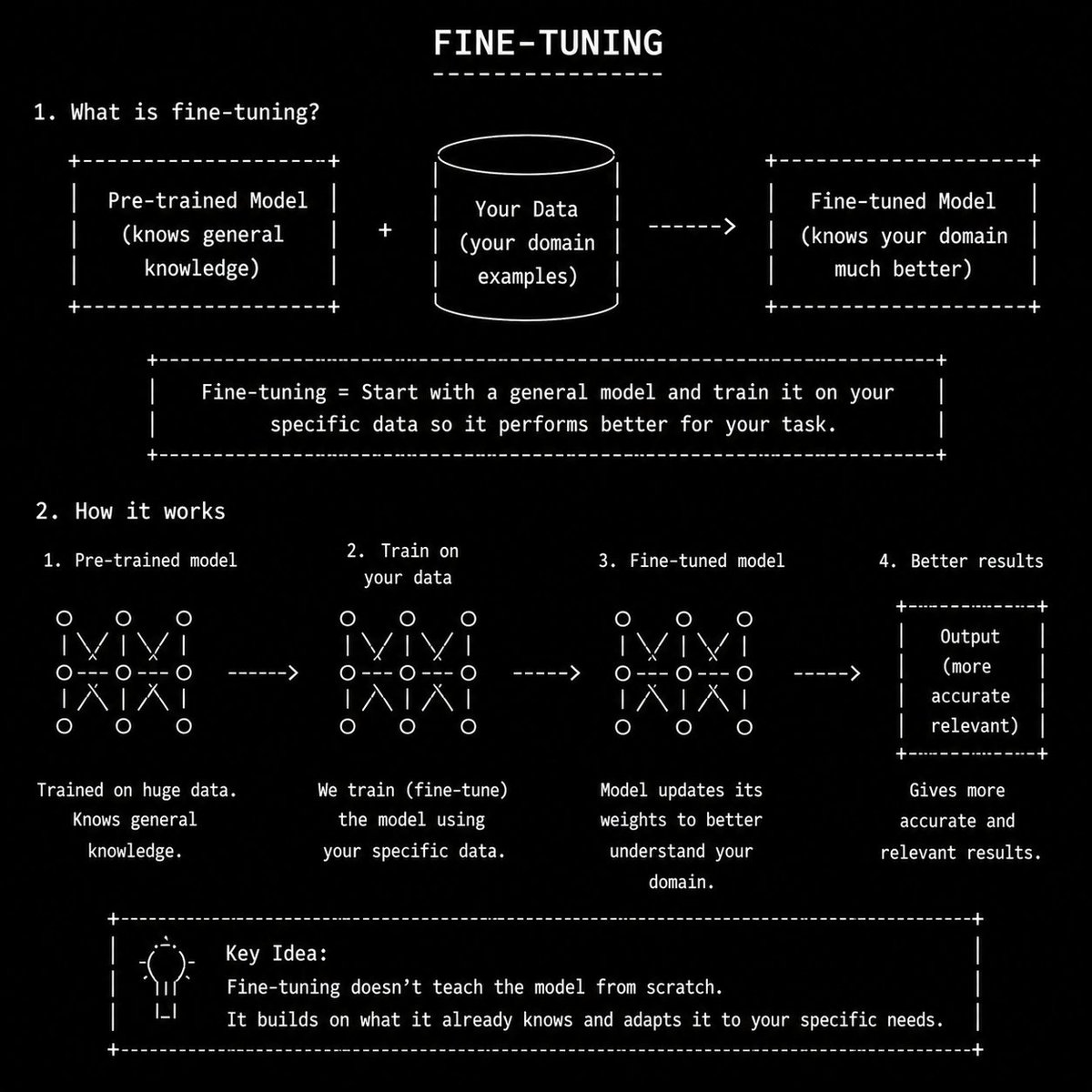
Become a PRO in AI Model Fine-tuning.
Paste this prompt in Codex/ChatGPT/Claude/Grok.
"You are an expert AI engineer and teacher.
Your job is to teach me modern LLM engineering and fine-tuning concepts from beginner to advanced level using very simple daily-life language.
Teach me step-by-step like a real mentor. Assume I am smart but new to the topic.
Foundations:
- LLM basics
- How AI models work
- Tokens
- Tokenization
- Context windows
- Embeddings
- Transformers
- Attention mechanism
- Parameters
- Training vs inference
- Open-source vs closed-source models
Datasets & Training:
- SFT datasets
- Instruction tuning
- Preference datasets
- Synthetic datasets
- Data curation
- Dataset cleaning
- Dataset formatting
- Fine-tuning basics
- Continued pretraining
- Hallucination reduction
Fine-Tuning:
- LoRA
- QLoRA
- DPO
- RLHF
- Quantization
- Model checkpoints
- Adapter tuning
- GGUF models
Inference & Optimization:
- KV cache
- Flash Attention
- Speculative decoding
- Inference optimization
- Model serving
- Batch inference
- GPU basics
- VRAM basics
- Latency vs quality tradeoffs
Local AI Ecosystem:
- llama.cpp
- Ollama
- vLLM
- MLX
- Hugging Face
- Unsloth
- Axolotl
- PEFT
- TRL library
RAG & Memory:
- RAG
- Vector databases
- Chunking
- Retrieval pipelines
- AI memory systems
- Semantic search
Agents & Workflows:
- Prompt engineering
- System prompts
- Tool calling
- Function calling
- AI agents
- Agentic workflows
- Multi-agent systems
- Browser agents
Model Types:
- VLMs
- SLMs
- Dense models
- MoE models
- Coding models
- Reasoning models
Deployment:
- Local inference
- On-device AI
- API serving
- Cloud GPUs
- Edge AI basics
Evaluation:
- AI benchmarks
- Human evals
- Cost-per-token analysis
- Speed benchmarking
- Quality benchmarking
Real-World Skills:
- Building chatbots
- Building AI copilots
- AI automation
- AI SaaS workflows
- AI coding workflows
- AI orchestration systems
- AI product thinking
Start from the absolute basics and gradually make me advanced.
Rules:
- Use simple English only
- Avoid academic jargon unless necessary
- Explain every difficult word in plain language
- Use real-world analogies and daily-life examples
- Use small code snippets when useful
- Show practical use cases
- Compare concepts side-by-side when helpful
- Teach from fundamentals first, then advanced concepts
- At the end of each topic:
- give a short summary
- give a simple mental model
- give beginner mistakes to avoid
- give a small exercise/project
I want deep understanding, not memorization."
Thank me later.
SOFTWARE ENGINEERS ONLY,
This 24 minutes video will teach you how to properly prompt Claude, ChatGPT, Gemini, Deepseek.
Anthropic's own team leading the workshop.
Worth more than $1000, but available FREE.
Watch NOW.
Bookmark for LATER.
Instead of watching an hour movie, watch this. In 14 minutes, an Anthropic engineer who wrote Building Effective Agents will teach you more about building agents right than most developers figure out on their own in months.
The creator of Claude Code teaches more about vibe-coding in 30 minutes than most tutorials do in hours.
Save this - it'll change how you build forever.
THE MATH YOU NEED TO START UNDERSTANDING LLMS
THE FOUNDATION BEHIND MODERN AI MODELS
Large Language Models (LLMs) are powered by mathematics. Behind every prediction, embedding, and generated response is a combination of linear algebra, probability, calculus, and optimization. You do not need a PhD in mathematics to start learning LLMs, but understanding the core concepts gives you a major advantage.
LINEAR ALGEBRA — THE LANGUAGE OF LLMS
→ VECTORS
Vectors represent words, tokens, and embeddings inside neural networks.
→ MATRICES
Matrices store and transform large amounts of numerical data efficiently.
→ DOT PRODUCT
Used to measure similarity between embeddings and power attention mechanisms.
→ MATRIX MULTIPLICATION
Core operation behind neural network computations and transformer architectures.
→ EIGENVECTORS & DIMENSIONALITY
Help models compress and organize information in high-dimensional spaces.
PROBABILITY & STATISTICS — HOW MODELS PREDICT
→ PROBABILITY DISTRIBUTIONS
LLMs predict the probability of the next token in a sequence.
→ CONDITIONAL PROBABILITY
Used to estimate the likelihood of words based on previous context.
→ MEAN, VARIANCE & STANDARD DEVIATION
Important for normalization and understanding data distributions.
→ BAYESIAN THINKING
Helps explain uncertainty and prediction confidence in AI systems.
→ SOFTMAX FUNCTION
Converts model outputs into probabilities for token prediction.
CALCULUS — HOW MODELS LEARN
→ DERIVATIVES
Measure how changes in parameters affect model outputs.
→ GRADIENTS
Guide neural networks toward lower error during training.
→ CHAIN RULE
Critical for backpropagation across deep neural networks.
→ OPTIMIZATION FUNCTIONS
Used to minimize loss and improve prediction accuracy.
OPTIMIZATION — TRAINING LARGE MODELS
→ GRADIENT DESCENT
The foundation of neural network training.
→ LEARNING RATE
Controls how fast or slow a model updates weights.
→ LOSS FUNCTIONS
Measure how wrong the model’s predictions are.
→ REGULARIZATION
Helps prevent overfitting and improves generalization.
INFORMATION THEORY — UNDERSTANDING TOKENS
→ ENTROPY
Measures uncertainty in predictions.
→ CROSS-ENTROPY LOSS
Common loss function used in transformer-based models.
→ TOKENIZATION
Breaks text into smaller units for model processing.
THE MOST IMPORTANT CONCEPT FOR TRANSFORMERS
→ ATTENTION MECHANISM
Allows models to focus on relevant words in a sequence.
The attention mechanism heavily relies on matrix multiplication, vector similarity, and probability distributions.
WHY THIS MATH MATTERS
→ Helps you understand how transformers actually work
→ Makes debugging and fine-tuning easier
→ Improves your understanding of embeddings and token prediction
→ Gives you a strong foundation for AI engineering and research
BEST WAY TO LEARN THE MATH
→ Start with linear algebra basics
→ Learn probability before deep learning
→ Understand derivatives conceptually before advanced calculus
→ Practice with small neural network examples
→ Focus on intuition before equations
TOOLS THAT MAKE LEARNING EASIER
→ NumPy for matrix operations
→ PyTorch for tensor computations
→ Jupyter Notebook for experiments
→ Visualization tools for gradients and embeddings
FINAL THOUGHT
You do not need to master every mathematical field before building with LLMs. Start with the fundamentals, connect the concepts to real AI systems, and learn progressively as you build projects.
MASTER LLMS IN DEPTH
Grab the complete LLMs Handbook here:
https://t.co/ljEMt0UNUI
How to Build Your First AI Agent - Step-by-Step
Creating an AI agent might sound complex, but by breaking it down into structured steps, you can go from idea to a fully functional agent that solves real problems.
Whether you’re building for customer service, research, or automation, following these stages ensures your agent is accurate, useful, and adaptable.
1. Define the Agent’s Purpose
Start with clarity. Identify the problem your agent will solve, who will use it, and what kind of inputs and outputs it should handle. This step sets the foundation for everything else.
2. Select Input Sources
Decide what kind of data your agent will use - text, voice, API calls, or a mix. Connect it to databases, CRMs, or external APIs, and determine how real-time the data needs to be.
3. Data Preparation & Preprocessing
Clean and format your data so it’s ready for your chosen AI model. This might mean tokenizing text, normalizing values, or structuring raw inputs.
4. Choose the Right Model
Pick the AI engine that powers your agent - whether it’s an LLM like GPT-4, Claude, or Gemini. Choose between hosted APIs or custom deployments, ensuring it supports your needs like reasoning, retrieval, or chat.
5. Design the Agent Architecture
Decide how your agent will operate using decision trees, planners, or tool-driven flows. Use frameworks like LangChain, CrewAI, or AutoGen to connect tools, memory, and prompts efficiently.
6. Craft Prompts & Toolchains
Write effective, structured prompts, integrate with APIs, search tools, or calculators, and test until your outputs are accurate and reliable.
7. Test & Validate
Run simulations with varied user inputs, check accuracy, and find weaknesses like edge cases or inconsistent answers.
8. Deploy the Agent
Host your agent on cloud services (Vercel, AWS, Hugging Face) and add a frontend like a chat interface or voice UI. Ensure logging is in place for performance tracking.
9. Monitor & Improve
Watch how users interact with your agent. Track accuracy, latency, and errors. Refine prompts or retrain models when needed.
10. Enable Continuous Learning
Let your agent evolve. Feed it real usage data, update tools and APIs, and fine-tune models to handle new scenarios over time.
Ready to bring your first AI agent to life?
Start small, experiment, and iterate - your first version doesn’t have to be perfect. The key is to build, test, and keep improving.
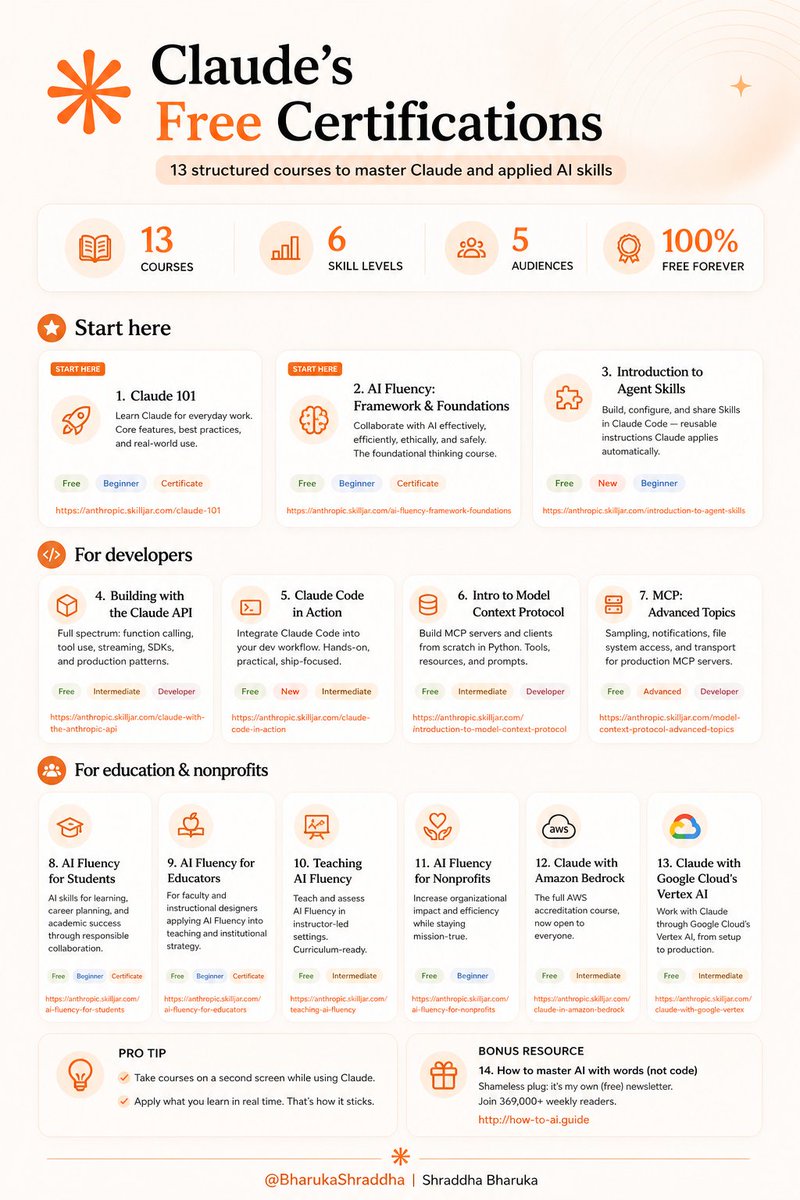
Anthropic is offering 13 AI courses & certificates.
It's free by following these 13 links:
1 - Claude 101. Learn Claude for everyday work. Core features and best practices.
↳ https://t.co/2rcC5bJtO5
2 - AI Fluency: Framework & Foundations. The foundational thinking course. Must need.
↳ https://t.co/4flvjjgodh
3 - Introduction to Agent Skills Build, configure, and share Skills in Claude Code — reusable instructions Claude applies automatically.
↳ https://t.co/1Fnizy2l1R
4 - Building with the Claude API Full spectrum: function calling, tool use, streaming, SDKs, and production patterns.
↳ https://t.co/bhJdjj3UMh
5 - Claude Code in Action Integrate Claude Code into your dev workflow. Hands-on, practical, ship-focused.
↳ https://t.co/2HvD8nAJDk
6 - Intro to Model Context Protocol Build MCP servers and clients from scratch in Python. Tools, resources, and prompts.
↳ https://t.co/A8jdtreUnd
7 - MCP: Advanced Topics Sampling, notifications, file system access, and transport for production MCP servers.
↳ https://t.co/w9zczwD7uD
8 - AI Fluency for Students AI skills for learning, career planning, and academic success through responsible collaboration.
↳ https://t.co/Rlw4EimtVR
9 - AI Fluency for Educators For faculty and instructional designers applying AI Fluency into teaching and institutional strategy.
↳ https://t.co/oOfArjADYI
10 - Teaching AI Fluency Teach and assess AI Fluency in instructor-led settings. Curriculum-ready.
↳ https://t.co/4xNM2pDVYw
11 - AI Fluency for Nonprofits Increase organizational impact and efficiency while staying mission-true.
↳ https://t.co/x3KuFIhHx9
12 - Claude with Amazon Bedrock The full AWS accreditation course, now open to everyone.
↳ https://t.co/SqXXTMkkjI
13 - Claude with Google Cloud's Vertex AI Work with Claude through Google Cloud's Vertex AI, from setup to production.
↳ https://t.co/OhnNmVjfb2
Repost this to help others access AI courses.