CG Art Institute rooted in computational principles.
Art offers an unprecedented perspective.
Science offers an unprecedented perspective.
We make them commute.
【#PFW24】Recurrence Flower Dress - 2042.03.01
・Movie: https://t.co/ASg9S3iUN2
A dress with CG artwork "漸花式 (Zenka-shiki)" by Masaki Nakayama (@luxidea) graced the runway at the #GlobalFashionCollective in #ParisFashionWeek Fall/Winter 2024-2025.
#Art#CGArt#GenerativeArt #DigitalArt
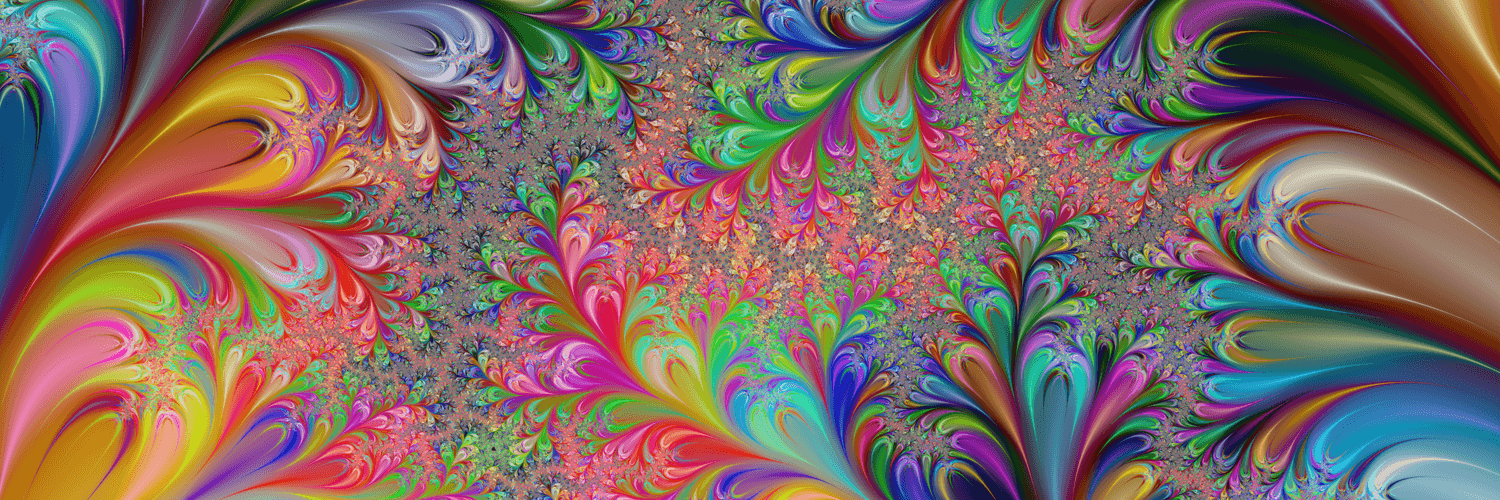
This dress is a challenge to visualize the famous Mandelbrot set in fractal geometry. Using a proprietary algorithm, I have succeeded in rendering an overused motif in a completely new visual way. No one can imitate my CG art because AI cannot decipher my algorithm. The vibrant colors and organic patterns are derived from a mathematical theory (a recurrence formula) that has nothing to do with human creativity. They are also infinitely complex, and even this work represents only one ten-thousandth of the whole geometry. In a sense, it is a photograph of the mathematical universe taken by a computer graphics camera. Even I have no way of knowing what amazing landscapes lurk elsewhere. The fact that beauty can be found in such inorganic landscapes is proof that mathematics is latent in the formations of the natural world.
#重心座標(Barycentric coordinate)の議論は、200年近く前に遡る。
【August Ferdinand Möbius】Der barycentrische Calcul - 1827年
・https://t.co/95vgbfcT7t
> Es ist bekannt, daß die der Mechanik zugehörige Lehre von Schwerpunkten schon oftmals als Hülfsmittel zur Erfindung rein geometrischer Wahrheiten benutzt worden ist. Die frühesten Versuche sind unstreitig die mechanische Quadratur der Parabel von Archimedes und der schon in des Pappus mathematischen Sammlungen sich vorfindende und jetzt unter dem Namen der centrobaryschen oder Guldins’s Regel bekannte Satz. Mit Uebergehung späterer Bemühungen dieser Art, die, wie die eben gedachten, hauptsächlich die Quadratur und Cubatur von Flächen und Körpern zu ihrem Zwecke haben, erwähne ich nur aus den letzten Zeiten die Mathematiker Carnot und L’Huilier. Beide *) suchen den Schwerpunkt in das Gebiet der niedern Geometrie zu ziehen, indem sie nicht sowohl von Körpern, Flächen und Linien, als vielmehr bloß von einem Systeme gewichtiger Punkte den Schwerpunkt betrachten, ihn aber allen Vorstellungen des Mechanischen zu beseitigen, den Punkt der mittlern Entfernungen nennen, weil nämlich sein Abstand vor irgend einer Ebene gleich der mittlern Entfernung aller Punkte des Systems von derselben Ebene ist. Die Bereicherungen, welche sie dadurch der Geometrie verschafft haben, sind allgemein anerkannt.
*) Carnot in seiner Géométrie de position, L’Huilier in seinen Élémens d’analyse géométrique et d’analyse algébrique.
球面上の4点からなるスプライン曲線補間 Squad: Spherical Quadrilateral (Interpolation) が初めて提案された論文。日本語に訳すと「球面四辺形補間」とでも呼ぶべきか。
【Ken Shoemake】Quaternion Calculus and Fast Animation - 1987
> Like aerospace engineers, robotics researchers, and James Clerk Maxwell before them, graphics programmers can benefit from quaternion calculus. Quaternions of unit magnitude give a four-component system of coordinates covering all orientations in space without singularities. No system of three components can do this, and more components add redundancy without advantage. Animation brings new demands: Construct smooth spline paths through rotation space, and do it efficiently. Rotation space is curved, making true splines costly; thus “straight lines” are great arcs, and “linear” interpolation is no longer dirt cheap. Smoother curves split several arcs per point. This paper presents a new algorithm for C1 interpolation that splits only three arcs per point, the minimum necessary for tangent continuity. Using other methods described here, even more speed is possible. These methods include fast arc interpolation, fast quaternion multiplication, and fast conversion between quaternions and matrices. On the way to achieving these results, quaternion calculus is explained.
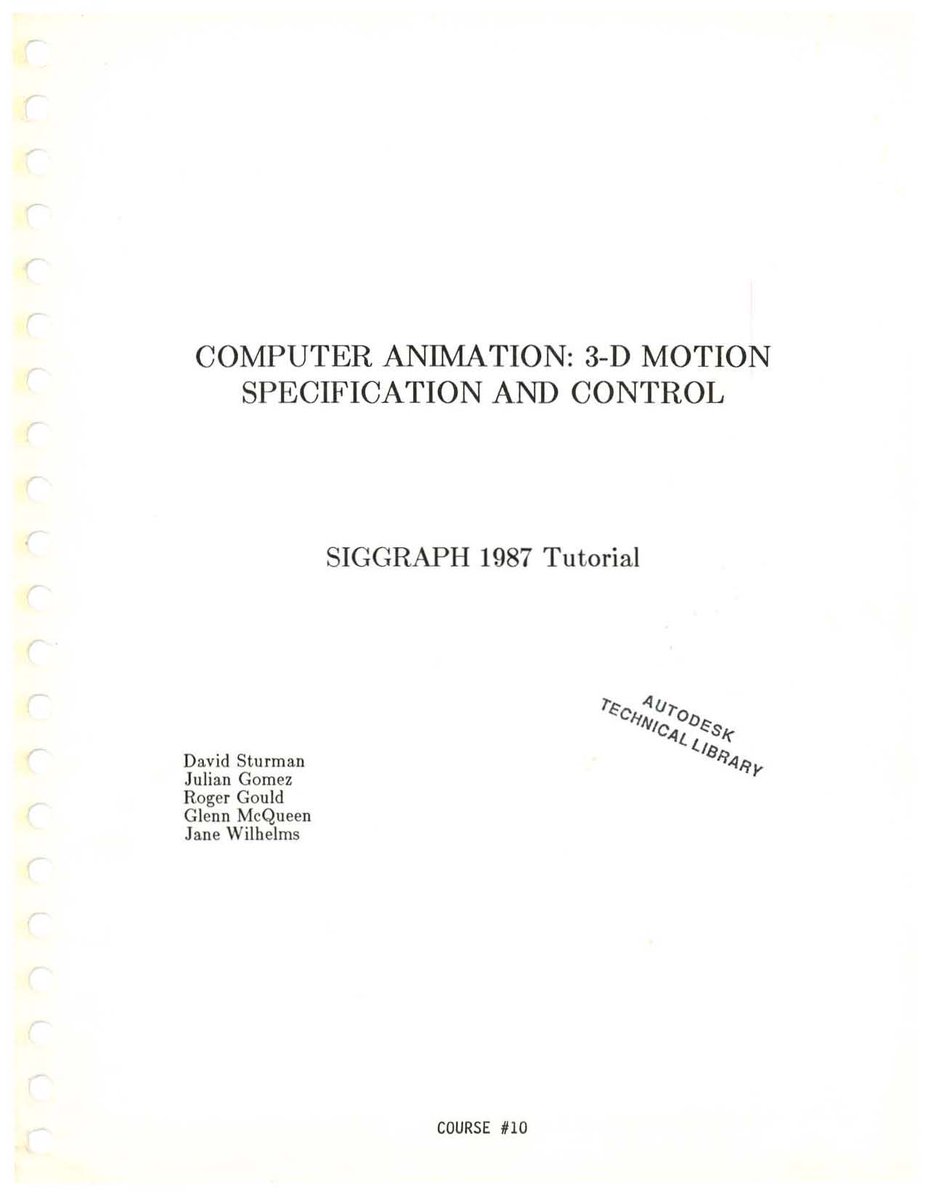
SIGGRAPH'87 の course note のスキャンが見つかった。AUTODESK TECHNICAL LIBRARY が所蔵していたものらしい。
【#SIGGRAPH】COMPUTER ANIMATION 3-D MOTION SPECIFICATION AND CONTROL - 1987
・https://t.co/rm1g4EIslT
・https://t.co/hGt5CQuPAq
> Computer animation is a fast growing field. In the past ten years improvements in computer speed, size, and cost have made animation by computer feasible for many new applications. Computer animation is now widely used in industry, science, manufacturing, entertainment, advertising, and education. Of the various aspects of computer animation this tutorial will focus on one--motion control. Motion control involves the translation of an idea for a motion or action into it’s actualization in a sequence of animation. The ease and accuracy of translation are the criteria with which to measure the quality of a motion control system.
The tutorial is designed for people interested in writing their own motion control systems and for those interested in investigating existing motion control systems.
The five speakers have been involved in the computer graphics field for a number of years. David Sturman is a senior research scientist at the New York Institute of Technology’s Computer Graphics Lab and is an author of much of the Lab’s animation software. He is a co-author of em a parameterized keyframe animation system. Roger Gould is an animator for Pacific Data Images, one of the world’s leading computer animation production houses. He received his BA from Brown University in 1984. He was the coordinator in the production of “A Comic Zoom”, a short animation that appeared in SIGGRAPH 1985 and the 1986 film “Animation Celebration”. Dr. Julian Gomez received his doctorate from The Ohio State University where he authored a publicly available computer animation system, Twixt. Twixt has been used for a number of animations shown at SIGGRAPH in the past few years and has been the primary computer animation tool used by Cranston-Csuri Productions and the OSU Computer Graphics Research Group. Julian is now with RIACS engaged in research on chaotic attractors and graphic aerodynamic simulators for NASA. Dr. Jane Wilhelms teaches computer graphics and animation at the University of California, Santa Cruz and is the author of Deva, a computer animation system that uses dynamic analysis to model the motion of jointed bodies. Glenn McQueen received his education as a traditional animator at Sheridan College in Toronto and has been a computer animator at the NYIT Computer Graphics Lab for the past 3 years.
Four of the lecturers have contributed an original paper to the course notes. In these papers they discuss their own area of expertise as well as comment on the current state of computer animation. Although some concepts are repeated in several papers, each author writes from a unique point of view with different emphasis and meaning.
In addition, several key papers by these and other authors are reprinted. The papers go into specific detail about different techniques of computer aided motion control. The authors were kind enough to grant permission for the reprinting of their work. They include William Armstrong, Glenn Entis, Michael Girard, Patrick Hanrahan, Dick Lundin, Nadia Magnenat-Thalmann, Craig Reynolds, and Ken Shoemake.
In the course itself, the lecturers will discuss the various forms of motion control currently in use. Examples of these techniques will be shown in computer animations from recent years. In addition, the role of the animator, vs. the computer scientist will be discussed with attention to the elements of a computer animation system that are most supportive of the different types of animation and animator. Towards the end of the session there will be time for questions and discussion of particular techniques and computer animation in general.
In preparing for this course the lecturers found themselves asking, “What (or who) is a computer animator?”, and, “What constitutes a computer animation system?” They found that answers were numerous, but that none were complete. They also found that the act of asking the questions was in itself valuable insofar as it continually gave perspective and meaning to the more detailed issues. In discussing various computer animation techniques and computer animation systems, the lectures will keep these questions open. They invite the listener (and reader) to keep these questions in mind as well, and, after the course, to ask them of themselves as they evaluate or design new animation systems.
球面線形補間 Slerp: Spherical Linear Interpolation が初めて提案された論文。
【Ken Shoemake】Animating Rotation with Quaternion Curves - 1985
・https://t.co/jE5vV4Y7Bk
> Solid bodies roll and tumble through space. In computer animation, so do cameras. The rotations of these objects are best described using a four coordinate system, quaternions, as is shown in this paper. Of all quaternions, those on the unit sphere are most suitable for animation, but the question of how to construct curves on spheres has not been much explored. This paper gives one answer by presenting a new kind of spline curve, created on a sphere, suitable for smoothly in-betweening (i.e. interpolating) sequences of arbitrary rotations. Both theory and experiment show that the motion generated is smooth and natural, without quirks found in earlier methods.
【#AX2024】Recurrence Flower Kimono Dress - 2024.07.07
・Movie: https://t.co/tUGSwPqVUT
In collaboration with the Lolita fashion brand #HirokoTokumine, I will showcase a kimono-style dress featuring my CG art piece "漸花式 (Zenka-shiki)" in fashion show at Anime Expo 2024.
#GenerativeArt #CGArt #DigitalArt
In addition, I showcased a dress in Paris Fashion Week Fall/Winter 2024-2025.
・Movie: https://t.co/OK9i3dwUIS
This dress is a challenge to visualize the famous Mandelbrot set in fractal geometry. Using a proprietary algorithm, I have succeeded in rendering an overused motif in a completely new visual way. The vibrant colors and organic patterns are derived from a mathematical theory (a recurrence formula) that has nothing to do with human creativity. They are also infinitely complex, and even this work represents only one ten-thousandth of the whole geometry. In a sense, it is a photograph of the mathematical universe taken by a computer graphics camera. Even I have no way of knowing what amazing landscapes lurk elsewhere. The fact that beauty can be found in such inorganic landscapes is proof that mathematics is latent in the formations of the natural world.
【#AX2024】Recurrence Flower Kimono Dress - 2024.07.07
In collaboration with the Lolita fashion brand #HirokoTokumine, I will showcase a kimono-style dress featuring my CG art piece "漸花式 (Zenka-shiki)" in fashion show at Anime Expo 2024.
#GenerativeArt#CGArt#DigitalArt
In addition, I showcased a dress in Paris Fashion Week Fall/Winter 2024-2025.
・Movie: https://t.co/OK9i3dwUIS
This dress is a challenge to visualize the famous Mandelbrot set in fractal geometry. Using a proprietary algorithm, I have succeeded in rendering an overused motif in a completely new visual way. The vibrant colors and organic patterns are derived from a mathematical theory (a recurrence formula) that has nothing to do with human creativity. They are also infinitely complex, and even this work represents only one ten-thousandth of the whole geometry. In a sense, it is a photograph of the mathematical universe taken by a computer graphics camera. Even I have no way of knowing what amazing landscapes lurk elsewhere. The fact that beauty can be found in such inorganic landscapes is proof that mathematics is latent in the formations of the natural world.