Labour risks being forced to seek emergency help from the International Monetary Fund (IMF) as Britain lurches toward a debt crisis, leading economists are now warning.
Former IMF chief economist Ken Rogoff says, in a new interview, that there is “more than 50:50 chance” of a major UK debt crisis before the end of this decade.
He is joined by Sir Charlie Bean, a former senior official at both the Bank of England and the Office for Budget Responsibility, who says the need for an IMF bail-out is now a “material risk” for the British economy.
I not only firmly agree with Ken Rogoff and Sir Charlie Bean – but have been repeatedly issuing the very same warnings for a very long time.
Because the grave risk of a major fiscal meltdown has been apparent for at least the last two years – to anyone who combines serious knowledge of UK economics and politics and global debt markets with an open mind.
The UK's public finances were already fragile when Labour took office back in July 2024.
But this government's misguided, ideologically-driven statist policies have made a bad situation much worse, seriously increasing the danger of a deep fiscal crisis - which would cause a disastrous state funding shortfall and a very nasty inflation spike.
That would result in Downing Street being forced to follow the orders of unelected technocrats flown in from Washington and elsewhere.
It would be a very major national humiliation combined with a deep economic slump and an even more intense cost-of-living crisis – in which low-income households, as ever, would suffer the most.
Yet those of us that have shown the brains and courage to point out these inconvenient truths over recent months and years have long been dismissed and derided for our trouble - not only by ignorant politicians and approval-seeking journalists but also the overwhelming majority of "leading economists".
Ahead of the general election in mid-2024, with Labour on course to win, the conventional wisdom among the great sages of broadsheet journalism and the economics establishment was that "the adults would soon be back in charge" ... Labour would "get lucky with the economy" ... and "Britain would now enjoy an extended period of political and fiscal stability".
I thought that was total nonsense – not least as I was well aware Labour's plans irresponsibly to increase borrowing and spending would be met with deep scepticism by the global pensions funds, insurance companies and other institutional investors that lend governments serious money.
My weekly @Telegraph "Economic Agenda" column of 23rd June 2024, a fortnight ahead of the general election, was a total outlier. I recounted the disaster of 1976 – when Britain was forced to go "cap in hand" to the IMF for a bailout – and warned that "The Ghosts of the 1970s" would haunt Labour's (so-called) economic resurrection".
Six months later, after the October 2024 "Hallowen" budget in which Chancellor Rachel Reeves did indeed sharply hike borrowing and spending, I assessed the market reaction then doubled-down – warning more assertively in my column of 12th January 2025 that "The UK risks a return to 1976 unless Reeves changes course".
And then again on 20th July 2025, as Labour's policies raised the costs of doing business, translating into price pressures which pushed up government borrowing costs even more, I again cautioned that "Inflation risks are taking Britain to the debt-crisis cliff edge".
"It’s now screamingly obvious that Labour’s crude Keynesianism – “pump priming” the economy by upping state borrowing and spending – isn’t working," I wrote in that column last July.
"Worse than that, this Government’s actions are pushing Britain towards a budgetary crisis every bit as serious as that in 1976 – when the UK was forced to go “cap in hand” to the IMF for a bail-out".
It's been a lonely task issuing these warnings. I've been hounded in public debates, slagged off by senior civil servants and often dismissed by "leading economists" as "alarmist".
So what do these same "leading economists" now say to Rogoff (Harvard Professor, Former IMF Chief Economist) and Bean (LSE Professor and Former Deputy Governor of the Bank of England)?
The "economics establishment" – with very few honourable exceptions, the brilliant @jagjit_chadha among them – has been and remains extremely reluctant to point out the deeply unsustainable nature of this government's addiction to ever more borrowing.
The systemic fiscal dangers of evermore "tax and spend" – and the prospect of a serious spike in gilt yields and related fiscal meltdown – are now so real and present as to be completely undeniable.
Yet the UK government is about to shift even further to the left, pushing up borrowing and spending even more under a new leader, in a bid to appease the massed ranks of economic illiterates among Labour's Parliamentary party and activist base – making those dangers even more acute.
Yet, still, the silence among "public intellectual" economists is deafening.
I'm glad the likes of Ken Rogoff and Charlie Bean are now issuing clear warnings. So where is the rest of the "economics establishment" - those who purport to understand fiscal management and financial markets, and often funded by taxpayers' money?
Britain is now clearly in the crosshairs of a very serious danger. The government's creditors are increasingly fickle and based overseas – with no regulatory or cultural obligations to lend money to the UK government.
Those holding UK gilts are increasingly "speculative" rather than "strategic" long-term investors – looking for quick returns, financing their government bond purchases with "leverage" (money borrowed from elsewhere), which will quickly be withdrawn when senitment decisively shifts, causing a plunge in gilt prices and a sharp additional surge in government borrowing costs, setting up a vicious circle.
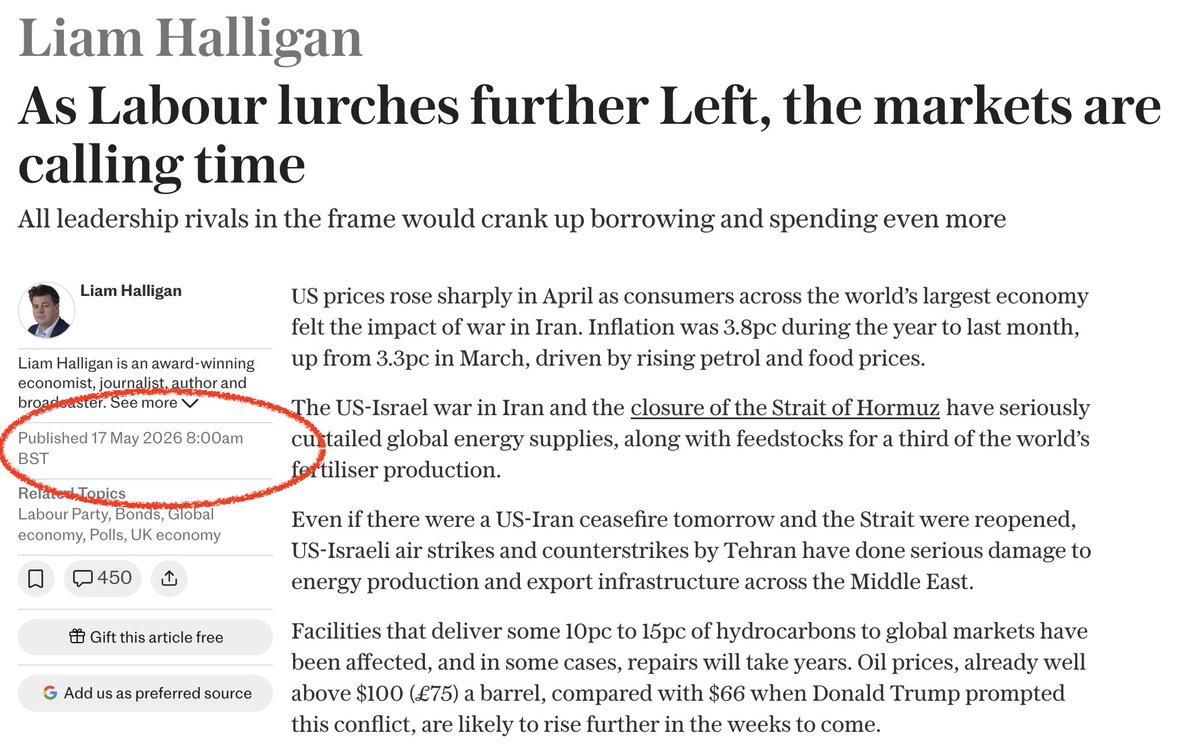
The UK government is very heavily indebted – and the global investors we rely on to bankroll a huge slice of our state spending are alarmed that of the £132bn the government borrowed last year, no less than £110bn was spent on debt interest – as I wrote in a column on 17th May 2026, "As Labour lurches further left, the markets are calling time".
Global investors are alarmed the UK has consistently had the highest inflation in the G7 (which pushes up borrowing costs) and has easily the highest share of index-linked debt (which magnifies the burden of inflation on the state's balance sheet).
And they are deeply, deeply alarmed that when Labour came to power in mid-2024, the Office for Budget Responsibility was forecasting additional state borrowing of £323bn by 2029, the scheduled end of this Parliament.
But Labour’s runaway spending and growth-crushing tax rises mean that the same five-year borrowing forecast is now £583bn – 80pc higher. And still, the trade unions, MPs and Labour activists who will choose Starmer’s successor now want even more.
It is not too late to pull the UK back from the fiscal brink, to avoid the extremely painful and deep, lingering damage of being forced to go to the IMF and perhaps other multi-lateral creditors for a bailout.
It is not too late to avoid the inflation surge, the currency crash, the shocking blow to consumer and business confidence alongside the sky-high interest rates that will seriously whack our economy – or the perhaps even deeper damage of yet more of the British electorate losing faith in the ability of our establishment to manage the country in a manner that avoids imposing serious hardship on so many hard-working people simply trying to make their way.
But our political and media class needs to start acknowledging the economic and financial truth – that the UK government is borrowing and spending too much, taxation is now so high that it's hammering growth and employment, and that trying to finally get the economy moving by "moving further left", borrowing and spending even more, will result in a fiscal collapse.
Smart, experienced, high-profile economists need to start speaking out – as Rogoff and Bean just have – raising the alarm in a bid to force the broader establishment to face reality. Before it's too late.
If you've read this far, you clearly think this analysis is worthwhile and important. So please like and share.
And for more, read my "Economic Agenda" column in The Sunday Telegraph each week – and subscribe to "When The Facts Change: Economics and Politics in a fast-moving world, with Liam Halligan"
Son feministas hasta que Bad Bunny les baila pegado.
Son socialistas hasta que descubren lo cómoda que es volar en primera clase.
Son ecologistas hasta que toca un fin de semana en yate o un vuelo a las Maldivas.
Son tolerantes hasta que se enteran de que votas a la derecha.
Son pacifistas hasta que alguien discrepa de ellos.
Son partidarios de la libertad de expresión hasta que escuchan algo que no les gusta.
Son antielitistas hasta que los invitan a un reservado VIP.
Son ciudadanos del mundo hasta que les toca tenerlos de vecino.
Son partidarios de repartir la riqueza hasta que les toca repartir la suya.
Once you hit about a 20-point IQ gap, communication starts to completely break down.
It's not that the lower IQ person is "stupid" (although that can often be the case) or the higher one is arrogant, it's that you're literally operating on different systems.
A 20 point difference (roughly 1.3 standard deviations) means:
Vocabulary and abstraction levels diverge sharply. What feels like crystal clear logic to one side sounds like vague, pretentious word salad to the other. Jokes land flat. Metaphors get taken literally. Complex cause and effect chains get simplified into "this good, that bad."
Different time horizons and pattern recognition. One person thinks in months or years and sees systems, the other is locked into days or immediate rewards. Trying to explain second order effects feels like speaking another language.
Also, processing speed and working memory gaps. The higher IQ person is already three steps ahead, getting impatient. The lower IQ person feels talked down to or overwhelmed.
Both walk away frustrated.
Both have wasted each others time.
A farmer dies in April 2026.
His son inherits the farm. The farm has been in the family since 1847.
The farm consists of: 300 acres of grazing pasture, a farmhouse built in 1892, a barn, a milking parlour, two tractors of varying ages, a Land Rover that runs about 70% of the time, and a herd of 180 Hereford-cross cattle.
On paper, the farm is worth approximately £3.2 million. This is because land near him has been bought recently by a London hedge fund looking for carbon credits, which has dragged the comparable value of every field within forty miles upward to a number nobody local can justify.
In cash, the farm produces a profit of about £28,000 a year in a good year. In a bad year it loses money. The son also works as a fencing contractor three days a week to keep the operation viable.
The inheritance tax bill on a £3.2 million estate, even at the reduced 20% rate, comes to approximately £140,000 after the increased threshold is applied. The son does not have £140,000. The son has never had £140,000. The son has £4,200 in his current account and an overdraft.
The son sells 60 acres to a developer to pay the tax. The developer puts solar panels on the 60 acres. The remaining herd cannot be sustained on the reduced land. The herd is sold. The barn becomes a holiday let.
A different family eats Brazilian beef this Christmas without knowing why the price went up.
The Treasury collects £140,000.
The land never produces British food again.
Elon Musk just described how the entire government operates in a single sentence.
Musk: “Paying people to do nothing doesn’t make sense.”
Then he told a Milton Friedman story that should terrify every bureaucrat on the payroll.
Friedman watched workers digging ditches with shovels.
He suggested they use excavators instead.
Someone pushed back.
“But then we’re going to lose a lot of jobs.”
Musk: “Friedman says, well, in that case, why don’t you have them use teaspoons?”
One sentence.
That’s all it took to gut the entire logic of modern government.
The teaspoon is not a punchline.
It is the actual policy.
Every agency that would cease to exist if it actually solved the problem it was created for.
Every department that measures success by headcount instead of output.
Every approval that routes through nine desks before someone can say yes.
Teaspoons.
The system doesn’t want excavators.
Excavators finish the job.
And a finished job is the one thing the system can’t afford.
So it hands you a teaspoon. Calls it a career. Gives you a pension for never asking why the ditch took forty years.
But this isn’t about laziness.
It’s about control.
A person digging with a teaspoon doesn’t have time to build something better.
Doesn’t have the energy to question the plan.
Doesn’t have a thought left to ask if the ditch even needed digging.
Busy people don’t ask dangerous questions.
That’s the point.
The economy doesn’t run on productivity.
It runs on the appearance of productivity.
Millions of people sit at desks right now doing work a single script could replace by morning.
They know it.
Their managers know it.
The people who sign their budgets know it.
But the teaspoon stays in their hand.
Because the moment you hand someone an excavator, they finish by noon.
And a person with a free afternoon starts thinking. Starts building. Starts wondering why they needed permission to dig in the first place.
That’s the thing the system can’t survive.
Not unemployment.
Free time.
Musk didn’t tell a joke on Rogan.
He described the longest con in modern governance.
Keep them digging.
Keep them busy.
Keep the teaspoon in their hand so they never look up long enough to see the ditch was pointless from the start.
Friedman told that story sixty years ago.
He meant it as a warning.
The system heard every word.
It just made sure everyone kept calling it a joke so no one would recognize it as a confession.
Oh god when will these morons stop? Leave people alone. We all know what this is and who the money it raises is for.
Allow me to educate you, Daniel:
The £2m threshold isn’t indexed. Frozen bands have been the Treasury’s favourite stealth lever since 2021, and there’s no reason this one escapes the same treatment. A decade of drift and £2m catches an ordinary family house in zones 2 and 3. Soaking the rich today, clobbering the upper-middle tomorrow.
Then there’s the asset-rich, cash-poor problem. Plenty of people bought in the 80s on teacher or civil service salaries and now sit on paper millions with pensioner incomes. The bill lands on cashflow they haven’t got. Telling them to downsize or remortgage to cover an annual charge on unrealised gains is a policy with forced sales baked in.
It also stacks. Stamp duty on the way in, council tax every year, CGT if it’s not your primary, IHT at the end. Each hits a different event so it’s not automatically incoherent, but piling a fifth recurring charge on the same illiquid brick is hard to defend on any efficiency basis.
Some owners will leave, but the genuinely internationally mobile wealthy sit well north of £2m. France ran almost exactly this experiment for thirty years. The (ISF) Impôt de Solidarité sur la Fortune was an annual wealth tax that caught a lot of high-value property. The behavioural response was the headline problem. Wealthy residents took the hint and left, mostly for Belgium, Switzerland and London, and they took their income tax, their VAT and their spending with them. By the time the Macron government scrapped it in 2017, the academic estimates suggested the tax had probably cost the French exchequer more than it raised once you accounted for everything that walked out the door. The exact number is argued over, some studies put the net loss higher than others, but the direction of travel isn’t really in dispute. France looked at the ledger and binned the tax. Because it was a shit idea.
That’s the real risk here. Not a guaranteed Laffer-curve disaster, but another shit policy that raises less than the press release claims because the people it targets have geo-arbitrage, offshore trusts, super mobile capital thanks to tech - as well as top drawer tax and wealth advisors.
What’s firmer still is the market freeze. Mirrlees and the IFS have spent years documenting how transaction taxes seize up mobility and carry hefty deadweight costs. Bolt a recurring surcharge on top of the existing stamp duty cliff and the band becomes a dead zone. Nobody trades in voluntarily, chains break, labour mobility takes a hit.
And the vehicle is incoherent. Council tax notionally pays for local services. Bins, street lights, social care, libraries. The family living in the £2.5m house don’t get its bins emptied more often than the flat down the road, and on most council-provided services is a lighter touch. Less social care, less means-tested support, more private provision of things the council would otherwise carry. So this isn’t council tax in any honest sense. It’s a wealth tax wearing a council tax lanyard, banked centrally and badged locally to dodge the cost of calling it what it is.
The precedent matters: any future government can now bolt a “surcharge” onto the council tax base and pretend it’s a local charge.
None of it builds a house. Britain’s affordability problem is a SUPPLY failure dressed up as a wealth problem.
A surcharge on existing stock doesn’t add a brick. It’s a gesture aimed at the politics of envy, standing in for planning reform successive governments have ducked because it’s hard and this is easy.
Boring tedious illiterate class-war slop as usual from Labour. None of them have a fucking clue what they’re doing. Bin.
Winston Churchill fought his depression with bricks. He'd lay them for hours at his country home in Kent. He joined the bricklayers' union. And in 1921 he wrote about why it worked. It took psychology another 75 years to catch up.
He called his depression the "Black Dog." It followed him for decades. His method for fighting it back was as basic as it sounds: laying brick after brick, hour after hour.
Churchill spelled out his theory in a long essay for The Strand Magazine. People who think for a living, he wrote, can't fix a tired brain just by resting it. They have to use a different part of themselves. The part that moves the eyes and the hands. Woodworking, chemistry, bookbinding, bricklaying, painting. Anything that drags the body into a problem the mind can't solve by itself.
Modern psychology now calls this behavioral activation. It's one of the most-studied depression treatments out there. Depression sets a behavior trap. You feel bad, so you stop doing things, and doing less means less to feel good about. Feeling worse makes you do even less. The loop tightens until you can't breathe inside it.
Behavioral activation breaks the loop from the action side. You schedule the activity first, even when every part of you doesn't want to. Doing it produces small rewards: a wall gets straighter, a painting fills in, a messy room gets clean. Those small rewards slowly rewire the brain. Action comes first, and the feeling follows.
Researchers at the University of Washington put this to the test in 2006. They studied 241 adults with major depression and compared three treatments: behavioral activation, regular talk therapy, and antidepressants. For the people who were most severely depressed, behavioral activation matched the drugs. It beat the talk therapy. A 2014 review of more than 1,500 patients across 26 trials backed up the result.
Physical work like bricklaying does something extra on top of this. It crowds out rumination, the looping bad thoughts that grind people down during the worst stretches of depression. Bricklaying needs both hands and gives feedback brick by brick: each one is straight or crooked. After an hour you can see exactly how much wall you built. No room left for the mental chewing.
The line George Mack used in his post, "depression hates a moving target," is good poetry. The science behind it is sharper. Depression hates a brain that has somewhere else to be.
Elon Musk avait dit un truc qui m'avait marqué sur l'allocation de ressources. En substance : passé un certain niveau de richesse, l'argent n'est plus de la consommation, c'est de l'allocation de capital.
Cette phrase change tout.
L'économie, dans le fond, c'est juste un problème d'allocation. Tu as des ressources finies et des usages infinis. Qui décide où va quoi ?
Imagine une cour de récré. 100 enfants, des paquets de cartes Pokémon distribués au hasard. Tu laisses faire. Très vite, un ordre émerge. Les bons joueurs accumulent les cartes rares, les collectionneurs trient, les négociateurs trouvent des deals. Personne n'a planifié. Et pourtant chaque carte finit dans les mains de celui qui en tire le plus de valeur. Le système maximise le bonheur total de la cour. C'est ça, la main invisible.
Maintenant fais entrer la maîtresse. Elle trouve ça injuste. Léo a 50 cartes, Tom en a 3. Elle confisque, redistribue, impose l'égalité. Trois effets immédiats. Les bons joueurs arrêtent de jouer, à quoi bon. Les mauvais n'ont plus de raison de progresser, ils auront leur part. Les échanges s'effondrent. La cour est égale, et morte. Elle a maximisé l'égalité, elle a détruit le bonheur.
Le problème de la maîtresse, c'est qu'elle ne peut pas avoir l'information que la cour avait collectivement. C'est le problème du calcul économique de Mises, formulé en 1920. L'URSS a essayé de le résoudre pendant 70 ans avec le Gosplan. Résultat : pénuries, queues, effondrement. Pas parce que les Soviétiques étaient bêtes, parce que le problème est mathématiquement insoluble en mode centralisé.
Quand Musk a 200 milliards, il ne les consomme pas, il les alloue. SpaceX, Starlink, Neuralink, xAI. Chaque dollar est un pari sur le futur. Et lui a un track record. PayPal, Tesla, SpaceX. Il a démontré qu'il sait identifier des problèmes immenses et y allouer des ressources avec un rendement spectaculaire.
L'État aussi a un track record. Hôpitaux qui s'effondrent, éducation qui décline, dette qui explose, services publics qui se dégradent malgré des budgets en hausse constante. Le marché identifie les bons allocateurs, la politique identifie les bons communicants.
Le profit n'est pas une finalité, c'est un signal. Il dit : tu as alloué des ressources rares vers un usage que les gens valorisent suffisamment pour payer. Plus le profit est gros, plus la création de valeur est grande. Quand Starlink est rentable, ça veut dire que des millions de gens dans des zones rurales ont enfin internet. Quand un ministère est en déficit, ça veut dire qu'il consomme plus qu'il ne produit. L'un crée, l'autre détruit, et on appelle ça redistribution.
Dans nos sociétés il y a deux catégories d'acteurs. Les entrepreneurs et les bureaucrates. L'entrepreneur prend un risque personnel pour identifier un problème, mobiliser des ressources, créer une solution. S'il se trompe il perd. S'il a raison, ses clients gagnent, ses employés gagnent, ses fournisseurs gagnent, l'État collecte des impôts. Il est la cellule de base du progrès humain.
Le bureaucrate ne prend aucun risque personnel. Son salaire est garanti. Au mieux il maintient une rente existante. Au pire il la détruit par excès de réglementation, mauvaise allocation forcée, incitations perverses qui découragent ceux qui produisent. Mais dans aucun cas il ne crée.
Regarde les 50 dernières années. iPhone, internet civil, SpaceX, Tesla, Google, Amazon, Stripe, mRNA, ChatGPT. Toutes des inventions privées, portées par des entrepreneurs, financées par du capital risque. Pas un seul ministère n'a inventé quoi que ce soit qui ait changé ta vie au quotidien.
La France est devenue le laboratoire mondial de la dérive bureaucratique. 57% du PIB en dépenses publiques, record absolu. Une administration tentaculaire, une fiscalité qui pénalise la création de richesse. Résultat : décrochage face aux États-Unis, à l'Allemagne, à la Suisse. Fuite des cerveaux. Désindustrialisation. Dette qui explose.
Et le pire c'est que la mauvaise allocation s'auto-renforce. Plus l'État prélève, moins les entrepreneurs créent. Moins ils créent, moins il y a de base fiscale. Plus l'État s'endette et taxe. Boucle de rétroaction négative parfaite. La maîtresse pense qu'elle aide, et chaque année la cour produit moins.
Dans nos sociétés, ce sont les entrepreneurs, toujours, qui font avancer la civilisation. Les bureaucrates au mieux maintiennent une rente, au pire la détruisent. Aucune société n'a jamais progressé en taxant ses créateurs pour subventionner ses gestionnaires.
La question n'est jamais qui a combien. C'est qui alloue le mieux la prochaine unité de ressource pour maximiser le futur de l'humanité. La réponse depuis 200 ans n'a jamais changé. Ce ne sont pas les fonctionnaires.
VAT on private school fees was sold as a policy on two grounds.
1) Taxpayers were “subsidising” private education of the wealthy.
2) The policy would raise £1.5 billion a year and fund 6,500 new teachers.
These were both lies, and have been proven to be so.
The Adam Smith Institute (ASI) suggests that the net cost to the economy of this crazy policy could reach as much as £1.58 billion.
In other words
1. Private schools were actually already subsidising state education.
2. Rather than filling the public purse with extra revenue this policy is sucking funds out of the public sector pot.
Once again, as with every major government policy, these people were elected on a raft of lies and invalidated assumptions.
Out of all the decisions this government has made, this is one of the very worst (and it’s a long list) - simply because it was made without proper due diligence and driven by the politics of envy, chasing a cheap headline.
It is a bitter, spiteful policy that shows no regard for the children immediately affected - not to mention the local economies that rely on these schools: teachers, caterers, sports clubs, cleaners, maintenance - the list goes on.
As predicted, schools are closing, and more pupils are being pushed into the state sector, adding pressure and cost where the system is already stretched.
Private education is one of Britain’s success stories. Countries around the world try to emulate these schools or send their children to them. So of course it makes sense that this government - which seems to resent British success - would want to undermine them with the stroke of a pen.
Not only that - it has made private schooling MORE elitist. Eton, Harrow, the very top end - were always going to be fine, as were the families who can afford those fees.
It is the mid-tier schools - and the aspirational families who stretch to afford them - who are taking the hit. The local tradesman, the local GP - the families for whom this was a genuine choice for their children.
For them, that choice is now gone. Children have been pulled out of their schools. People have lost their jobs - all for nothing.
This is a government that seems to hate Britain, its culture and traditions - and is determined to crush hope and aspiration within it.
You are bored because you are not doing side quests.
Life is not just work and lying in bed doing nothing.
Here are 50 side quests every man should complete:
When you’re trying to:
- be a good dad
- be a good husband
- stay jacked
- provide for the family
- fix things around the house
And not have a mental breakdown 😮💨
6 coisas que os filhos fazem só por um tempo... e depois desaparecem para sempre 😞
1. Um dia eles param de correr até você assim que acordam.
Aquele barulho de pezinhos no corredor, o abraço na cama... aos poucos dá lugar ao silêncio e à porta fechada do quarto.
2. Eles param de dizer: "Mamãe, papai, olha!"
Já não correm mais para te mostrar cada pedrinha ou cada desenho.
Pouco a pouco, o mundo deles fica mais silencioso... e mais deles.
3. Um dia eles param de segurar sua mão enquanto caminham.
E de repente você sente o vazio.
Não porque o amor acabou... mas porque eles estão crescendo.
4. Um dia eles param de dormir nos seus braços.
Aquele apoio no seu ombro, a respiração ficando calma...
são momentos que, sem aviso, acabam.
5. Em algum momento, eles deixam de acreditar que o seu beijo resolve tudo.
Antes bastava um curativo.
Depois, as feridas mais profundas começam a se esconder na música e no silêncio... não mais nos seus braços.
6. Eles param de te trazer seus "tesouros".
Folhas, papéis, pequenas descobertas.
Aquele amor puro e espontâneo... simplesmente diminui.
A infância não é um ensaio. Acontece agora e, enquanto ainda pedem colo e chamam você o dia inteiro, aproveite cada momento. ❤️
It suddenly struck me as odd, that at a time when the world is totally fucked by massive male egos, we are all being told of the advantages of a religion which glorifies and inflates and enables the male ego and protects it from any criticism
Jordan Peterson: "If you can't fix your room, you can't fix your life"
"Why should you even bother improving yourself? The answer is something like: so you don't suffer anymore stupidly than you have to. And maybe so others don't have to either. It's not some casual self-help doctrine. If you don't organize yourself properly, you'll pay for it. In a big way. And so will the people around you."
Peterson continues:
"You can say, 'Well, I don't care about that.' But that's actually not true, you do care about it. Because if you're in pain, you will care about it. It's very rare that you can find someone in excruciating pain who would say, 'Well, it would be no better if I was out of this.' Pain brings the idea that it would be better if it didn't exist along with it. It's incontrovertible."
On how to start:
"Look around for something that bothers you and see if you can fix it. You can do this in a room. Sit in your bedroom and think: 'If I wanted to spend ten minutes making this room better, what would I have to do?' You have to ask yourself that, it's a genuine question. And things will pop out. There's a stack of papers bugging you. Some rubbish behind your computer monitor you haven't attended to for six months. Cables tangled up."
He explains why this matters:
"If you were coming to see me for psychotherapy, the easiest thing would be to get you to organize your room. You think, is that psychotherapy? It depends on how you conceive the limits of your being. Start where you can start. If something announces itself as in need of repair that you could repair, fix it. Fix a hundred things like that, your life will be a lot different."
On fixing what you repeat every day:
"People tend to think of their daily routines as trivial. You get up, brush your teeth, have breakfast. Those probably constitute 50% of your life. People think, they're mundane, I don't need to pay attention to them. No, that's exactly wrong. The things you do every day are the most important things you do. Hands down. Just do the arithmetic."
On staying within your competence:
"Sometimes you don't know how to fix something. Imagine you're walking down the street and there's a guy who's alcoholic and schizophrenic and has been homeless for ten years. That's a problem. It would be good if you could fix it, but you haven't got a clue. You walk around that and go find something you could fix. Just because something announces itself as in need of repair doesn't mean it's you, right then and there, who should repair it. You have to have some humility. You don't walk up to a helicopter that isn't working and just start tinkering away."
Peterson shares the key insight:
"As soon as you give your mind a genuine aim, it'll reconfigure the world in keeping with that aim. That's actually how you see to begin with. You've all seen the video where you watch basketballs being tossed back and forth, and while you're doing that, a gorilla walks into the middle of the video and you don't see it. If you thought about that experiment for five years, that would be about the right amount of time to spend thinking about it."
He explains what it reveals:
"What it shows you is that you see what you aim at. If you can get one thing through your head, that would be a good one. You see what you aim at. One inference you might draw from that is: be careful what you aim at. What you aim at determines the way the world manifests itself to you. So if the world is manifesting itself in a very negative way, one thing to ask is: are you aiming at the right thing?"
So apart from trying to give away the Chagos islands.
Recognising Palestine.
13 ministerial resignations.
Showing full confidence in Morgan McSweeney, Peter Mandelson, Sue Gray and Lord Ali.
Blaming the far right for an island of strangers.
16 Policy U turns and rising.
Having no operable warships.
Not smashing the gangs.
Approving a huge Chinese embassy in London.
Spending 23 seconds laying a wreath in Southport only to rush back to a drinks party.
Appointing an anti Muslim hostility tsar.
Raising income tax.
Raising inheritance tax.
Raising national insurance.
Raising capital gains tax, Raising council tax.
Raising value added tax.
Raising mansion tax.
Increasing welfare spending and the minimum wage whilst freezing tax allowances.
Scrapping jury trials.
The only boat he has stopped is HMS dragon from crossing the channel.
What has Starmer really achieved apart from breakfast clubs and the decay of our country?