Wpis znaleziony na FB - wart przeczytania i rozważenia.
Witold Szabłowski - Notatnik Reportera
Pomyślałem sobie, że jak ktoś nie siedział dotąd w tematach polsko-ukraińskich, to musi mieć w ostatnich dniach niezły dysonans poznawczy. Ja, gdyby nie to, że siedzę w tym temacie od kilkunastu lat, pewnie bym miał.
I pomyślałem, że niektórym może się przydać kilka w miarę uczciwych zdań o polsko-ukraińskiej historii. Bez specjalnego wybielania się - ale też bez bicia się w piersi tam, gdzie akurat nie powinna to być nasza pierś.
Jeśli ktoś to wszystko wie - niech scrolluje dalej.
A jeśli ktoś uzna wpis za wartościowy - proszę o podanie go innym.
1.
Ukraina, podobnie jak Polska, chciała po 1918 być niepodległym krajem. Powstało nawet na chwilę państwo - Zachodnioukraińska Republika Ludowa. Ale owa Republika przegrała wojnę z Polską. Galicja i Wołyń, gdzie większość mieszkańców stanowili Ukraińcy, weszły w skład II RP.
2.
Niedługo później, w 1920, w czasie wojny z bolszewikami, doszło do taktycznego pokoju z Ukraińcami pod wodzą atamana Petlury. Ukraińcy bardzo nas wsparli w walce. Polecam poczytać choćby o generale Marko Bezruczko, który skutecznie powstrzymywał konarmię Budionnego w Zamościu. Między innymi dzięki niemu Budionny nie dotarł pod Warszawę, a Warszawa ocalała.
Tak, Cud nad Wisłą zawdzięczamy między innymi ukraińskiemu generałowi.
Tyle że po zwycięskiej wojnie Polska zawarła na własną rękę pokój z ZSRR i zamiast wesprzeć Ukraińców w walce o ich państwo - wypięła się na nich.
Piłsudski nawet przepraszał za to ukraińskich oficerów. Ale fakt był faktem. Zostawiliśmy ich wtedy.
3.
Na terenach II RP Polacy prowadzili w międzywojniu politykę bardzo krótkowzroczną - i bezdennie głupią. Na siłę próbowali robić z Ukraińców Polaków.
Owszem, były chlubne wyjątki, jak wołyński wojewoda Henryk Józewski. Ale głównie polskie rządy na Wołyniu i w Galicji to prześladowanie Ukraińców i postawa wyższościowa. Dość powiedzieć, że w latach 30. zburzono ponad 100 cerkwi. Nie było edukacji po ukraińsku. A wielu Polaków patrzyło na swoich ukraińskich sąsiadów z góry.
Warto do tego dodać, że na ziemiach ukraińskich zajętych przez ZSRR doszło do zaplanowanego przez Stalina głodu. W jego wyniku zginęło ponad 5 milionów Ukraińców.
4.
Od lat 30. wśród Ukraińców popularny staje się ruch nacjonalistyczny. powstaje OUN-organizacja, której jednym z liderów jest Stepan Bandera.
odpowiedzią na brak własnego państwa staje się terroryzm i motywowane politycznie zamachy.
pojawia się również pomysł, by - w wypadku kolejnego konfliktu zbrojnego - dokonać czystki etnicznej, która sprawi, że ziemie Wołynia i Galicji będą jednoznacznie ukraińskie
5.
W 1939 wybucha II wojna światowa. Ukraińcy dążą do niepodległości. Uznali, że ich wsparciem w tej sprawie będą Niemcy.
Niemcy oczywiście chętnie z tego skorzystali i przy pomocy Ukraińców - wcielonych masowo do tzw policji pomocniczej - wymordowali tysiące
miejscowych Żydów.
Oczywiście, o żadnej niepodległości dla Ukrainy nie ma mowy. Gdy Ukraińcy próbują stawiać Niemców przed faktem dokonanym, wielu liderów ukraińskiego ruchu narodowego., w tym Bandera, trafiło do więzienia.
6.
Po klęsce Niemiec pod Stalingradem jasne jest, że III Rzesza upadnie. w 1943 Ukraińcy dezerterują, uciekają do lasu, gdzie zasilają szeregi Ukraińskiej Powstańczej Armii - po czym rozpoczynają czystkę etniczną na Polakach.
czystkę, która nosi znamiona ludobójstwa.
pominę opisy zbrodni, bo są one bardzo drastyczne. dość powiedzieć, że rzeź wołyńska wśród historyków uchodzi za jeden z najbardziej okrutnych epizodów II wojny światowej.
Ale warto podkreślić: tysiące Ukraińców ryzykują śmiercią z rąk UPA, ratując swoich polskich sąsiadów. UPA za pomaganie Polakom karze śmiercią. I tysiące Ukraińców giną z rąk UPA właśnie za pomaganie swoim polskim sąsiadom. Właśnie o tych ludziach jest moja książka "Opowieści z Wołynia".
7.
Polacy przez wiele miesięcy są bezradni. Na Wołyniu niemal nie ma zorganizowanej obrony - oprócz kilku wiosek. Kiedy jednak udaje się sformować oddziały, często atakują one ukraińskie wioski. Odpłacając za rzeź w sposób często równie okrutny.
W wyniku rzezi w Wołyniu i w Galicji zginęło łącznie około 100 tysięcy Polaków
W wyniku polskich akcji odwetowych - kilkanaście tysięcy Ukraińców.
8.
Wygrywa na tym wszystkim - jak zawsze - sąsiad ze wschodu. Związek Radziecki, który wciela Wołyń i Galicję w swoje granice. I znów nie dopuszcza do powstania niepodległej Ukrainy.
I - co bardzo istotne - przez lata nie pozwala na to, by Polacy i Ukraińcy prowadzili dialog na temat swojej trudnej historii.
Na Kremlu rozumieją, że dopóki tak jest, to oni kontrolują narrację.
9.
Nawet kiedy w latach 90. Ukraina uzyskuje wreszcie niepodległość, przez wiele lat rozmowy na temat trudnej przeszłości są traktowane po macoszemu.
W Ukrainie narasta w tym czasie, najpierw powoli, ostatnio lawinowo - kult UPA. formacji, która - owszem - walczyła z Sowietami. Ale z polskiej perspektywy, przede wszystkim wymordowała 100 tysięcy ludzi wyłącznie za to, że byli Polakami.
10.
Ukraina ma swój uzasadniony ból - zdrada z 1921, złe traktowanie przez Polskę w latach 30., burzenie cerkwi.
Polska również - a jest nim okrutna rzeź wołyńska - i dzisiejszy kult UPA.
Ale prawda jest taka, że dopóki nie rozmawiamy o tym między sobą - po raz kolejny działamy na korzyść Rosji.
Mamy trudną historię - ale powinniśmy o niej jak najwięcej rozmawiać między sobą. Nie ma innej drogi, choć siłą rzeczy nie będą to rozmowy łatwe, co pokazują ostatnie tygodnie.
Ale ważne, żeby były.
Inaczej już niedługo historię będą nam wspólnie pisać Braun z Putinem.
Przydałby się kubeł zimnej wody na rozgrzane głowy. I dotyczy to obu stron.
PS: Jak już pisałem - wdzięczny będę za podanie tego wpisu dalej, jeśli wyda się Wam ważny.
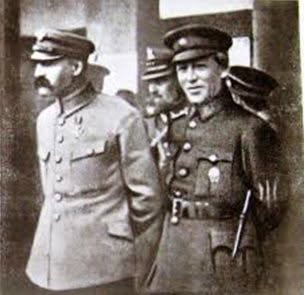
Na zdjęciu - Józef Piłsudski i Semen Petlura w roku 1920.
Italian efficiency when it comes to coffee should be studied.
In Italy:
- Walk into a bar and look at the guy
- Un caffe
- 30 seconds later it’s ready
- Shoot it
- Leave €1
- Walk out
In the US:
- Join a line
- Wait
- Order coffee
- Answer 12 questions: Size? Milk? Roast? Sugar? Temperature? Colombia beans? Name? How do you spell it?
- $12.34
- Ask for a 20% tip. Click 5 times on a ipad to have a custom tip
- Tap phone
- ask where to send the invoice
- Wait again on a different line
- Someone call a name that sounds similar to mine
- get the coffee
- too hot, can't drink it
- finally at temperature
taste like shit
The oil industry was born in Poland!
On 30 March 1853, the first kerosene lamp lit up in the shop window of the "Under the Golden Star" pharmacy in Lviv (Lwów) thanks to Ignacy Łukasiewicz, Polish pharmacist, engineer and inventor.
He also built the first modern oil well and established the world’s first oil company.
Bunker “Krysia” was a secret hideout in Warsaw where the Wolski family sheltered 38 Polish Jews, including Dr Emanuel Ringelblum, co-creator of the underground archive documenting the German crimes.
On 7 March 1944, the Germans murdered everyone.
https://t.co/W1fPzQgOn3
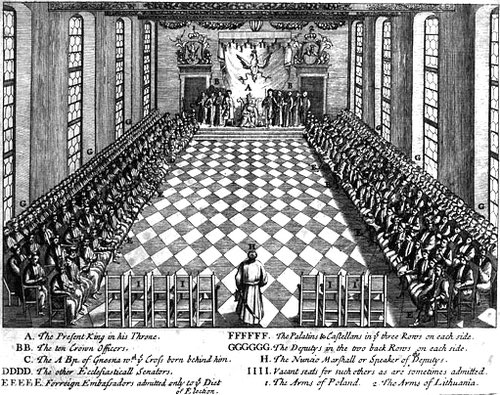
I’ve been thinking about the Polish–Lithuanian Commonwealth lately. It’s really a delightfully idiosyncratic proto-democracy.
The nobles of Poland and Lithuania decided to strip the monarchy of its hereditary nature and treat the king almost like a CEO position. After the old dynasty died out they literally talent-searched across Europe for a suitable foreign prince and then treated him more like an employee, complete with a kind of job contract. He couldn’t pass laws without parliament (the Sejm).
The whole system was designed to stop the king from turning into a tyrant, especially at a time when most of Europe was absolute monarchy.
And for a long time it actually worked.
Part of the reason is that politics in the Commonwealth ran on consensus. The sejm had a culture of working together to reach unanimity.
That’s where the infamous Liberum veto comes from. Any one noble could veto legislation. On paper that sounds insane, but it mostly worked because ppl almost never used it.
The problem came once politics became more factional, the veto turned into the perfect sabotage tool. Foreign powers could simply bribe a single deputy to bring the Sejm to a grinding halt. Catherine the great got very good at this.
She also got one of her lovers in as the last king so definitely some foreign interference heh. Aaaaand then she just partitioned it and poor Poland wasn’t a country for a looooong time after that.
What makes the story interesting is that the rules themselves didn’t suddenly change. What changed was the political culture around them.
The system was built on the assumption that elites would act with a certain level of restraint and shared responsibility. Once that assumption stopped being true, the safeguards became attack surfaces.
I sometimes wonder if something similar is happening in the United States.
The founders designed the American system with checks and balances to prevent executive overreach. But it was actually dependent heavily on norms that are not written down and are hard to put back after they erode for whatever reason.
The math on this project should mass-humble every AI lab on the planet.
1 cubic millimeter. One-millionth of a human brain. Harvard and Google spent 10 years mapping it. The imaging alone took 326 days. They sliced the tissue into 5,000 wafers each 30 nanometers thick, ran them through a $6 million electron microscope, then needed Google’s ML models to stitch the 3D reconstruction because no human team could process the output.
The result: 57,000 cells, 150 million synapses, 230 millimeters of blood vessels, compressed into 1.4 petabytes of raw data. For context, 1.4 petabytes is roughly 1.4 million gigabytes. From a speck smaller than a grain of rice.
Now scale that. The full human brain is one million times larger. Mapping the whole thing at this resolution would produce approximately 1.4 zettabytes of data. That’s roughly equal to all the data generated on Earth in a single year. The storage alone would cost an estimated $50 billion and require a 140-acre data center, which would make it the largest on the planet.
And they found things textbooks don’t contain. One neuron had over 5,000 connection points. Some axons had coiled themselves into tight whorls for completely unknown reasons. Pairs of cell clusters grew in mirror images of each other. Jeff Lichtman, the Harvard lead, said there’s “a chasm between what we already know and what we need to know.”
This is why the next step isn’t a human brain. It’s a mouse hippocampus, 10 cubic millimeters, over the next five years. Because even a mouse brain is 1,000x larger than what they just mapped, and the full mouse connectome is the proof of concept before anyone attempts the human one.
We’re building AI systems that loosely mimic neural networks while still unable to fully read the wiring diagram of a single cubic millimeter of the thing we’re trying to imitate. The original is 1.4 petabytes per millionth of its volume. Every AI model on Earth fits in a fraction of that.
The brain runs on 20 watts and fits in your skull. The data center required to merely describe one-millionth of it would span 140 acres.
The January Uprising of 1863 was a broad national revolt against Russian rule in the former Polish–Lithuanian lands. It emerged after decades of repression following the partitions of Poland, when political autonomy had been stripped away and efforts to preserve language, culture, and civic life were met with surveillance, arrests, and exile. What finally ignited the revolt was a forced conscription ordered by Russian authorities, aimed at breaking underground independence movements before they could mature.
Unlike earlier insurrections, the January Uprising was largely a guerrilla struggle. Poorly armed volunteers, students, peasants, nobles, clergy, and townspeople, formed small partisan units that fought across forests and villages from January 1863 into 1864. There was no single decisive battle, but hundreds of skirmishes, sustained by secrecy, local support, and a shared belief that national dignity was worth the risk of annihilation.
The Russian response was brutal and systematic. Executions, mass deportations to Siberia, confiscation of estates, and the elimination of remaining self-governing institutions followed. Sites such as the Warsaw Citadel became instruments of terror, used to imprison and kill those suspected of aiding the revolt. In the aftermath, policies of intensified Russification sought to erase Polish political life altogether.
Militarily, the uprising failed, yet historically, it succeeded in another way. It reshaped Polish identity around endurance rather than victory, embedding the idea that nationhood could survive without a state. The memory of 1863 influenced later generations, informed cultural life, and helped sustain the resolve that eventually led to the reestablishment of Polish independence in the twentieth century.
Artur Grottger, Polonia (January Uprising cycle), 1863–1864
𝗔𝗻 𝗢𝗦𝗜𝗡𝗧 𝗔𝘀𝘀𝗲𝘀𝘀𝗺𝗲𝗻𝘁 𝗼𝗳 𝘁𝗵𝗲 𝗩𝗲𝗻𝗲𝘇𝘂𝗲𝗹𝗮 𝗢𝗽𝗲𝗿𝗮𝘁𝗶𝗼𝗻
𝙎𝙮𝙢𝙥𝙩𝙤𝙢 𝙖𝙣𝙙 𝘾𝙖𝙪𝙨𝙚
I. Executive Summary
President Trump is describing a victory that never happened. The United States is not running Venezuela, not holding its oil, and not occupying the country. The operation was real. The control was not. The widening gap between Trump’s claims and observable reality is the key signal, and it points to a deliberately constrained, in-and-out action shaped by internal containment rather than presidential direction.
II. Symptom
What became increasingly clear over the course of the day is that the central feature of the Venezuela operation is not what happened on the ground, but the widening gap between how President Trump understands what happened and what was actually executed. His public statements describe a level of control, ownership, and leverage that simply does not exist. U.S. troops are not holding Venezuelan oil. The United States is not running the country. There is no occupation footprint, no transitional authority, no stabilization mission, and no on-the-ground mechanism through which such control could be exercised. All U.S. forces withdrew. The operational reality is settled, even as the rhetoric continues to drift.
This does not preclude the possibility of future indirect leverage through diplomacy or economic engagement, such as U.S. firms investing under a more cooperative Venezuelan leadership. But those mechanisms are prospective, contingent, and negotiated. They do not exist now, and they were not created by the operation Trump is describing.
Trump’s language throughout the day was revealing. He spoke almost exclusively about oil, money, and dominance. He promised wealth. He renamed doctrines. He framed the strike as something unprecedented since World War II and repeatedly emphasized that a second, much larger strike had been prepared but was ultimately unnecessary. He talked like someone who expected spectacle, collapse, and ownership. Notably absent was sustained language about democracy, constitutional order, or rule of law. This is consistent with Trump’s transactional worldview. Power is measured in assets. Success is measured in control. Legitimacy follows dominance, not procedure.
III. Cause
Around Trump are actors with very different incentives and constraints. For ideological MAGA adherents, force is acceptable but occupation is not. Their opposition is not to action, but to entanglement. Nation-building, permanent deployments, and administrative control of foreign societies run directly against their core beliefs. An in-and-out operation fits their ideology. Running Venezuela does not.
Senior military leadership would have seen the risks immediately. Any attempt to occupy or administer Venezuela would mean inheriting civil collapse, humanitarian crisis, insurgency risk, and regional instability, all without a viable exit strategy. Militaries do not drift into occupations. They require staging, logistics, force posture signaling, and follow-on planning. None of those indicators appeared. The absence is decisive. The operation was designed with a hard stop from the beginning.
Marco Rubio’s behavior fits the same pattern. His communications to Trump about Venezuelan leadership cooperation were contradicted almost immediately in public. That does not suggest ignorance. It suggests expectation management. Authoritarian regimes often speak conciliatorily in private while performing defiance in public. Rubio would understand that dynamic. What mattered was not whether cooperation was genuine, but whether Trump believed escalation was unnecessary. Soft framing reduces pressure for follow-on action. Once the operation concluded and forces withdrew, escalation became structurally impossible regardless of rhetoric.
The global context matters even more. A U.S. occupation of Venezuela would have detonated ripple effects across every major security theater the United States is engaged in. Arguments about sovereignty in Ukraine would collapse overnight. Deterrence messaging toward China over Taiwan would be severely weakened. Alliances would fracture or hedge. Adversaries would weaponize the precedent immediately. Anyone responsible for alliance management or deterrence would have seen this instantly. Containment was not just about Venezuela. It was about preventing strategic self-sabotage elsewhere.
Taken together, the pattern is consistent and coherent. Trump expected domination, control, and asset capture. The people around him understood that translating those instincts into policy would drag the United States into a destabilizing conflict of historic scale in the Western Hemisphere and simultaneously weaken U.S. positions globally. So they shaped an operation that delivered removal and exit, not ownership. Trump received the optics. The system imposed the ceiling.
That is why the rhetoric now floats free of reality. Trump continues to describe the outcome he expected, not the one that occurred. This is not classic deception. It is cognitive dissonance between expectation and execution. His mental model assumes control because that is how he measures success. The operation delivered a bounded result by design.
The press is now describing the discrepancy. What it is not doing, at least not explicitly, is naming the cause. The gap between Trump’s statements and observable reality is not confusion or chaos. It is the visible symptom of an internally contained decision process. Trump talked like an autocrat. The system acted like a scalpel.
That divergence is not incidental. It is the story.
#OSINT #Venezuela
Reports from the Shadow. Poles Warn about the Holocaust!
In 1942, after the Germans embarked on the mass murder of the Jewish population, Poland initiated the first international action aimed at stopping and condemning the German atrocities.
The Polish government-in-exile alarmed the world with information about the German terror, concentration camps, and continuing destruction of the Jewish nation. The data were met with disbelief in the West – even among the Jews themselves. Many politicians doubted that the Germans would run a genocidal scheme on such a scale.
To convince Western leaders that the terror-based German occupation and slaughter of the Jews was real, the Polish Underground State structures collected and used the government in exile to transmit detailed data on the Holocaust.
Among those who took risks to inform the world about what was happening in Poland under German occupation were also ordinary Poles, often acting in conditions of immediate danger to their lives – especially in the occupied territories (the General Government), including the areas incorporated into the Third Reich (the so-called Wartheland). One of them was Stanisław Kaszyński, who, despite the risk of repression, decided to raise the alarm about the German mass murders. He attempted to inform diplomatic representatives and the International Red Cross, trying to raise awareness of the scale of the German crimes, including the extermination of Jews and Roma.
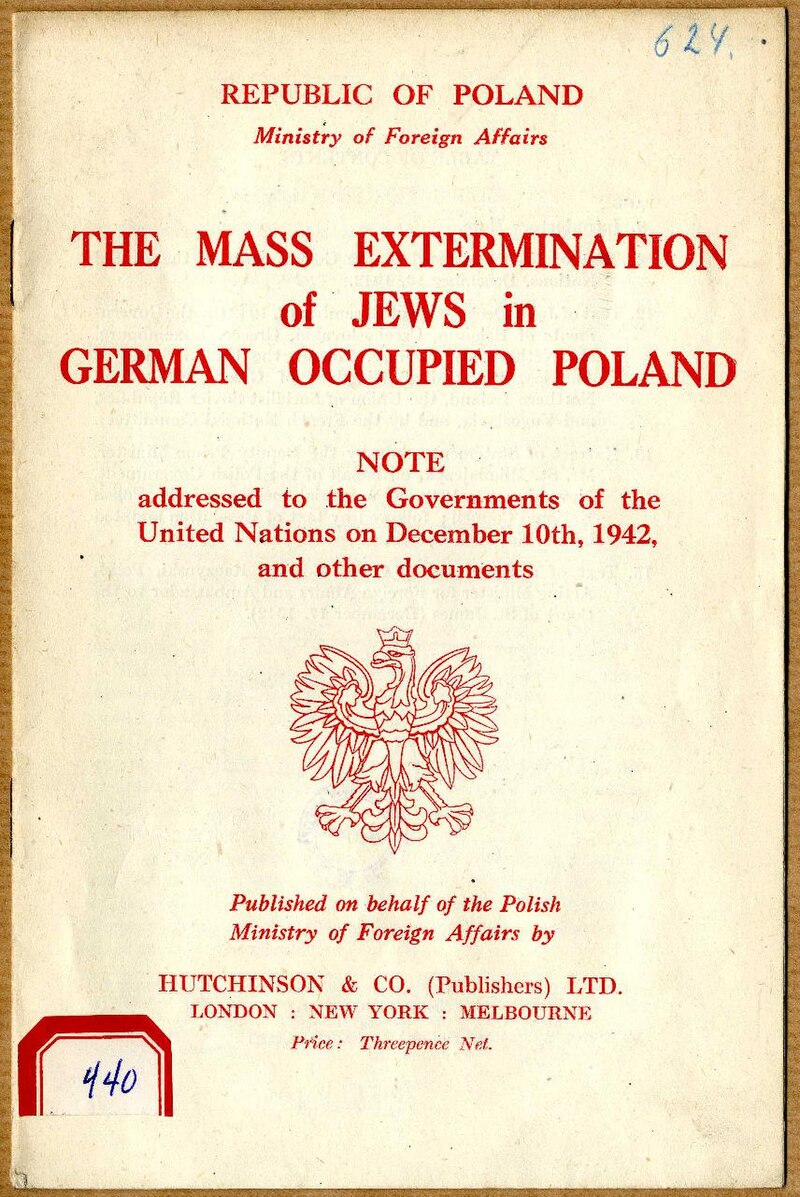
The efforts of these individuals, carried out under the dramatic conditions of occupation, were combined with the activities of the Polish government-in-exile, which alerted the Allies and undertook diplomatic initiatives aimed at rescuing the victims of the German terror. On 10 December 1942, the Polish government-in-exile appealed to the signatories of the United Nations to stop the extermination of Jews. The note, signed by Polish Foreign Minister Edward Raczyński and dated 9 December 1942, was a document prepared on the basis of, among other things, the accounts of Jan Karski, who had arrived in London a few weeks earlier with reports from the Polish Underground State.
Raczyński's note was the world's first official report on the Holocaust, submitted to the governments of the Allied powers, and at the same time, the first public statement by a European government in defense of all exterminated Jews, not only citizens of pre-war Poland. It contained data on the current situation of Jews, confirmed the crimes committed by the Germans, and presented the efforts of the Polish government-in-exile while appealing for immediate action and the punishment of German criminals.
The document played a key role in informing the world about the Holocaust. As a result, on 17 December 1942, the Allied powers issued a special declaration condemning German crimes and announcing that those responsible would be punished.
In this way, both the dramatic attempts of individuals such as Stanisław Kaszyński and the diplomatic efforts of the Polish authorities contributed to the first appeal in history to stop the Holocaust.
#ReportsformtheShadow #StanisławKaszyński #PolesSavingJews #RaczyńskisNote #Holocaust #WW2 #WW2History #History #PolishHistory #JanKarski #WeRemember #CouriersofTruth
@MaykowskiD@cezarykrysztopa@Stan_Fischer At the time the U.S. had strict and low immigration quotas from Eastern Europe as they feared the "typhus of Bolshevism", as they put it, Poland granted citizenship to 500,000 Jews fleeing the Bolshevik revolution... and who never planned to integrate. https://t.co/kq1RGpSxml
In 1942, after years of starvation, imprisonment, and despair in the Soviet Union, thousands of Polish soldiers finally stepped onto Persian soil, modern-day Iran. The men in this photograph, weary yet smiling, were among them.
They were survivors of the Soviet Gulag system, the remnants of the Polish Army that had been captured after the joint German-Soviet invasion of Poland in 1939. For many, the journey to freedom had begun in frozen labor camps scattered across Siberia and Kazakhstan, where hunger, cold, and disease claimed countless lives. When Hitler turned on Stalin in June 1941, the Soviets, now desperate for allies, signed an agreement with the Polish government-in-exile to release Polish prisoners and allow the creation of a new army on Soviet soil under General Władysław Anders.
This “Anders Army,” as it came to be known, gathered slowly from the vast distances of the USSR, soldiers, civilians, children, and families walking and riding across deserts and mountains toward the promise of deliverance. By spring 1942, more than 100,000 Poles crossed the Caspian Sea to Iran, a place that to them seemed almost unreal: a land of warmth, bread, and life. British and Polish officers described the arrivals as “living skeletons in rags,” yet the faces in this photograph show something remarkable - relief, dignity, and the first flicker of hope after years of captivity.
From Iran, they would move on to Iraq, Palestine, and Egypt, retraining and rebuilding into one of the most disciplined and courageous fighting forces of the war. These same men, Polish soldiers who had once been prisoners of the Soviets, would later fight with honor at Monte Cassino, Ancona, and Bologna, carrying with them the memory of the countless comrades who never made it out of the East.
Their story is one of endurance and rebirth: a testament to the strength of the Polish spirit, forged in exile, tempered in suffering, and resurrected in freedom.
81 years ago, on October 13, 1944, the Nazi German army barbarously burnt the collections of the Polish National Library in Warsaw. Over 80,000 prints from the 15th-18th centuries, over 26,000 manuscripts. A reminder of this is an urn with a handful of ashes from this crime.
📜🩸
In October 1944, during the final phase of the Warsaw Uprising, as the city was already crushed and abandoned to ruins, German forces set fire to the Polish National Library. It was not an accident of war. It was a deliberate act of cultural annihilation, part of a systematic plan to erase the spiritual and intellectual heart of the Polish nation.
Within days, three million volumes , books, manuscripts, maps, and letters were reduced to ash. Among them were medieval chronicles, royal correspondence, rare atlases, the writings of scientists, theologians, and poets. The entire history of Polish civilization, recorded over centuries, was turned into smoke and dust.
Those who witnessed it described how the heat from the fire warped the air and filled the sky with black fragments that once held the words of generations. It was as if the memory of Poland itself had been set alight.
The destruction of the National Library was one of the greatest cultural losses in modern European history ever. It represented the attempt not just to conquer a people, but to erase their past and their capacity to remember. For totalitarian power depends on amnesia…
Today, what remains is preserved behind glass, the compacted ashes of manuscripts and parchment, pressed together by flame and time. These are sacred. Each fragment stands as a witness, silent yet unyielding, proof that what was once meant to vanish still endures.
For Poland rebuilt, the libraries reopened, the words returned, the people remembered and in that act of remembrance lies the ultimate defiance.
As historian Norman Davies wrote, “To destroy a people, you must first destroy its memory. Yet memory, once awakened, cannot be extinguished.”
These ashes are not only a record of what was lost, but of what could never truly be taken - the persistence of culture, the endurance of spirit, and the unbroken will of a nation that refused to forget.
“I had read Hemingway and Remarque for years. I thought they knew everything about war. But they didn’t know mine.”
“When I came back from the front and saw my bookshelf, I felt like a fool,” wrote 25y old Ukrainian soldier and author Artur Dron in UP. 1/
When the Warsaw Uprising was crushed, Heinrich Himmler demanded the complete destruction of Warsaw as revenge for the Polish revolt. #OTD in 1944, he gave a chilling order:
“The city must be completely destroyed. No stone can remain standing. Every building must be razed to the ground.”
What followed was one of the most deliberate acts of urban annihilation in modern history.
German forces, enraged by the 63-day resistance of the Polish Home Army, began the systematic demolition of the city. They set fire to buildings, placed explosives in hospitals, churches, and schools, and executed civilians on a mass scale. Whole districts were flattened. The city that had fought for freedom was turned into a wasteland of ashes and stone.
By January 1945, when Soviet troops finally entered Warsaw, over 85 percent of the city lay in ruins. The capital of Poland, once home to more than a million people, had been erased from the map. Up to 200,000 civilians were murdered, many shot in the streets or burned alive in their homes. The survivors were deported to concentration camps or sent as forced laborers to Germany.
And after all this, Poland received no reparations. The nation that suffered one of the highest civilian death tolls of the war, whose capital was deliberately destroyed, was never compensated for its loss. Instead, it was handed over to Soviet domination at Yalta, betrayed by the very Allies it had fought beside.
Still, from this devastation came something extraordinary. The people of Warsaw began to rebuild their city with their own hands, brick by brick, often using the rubble of what had once been their homes. The Old Town, now restored from ruins, stands as a monument to faith, courage, and national resurrection.
Warsaw is not only a city. It is a symbol of endurance, of the will to survive when everything has been taken away. It reminds the world that even when a city is destroyed, the human spirit cannot be conquered.
Countless Poles risked everything to shelter, feed, and hide Jews under the German occupation in a land where helping a Jew was punishable by death, not only for the rescuer but for their entire family.
Many of these rescuers, members of Żegota, Catholic clergy, ordinary villagers, and families were executed or sent to concentration camps for their courage. Poland has the highest number of recognized “Righteous Among the Nations” at Yad Vashem, and thousands more remain unrecognized.
To claim “no one helped” erases their sacrifice and dishonors the memory of those who gave their lives so that others could survive. This is not just inaccurate it’s Holocaust distortion.
Oxford University shouldn't expel George Abaraonye for celebrating the killing of Charlie Kirk. Abaraonye is doing exactly what they brought him in to do; to be a mascot of the complete enshittification of a once peerless institution.
His slouching bravado, his slovenly tracksuit-at-High-Table aesthetic; his slippers; his elevation for politics rather than academic merit; his glorying in the death of a good man who dared beat him.
He's one of the new aristocrats, an inferior to be revered, held aloft above our heads so we can see the Habsburg lip and drooling incontinence, a signal from the kakistocracy that they've seized and salted another square of hallowed turf.
Erect a statue of him so that nobody forgets that.
I read Google's paper about their quantum computer so you don't have to.
They claim to have ran a quantum computation in 5 minutes that would take a normal computer 10^25 years.
But what was that computation? Does it live up to the hype?
I will break it down.🧵