We are banning social media access for under 16s.
These days kids must find their feet in a world where technology intrudes into every area of their life.
I just can’t let that go on anymore. So we’re giving children their childhoods back.
👓Meta admits its smart glasses were recording private conversations WITHOUT users even giving consent.
Covert recording is the inevitable result of putting surveillance hardware on people's faces.
Read more ⤵️
https://t.co/hD4Q8dBHCY
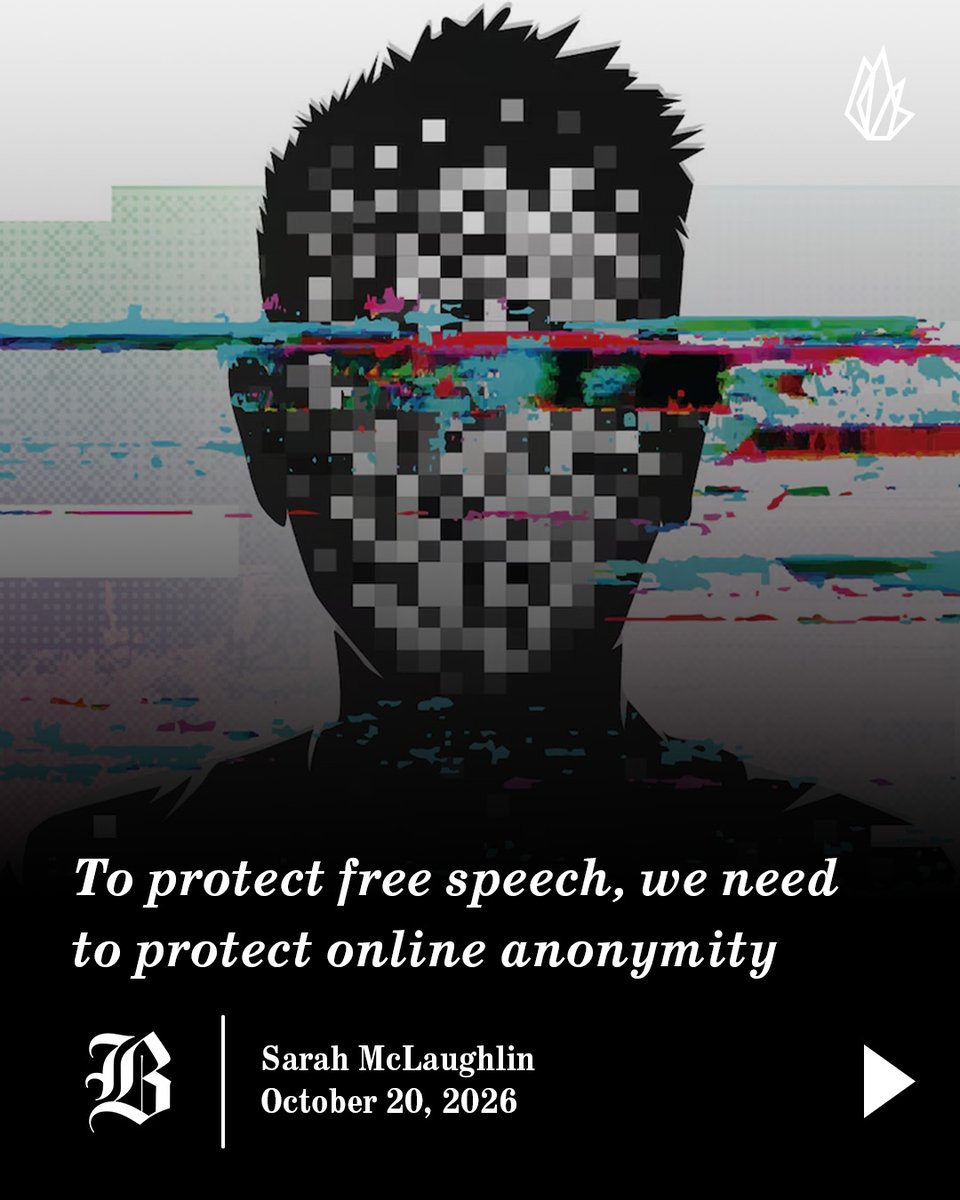
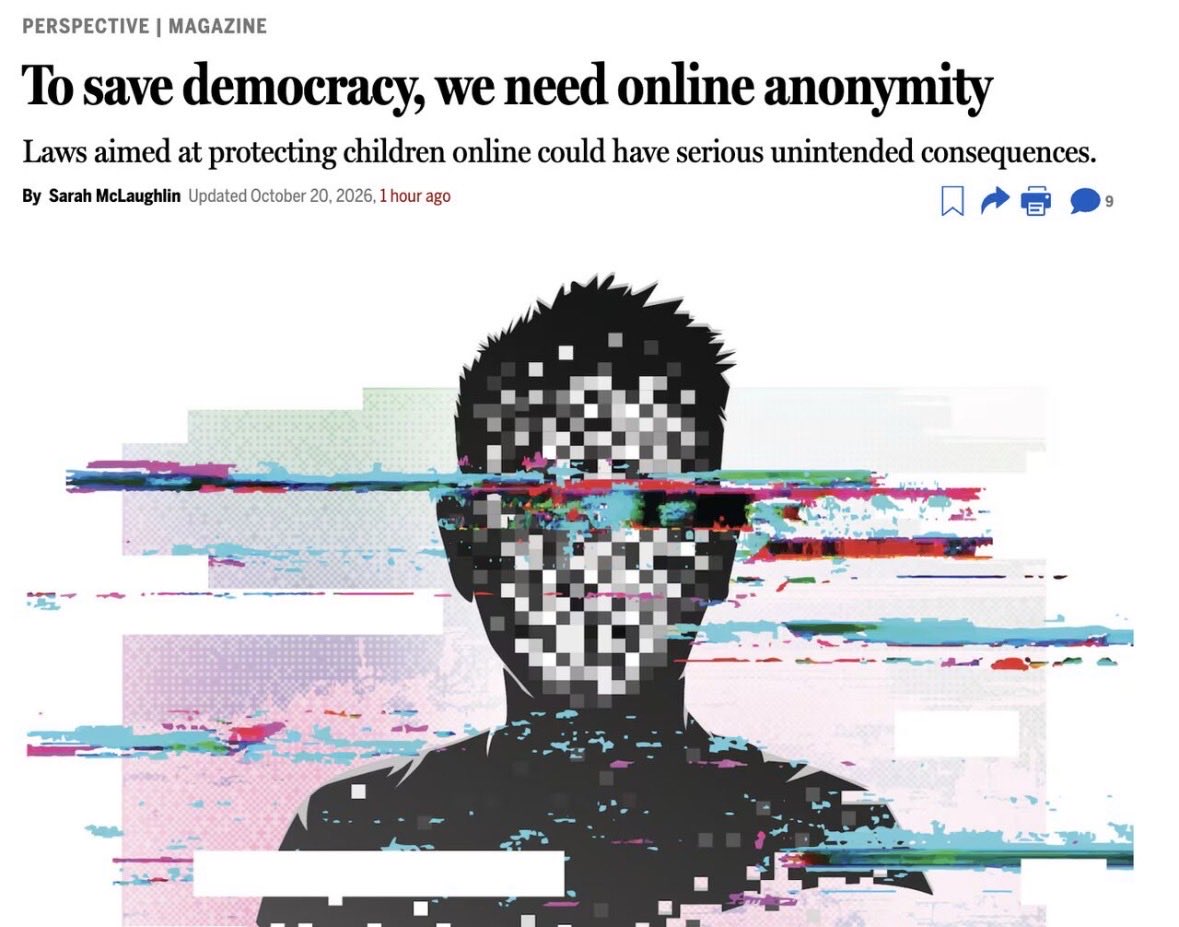
The death of internet anonymity is looming, bringing with it severe implications for our free speech rights. And no one seems to want to stop it.
Laws aimed at protecting children online could have serious unintended consequences.
📰 @BostonGlobe
🖊️ @sarahemclaugh
Anonymity is one of the best guards we have against consequences ranging from social embarrassment to overt government oppression. So why are we giving it up without a fight?
My latest at @BostonGlobe on free speech, anonymity, and the changing internet: https://t.co/wHA3HV1BsM
Big Tech is using workplace surveillance to silence political dissent and strip workers of their fundamental right to organise.
Read more from @openDemocracy ⤵️
https://t.co/x9TkmEjzZW
Just two tech companies have paid fines to Ofcom for being in breach of the Online Safety Act, Melanie Dawes of Ofcom tells MPs this morning
One is being appealed, and one is not yet overdue, leaving a total of nine currently unpaid.
"Of the nine that are unpaid in total, two are porn companies that have now implemented highly effective age assurance...
"Another four have geo-blocked the UK. And so that's three that are still available without the risks being mitigated out of the 11 services."
"We won't be able to recover every single fine on online safety," she continued. "If foreign courts decide to... try and get in our way, there will be a point at which we have to accept that we won't be able to recover that money.
"But we will always seek to go as far as we can. And in the end, what encourages me about the companies we fined is that they've actually done the things that we want to protect the public, and that is the real test of our implementation of the Act."
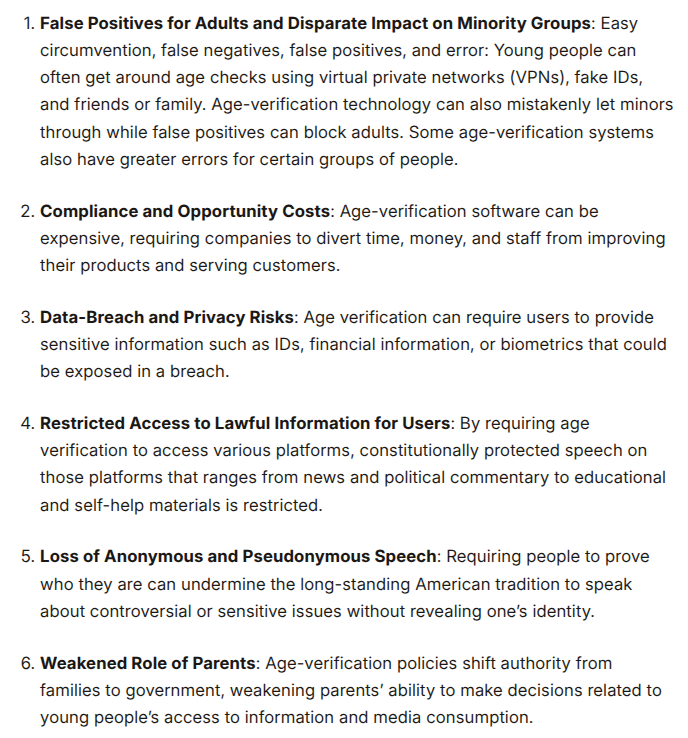
Age-gating the internet won't dismantle Big Tech's toxic business model - but it will strip away online privacy and security for millions of us.
Six reasons why online age verification is a guaranteed policy failure, from @CatoInstitute ⤵️
.@dr_inserra and I have a new paper out today. In it we look at youth online safety policy such as age verfication about the 6 clear potential harms/costs that should be weighed against any purported benefits. You can read the full paper here: https://t.co/iPUbeoBit3
At the same time ministers are pushing laws to force algorithms to boost "trustworthy" state-approved media, we find that civil servants were secretly writing BBC "fact-checks" on small boat crossings, crime, and COVID.
When the state writes the news AND forces social media platforms to amplify it, we should all be concerned.
https://t.co/PRSNAPfilf
The British government wants the public to fund the BBC through a “YouTube tax.” It wants YouTube and other platforms to push the BBC to the top of feeds. And for the past eight years, it has been lending the BBC its own government employees to help write the "fact-checks."
Compelling people to pay a tax on non-BBC streaming, simply because they chose to watch content online, destroys public trust.
Worse still, people shouldn't be forced to finance campaigns designed to discredit political dissent under the guise of "tackling misinformation".
Public service broadcasting relies on public consent. When the state decides which political narratives are "trustworthy" - and taxes citizens to subsidise them - it undermines democratic accountability.
Read more ⤵️
https://t.co/q4WTC0JxMA
Around the world, states are using tech to monitor populations, suppress dissent & exert control often without transparency, meaningful oversight or routes to redress.
Our new Global Report on the Authoritarian Use of Technology documents this trend.
https://t.co/B5QzlndVLc
This report by @privacyint warns that intrusive surveillance tech is being deployed by democratic regimes to normalise population control and eliminate dissent.
Unsurprisingly, the UK features heavily in the report: from scanning 50,000 faces per police deployment in London to mobile phone extraction and social media monitoring, it confirms that we are sleepwalking into a biometric surveillance state.
Labour must step back from the brink and protect our digital rights.
Around the world, tech is increasingly being used to stifle dissent, assert control and diminish human rights.
Our new Global Report on the Authoritarian Use of Technology documents how states are deploying surveillance technologies.
https://t.co/B5QzlndVLc
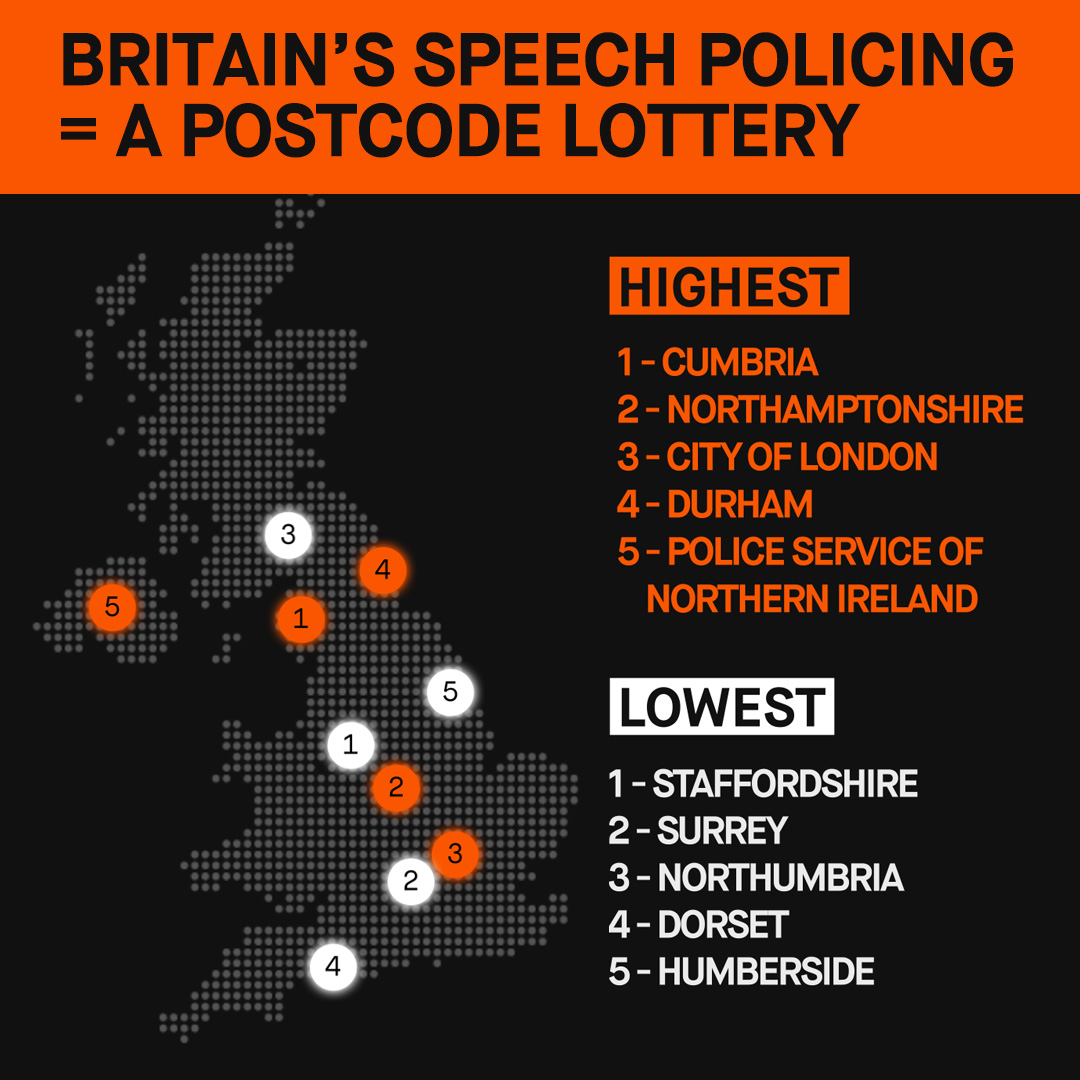
🎲Speech policing in the UK has become a game of chance.
Cumbria Police arrests people for “speech offences” at 14 times the rate of neighbouring Northumbria.
In our report, we expose the postcode lottery of policing in Britain.
Read⤵️
https://t.co/A4PP3o6zc5
Banning things is easy.
Drawing a clear line between criminality and consensual sexual expression is much harder, writes @cgdav135 👇
https://t.co/EWZsO38vuj
✍️ Not quite how I expected to make my @unherd debut.
If free speech means anything, it means defending even that which we find objectionable or morally reprehensible.
Please give it a read. 👇
At conference I had a number of Labour members who were critical/concerned that I am active on here with @LabDRN.
Whether we like it or not, this platform is where a significant chunk of political discourse takes place. We should be part of the conversation.
🔴 NEWS: Met Police officers unlawfully shared the personal information of 179 people, including three children, on an unauthorised retail crime platform.
🔸 Names and home addresses were uploaded to a platform called Auror.
🔸The platform was never risk assessed, reviewed or approved by the Met.
The UK's data watchdog @ICOnews has launched an action against the Met's severe lack of accountability.
Officers have repeatedly used third-party platforms unchecked - and the Met has nothing in place to stop them from continuing to do so.
Outsourcing asylum reviews to flawed AI risks a dual threat to human rights and national security:
Legitimate refugees fleeing persecution may have their claims wrongly flagged and denied, while fraudulent claims pass through undetected, undermining security and public trust.
Stop using broken algorithms as a substitute for due process.
Read more from @ComputerWeekly ⤵️
https://t.co/ONye33E0nC
🇹🇷 In just one month, Turkish authorities used vague "public safety" laws to block over 1,200 social media accounts, independent news outlets, and human rights monitors, according to a new report by @article19org.
Our Labour government must take heed. By maintaining and expanding the Online Safety Act, pushing for mandatory age verification and digital ID checks, as well as granting ministers sweeping secondary legislative powers to restrict internet services, the state is constructing its own digital control apparatus.
It can happen here.
Read more ⤵️
https://t.co/nuFWLWKOaB
Doctors are now sounding the alarm, with 150 leading clinicians recently writing to Lucy Powell, the Education Secretary, to warn that we are seeing a 'crisis unfold with children presenting earlier and more severely' with physical and developmental health issues, including language and eyesight problems, due to screen time in class.
So why are tablets, monsters and gaming taking over schools across the country?
At first, it was the promise of futuristic tech for the digital age. But there's more at play. One former teacher tells me it's the only way for staff to cope. Class sizes in secondary schools are getting bigger and classrooms are harder to control. The admin load is more burdensome.
A lot of children have English as a second language and need extra support, while much of the teacher's free time will be spent on things like safe-guarding or filling out behavioural reports. Something had to give, and teachers decided that marking homework was the best sacrifice.
✍️ Lara Brown
Article | https://t.co/8em7dyoypa | @lara_e_brown
Clinicians warning against classroom screen overuse exposes a massive contradiction in this government's tech policy.
Over-relying on screens in schools is damaging children’s speech and eyesight, yet ministers remain obsessed with enforcing unworkable social media bans.
We need healthy screen habits in daily life and real-world play - performative bans that ignore the root causes of digital harm will not help anyone.
Exclusive from @benclatworthy
Screen time in classrooms should be slashed as there are fears it is fuelling a “crisis” in pupils’ speech and language development, ministers have been urged
Leading clinicians have written to Lucy Powell, the education secretary, to warn that they are witnessing a “crisis unfold with children presenting earlier and more severely” with physical and developmental health issues, including language and eyesight problems
The letter, which was also sent to Yvette Cooper, the health secretary, was signed by 150 clinicians inlcuding Dr Louise Milne, consultant paediatrician at Portsmouth Hospitals University Trust, and Dr Sanjiv Nichani, a senior consultant paediatrician and co-founder of the Children’s Intensive Care Unit at Leicester Children’s Hospital
Experts said the use of tablets, laptops, interactive whiteboards and headphones “exploded” during the pandemic and has “never been rolled back”. Recent research found that many pupils now spend longer on screens in the classroom than they are recommended to spend across an entire day.
They warn: “A generation is being taught on devices and platforms that have never been subject to systematic, child‑focused testing for their cumulative impact on children’s eyes, ears or speech, and we are the clinicians who will spend the rest of our careers treating the consequences.”
https://t.co/NhCIW67HOI
As Alex Younger said, the Russians "did not create the things that divide us, we did that to ourselves".
The end results of state failure and foreign disinformation operations look remarkably similar.
Burnham should be cautious about giving rise to the suggestion that the fears and concerns of ordinary people are the construct of foreign information warfare.
https://t.co/15UYzPxsLp