Our newest paper on the influence of aging and hearing loss on cortical inhibition is out! It has been featured on the #eNeuro front page - congrats @MeikeRogalla, well done! Check it out: https://t.co/4dk1CoH2AZ
Reawakening this account to celebrate THE highlight of our lab during my silent summer: @MeikeRogalla’s doctorate was officially approved with highest honors. Yeah!!! So deserved - very proud of the excellent science, extremely happy to have worked with Meike during these years.
Applications for the most magical neuroscience summer school (fight me) are due March 8th: https://t.co/QPm9y6us5W. Learn to solve problems, do creative experiments, and become an optics&ephys wizard 🐁🔬🧠⚡️🖥️🧙🧙♂️. Spread the word!
1/8 Very happy to share our new paper on bioRxiv: Two distinct types of eye-head coupling in freely moving mice: Arne Meyer, John O'Keefe, Jasper Poort: https://t.co/nHOECpCjdH How do mice use head and eye movements to explore their environment? Thread below...
Interesting new study on potentially ethological relevance of mouse vocalizations - nicely solving the major technical issue to seperate tweets from different individuals during social interaction. Discrete tweet types, depending on social context. https://t.co/UDfs8XMdHE
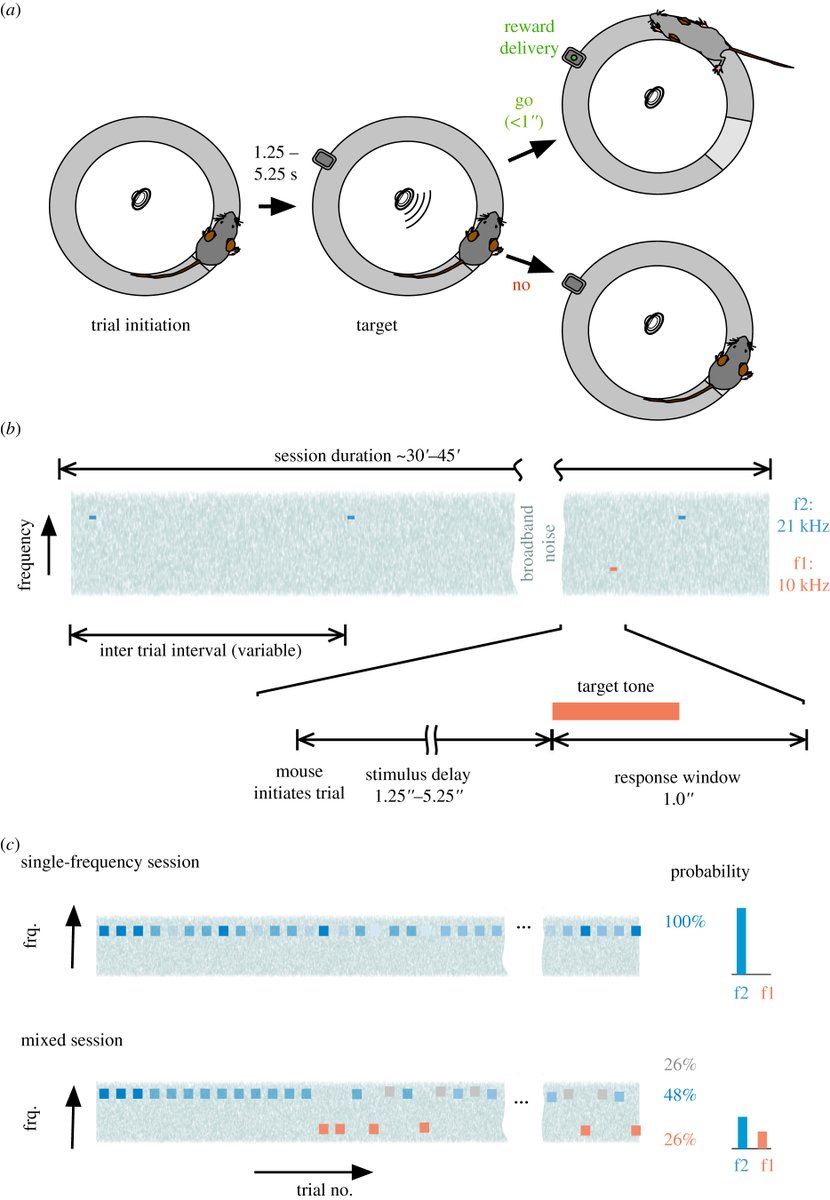
Mice tune in to the unexpected - new #ProcB study shows how mice are better at hearing rare sounds, possibly as a threat detection mechanism https://t.co/N4526fehWe @MeikeRogalla@LabHildebrandt @UniOldenburg #auditoryneuroscience
Great preprint from @c_perrodin on female mouse song preference, using manipulated playbacks of male songs. Females do care, and mostly about temporal regularity! Finally, we know a bit more about what the relevant stimulus for physiological experiments could be. Congrats!
https://t.co/DA0a2zq483, a thread (featuring mice, songs and love):
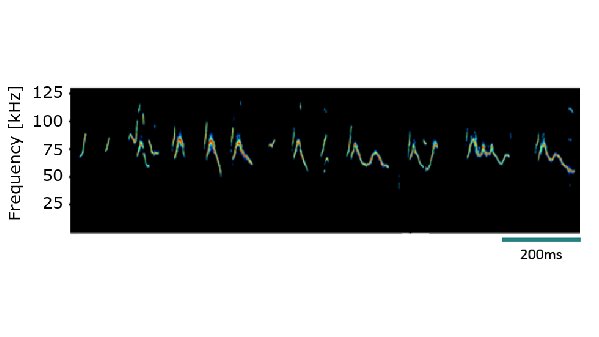
Did you know that male mice sing elaborated, ultrasonic “love” songs to attract females? All this at frequencies so high-pitched that they are inaudible to humans? (1/6)
Our new paper on how expectations shape auditory perception in mice is finally out. @RSocPublishing - Proc Roy Soc B. Congrats to @MeikeRogalla and the rest of the team! Mice, other than humans, are better at hearing surprising sounds than expected ones https://t.co/pJSMeT1XtU
If you look for a postdoc position, and auditory cognitive neuroscience and aging is your topic ... stay tuned for a call opening soon to work with me at @rotmanresearch in Toronto. Meanwhile, if you are at ARO next week and would like to chat: email or DM me, or come find me.
"...we're spending increasing amounts of money to produce more and more research that is less and less comprehensible." Very interesting read. Shouldn't we try to make 2020 the year when things started to turn around?
New year - new ideas on changing bloated research culture. @deevybee presents hard data on the flood of papers and considers solutions. Slowing down may be a question of confidence.
#Slowscience
https://t.co/XTXa8UGSpG
Very interesting use of deep learning to see which stimulus parameters are encoded in population activity -DeepInsight: A general framework for interpreting wide-band neural activity https://t.co/ncgJa6NyoZ
@bjoherrmann These fees will bias submission towards big labs. Fees for low-income countries are often waived, but no differentiation otherwise. We typically have central funds for publications, e.g. big collaborative grants or the university. DFG has a program to cover costs up to €2000.
Bring on the sharks, the birds, the frogs...! 🦈🐥🦅🐸🦍🦎🐍🦓🐿A long time cooking, here are some of our musings on why we absolutely must re-expand our narrow focus on a handful of model species in vision research /w @teulerlab @CellTypist https://t.co/OFHlwVK1Gm
Very interesting paper: let a RL-DNN learn to be a simulated animal and then look how this 'brain' solves motor-tasks. A bit skeptical about the 'neurethology' title. NE is about evolutionary and comparative approaches in neuroscience, not just behavior-physiology mapping?
Can a neuroscientist understand a virtual rodent?
Authors took a realistic 3D animal, trained deep RL to control it during tasks, and then used neuroscience techniques to peak inside this animal...
[Josh Merel, Diego Aldorando, Greg Wayne, @BOlveczky]
https://t.co/BNgd0gmSQm
A must-read for all those working with models to study neuronal dynamics at the mechanistic level. Exciting approach for parameter tuning by @ppjgoncalves et al.: Let DNNs do the work to find the right model parameters!


![neuroecology's tweet photo. Can a neuroscientist understand a virtual rodent?
Authors took a realistic 3D animal, trained deep RL to control it during tasks, and then used neuroscience techniques to peak inside this animal...
[Josh Merel, Diego Aldorando, Greg Wayne, @BOlveczky]
https://t.co/BNgd0gmSQm https://t.co/yHSro4KcvV](https://pbs.twimg.com/media/EJ_FuKlXsAAwamn.jpg)
![neuroecology's tweet photo. Can a neuroscientist understand a virtual rodent?
Authors took a realistic 3D animal, trained deep RL to control it during tasks, and then used neuroscience techniques to peak inside this animal...
[Josh Merel, Diego Aldorando, Greg Wayne, @BOlveczky]
https://t.co/BNgd0gmSQm https://t.co/yHSro4KcvV](https://pbs.twimg.com/media/EJ_FtlqWsAAvu-y.jpg)





![neuroecology's tweet photo. Can a neuroscientist understand a virtual rodent?
Authors took a realistic 3D animal, trained deep RL to control it during tasks, and then used neuroscience techniques to peak inside this animal...
[Josh Merel, Diego Aldorando, Greg Wayne, @BOlveczky]
https://t.co/BNgd0gmSQm https://t.co/yHSro4KcvV](https://pbs.twimg.com/media/EJ_FupiW4AEPjoN.jpg)


