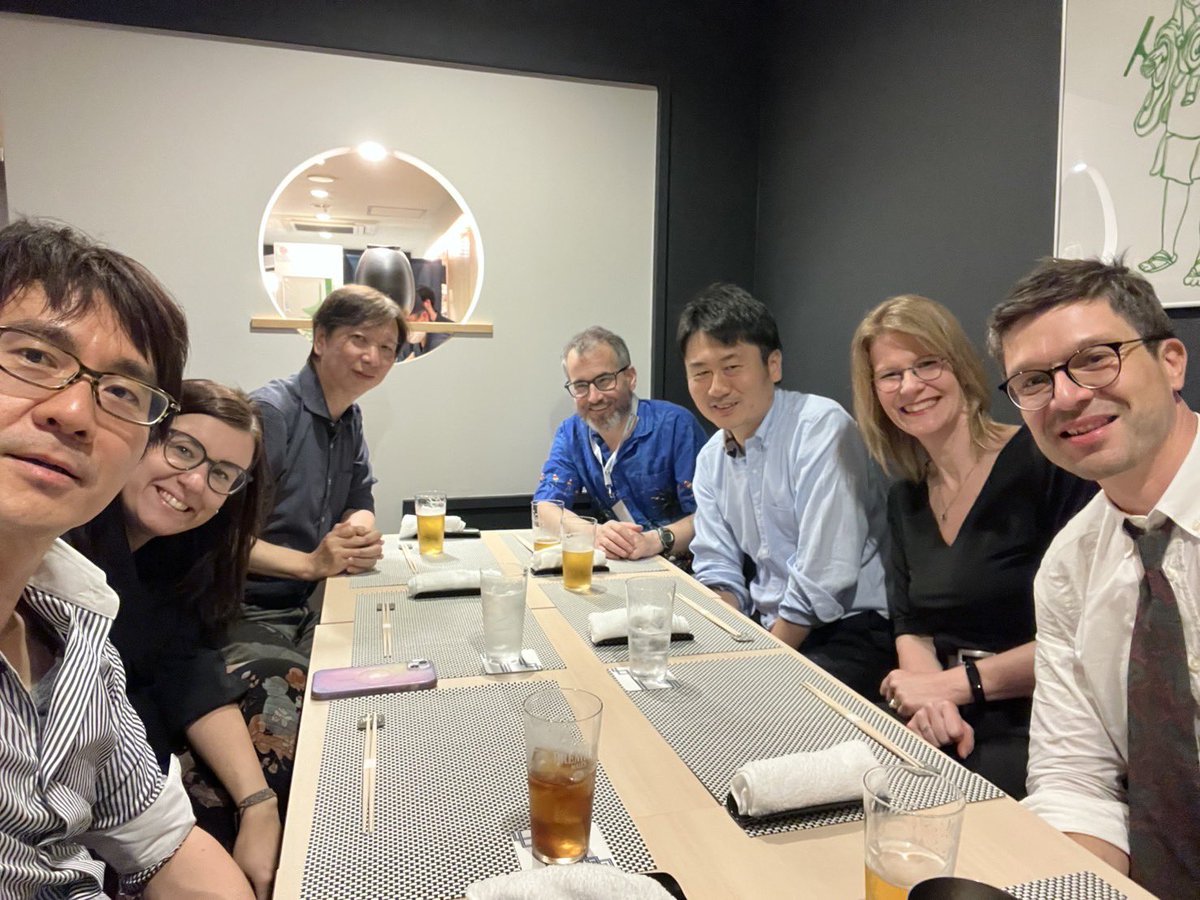
A true community effort ! The Martini 3 Lipidome: Expanded and Refined Parameters Improve Lipid Phase Behavior | ACS Central Science https://t.co/IubUxR8I6Q
A true community effort ! The Martini 3 Lipidome: Expanded and Refined Parameters Improve Lipid Phase Behavior | ACS Central Science https://t.co/IubUxR8I6Q
Metals owe their properties to how local defects emerge & amplify in collective dislocations under stress.🛠️
👉We show how tracking local atomic fluctuations & their space&⏱️correlations allows tracking metals' behavior through the elastic&plastic phases🚀
https://t.co/XgdUosXWU0
This provides a general data-driven approach for studying the internal physical behavior of metallic (but also other types of) systems just building on the abstract concepts of fluctuations & spatio-temporal fluctuations' correlations. 🤯🤩
How much complexity is needed in self-assembling molecular systems to observe non-trivial emergent behaviors typical of more complex, higher-scale systems?🤯
Not much!😲
See @NatureComms our work on the collective resilience of supramolecular polymers!🚀
https://t.co/iQGTgj0vQW
In non-cooperative systems, all entities populating them suffer comparably from external perturbations.
In cooperative systems (with internal "interactions-avidity"), the stronger units survive at the expense of the weaker ones!🤯
@MarioBarbatti Great paper! And thank you @MarioBarbatti for including our work on defects & dynamics of supramolecular polymers! https://t.co/luVJXQQG7c
🤫 you can get a better universal #machinelearning potential by training on fewer than 100k structures. too good to be true? head to arxiv:2503.14118, to the atomistic cookbook, or to the better science social if you want to find out more about PET-MAD. 🧑🚀 over and out 👋
#LEAP is out @PNASNexus!🚀
Building on abstract concepts of local fluctuations & their correlations in space & ⏱️, #LEAP provides info on the physics of complex dynamical systems from the atomic- to the macro-scale in agnostic & purely data-driven way!🤩
https://t.co/Rs7HtD5IRv
#LEAP analyses are agnostic & require just that a trajectory of the building blocks constituting the complex dynamical system is available.
Useful to explore complex dynamical systems whose physics is unknown a priori & to revisit well-known phenomena under a new perspective.🤯
#LEAP allows to:
1) Detect relevant fluctuations in noisy trajectories
2) Classify fluctuations in classes based on their physics
3) Identify correlations in space & time between fluctuations
4) Unveil local & collective events, their correlations, causal relationships, etc.