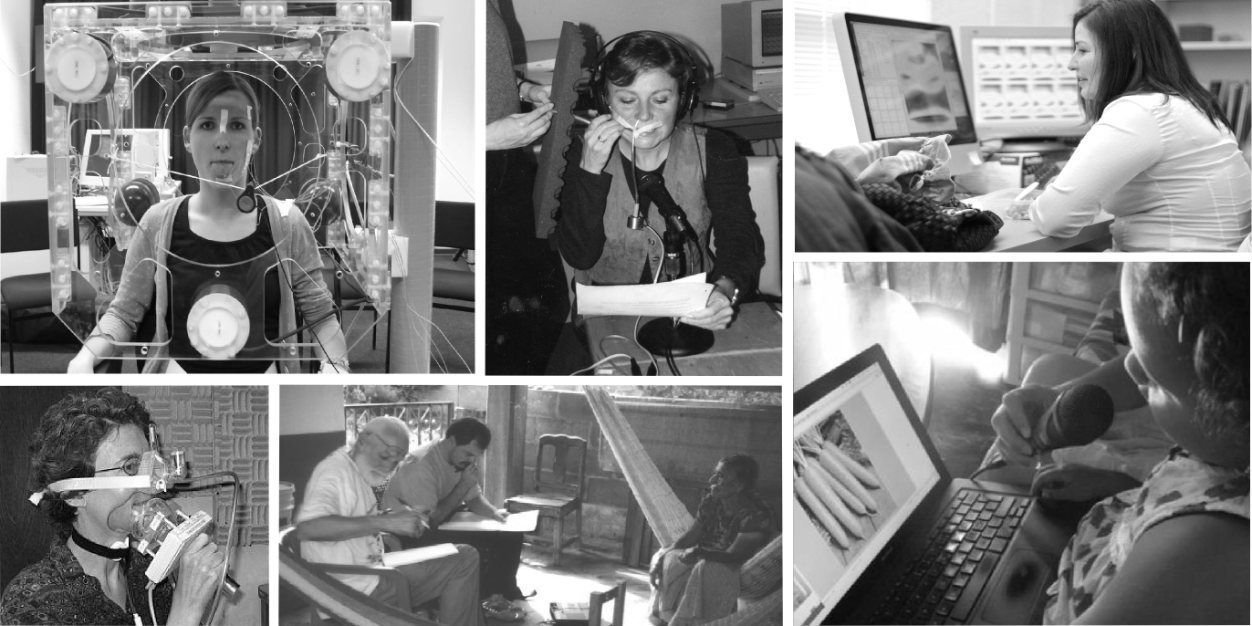
We're delighted to announce that #LabPhon20 will be held in Montréal, Québec, Canada, in the (North American) summer of 2026, with the theme “Looking back and looking forward.” Dates, thematic sessions, invited speakers, and more will be announced by the organizers. #LabPhon
How marginal can phonological contrasts be? In Zongozotla #Totonac, phonation type and glottal stops are phonologically contrastive, but they are weakly differentiated phonetically and the glottal stops only surface phrase-finally. #LabPhon#openaccess https://t.co/j9DPmP4ThW
Vowel & consonant duration vary inversely in Australian #Yolngu language Djambarrpuyŋu, so what’s contrastive? A pair of production & perception studies show that V length is contrastive, though both V & C duration influence perception #LabPhon#openaccess https://t.co/UgZiXuASLB
Most models of #word recognition assume that the input is faithful to the #phonological specifications in the #lexicon, but this is not always the case. How does word recognition work in such unusual cases? #Mawng#Iwaidja#lenition#LabPhon#openaccess https://t.co/OlXjz1UOD8
How does dialect exposure affect perceptual adaptation to a novel vowel shift? New results from regional US dialects explore listeners' behaviors via lexical decision tasks to understand the mechanisms governing generalization ability. #openaccess#LabPhon https://t.co/usGaCaozSa
In #Chicago the #vowels LOT/THOUGHT are in flux—how do speakers maintain their contrast? Articulatory & perceptual results show that lip rounding, not necessarily tongue position, provides auditory & visual differentiation. @jhavenhill#openaccess#LabPhon https://t.co/rMyRi9j1hW
Linguists have often observed prosody-syntax interactions in #informationstructure marking, but do speakers rely less on #prosody when #clefting can mark focus? In #Mandarin, such tradeoffs aren't found in production or perception: https://t.co/hl8WzLh3aJ #LabPhon#openaccess
In word shadowing tasks, do participants imitate formant frequencies or vowel shifts? Given the Northern Cities Vowel Shift, talkers imitate normalized phonetic properties of NCVS vowels, not the model talker's high F1,F2 frequencies. #openaccess#LabPhon https://t.co/tEyoyKEh4u
Prosody encodes multiple types of information simultaneously. How do focus & constituency interact to shape prosody in speech production? Results from #Mandarin & #English suggest they are encoded orthogonally via F0, duration, dB. #openaccess#LabPhon https://t.co/AV6srlThkZ
How is phonological alternation represented in the brain? Analysis of brain event-related potentials during processing of lexical tone alternations in #Cantonese and #Mandarin links cross-linguistic differences to lexical distribution. #LabPhon#openaccess https://t.co/73hrLPj3YJ
Is Lyman’s Law sensitive to a distance-and-decay effect, as observed for dissimilation in other languages? New research by @PhoneticsKeio shows #rendaku in #Japanese is sensitive to a locality effect, despite an absence of lexical evidence. https://t.co/TUu0SWVhZi #openaccess
How can researchers diagnose whether word #stress is stored lexically? A comparison of listeners' stress recall ability across #PapuanMalay and #German highlights perceptual differences in fixed-stress and free-stress systems. #LabPhon#openaccess https://t.co/5HeNCnD0nd
Is #wordstress stored as an abstract structure in our minds, or instead as #phonetic detail? In this #LabPhon article, speakers choosing #stress for novel words are influenced by abstract, not phonetic, stress patterns of previous novel words. #openaccess https://t.co/NdglBR7w4z
Can syllable weight & word minimality distinguish metrical structure in #English & #Portuguese? Experimental analysis reveals significant representational differences, w/robust support for metrical feet in English but not Portuguese. #LabPhon#openaccess https://t.co/UHrnhDSlGu
How reliable is #remote recording for #prosody research? @congprosody's new #LabPhon study compares acoustic features over time for a lab-quality recorder vs three #remote options using #dynamic methods. Read more to learn its recommendations! #openaccess https://t.co/NvZ6klRTAR
Can we signal prosodic #prominence when we speak loudly? A new #LabPhon article by members of the @SpeeDy_Lab explores the flexibility and robustness of #articulatory and #acoustic signatures of focus structure across speaking styles. https://t.co/MfI5Q1mdV7 #openaccess
How much do you know about an utterance before you speak it? An eye-tracking study shows that #Estonian speakers' knowledge includes phrasal structure & words, enabling them to adjust pitch in long utterances even on the first word. #LabPhon#openaccess https://t.co/PmmnzQ1YWY
Do British choirs sing with an #SSBE accent?
@E_JMarshall @jhstuartsmith & @Beniskeys analyze #classical#choral#singing to show that front vowels lower & retract over the 20th century, while Scottish choirs use SSBE vowel phonology. https://t.co/GKn0I2dMfh #openaccess#labphon