

Top Tweets for #LabPhon20

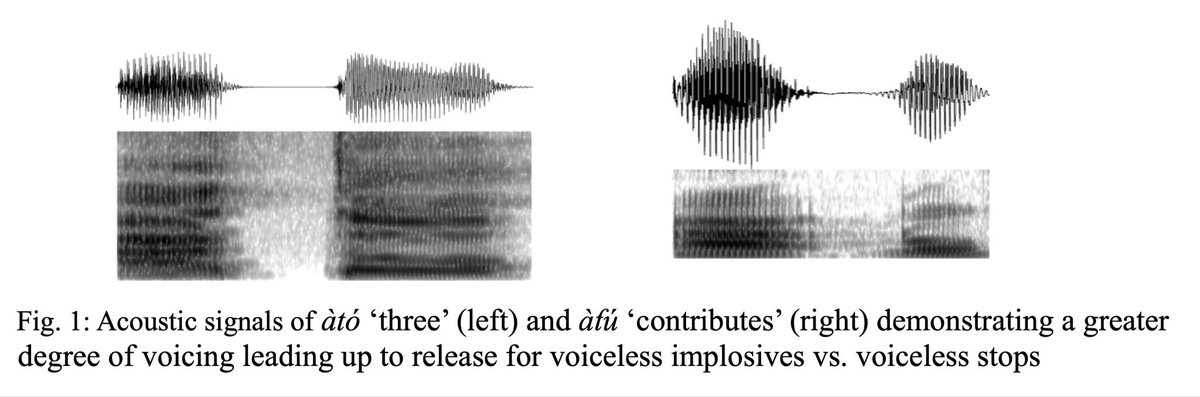
PhD candidate Vincent Nwosu and his co-supervisor Harvard prof. Katie Franich presented “Cross-dialectal incomplete neutralization in Igbo implosives” at https://t.co/mKROiLG6uE #LabPhon20



Huge kudos to @UCalgaryLing PhD candicate Vincent Nwosu @nwosuvincent and his co-supervisor @Harvard prof. Katie Franich on organizing the satellite workshop “Pitch at the Crossroads: Experimental Approaches to the Language–Music Connection” at #LabPhon20 https://t.co/zlgaGDjtuM
“Rethinking the source-filter theory” by Susanne Fuchs (June ’26) https://t.co/GasWezWuVw #LabPhon20

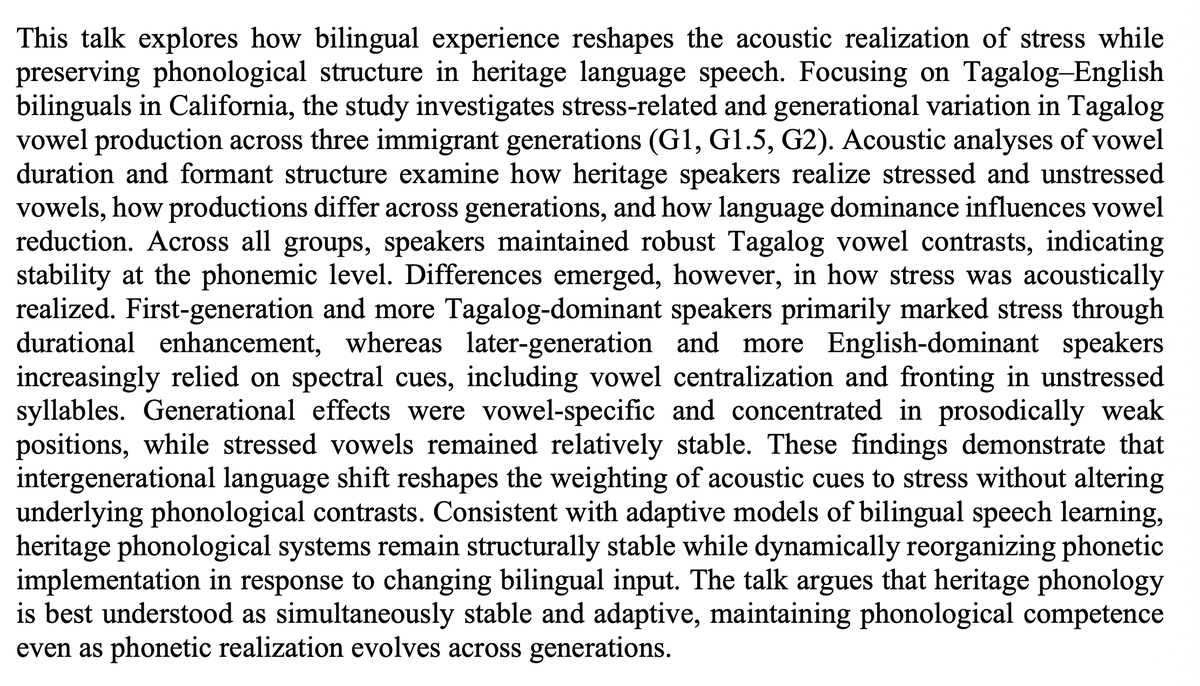
“Cue weighting and the acoustic realization of stress in heritage Tagalog” by Mark Amengual (June ’26) https://t.co/GasWezWuVw #LabPhon20
“Co-speech gesture as evidence for prosodic planning and as a resource for fieldworkers,” invited talk by Katie Franich at https://t.co/GasWezWuVw #LabPhon20
Recent LabPhon and Glossa articles by Franich, Nwosu (@nwosuvincent) and Keupdjio below!
Photo by Charles B. Yang:


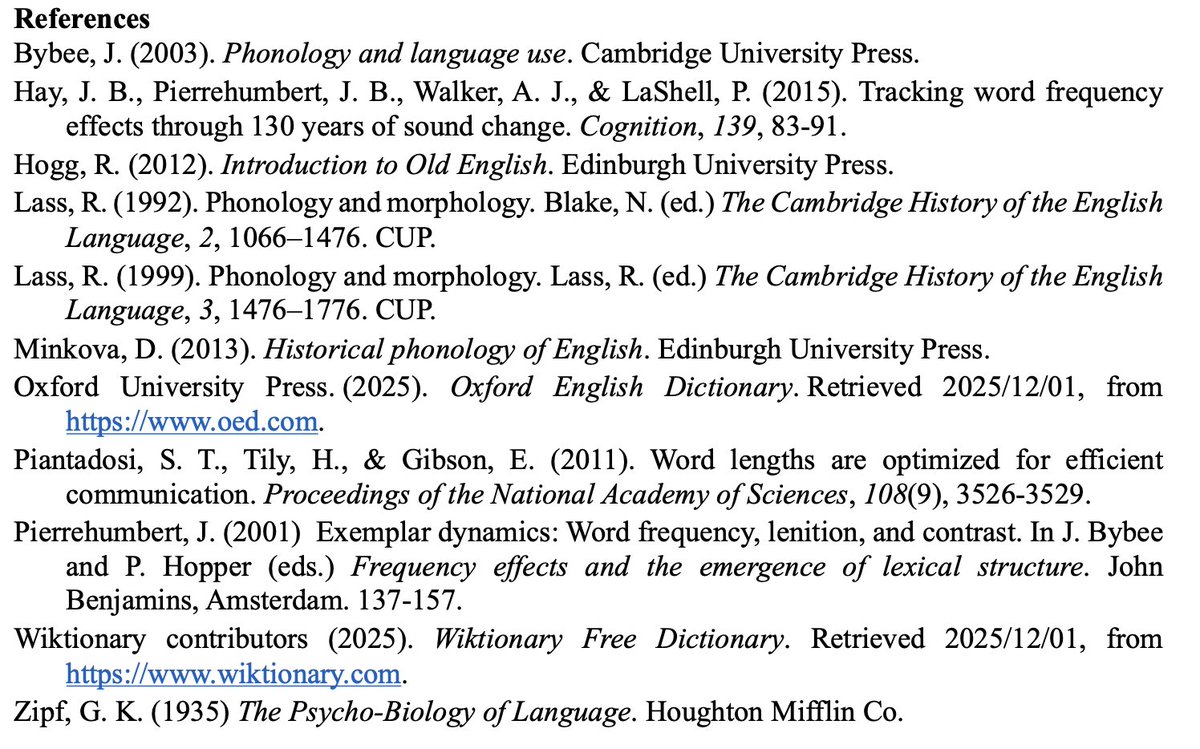
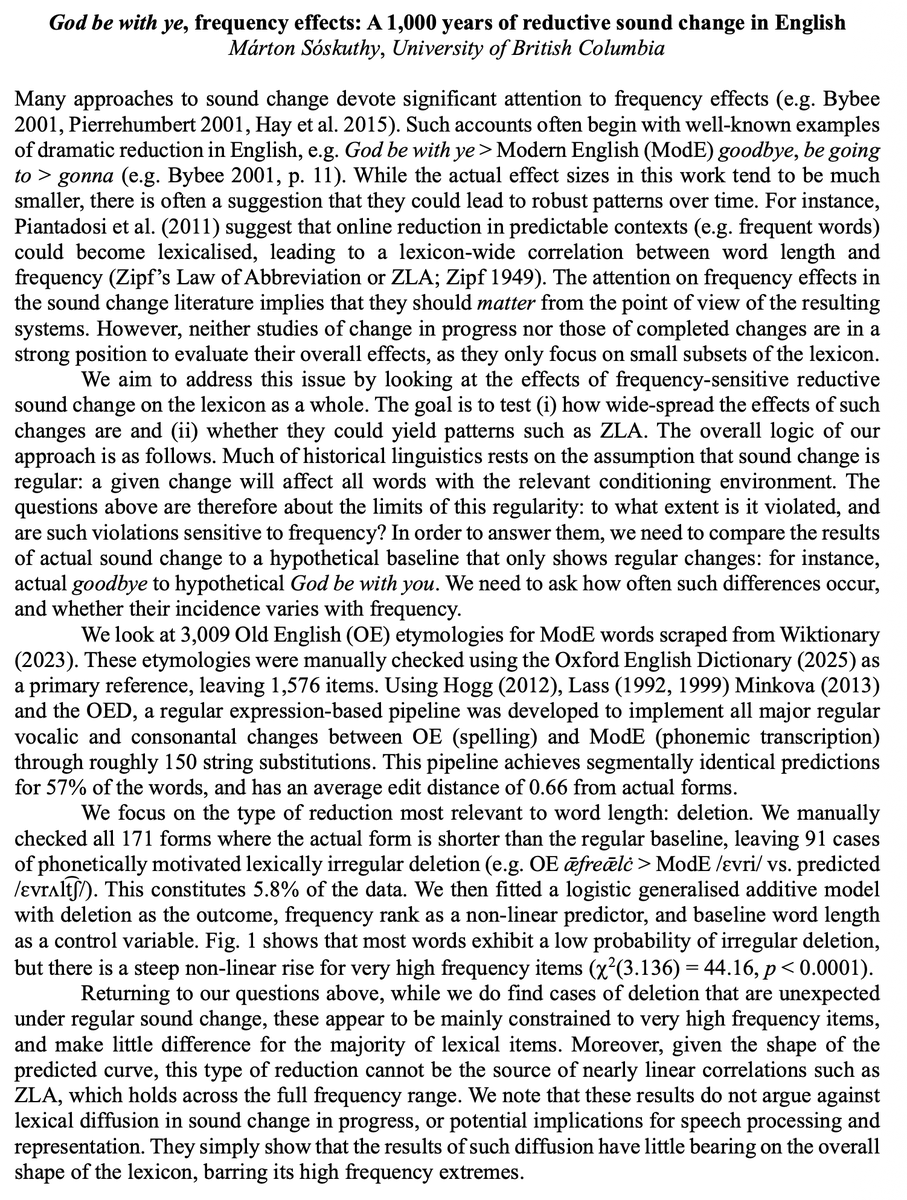
“God be with ye, frequency effects: A 1,000 years of reductive sound change in English” by Márton Sóskuthy (June ’26) https://t.co/8vDBl9oZy5 #LabPhon20
(Good) bye < ... < God be with you
Data and code: https://t.co/OIfv8SxyRD

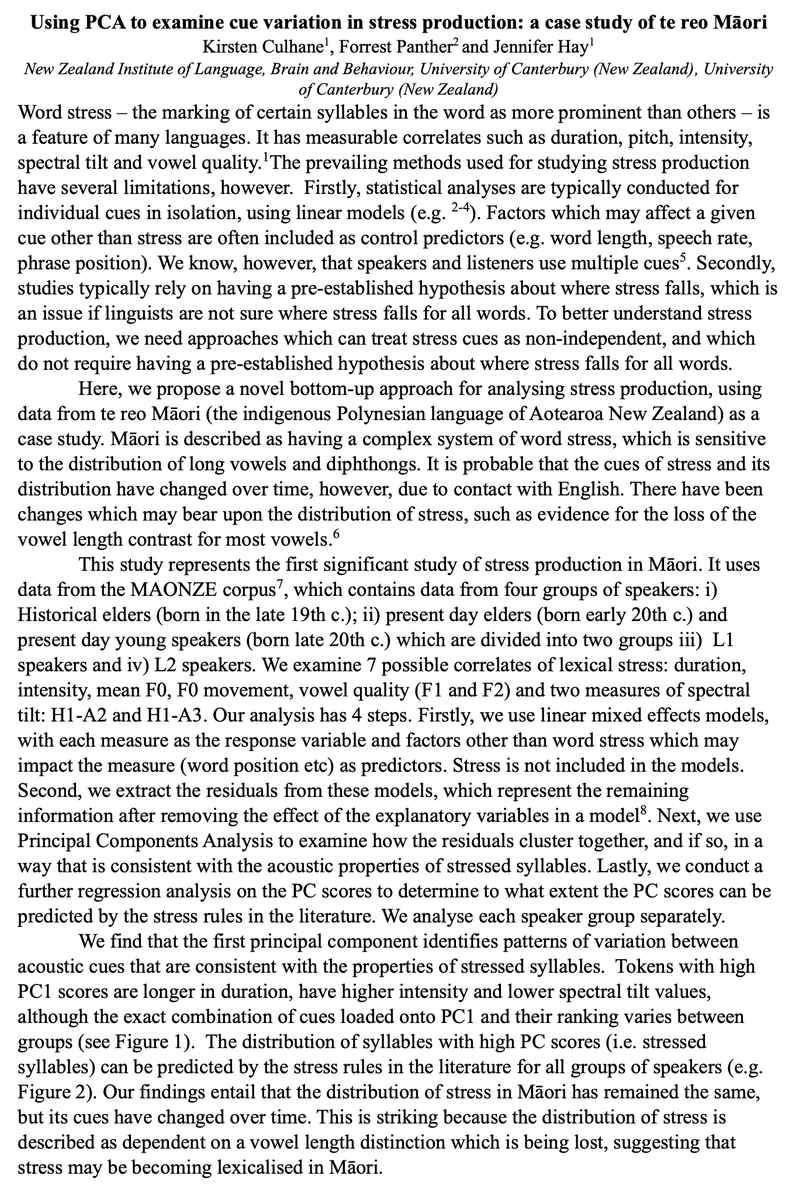
So cool: “The functional status of f0 shapes the neural encoding of English stop voicing contrasts: Evidence from Korean and English listeners” by Chao Han, Yoonjung Kang, Juhyung Cho, Tae-Won Lim, Say Young Kim and Philip J. Monahan (June ’26) https://t.co/8vDBl9oZy5 #LabPhon20


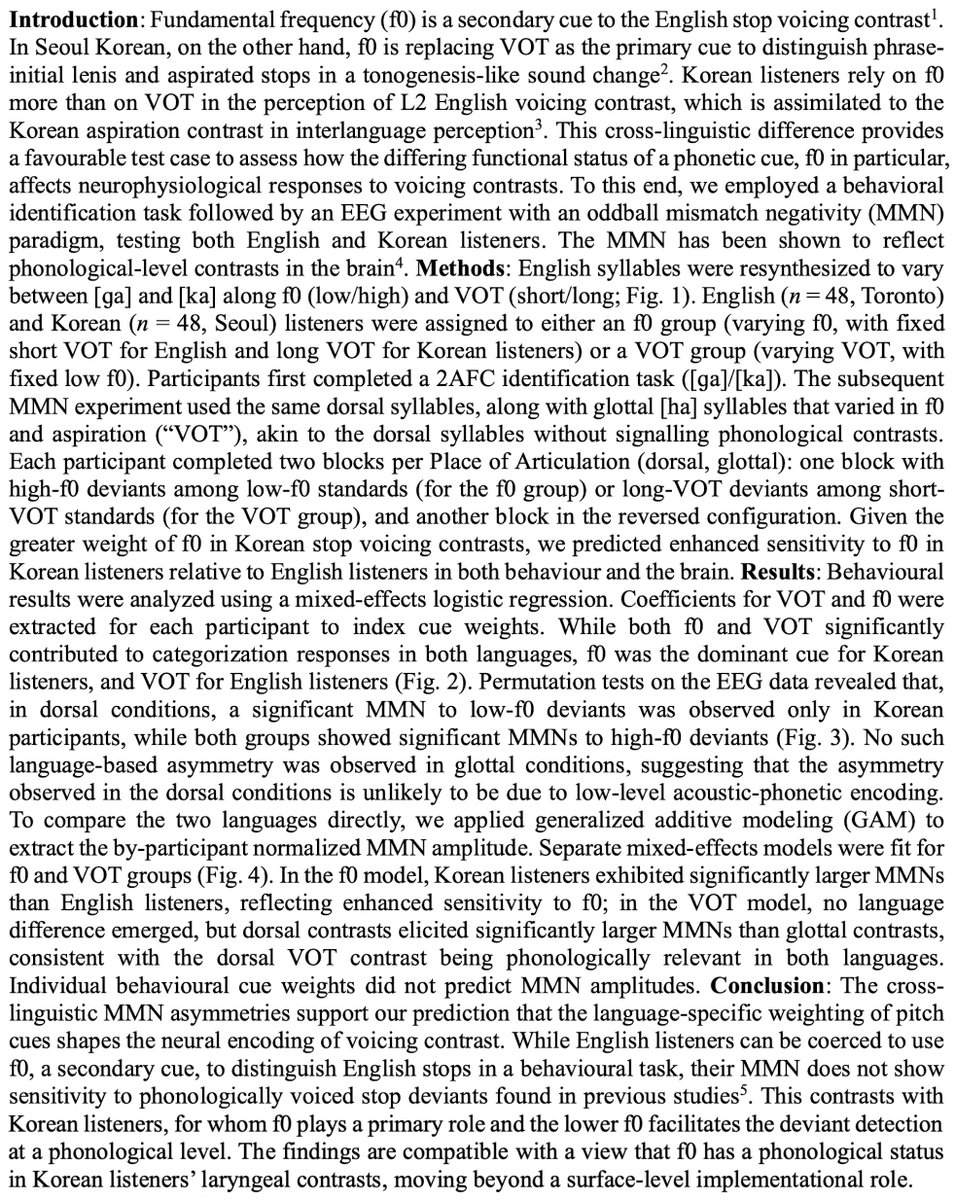
“Does opacity allow recoverability? A processing view of Canadian Raising” by Ashley Farris-Trimble, Anne-Michelle Tessier and Danica Reid (June ’26) https://t.co/GasWezWuVw
Cool study/results. Betteridge’s law holds for nonce words. #LabPhon20


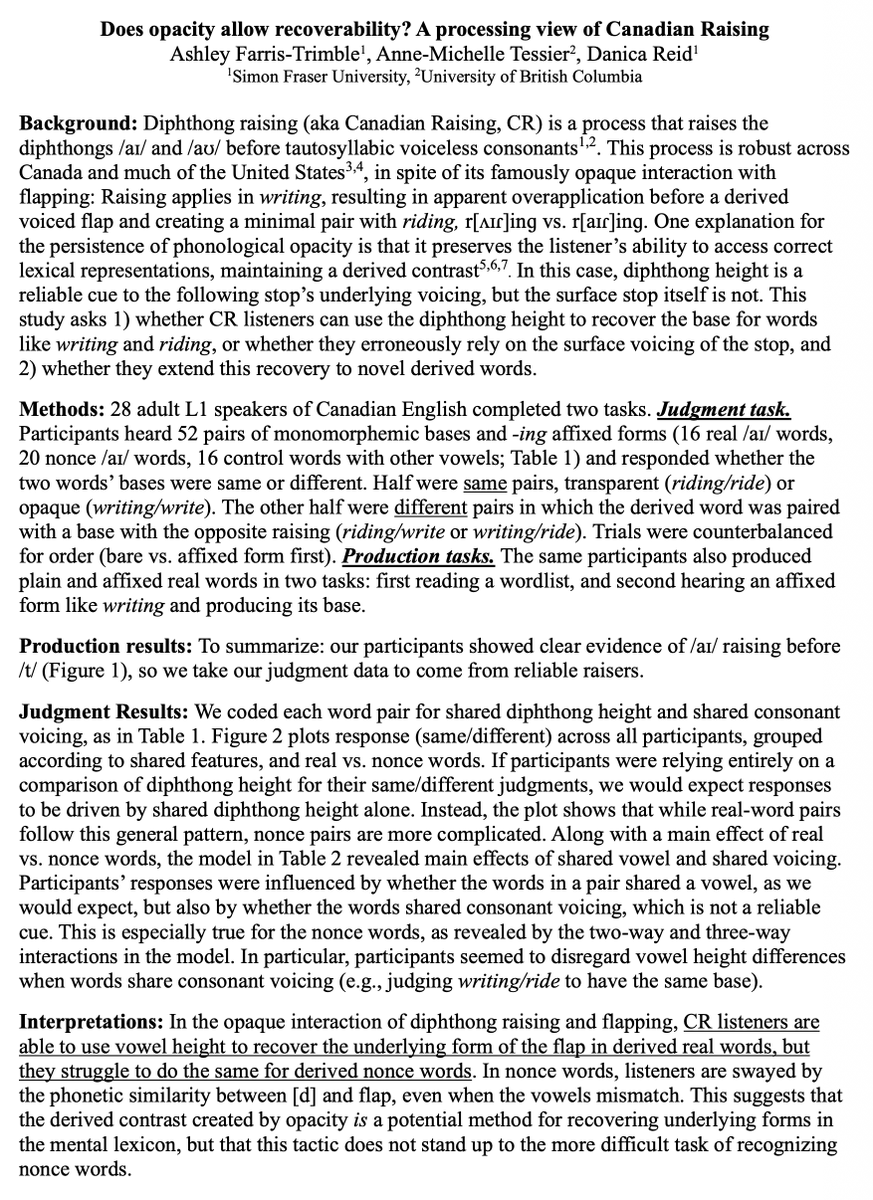
“Using PCA to examine cue variation in stress production: a case study of te reo Māori” by Kirsten Culhane, Forrest Panther and Jennifer Ha (June ’26) https://t.co/GasWezWuVw
“This study represents the first significant study of stress production in Māori.” #LabPhon20


“Articulatory evidence for ambisyllabicity: a modern approach to an old question” by Sam Tilsen (June ’26) #LabPhon20


“From Universals to Variation: Phonetic Grammar through Prosody” by Taehong Cho (June ’26) #LabPhon20

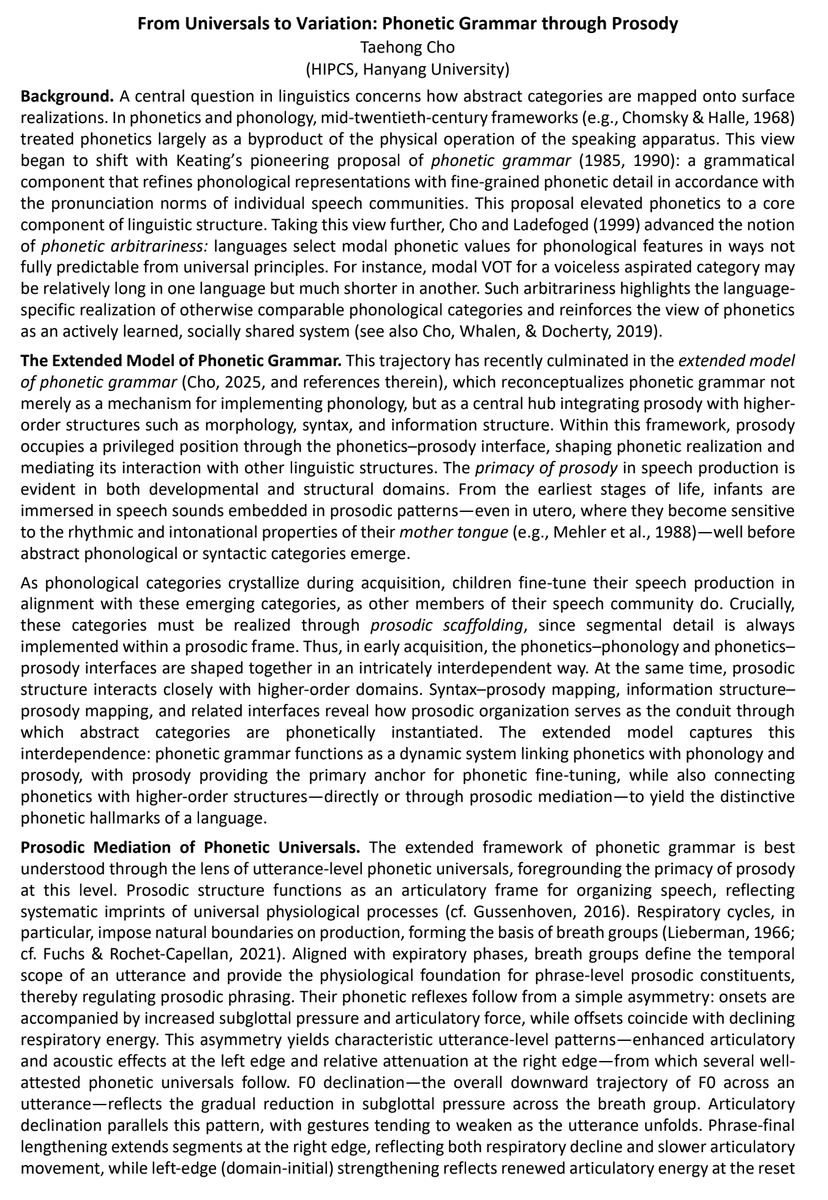
“Prof. Taehong Cho (Hanyang U.) kicks off #LabPhon20 with a pre-conference lecture going ‘From Universals to Variation: Phonetic Grammar through Prosody’” –Charles B. Yang, @CityUHongKong


#CfP Call for Papers 📌🗓️🗣️🗣️🗣️🗣️
#LabPhon20 Satellite Workshop (#Montréal, #Canada)
Whistled Languages of the World: Phonetic, Phonological, and Neurocognitive Insights into an Alternative Speech Modality - June 29, 2026.
Date: Monday, 29 June 2026 (full day) (LabPhon20 satellite workshops take place on June 25 and June 29, 2026).
Location: Montréal, Québec, Canada (LabPhon20: June 26–28, 2026).
Workshop webpage (info & updates):
Description : Whistled languages offer a natural laboratory for studying how human speech can be acoustically reduced yet remain intelligible. This interdisciplinary workshop explores their phonetic, phonological, and neurocognitive dimensions across the world—from Greek Sfyria to Silbo Gomero and Tashlhiyt Berber. By integrating acoustic analysis, typology, and recent EEG and behavioral findings, the meeting investigates how left- and right-hemispheric processes cooperate in decoding melodic speech signals. Bringing together researchers in laboratory phonology, cognitive neuroscience, and music perception, this event aims to advance our understanding of how linguistic structure adapts to an alternative auditory modality.
https://t.co/2A7C8DdSSw
Organizers
Michela Russo (CNRS SFL / Université Paris 8 & Université Lyon)
Sophia Katsiouris (Université Paris 8; CNRS SFL)
Keynote speakers (2 × 1 hour)
• Rachid Ridouane (LLP, CNRS Paris, in collaboration with Julien Meyer, GIPSA-Lab, Grenoble)
Whistled speech in Tashlhiyt: Perspectives on phonetic and phonological structure
• Fanny Meunier (BCL, CNRS, Nice)
From Music to Speech: The Impact of Musical Training on the Perception of Whistled Speech
• Scope
Whistled languages constitute a remarkable natural experiment in speech reduction and adaptation. By transposing segmental and prosodic cues into a narrow-band acoustic signal (roughly 0.9–4 kHz), they reveal how linguistic structure can remain intelligible under extreme physical constraints. Found across diverse linguistic families (e.g., Greek sfyria, Spanish Silbo Gomero, Tashlhiyt Berber, Turkish Kuşköy, Mazatec Oaxaca), whistled systems provide an exceptional window into phonetic encoding, phonological abstraction, and hemispheric specialization / brain lateralization in speech processing
Building on recent advances in experimental phonetics and neuro-phonology, the workshop aims to bring together phonetic, phonological, and neurolinguistic perspectives on whistled languages, comparing tonal and non-tonal systems and exploring their implications for models of speech perception, hemispheric cooperation, and phonological representation.
We welcome submissions on (non-exhaustive list):
• Typology of whistled languages: Tonal vs non-tonal systems
• Acoustic/phonetic encoding (e.g., formant-to-harmonic mapping, segmental loci)
• Production, aerodynamics, and articulatory strategies in whistling
• Perceptual categorization, intelligibility, learning, and expertise effects
• Speech–music interface (including musical training advantages)
• Neurocognitive/neurolinguistic approaches (EEG/MEG/fMRI; hemispheric specialization)
• Documentation, endangerment, revitalization, corpora, tools, and field methods
Contributed talks: 30 minutes total (recommended: 20 min talk + 10 min discussion)
• The program will be balanced across phonetics, phonology, and cognitive/neuro approaches.
Panel discussion uniting phonologists, phoneticians, and neuroscientists on “How hemispheric specialization adapts to alternative speech codes.”
Submission guidelines
• Extended abstract: max. 2 pages, including references (PDF)
• Please include: title, research question(s), data/methods, main results, and key references.
• Submission email: [email protected] & [email protected]
Important dates
• Abstract deadline: 16 March 2026
• Notification of acceptance: 31 March 2026
Questions
For queries about fit, accessibility, or scheduling constraints, contact the organizers: [email protected] & [email protected] - @cnrs @CNRSshs
https://t.co/2A7C8DdSSw

We're delighted to announce that #LabPhon20 will be held in Montréal, Québec, Canada, in the (North American) summer of 2026, with the theme “Looking back and looking forward.” Dates, thematic sessions, invited speakers, and more will be announced by the organizers. #LabPhon
The Association for #LabPhon welcomes bids to host #LabPhon20, in 2026. The 20th Conference on Laboratory Phonology will be a special occasion to mark almost 40 years since its inception in 1987. 🥳 Guidelines for preparing an institutional bid are here: https://t.co/cizr7GTKi4

Last Seen Hashtags on Sotwe
minichatt
Seen from Netherlands
MGAI((((*))))** filter:videos()
omegle
Seen from Argentina
ryma officiel
Seen from Netherlands
unexpected filter:Videos
Seen from United States
anxiouspandaa
Seen from United States
nsfwtwtًً
Seen from United States
Jeanspoop
Seen from Korea
MGAI (**)*******+filter:native_video
Seen from Japan
Trends for you
Most Popular Users

Elon Musk 
@elonmusk
241.5M followers

Barack Obama
@barackobama
118.8M followers

Cristiano Ronaldo
@cristiano
114.5M followers

Donald J. Trump
@realdonaldtrump
111.8M followers

Narendra Modi
@narendramodi
107.1M followers

Rihanna
@rihanna
98.7M followers

NASA
@nasa
92.3M followers

Justin Bieber
@justinbieber
91.8M followers

KATY PERRY
@katyperry
90M followers

Taylor Swift
@taylorswift13
84M followers

Lady Gaga
@ladygaga
75.5M followers

Virat Kohli
@imvkohli
73.5M followers

Kim Kardashian
@kimkardashian
70.9M followers

YouTube
@youtube
68.8M followers

Neymar Jr
@neymarjr
66.5M followers

Bill Gates
@billgates
65.3M followers

Selena Gomez
@selenagomez
63.1M followers

The Ellen Show
@theellenshow
62.2M followers

CNN
@cnn
61.7M followers

X
@x
60.7M followers