Good evening Twitter World!
This is the new account of the MBBLab @LabSantama at the @UCYOfficial
Please visit and enjoy our new Website https://t.co/SuOAIWmwNt
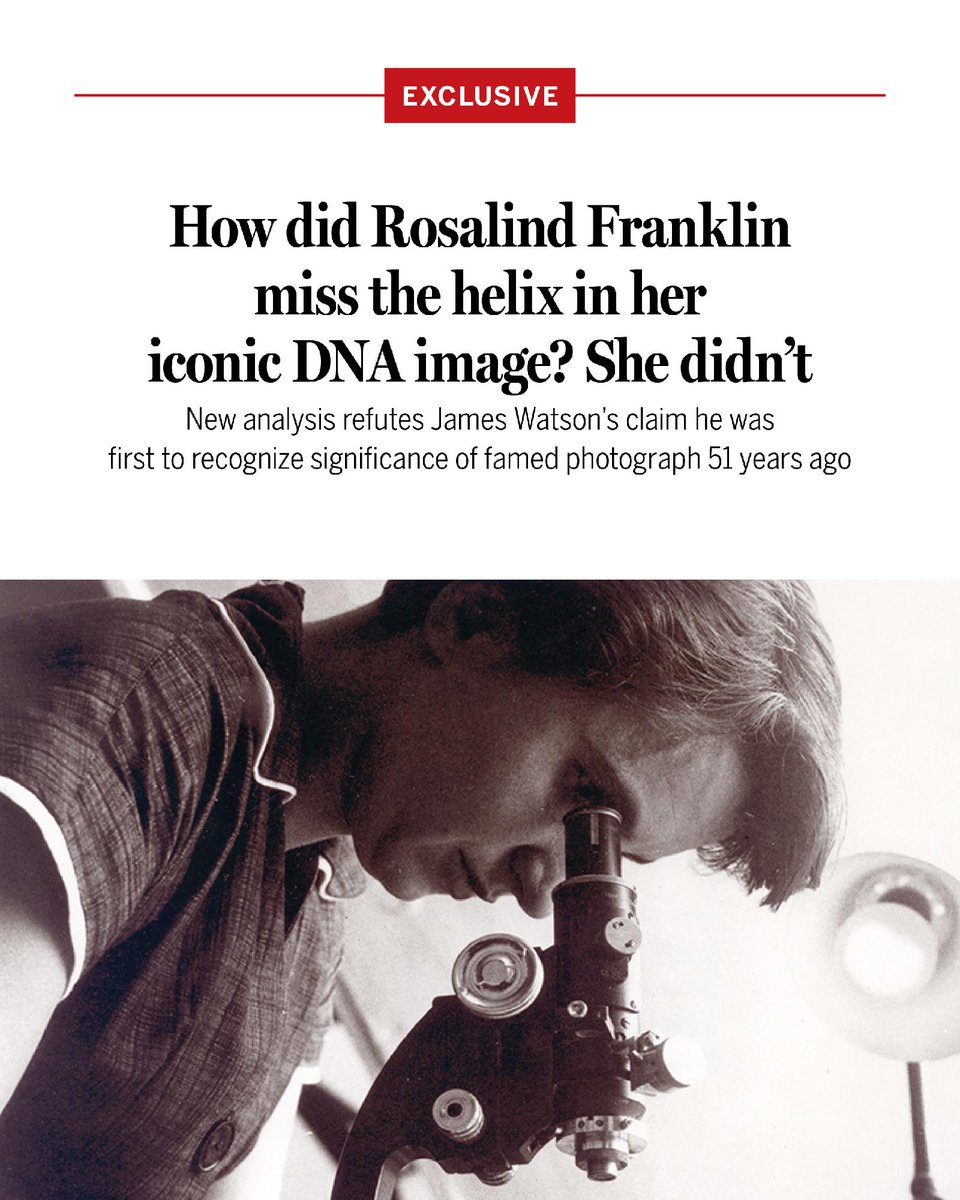
Exclusive: “The instant I saw the picture my mouth fell open and my pulse began to race.” So wrote James Watson in The Double Helix: A Personal Account of the Discovery of the Structure of DNA, his controversial account of how he and Francis Crick deciphered the structure of DNA in 1953.
The image, now known as photograph 51, showed an elegant, symmetrical pattern of spots formed by x-rays diffracted from strands of DNA—the fingerprint of the molecule’s helical structure.
Rosalind Franklin, an x-ray crystallographer, had produced the image in the spring of 1952. But Watson’s 1968 book, amid other slights and sexist language directed at Franklin, implied the flash of insight was his alone.
Popular accounts still routinely suggest Franklin missed the significance of the photo. She never had a chance to challenge Watson’s dismissive narrative; she died of cancer in 1958, a decade before his memoir was released and became a bestseller.
But a new analysis of her notes on another x-ray image, which she made just days earlier using the same DNA sample, offers a firm rebuttal.
Learn more: https://t.co/M7Jm1ykMkT
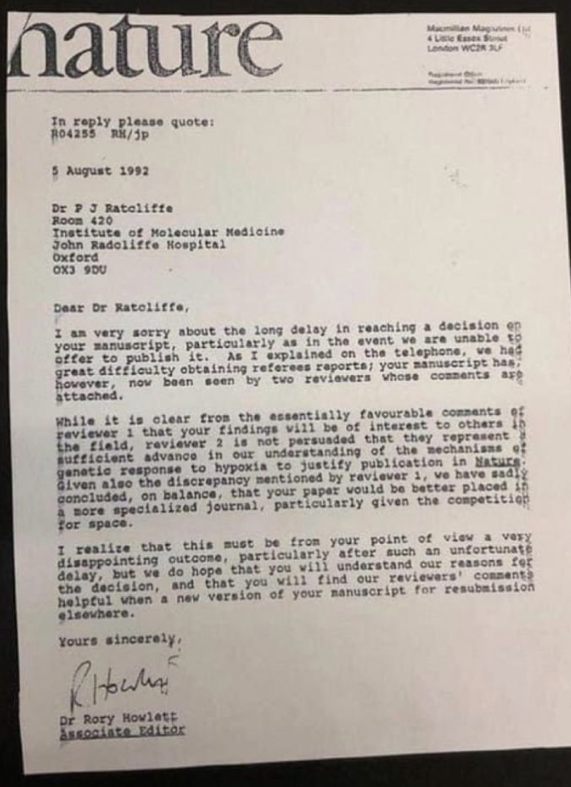
In 1992 Peter Ratcliffe received this rejection from Nature.
Almost 30 years later he won the Nobel Prize for the same discovery.
Don't lose faith in the things you believe in.
🏅Congratulations to all the new Nobel Prize laureates in Physiology or Medicine!
The European Research Council has supported Prof. Peter Hegemann with two substantial grants since 2016.
#EUfunded
🇪🇺
I (fondly) remember as a TA insisting Berkeley undergrads memorize the Krebs cycle and OxPhos ('it's good for your soul,' id say). We'd draw the Krebs cycle as a loop floating free in the mitochondrion, and the respiratory chain as a separate machine in the membrane. In one organism they are bolted together.@VamsiMootha
https://t.co/8vjO6r2RZz
Unpopular opinion: the age of omics and high throughput data in Biology took us away from very good fundamental questions.
The omics failed to have outsized returns as they were thought to and now we have a generation that’s trained to not think simple.
Interested in nuclear mechanobiology and want to know what some of the big open questions are in the field?
Read our recent editorial with input from >15 leading experts in the field, along with a list of review articles on nuclear #mechanobiology:
https://t.co/UVviaxBTTT
Everyone who has worked in a lab has wasted days trying to make a “bad antibody” work. Every lab has a box of “bad antibodies” that never performed as promised. But what if the problem wasn’t your technique, it was the catalog itself?
Researchers have now uncovered roughly 18,000–19,000 manipulated antibody validation images across ~17,500 products. The cost isn’t just a $200 antibody and a week of bad Western blots. It’s graduate students and postdocs wasting crucial years chasing irreproducible results, discoveries delayed or never made, and potentially drugs entering clinical trials because the underlying biology was wrong.
We’re all paying for this massive fraud whether you’ve ever pipetted or not.
🔬🔬🔬
A cell size-dependent competition between geometry and polarity governs nuclear and spindle positioning in early embryos @CurrentBiology
https://t.co/M6kFeuWIg5
Akayama, Shima, Nakamura et al. show that TFEB is regulated by at least two different regulatory mechanisms during lysosomal damage: ATG conjugation system–dependent/independent regulation. https://t.co/tLQUnYQuRX
📕 In #Lysosomes 2026: https://t.co/mnZjkDUr8z
📣 ERC Plus Grant - New grant scheme 📣
🔸Up to €7 million
🔸Supports transformative research
🔸Aimed at outstanding researchers
🔸Seeks to attract and retain top talent in Europe
🔸~30 ERC Plus Grants each year
More info: https://t.co/oPgqdBJkMi
#ChooseEurope#ERCPlus
Fabricated citations: an audit across 2·5 million biomedical papers
The fabrication rate increased more than 12 times between 2023 and early 2026.
Possible causes: Paper Mills, AI use etc
https://t.co/ddCHLW6kv7
Experienced researchers are less likely to produce ‘disruptive’ science than are those just starting their careers, finds an analysis of the scientific papers published by 12.5 million researchers over 60 years.
https://t.co/b3L5aP3AWw
A new mechanism for “RNA memory”! 😱
Thrilled to share another crazy paper from the lab (can’t believe we posted 2 in 2 days!), summarizing >10 years of research:
Work on transgenerational inheritance of small RNAs in the powerful model organism C. elegans changed how we think about what’s possible in inheritance and evolution, because it allows the most heretical thing: inheritance of parental responses to the environment! However, it’s still unclear whether RNAs are inherited across generations in other animals, largely because the RNA-dependent RNA polymerases that amplify heritable small RNAs and prevent their dilution in C. elegans are not conserved in mammals.
In this new work, an amazing collaboration with the Rink and Wurtzel labs, we show that planarians establish long-lasting and heritable small RNA–based gene regulatory states despite lacking canonical RNA-dependent RNA polymerases and nuclear RNAi machinery (that are required in C. elegans).
You might say “they are both worms…” BUT planarians are evolutionarily very distant from C. elegans (flatworms vs. roundworms, diverged more than 500 million years ago), making this particularly surprising. These are totally different animals.
We find that ingestion of double-stranded RNA induces sequence-specific silencing that persists for months and survives repeated cycles of whole-body regeneration. Even more strikingly, RNAi can be transferred between animals, echoing James V. McConnell’s controversial “RNA memory” experiments from the 1970s (his lab was targeted by the Unabomber terrorist Ted Kaczynski, who sent McConnell a bomb. This and other controversies ended this line of experiments…)
Mechanistically, we find that the response transitions from a transient systemic dsRNA-triggered phase to a stable, cell-autonomous post-transcriptional “memory phase” maintained by antisense small RNAs. Using a new luminescence reporter (transgenesis is currently impossible in planarians), we show that silencing spreads along the targeted gene and identify a weird type of planarian small RNAs with untemplated polyA tails.
RNAi inheritance without canonical RdRPs establishes planarians as a powerful system for studying RNA-based regulatory inheritance beyond C. elegans and raises the possibility that RNA-mediated inheritance may be more broadly conserved in animals, potentially even in mammals.
Here’s a video of a planarian that is treated by RNAi against β-catenin and develops multiple heads instead of just one. This is one of the phenotypes that is inherited. Another phenotype is “loss of eyes” (which we show is not only inherited across multiple regeneration cycles, but can also be transmitted between animals in transplantation experiments).
Amazing work led by first authors Prakash Cherian and Idit Aviram (co-supervised by Omri and me).
Please read the preprint, the link is in the next tweet, and share!
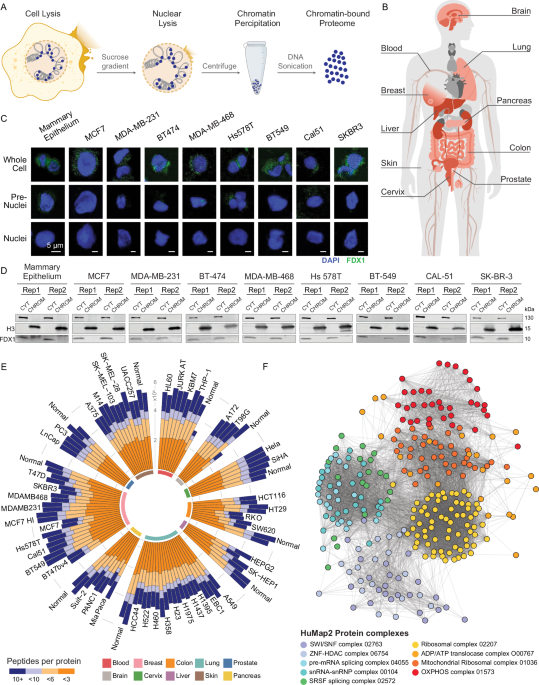
A recent study in Nature Communications reveals over 250 metabolic enzymes located directly on chromatin, a discovery that vastly expands the previously known count of only about 20.
https://t.co/8ucPDDVX01
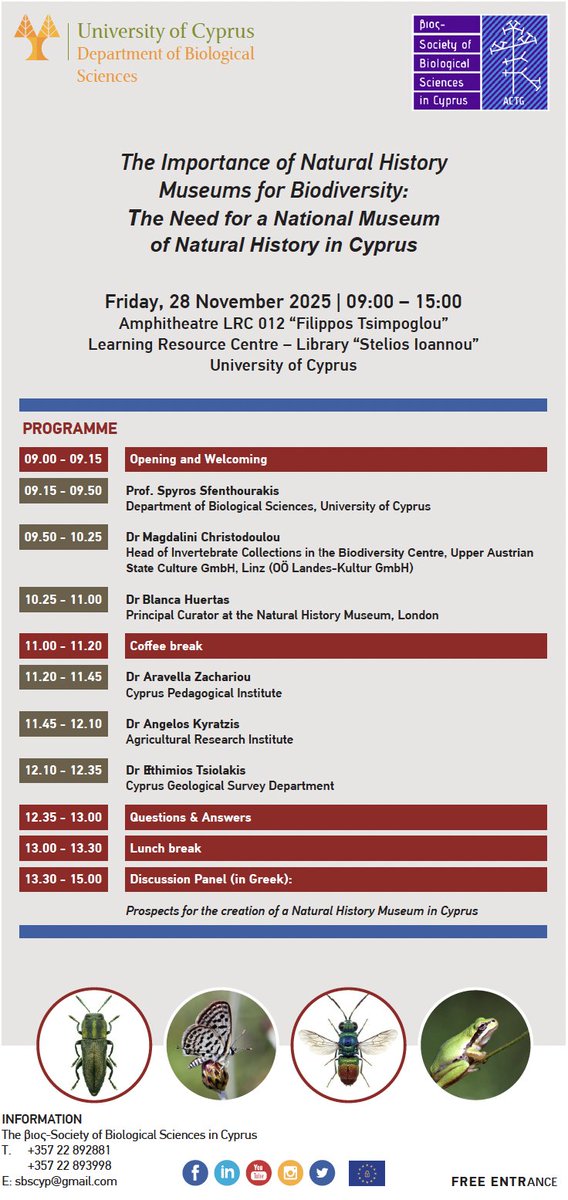
The βιος-SBSCy 2nd national conference this Friday 28/11 is not to be missed. A natural history museum in Cyprus?
Open to everybody, free entrance. At the University of Cyprus Library, auditorium LCR 012!
Read this inspiring perspectives coauthored by the Worm Resource directors and worm Nobel Laureates! 4 Nobel Prizes and how they were enabled by major NIH-supported research resources (the Caenorhabditis Genetics Center, WormBase, and WormAtlas)
https://t.co/dinysHC5DT
In 1992 Peter Ratcliffe received this rejection letter from Nature.
His findings were not "a sufficient advance in our understanding".
27 years later he won the Nobel Prize for the same discovery.
Don't lose faith in the things you believe in.