In 2010, Andernach, Germany planted 101 varieties of tomatoes in the town center and told everyone to take whatever they wanted.
It was so popular that they did it again, adding beans the next year. Over time, they added onions, fruit trees, lettuce, zucchini, berries, and herbs, all free to the public and maintained by the city.
Andernach is now nicknamed the "edible city." And they're not alone.
Philadelphia has been doing a version of this since 2007. The Philadelphia Orchard Project has helped establish 67 sites across the city with thousands of food-bearing trees.
Baltimore is planting fruit trees on sidewalks. Seattle, Boston, San Francisco, and Asheville all have public urban orchards.
A mature apple tree produces 400-500 pounds of fruit per year. A mature pear tree can produce for 75 years.
Cities pride themselves on their tree cover. We've decided that trees are important, but we haven't fully decided those trees should feed people yet.
Would you support urban fruit trees and vegetables in your city?
Es gibt keinen sinnvollen Grund dafür, dass der Sonderbericht zur Maskenbeschaffung vom Gesundheitsministerium zurück gehalten wird.
Außer man will nicht, dass die Bürger sehen, wie Jens Spahn mit krummen Geschäften Steuermilliarden verprasste.
#SpahnUntersuchungsausschuss
Some nursing homes struggle to attract visitors. One in the Netherlands chose to invite roommates instead.
In the Dutch city of Deventer, a retirement home called Humanitas introduced an idea that would eventually gain attention around the world.
Rather than accepting loneliness as a normal part of aging, they approached it as something that could actually be solved.
For over ten years, Humanitas has allowed university students to live inside the nursing home rent free.
In return, the students spend about thirty hours each month connecting with residents. Sometimes that means sharing meals, having conversations, helping with technology, joining activities, or simply keeping someone company during a quiet afternoon.
They are not nurses or employees. They are simply part of the community.
At first, the idea sounded like a smart response to expensive student housing.
But the real impact appeared in the lives of the residents. Reports from outlets such as PBS NewsHour and AARP described seniors becoming more social, more active, and less isolated once younger people became part of everyday life.
What makes the story even more meaningful is that many students chose to spend far more time there than the agreement required.
Some even stayed connected after graduating. Over time, casual interactions turned into genuine friendships.
Humanitas didn’t really create something new. It brought back something many societies once had naturally: different generations living side by side instead of separately.
Maybe the issue was never aging itself. Maybe it was the distance we created between generations.
Sometimes the most powerful ideas are simply old human connections rediscovered.
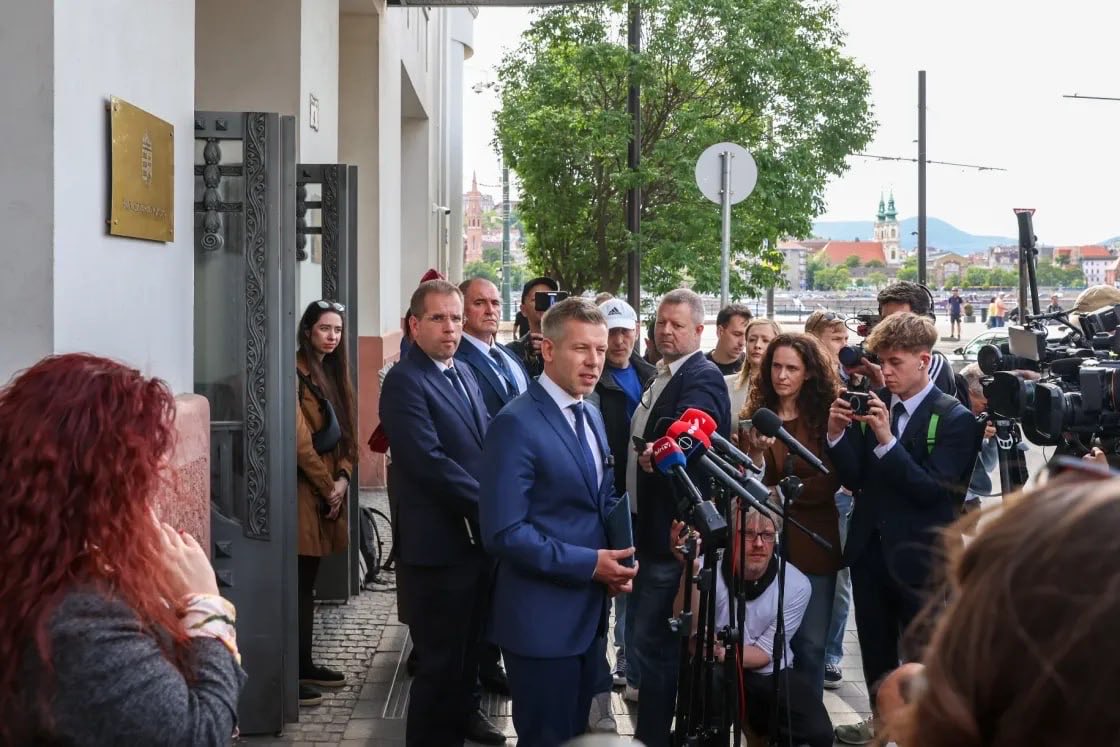
I would like to introduce my Chief of Staff, who will take on one of the most complex and demanding responsibilities of the next four years.
Claudia Sümeghy is an economist specialising in international relations, a film producer, and the mother of a daughter. She speaks English and Italian fluently and is currently participating in the University of Oxford’s executive leadership programme.
She worked in the financial sector for nearly a decade, where she became one of Europe’s leading regional managers together with her 200-member sales team. She has been an entrepreneur and executive since her university years.
Since 2016, she has served as producer and communications director of the film production and distribution company she runs together with her husband, film director Tamás Yvan Topolánszky.
As one of the creators of the documentary film “Tavaszi szél – az ébredés”, she has followed my work and the TISZA community over the past year and a half. She is therefore familiar with our work, decision-making processes, and values.
As Chief of Staff, she will help create a leadership environment guided by clear intentions, strategic direction, and a people-centred approach, one in which decisions contribute to building a functioning, forward-looking, and humane Hungary.
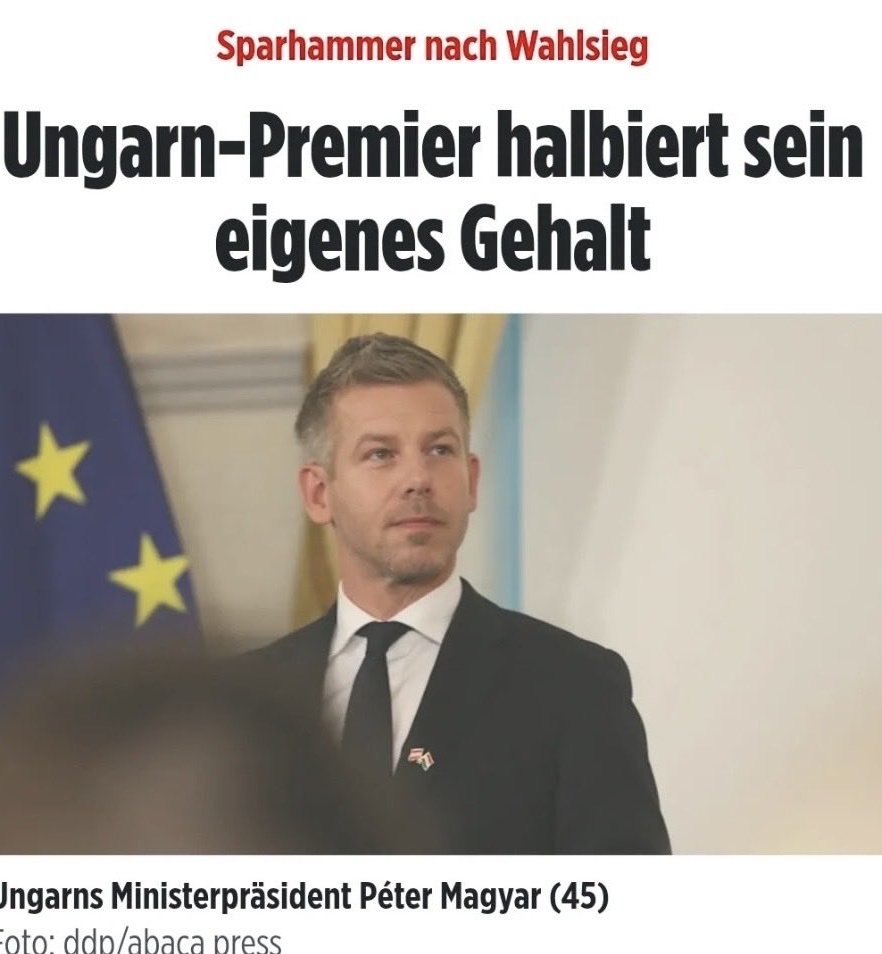
Ungarns neuer Ministerpräsident hält sein Wahlversprechen und halbiert sein eigenes Gehalt.
Von 7,18 Millionen Forint – dem Gehalt seines Vorgängers Orbán – auf 3,8 Millionen Forint brutto monatlich. Rund 10.500 Euro.
Gleichzeitig kürzt Péter Magyar die Gehälter von Ministern, Staatssekretären und Abgeordneten.
Das durchschnittliche Bruttogehalt in Ungarn liegt bei 1.630 Euro.
Nach 16 Jahren Orbán – der den Staat zur persönlichen Bereicherung nutzte – hält Magyar sein erstes Versprechen. 🇭🇺🇪🇺
Heute vor 7 Jahren….
Während sich der eine in dieser Zeit vom Staatsmann zu einem lächerlichen Clown entwickelt hat, entwickelte er sich von einem erfolgreichen Clown zum größten Staatsmann Europas.
Herzlichen Glückwunsch zum Jubiläum, Präsident @ZelenskyyUa
Slava Ukraïni 🇺🇦
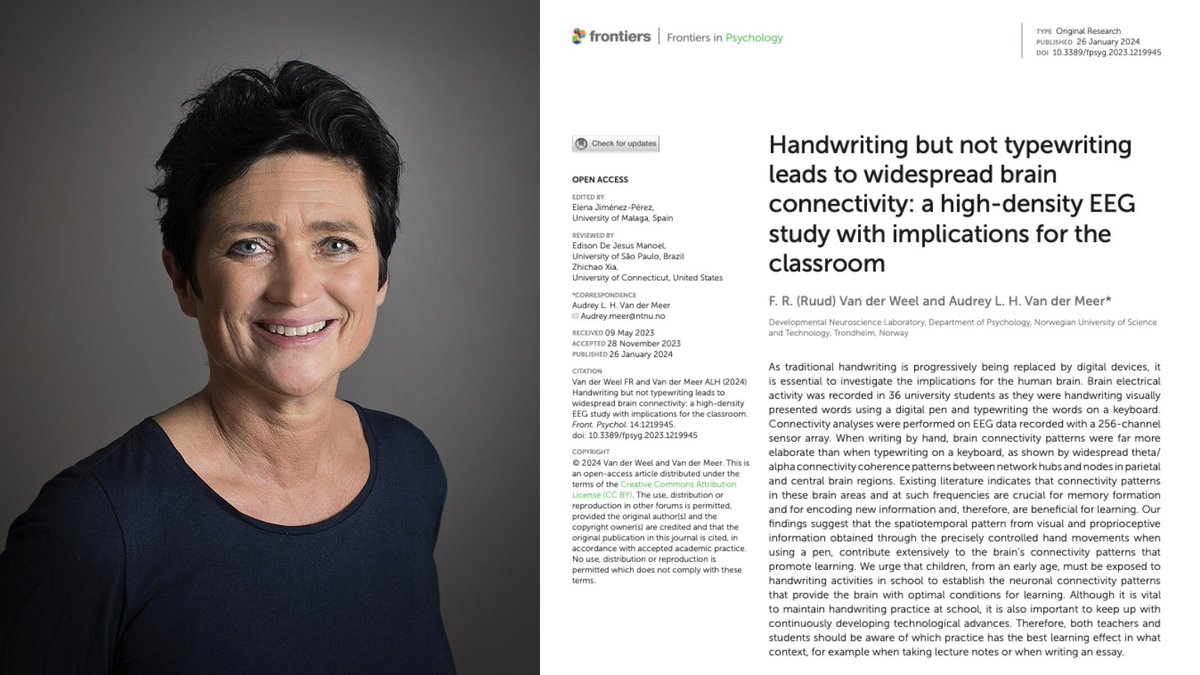
A Norwegian neuroscientist spent 20 years proving that the act of writing by hand changes the human brain in ways typing physically cannot, and almost nobody outside her field has read the paper.
Her name is Audrey van der Meer.
She runs a brain research lab in Trondheim, and the paper that closed the argument was published in 2024 in a journal called Frontiers in Psychology. The finding is brutal enough that it should have changed every classroom on Earth.
The experiment was simple. She recruited 36 university students and put each one in a cap with 256 sensors pressed against their scalp to record brain activity. Words flashed on a screen one at a time.
Sometimes the students wrote the word by hand on a touchscreen using a digital pen, and sometimes they typed the same word on a keyboard. Every neural response was recorded for the full five seconds the word stayed on screen.
Then her team looked at the part of the data most researchers had ignored for years, which is how different parts of the brain were communicating with each other during the task.
When the students wrote by hand, the brain lit up everywhere at once.
The regions responsible for memory, sensory integration, and the encoding of new information were all firing together in a coordinated pattern that spread across the entire cortex. The whole network was awake and connected.
When the same students typed the same word, that pattern collapsed almost completely.
Most of the brain went quiet, and the connections between regions that had been alive seconds earlier were nowhere to be found on the EEG.
Same word, same brain, same person, and two completely different neurological events.
The reason turned out to be something nobody had really paid attention to before her work. Writing by hand is not one motion but a sequence of thousands of tiny micro-movements coordinated with your eyes in real time, where each letter is a different shape that requires the brain to solve a slightly different spatial problem.
Your fingers, wrist, vision, and the parts of your brain that track position in space are all working together to produce one letter, then the next, then the next.
Typing throws all of that away. Every key on a keyboard requires the exact same finger motion regardless of which letter you are pressing, which means the brain has almost nothing to integrate and almost no problem to solve.
Van der Meer said it plainly in her interviews.
Pressing the same key with the same finger over and over does not stimulate the brain in any meaningful way, and she pointed out something that should scare every parent who handed their kid an iPad.
Children who learn to read and write on tablets often cannot tell letters like b and d apart, because they have never physically felt with their bodies what it takes to actually produce those letters on a page.
A decade before her, two researchers at Princeton ran the same fight using a completely different method and ended up at the same answer. Pam Mueller and Daniel Oppenheimer tested 327 students across three experiments, where half took notes on laptops with the internet disabled and half took notes by hand, before testing everyone on what they actually understood from the lectures they had watched.
The handwriting group won by a wide margin on every question that required real understanding rather than surface recall.
The reason was hiding in the transcripts of what the two groups had actually written down.
The laptop students typed almost word for word, capturing more total content but processing almost none of it as they went, while the handwriting students physically could not write fast enough to transcribe a lecture in real time, which forced them to listen carefully, decide what actually mattered, and put it in their own words on the page.
That single act of choosing what to keep was the learning itself, and the keyboard had quietly skipped the choosing and skipped the learning along with it.
Two studies. Two countries. Same answer.
Handwriting makes the brain work. Typing lets it coast.
Every note you have ever typed instead of written went into your brain through a thinner pipe. Every meeting, every book highlight, every idea you captured on your phone instead of on paper was processed at half depth.
You did not forget those things because your memory is bad. You forgot them because typing never woke the part of the brain that would have made them stick.
The fix is the thing your grandmother already knew.
Pick up a pen. Write the thing down. The slower road is the faster one.
Viktor Orbán’s puppet president gave an interview today to the mafia’s propaganda outlet @indexhu — an online outlet that courts have repeatedly ruled against for publishing false information during the campaign.
@DrTamasSulyok has failed every test of human, legal, and political suitability during his inglorious two years in office as President of Hungary.
It was clear from the very beginning that @PM_ViktorOrban wanted a president for whom loyalty to Fidesz comes first, while the defense of constitutionalism and national unity comes last. That is why he chose Tamás Sulyok.
Hungary, however, needs a President who is loyal not to one political camp, but to the Hungarian nation and to every Hungarian — including the poorest and most vulnerable.
We need a President who helps reunite the nation rather than trying to explain away his own indefensible record.
We need a President who does not defy the will of the Hungarian people, but serves his country.
In this interview, Tamás Sulyok made several false statements. He misrepresented the role and constitutional powers of the President of Hungary, spoke falsely about children affected by Orbán’s so-called “child protection system,” and also misrepresented what was said in our private meetings.
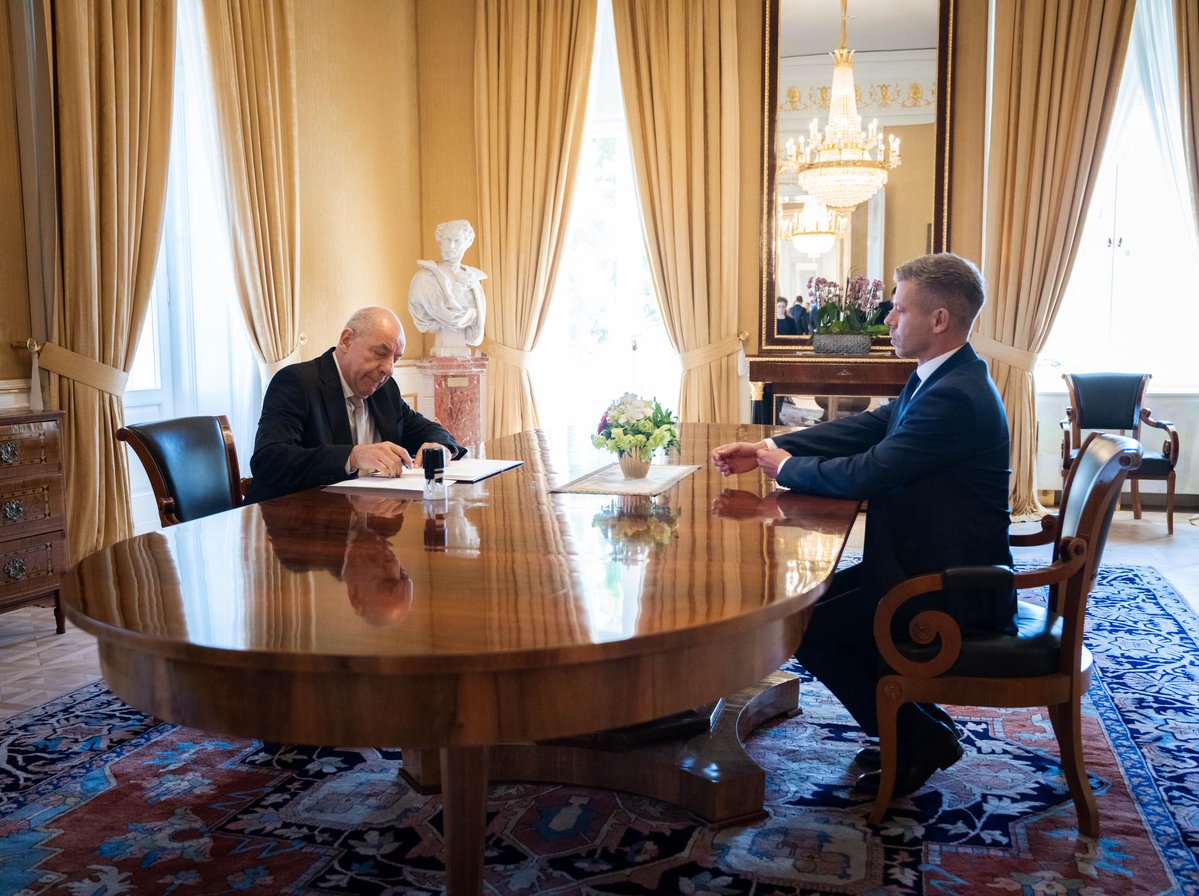
During our first meeting, he did not reject my clear call for his resignation; he merely indicated that he would consider it.
During our second meeting, he asked whether, if he decided to resign, it would be appropriate to coordinate the details with the Minister of Justice.
It is obvious that since our last meeting, the order has come from the mafia boss: he must stay.
Mr. President,
There is nothing to coordinate. In today’s propaganda interview, you tried to deny that millions of Hungarians voted for change on April 12, but that does not alter reality. You were a puppet of a failed system — one that the Hungarian people decisively rejected, and which the majority of Hungarians now oppose.
The Hungarian people regard you as an obstacle to change and to building a functioning, humane Hungary.
Mr. President,
You must leave. And you will leave.
You still have the opportunity to do so voluntarily by May 31.
.@TackeSarah leitet die Rechtsredaktion des ZDF und moderiert WISO, umso erschreckender ist diese Art von „Journalismus“.
In ihrer neuen Doku über Bürgergeld & hier beim roten Sofa wird ernsthaft die Frage aufgemacht, wie es „5 Millionen Bürgergeldempfänger & gleichzeitig 1 Million offene Stellen“ geben könne.
Die Antwort darauf ist weder geheimnisvoll noch kompliziert:
- 1,5 Mio. der Bürgergeldempfänger sind Kinder
- Hunderttausende arbeiten bereits und stocken nur auf
- Viele sind krank oder pflegen Angehörige
- Und ein Großteil der offenen Stellen verlangt Qualifikationen, die fehlen. Genau deshalb sprechen wir seit Jahren von Fachkräftemangel.
Das alles ist öffentlich einsehbar. Einmal Google hätte gereicht.
Besonders problematisch wird es, wenn dann behauptet wird, Jobcenter würden von „30–40 % Totalverweigerern“ sprechen, obwohl es dafür laut eigener Aussage keine offiziellen Statistiken gibt.
Wie kann man als Leiterin einer Rechtsredaktion anekdotische Aussagen einzelner Jobcenter-Mitarbeiter senden, ohne belastbare Datenbasis, wohl wissend, welches gesellschaftliche Klima damit befeuert wird?
Während Steuervermeidung, Vermögensungleichheit und Milliarden für Aufrüstung politisch kaum emotionalisiert werden, wird beim Bürgergeld seit Jahren mit maximaler Härte Stimmung gegen Arme gemacht.
Öffentlich-rechtlicher Rundfunk sollte aufklären und nicht Ressentiments reproduzieren.
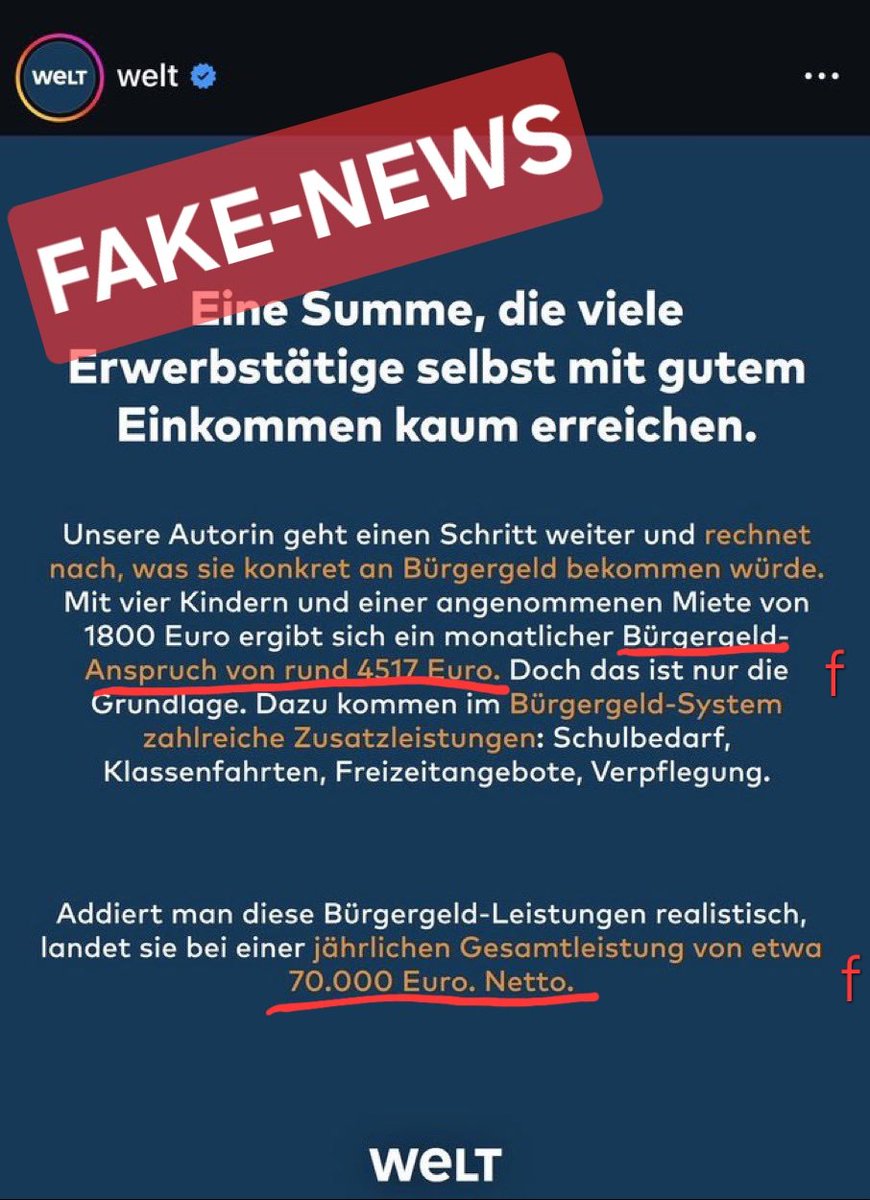
Realitätscheck zu den Behauptungen der @welt:
1. Bürgergeld-Berechnung ist Unsinn - laut Artikel geht es um eine Alleinerziehende mit 4 Teenies:
563€ Regelbedarf Mutter
270€ Mehrbedarf Alleinerziehung
4x471€ Regelbedarf Kinder (Teenager)
4x25€ Kindersofortzuschlag
1800€ Warmmiete
--------
4617€ Bedarf
-4x259€ Kindergeld
-------
3581€ Bürgergeld
2. Selbst wenn man vom Bedarf ausgeht:
12x4617€ = 55.404€
Da fehlen 14.596€ um auf die "70.000€" zu kommen - die gibt es an Bildung und Teilhabe niemals.
3. Würde die Mutter 1100€ Brutto verdienen bräuchte sie kein Jobcenter mehr:
955€ Netto
4x259€ Kindergeld
4x394€ Unterhaltsvorschuss
922€ Wohngeld (Stufe 7 - überall sonst wären 1800€ Warm völlig absurd)
479€ Kinderzuschlag
------
4968€ Einnahmen
Auf die Leistungen für Schulbedarf, Klassenfahrten, Freizeitangeboten und Schulessen hat sie auch dann Anspruch.
Damit hätte sie als Teilzeit-Erwerbstätige bereits mehr Einkommen als als Erwerbslose.
FAZIT:
Die Überschrift ist falsch.
Die Berechnungen sind falsch.
Die @welt hat Falschbehauptungen verbreitet.
Hungary will transfer the severance payments of Orbán’s resigned government ministers to Ukraine.
The money will be transferred to an orphanage in the village of Velyka Dobron in Transcarpathia, Péter Magyar announced.
The new head of government has mandated that the former officials make these payments.
I appeal to all the ministers who have destroyed our country and driven it into debt: Do not even think about accepting this money! Given the state in which they left the country, this is the very least they can do.
Including members of parliament, the total sum amounts to 2.8 million euros.
Stephen Colbert dice adiós a CBS, la cadena que le echa por criticar a Trump, tirando los muebles de su oficina desde la terraza en compañía de su antecesor en el late night, el gran David Letterman. “Fuck you, motherfuckers”.
Ich habe die letzten Jahre der DDR noch selbst erlebt. Alt genug, um zu merken, worüber Erwachsene nur leise gesprochen haben. Welche Themen man besser nicht angesprochen hat. Dass in den Nachrichten oft etwas anderes erzählt wurde als das, was Menschen im Alltag wirklich erlebt haben. In der Schule gab es klare Vorgaben. Und sobald es um Politik ging, wurden viele plötzlich vorsichtig.
Nach der Wiedervereinigung habe ich in der BRD zum ersten Mal erlebt, was Freiheit wirklich bedeutet. Frei reden. Frei wählen. Widersprechen dürfen. Ohne Angst.
Vielleicht höre ich deshalb heute genauer hin, wenn die Alternative für Deutschland von Indoktrination spricht, aber selbst tief in Bildung, Gesellschaft und unser Denken eingreifen will. Wenn die NATO infrage gestellt wird, Nähe zu Russland gesucht wird und unsere westliche Bindung klein geredet wird.
Und ganz ehrlich, ich verstehe bis heute nicht, wie Menschen, die die DDR selbst erlebt haben, sich wieder nach solchen Denkmustern sehnen können. Wer weiß, wie sich fehlende Freiheit anfühlt, sollte wissen, was wir heute zu verlieren haben.
#DDR #Demokratie #Freiheit #NieWieder #ErinnernStattVergessen