What is mathematics, how do we do it, and how will A.I. change it for ever?
Thrilled to announce Explaining Universal Truths, a @templeton_fdn & @CMU_DietrichHSS project to fund an interdisciplinary team of philosophers, mathematicians, and cognitive scientists. We're hiring!🧵
message seems to be “Does everything about your life feel vaguely wrong somehow? Try building random stuff with Codex! It’s like a hallucinogen and an amphetamine in one app! It will make you feel just like you’re doing something that matters — guaranteed!” 😂
stackoverflow is a ghost town now. it’s like walking through an abandoned liminal space. the top question from the past month has 78 upvotes and is titled “how can i avoid using LLMs as a software developer”
🦔UC Berkeley's computer science department just posted its worst failure rates in years. 35.3% of CS 10 students got F's in spring 2026, up from under 10% in prior semesters. Professor Dan Garcia says the primary driver is a "vast increase in academic dishonesty" through LLMs. Students use AI to complete assignments, never learn the material, then fail exams. His office hours, once full, are now empty.
My Take
Companies are firing experienced engineers while the pipeline that produces new ones is being gutted by the same technology. Students use AI to bypass the hard part of learning, show up to exams without the understanding, and fail. One professor discovered a student's linear algebra class had an "open AI" policy for homework and exams. That student then couldn't do basic linear algebra in the next course.
Both ends of the workforce are eroding at the same time. Senior engineers are getting cut to fund AI spending. Junior engineers are graduating without the skills because AI did their coursework. And the companies spending trillions on these tools haven't connected those two facts yet.
Hedgie🤗
*in Slavoj Žižek voice*
You know, the true horror of C++ is not the segfault, that is merely the symptom, the hysterical acting-out of the subject. No! The real nightmare is the pointer.
Imagine: you declare your little int* p, this fragile thing pointing to some memory that the big Other (the compiler) promises is there. But in the night of runtime, when the ideological fantasy collapses, what do you get? A dangling pointer! The thing is gone, evaporated, yet you still believe it is pointing somewhere. This is ideology at its purest: you keep dereferencing the illusion, saying to yourself, "It works on my machine," while deep down you know the memory has been freed by the invisible hand of the destructor.
The STL is the worst part. This is the superego in code form. Endless instantiation, each one more specialised than the last, promising total freedom ("I can be anything!"), but in reality trapping you in a monstrous, overdetermined hierarchy where even a simple vector becomes a dialectical contradiction: it grows, it shrinks, but it can never escape its own reallocation trauma.
In short, my friends, C++ is not a programming language. It is the symptom of late capitalism itself. We pretend we are in control with our smart pointers, but we all know... one day, the garbage collector will not come. It never does.
Good to see Berkeley professors holding the line on standards:
“Garcia believes the ‘primary driver’ of these abnormally high failing rates is due to a ‘vast increase in academic dishonesty’ due to students’ usage of large language models.”
“In other cases, it’s students who are leaning a little too hard on LLMs to do their work for them, and then at exam time just really aren’t ready.”
“Garcia also pointed out that many students are underprepared mathematically.”
These professors are signatories to the recent letter calling for reinstatement of standardized testing.
@J_Simcik@MikeJazzpenis@NathanielGivens I think we’re missing each other here (the way you’re using the term drift indicates we are using it to refer to different things.) If there is a video of people zipper merging (merging at a single point without stop-start) it would help me understand your intuition.
@AndrewRowley10@NathanielGivens Say (1) two car length spacing required (2) people wait when the spacing drops below one. If fluctuations are 0.1 car lengths, you hit start-stop in ~25 cars.
If you say you've seen a continuous stream of cars merge at a single point without stopping, I don't believe you!
The French hate air conditioning.
So Paris built a 120-kilometre machine under its streets for producing cold.
It’s called Fraîcheur de Paris, and it does for summer heat what district heating did for winter: centralise the problem.
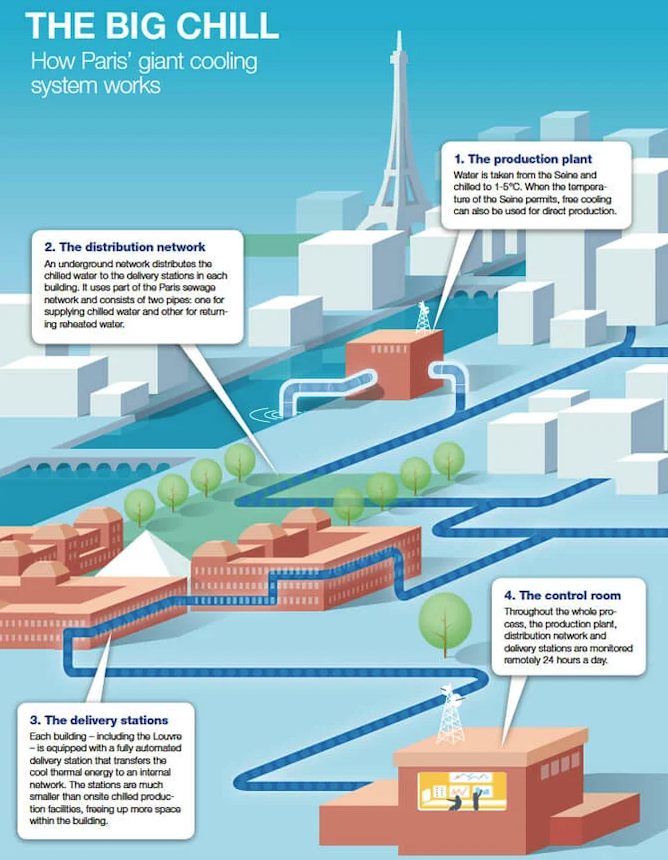
Instead of every museum, office, hotel, hospital and shop bolting its own cooling plant onto the building, Paris moves cold through pipes.
The network sends water chilled to 2 to 4°C through buried supply lines. The water enters a connected building, absorbs heat through an exchange station, then returns at 12 to 14°C to be cooled again.
It essentially functions with two pipes. One carries the cold out, the other carries heat back.
The production plants cool the circuit from 12°C to 4°C. Some sites use the Seine as a heat sink. In colder periods, the system can use the river’s own temperature for free cooling, which means the machines work less and the electricity demand drops. The Seine water doesn’t become the building water. It stays separate, passing temperature across heat exchangers.
The scale is pretty strange when you see it written down though.
It's got 15 production sites, 4 storage sites, 120 km of underground network with 924 subscribers. This has resulted in 7 million square metres cooled, and 493 GWh of cooling sold.
A cold utility running beneath one of the densest cities in Europe.
The Forum des Halles has been cooled this way since 1979. The Louvre since 1986. Galeries Lafayette, Opéra Garnier, Hôtel de Ville, Station F, La Samaritaine and the National Assembly all sit on the same idea. Tourists stand in the Louvre looking at paintings while a municipal cold loop does part of the dull work below ground.
The boring part is the breakthrough.
Cold can be stored at night in chilled water or ice, then used during daytime peaks. The network is monitored from a control room with more than 125,000 control points. A delivery station inside a building takes 5 to 7 times less space than a standalone cooling installation and avoids the roof and façade clutter that turns cities into compressor farms.
That matters because conventional air conditioning solves heat by moving it somewhere nearby. In a dense city, thousands of private machines mean thousands of outdoor units rejecting heat into streets, courtyards and roofs, plus refrigerants, noise, vibration and maintenance spread across every building.
Paris’s public cooling network has a stated coefficient of performance of 4, against 3 for a wet standalone system and 2 for a dry standalone system. Against an equivalent set of autonomous installations, Fraîcheur de Paris says the network gives 100% higher energy efficiency, 35% less electricity use, 90% fewer refrigerant-fluid emissions and 50% lower CO2 emissions.
The climate backdrop is the real reason this exists.
Paris ran a full crisis exercise called “Paris at 50°C” in 2023. Météo-France’s 2050 reference trajectory for France points to heatwave days becoming five times more frequent, hot nights rising sharply in urban centres, and some local extremes around 48°C becoming possible.
The city signed a 20-year concession in 2022 with Fraîcheur de Paris, owned 85% by ENGIE and 15% by RATP. The contract is worth a projected €2.4 billion. The plan is to extend the network by 158 km by 2042, add 20 production plants and 10 storage sites, and reach more than 3,000 subscribers, including hospitals, nurseries, schools and care homes.
This is basically the infrastructure version of admitting that summer is becoming a public systems problem...
@tobiaschneider CMU students seem chronically overloaded by classes — at least those in STEM. We have some extracurricular load, but it’s mostly extreme course demands. 45 h/wk of actual work (5 9h/wk classes) is intense, and they do it.
@J_Simcik@MikeJazzpenis@NathanielGivens I think we’re missing each other here (the way you’re using the term drift indicates we are using it to refer to different things.) If there is a video of people zipper merging (merging at a single point without stop-start) it would help me understand your intuition.
@J_Simcik@MikeJazzpenis@NathanielGivens You’re the second person to say this (the other was in Australia, where he says it’s a regular occurrence). I’d like to see a video, because I can’t understand how the random drift problem is solved.
@nntaleb BTC is capital-intensive and capital in any domain moves to power-law distributions. Ordinary development proceeds by creative destruction but protocol lock-in creates, ironically enough, the monopolistic death-spiral identified by Marx!
@J_Simcik@MikeJazzpenis@NathanielGivens Yes, this is the empirical claim at issue. If zipper merging means “cars merge at a single predetermined point”, it can not possibly preserve speed because of timing issues — gaps need to be precisely aligned and staggered, and random drift spoils this quickly.
the thing about “gentle parenting” is, people ask: what if they just refuse, or, what if they just won’t stop? and the answer is: there’s no answer. its true. you might leave the restaurant. you lose some battles. but, ultimately, you may win the war. the war against your child
@AS25990AS@NathanielGivens One of the interesting things about this discussion is how it reveals that common and often-valid assumptions (e.g., "it's more efficient if we all agree on when to do something") don't always hold.
@AS25990AS@NathanielGivens The error is to assume that creating a defined point increases efficiency. In many cases, creating a consensus point does so! But not in this case.
@AndrewRowley10@NathanielGivens Say (1) two car length spacing required (2) people wait when the spacing drops below one. If fluctuations are 0.1 car lengths, you hit start-stop in ~25 cars.
If you say you've seen a continuous stream of cars merge at a single point without stopping, I don't believe you!
@AndrewRowley10@NathanielGivens It's actually essentially impossible. Imagine you have the desired spacing. Now imagine a small fluctuation at the barrier — one car went a bit too slow or fast. This compounds as sqrt(N). For a 10% error, after maybe 10-20 cars, zipper will be start-stop.