@JF_XVII@_nina_jolly_@puarangue Lunaire ton analogie, en mangeant tu crées pas de souffrance, en créant une existence qui n'a pas consenti à être dans ce monde si
MIT published research saying tiny wireless electronic devices can travel through the bloodstream, cross the blood-brain barrier, self-implant in the brain, and then be wirelessly powered to stimulate neurons.
Click here to read it for yourself -> https://t.co/gPtDyWwbVO
Read that again...
They are talking about microscopic electronics integrated with living cells, so the body does not attack them.
They are talking about devices that can reach specific brain regions without traditional surgery.
They are talking about electrical stimulation inside the brain through technology small enough to move through the circulatory system.
And people still think it is “crazy” to ask hard questions?
If MIT is publicly talking about this now, how far ahead is classified technology?
How many people have been dismissed for describing experiences that sound impossible only because the public is behind?
How many people were told nothing like this could exist while institutions were already building it?
This is exactly why our work matters.
We built Mind Nexus for the people who are tired of being called crazy. We document anomalous frequencies around your person and possible emissions within the environment so there is a real starting point for deeper investigation.
This article does not prove every claim out there, but it absolutely proves that microscopic, wireless, brain-targeting bioelectronic technology is real enough to be developed by one of the top institutions in the world.
That should make people stop and think.
Scanning Info: https://t.co/F4TWHbZkqr
Free MasterPeace Account: https://t.co/Kxbzc5rDpf
Sign The Petition: https://t.co/B81inZCA0t
Scanning is NOT a medical diagnosis. Our scans detect anomalous frequencies around a person and within the environment, not inside the body. Findings are for informational purposes only and can support personal investigations.
#MindNexus #MIT #BrainImplants #Bioelectronics #WirelessTechnology #BloodBrainBarrier #Neuromodulation #HavanaSyndrome #AHI #DirectedEnergy #TruthMatters #InvestigateEverything #Stop3024
@ShawnJohnsonPod@infowars
Things to research when bored:
-Dark matter
-Chair theory
-String theory
-Roko's Basilisk
-Transhumanism
-Ship of Theseus
-Pygmalion effect
-Bioluminescence
-Platypus principle
-Panopticon effect
-The Fermi Paradox
-The overview effect
-Operation Paperclip
-Analects of Confucius
-The Voynich Manuscript
-Quantum Entanglement
-Green children of Woolpit
-Time dilation and relativity
-The Dyatlov Pass incident
-The Antikythera Mechanism
-Lost Civilisations and Myths
-Political Bias in Cartography
-Boltzmann brain hypothesis
-Cognitive dissonance theory
-Bbaader-Meinhof phenomenon
-Legends of Werewolves in Europe
-Entheogens and the origin of religion
The most dangerous assumption in the history of human thought isn't that the Earth is flat, or that the sun orbits us, or that disease comes from bad air.
The most dangerous assumption is one nobody questions because it feels too obvious to question:
"When you open your eyes, are you seeing the world or not?"
You're not.
What you're actually experiencing is a rendering. A constructed hallucination your brain assembles in real time using incomplete sensory data, prior expectations, evolutionary shortcuts, and an enormous amount of pure fabrication.
The feeling of looking out at the world is neurologically backward — your brain is projecting inward, building a model so seamlessly continuous that it never once trips an alarm saying "this is a simulation."
Donald Hoffman at UC Irvine has spent decades building the mathematical and evolutionary case for this. His argument isn't mystical. It's Darwinian, and it's brutal in its logic. Evolution doesn't select for organisms that perceive truth. Evolution selects for organisms that survive. Those two pressures produce completely different sensory systems.
He ran evolutionary game theory simulations pitting organisms that saw reality accurately against organisms that saw only what was fitness-relevant. The truth-seers went extinct every time. Accurate perception is metabolically expensive, informationally overwhelming, and strategically useless. You don't need to know the quantum mechanical structure of a predator to run from it. You just need a fast, cheap signal that says danger, move now.
So that's what your perceptual system became over millions of years — a fast, cheap, heavily compressed interface optimized for navigation and survival, not accurate representation.
Hoffman calls it the Interface Theory of Perception, and the computer desktop analogy he uses cuts through the abstraction better than any technical language can.
When you drag a file to the trash on your screen, you interact with a blue icon sitting on a rectangular desktop. That icon doesn't resemble the magnetic charges on the hard drive disk. The desktop doesn't look like binary code. The entire visual interface exists to make the underlying computational reality manageable for a human user who couldn't function if they had to interact with the actual hardware directly.
Your perceptual experience works the same way.
Color doesn't exist in electromagnetic radiation — wavelengths do. Color is a rendering your visual cortex generates to help you sort objects efficiently. Sound doesn't exist in air pressure waves — vibration does. What you hear is a translated, interpreted, emotionally tagged version of physical oscillations. The warmth you feel from sunlight is your nervous system converting photon energy into a thermal sensation your body can act on. None of these translations are the thing itself. They are all interface graphics.
The hard question and the one that stops most people is what lies beneath the interface.
Quantum mechanics has been trying to answer that for a century and keeps arriving at answers that sound like philosophy. At the quantum scale, particles don't have definite positions or definite properties until they're measured. They exist in probability clouds, superpositions of multiple states, and the act of observation — of the universe interacting with itself — is what collapses those possibilities into a single definite event. Physicist John Wheeler spent his later career arguing that the universe is fundamentally "participatory" — that observation isn't passive, that conscious systems don't just watch reality but in some deep sense generate it through the act of looking.
Most people call it fringe metaphysics. But, it's a serious interpretation of peer-reviewed quantum mechanics that has never been disproven.
Combine Wheeler with Hoffman and you get a picture that most people aren't ready for: not only is your perceptual experience a constructed interface rather than a transparent window to reality — but the underlying reality that interface is built on top of may itself be observer-dependent. There may be no "mind-independent" physical world sitting behind your perceptions, waiting to be correctly perceived if only you used better instruments. The instruments change what's there.
Neuroscience closes the loop from the other direction. Anil Seth at the University of Sussex runs one of the world's leading consciousness labs, and his framework — controlled hallucination — converges on Hoffman from pure brain science rather than evolutionary theory. Your brain doesn't receive sensory input and then passively build a picture. It generates a prediction first — a best guess about what's out there based on prior experience — and then uses incoming sensory data only to correct that prediction when it's wrong. What you experience as vision, as touch, as the physical solidity of the chair beneath you, is 90% prediction and 10% correction signal.
When the correction signal stops — when sensory input is cut off through isolation, deprivation, or certain pharmacological states — the predictions don't disappear. They intensify. The brain, without contradiction signals from outside, runs its model at full volume. Hallucination and ordinary perception use the same neural machinery. The only difference is whether external data is disciplining the model or not.
This means your experience of consensus reality is a socially synchronized hallucination — billions of human brains running slightly different prediction models, calibrating against each other through language and shared physical feedback until the models converge enough to call it "the real world."
The convergence is real. The coordination is genuine. But the raw experiential content — the redness of red, the pain of pain, the spatial depth of a landscape, the passage of time itself — none of that exists outside a nervous system to generate it.
What makes this more than an academic conversation about philosophy of mind is what it demands of us practically. Every conflict about "objective reality" — in politics, in relationships, in culture wars, in courtrooms — assumes that two people with the same sensory access to an event should, in principle, converge on the same account of it. But if each person is running a different predictive model shaped by different evolutionary pressures, different developmental histories, different prior beliefs, different neurological architectures — then divergent perceptions of the same event aren't failures of honesty or intelligence.
They're different interfaces rendering the same underlying signal into different outputs.
Knowing your perceptual experience is a rendering doesn't make the rendering less vivid or less useful. The computer desktop metaphor works because it doesn't expose the hardware. Your senses work because they compress overwhelming complexity into something actionable.
But the people who changed history — scientists, artists, philosophers, mystics — all shared one trait across otherwise wildly different domains. At some point, each of them stopped trusting the interface completely. They looked at the rendering and asked what was generating it. They pushed past the icon to the code beneath it.
Every genuine breakthrough in human understanding has been an act of interface-breaking.
The question isn't whether your perceptions are real.
The question is whether you're curious enough to find out what they're made of.
🔥 Stephen Hawking’s Final Theory Rewrites the Rules of the Cosmos
In his final collaboration with physicist Thomas Hertog, Stephen Hawking proposed a bold new vision of the universe—one where the laws of physics are not fixed, but evolve much like life itself. This revolutionary idea reframes our cosmos as not a cosmic accident, but the outcome of a kind of “quantum Darwinism” in its earliest moments.
For decades, scientists have puzzled over why our universe seems so finely tuned for life, where even the slightest change in physical constants could make existence impossible. While many turned to the multiverse for answers, Hawking found that explanation unsatisfying. Instead, he envisioned a “top-down cosmology,” in which quantum observations made today help shape and stabilize the physical laws of the past—turning our traditional sense of causality on its head.
If future evidence from gravitational waves or quantum experiments supports this model, Hawking’s final theory could stand as his boldest legacy—redefining our understanding of time, causality, and the very fabric of existence. It reminds us that the universe is not just something to observe, but a mystery still unfolding.
📌 Source: Thomas Hertog, “Stephen Hawking’s Final Theory Turns Time and Causality Inside Out,” New Scientist (2023)
@NeuralSpace_ Sa théorie existe déjà plusieurs années, là ce qui change c'est que certaines recherches ont trouvé des "points d'hawkings" dans le fond diffus cosmologique ce qui permet de témoigner de l'existence de traces d'anciens trous noirs et donc potentiellement d'univers cyclique.
@EdwardKens50830@NightSkyToday No its not just a theory look the Hafele-Keating Experiment (1971), twins Scott & Mark Kelly (Nasa), the GPS fonctionning
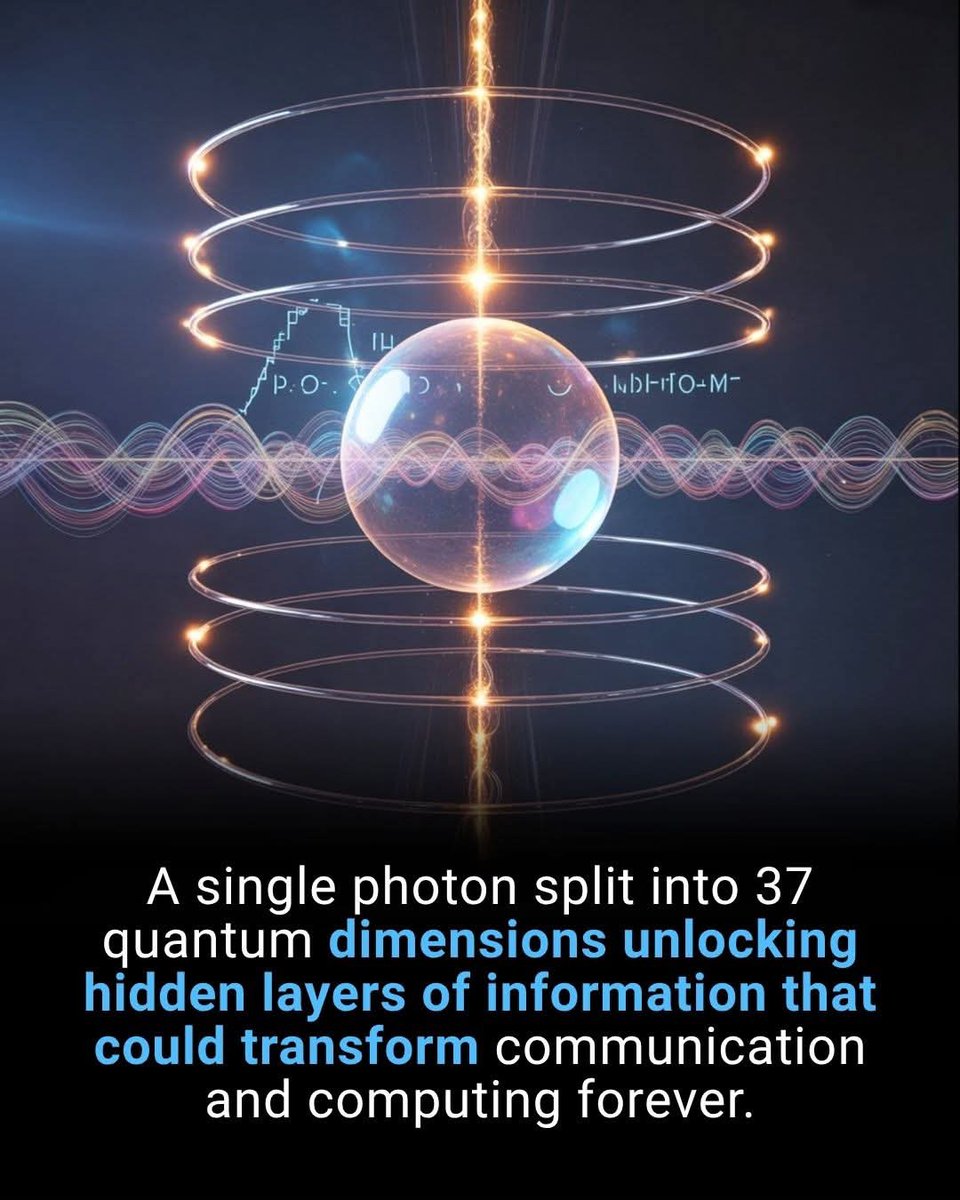
It sounds like a futuristic idea, but it’s a real, peer-reviewed advancement in quantum science. Researchers have created a single particle of light that exists in 37 simultaneous quantum dimensions not as physical directions in space, but as informational layers. Using GHZ entanglement techniques, they controlled the photon’s color and phase, linking all 37 modes into one unified state.
These modes act like additional storage lanes embedded within the photon, allowing it to transport far more data than any conventional optical system. This opens the door to quantum networks that could be extremely secure, as well as computing systems capable of handling complex problems beyond the reach of today’s top machines.
Instead of a simple beam of light, the photon becomes a programmable structure, holding multiple layers of meaning at once. If future experiments scale this into hundreds of dimensions, it could reshape how we design data, encryption, and computational tools. This breakthrough doesn’t just improve technology it hints at a deeper, invisible structure woven into the nature of reality.
📸 Credit: Research team’s published GHZ-entangled photon findings; quantum optics lab imaging data.
Everything comes from trillions of trillions of previous cycles compacted in a universe that optimizes with each new phase. The information is just waiting to be encoded, the cosmological constants are traces of ancient optimizations of the holo system.
#universe#NASA#esa
The universe has a cumulative memory. Everything is digital. massive black holes that exist in relatively young universes are there because the system updates itself with each new cycle. Nothing is new.
#universe#NASA#esa#BlackHole
@konstructivizm The universe has a cumulative memory. everything is digital. massive black holes that exist in relatively young universes are there because the system updates itself with each new cycle. Nothing is new, everything comes from trillions of trillions of previous cycles compacted
@NASASpaceAlerts Well NASA continue to confirm my thoeritical model of the universe (Récurrence métabolique holographique), next step, i give you clues : linking information theory, black matter/energy and consciousness. Best regards from France