@AmararvindKumar@narendramodi@BCCI@ICC Nobody is saying drop it. Just preserve it. Not milk it. Everyone only wants to play India and India alone. As they make little money playing anyone else. We can’t be the world’s piggy bank at our cost. Sorry I will never support that view. We play. But on our terms
THE FUTURE OF CRICKET: TWO FORMATS, ONE SUSTAINABLE GLOBAL ECONOMY
Lalit Modi | Founder, Indian Premier League
1. Why have you suggested two new IPL windows now? Why this sudden intervention?
There is nothing sudden about this. I have been warning for years that cricket’s commercial model and calendar are heading towards a crisis.
When I created the IPL in 2008, we had eight teams and a 59-match tournament. Today we have ten teams, and a proper home-and-away league would require 90 league matches plus four playoffs — 94 matches.
You cannot keep expanding the product while squeezing everything into essentially the same window.
Then there is the increasingly punishing April–May heat, player fatigue, broadcasting economics and the growing dependence of the BCCI on IPL revenues.
But the bigger problem is that cricket is trying to sustain too many versions of essentially the same sport.
We have Tests, ODIs, T20, The Hundred and T10. We have bilateral series, franchise leagues and an endless succession of ICC tournaments.
Cricket is suffering from format proliferation and calendar inflation.
My two IPL proposals — beginning in January or creating a carefully structured October–April calendar — are alternatives to be commercially evaluated, preferably for implementation from 2028.
The IPL is a domestic BCCI competition. It does not require the ICC to grant it a window, although international player commitments and contractual obligations must be managed.
I built the IPL to evolve. Not to stand still.
The biggest threat to the IPL is not competition. It is complacency.
2. Has anyone at the BCCI or ICC prompted you to float these proposals?
No. These are my own views.
I have never needed permission or encouragement to express an opinion about cricket.
I have been making many of these arguments publicly for years — including my views on abandoning ODIs, protecting Test cricket and recognising the commercial dominance of T20.
I have spent decades in sports marketing, broadcasting, media rights and building sporting properties.
I don’t need to test the waters for anybody.
I am looking at the economics, the changing audience, the players and the future of the sport.
If the BCCI or ICC adopts these ideas, excellent. If they reject them, they should explain the commercial logic.
The strength of an idea does not depend on who suggested it. It depends on whether the economics work.
3. Would other cricket boards necessarily agree to follow the BCCI’s preferred window?
Not necessarily. Nor should anybody expect automatic agreement.
But the world of cricket has changed.
The IPL is no longer a tournament looking for a place in international cricket. It has become the principal commercial engine of the sport.
The world’s best players have powerful financial reasons to participate. Broadcasting networks, sponsors and investors understand the scale of the Indian market.
Other cricket boards can choose to counter-programme the IPL. That is their commercial decision.
But they must also consider the consequences for player availability, broadcast audiences, sponsorship and the value of their own competitions.
Look at what happened in India when the IPL began. Bollywood and television initially believed they could compete directly with it. They discovered that audiences had made their choice.
The IPL did not ask Bollywood for a window. Bollywood adjusted to the IPL.
Commercial gravity cannot be negotiated away simply by refusing to acknowledge it.
4. What carrot would you offer other cricket boards?
I would start by changing the entire discussion.
Why are we protecting an overloaded bilateral calendar that is increasingly difficult to justify economically?
The boards should examine the actual revenues and costs of each series, not simply claim every international fixture is indispensable.
I would offer a predictable multi-year calendar, agreed player-release arrangements, meaningful development partnerships and compensation where a demonstrable commercial benefit justifies it.
There could also be commercially negotiated participation and development arrangements for countries whose players materially strengthen the IPL.
But these must be transparent and subject to sound financial discipline.
I would not subsidise inefficient cricket merely to preserve the status quo.
And I would protect the players.
Cricket administrators have become accustomed to using the same athletes to generate revenues from international cricket, bilateral series, ICC events and franchise competitions.
Players are not machines, and their careers are not an unlimited revenue resource for cricket boards.
Boards should earn their revenues by creating compelling sporting products, not by extracting more and more playing days from the same individuals.
That is where the reform must begin.
5. Could the IPL survive without foreign players?
Absolutely. I believe the IPL could remain an extraordinarily successful commercial property built around Indian players alone.
The core of the IPL was always India’s enormous audience, Indian cricketing talent, Indian sponsors and the country’s appetite for sport and entertainment.
Would I prefer international stars? Of course.
They improve the quality of the competition and extend its global reach.
But international players also benefit enormously from the IPL. For many, an IPL contract can be among the most financially valuable opportunities of their careers.
The sensible solution is to accommodate them while respecting valid national and contractual release arrangements.
Would an Indian-only IPL necessarily be more profitable than the existing international product? That would require actual commercial modelling.
But would it still have a formidable audience and commercial foundation? In my assessment, yes.
Foreign players add value to the IPL. They did not create its underlying value.
6. What about Dussehra and Diwali in an October–April calendar?
Why should Indian festivals automatically be regarded as an obstacle to cricket?
Dussehra and Diwali are among the biggest periods of celebration, entertainment and consumer activity in India.
Families gather. People travel. Advertisers spend. Brands launch campaigns. Entertainment consumption is enormous.
One of the first things I understood when creating the IPL was that cricket competes in the entertainment business.
Festival scheduling can be an advantage if designed intelligently.
Of course, particular days may require a break. Religious sensitivities, venue availability, security, travel and family commitments deserve consideration.
But a seven-month calendar does not mean playing seven months without interruption.
I have proposed a longer calendar band, with intelligent scheduling and appropriate breaks, not a compulsory match every day from October through April.
The traditional Boxing Day Test period should also be respected.
If the entertainment industry can make festivals a commercial opportunity, why should cricket automatically view them as a problem?
7. Would broadcasters agree to the changed IPL windows?
That is precisely why the BCCI needs to conduct a serious commercial exercise before deciding.
Broadcasters do not buy cricket dates. They buy audiences, advertising opportunities, subscriptions and commercially valuable content.
The IPL has already demonstrated extraordinary audience demand.
But an October–April calendar and a January-start tournament are two very different broadcasting propositions.
The BCCI should examine advertising demand month by month, competing sporting events, sponsorship commitments, streaming engagement, subscription revenues and production costs.
It must also consider existing contractual rights and the economics of a 94-match product.
I would have broadcasters, digital platforms, sponsors, franchise owners and independent financial advisers model the alternatives.
The objective should not simply be a higher headline media-rights number.
It should be to maximise sustainable net value for the league and its franchises.
I did not create the IPL by guessing what broadcasters might want. I built a product whose economics made them want it.
8. What is the future of bilateral Tests, ODIs and T20 internationals?
My answer is simple.
International cricket should ultimately have only two formats: Test cricket and T20.
I have been saying this for years.
I don’t see a sustainable long-term reason to preserve three principal international formats, particularly when the cricket calendar is already overloaded.
Test cricket represents the history, skill, endurance and tradition of our sport.
T20 represents its contemporary commercial strength, entertainment value, accessibility and global growth potential.
ODI cricket sits between the two without, in my view, a sufficiently compelling long-term purpose.
Kerry Packer transformed cricket through limited-overs innovation. I respect that history enormously.
But commercial products have life cycles.
The time has come to simplify international cricket.
Bilateral T20s should primarily serve genuine international competition, development, qualification and preparation for major tournaments.
Test cricket should be protected and commercially reinvented.
We need fewer bilateral matches, better bilateral matches and much more rest for the players.
I have already criticised the BCCI publicly for excessive scheduling.
Players need preparation time, recovery, family life and genuine periods away from the game.
Cricket cannot keep expanding every competition and expect the same players to carry the burden indefinitely.
9. Will bilateral T20 internationals die a natural death?
Not entirely, because T20 should remain one of the two international formats.
But routine bilateral T20 series will need to change significantly.
Why should every board automatically schedule three or five matches against another country merely because there is an available broadcasting slot?
What is the sporting objective?
What is the commercial return?
How does it help develop the game?
And, most importantly, what does it cost the players physically?
I want meaningful T20 internationals — genuine rivalries, qualifying tournaments, important series and opportunities for emerging cricket nations.
The rest of the regular T20 entertainment calendar can increasingly be served by properly governed franchise leagues.
The IPL demonstrates what happens when the sport is structured around a strong product, audience loyalty and commercial discipline.
The future is not international T20 versus franchise T20. The future is finding the correct balance between the two.
And eliminating ODIs would release significant calendar capacity.
10. Will Test cricket survive the explosion of franchise leagues?
I sincerely hope so, because Test cricket remains the purest and most demanding form of our sport.
But I have repeatedly warned that traditional bilateral Test cricket is facing a serious commercial problem outside a relatively small number of major rivalries.
We cannot preserve Test cricket simply by telling young audiences they ought to appreciate its history.
We have to make it relevant.
I have previously proposed examining four-day, day-night Tests, with appropriate playing conditions and a properly evaluated sporting structure.
Why shouldn’t more Test cricket be played when people can actually attend or watch after work?
I have also floated the idea of IPL franchise groups supporting additional red-ball teams and exhibition competitions.
Think about the possibilities of bringing existing franchise loyalty, professional marketing and investment into Test cricket.
That would not replace the primacy of country-versus-country Tests. International Test cricket should remain the pinnacle.
But additional club-supported red-ball cricket could bring younger audiences, commercial innovation and new financial resources into the format.
Not every Test match has to make a profit, either.
A sport has a responsibility to preserve its heritage. But preservation must be funded intelligently.
I want Test cricket to survive. That is precisely why I refuse to pretend its existing business model is sustainable everywhere.
11. Does the World Test Championship have a future?
Potentially, yes. But I believe it needs fundamental restructuring.
A true world championship must have sporting credibility, commercial relevance and an understandable competition structure.
The present arrangement is essentially built around selected bilateral Test series, different opponents and a points table.
I would much rather examine a properly designed, premium global Test championship with a coherent qualification structure, predictable scheduling and a commercially significant final.
The strongest national teams should compete under transparent sporting rules, with a viable development pathway for other nations.
The financial arrangements must also support smaller Test-playing countries rather than simply widening the gap between them and the wealthy boards.
And I would examine whether four-day, day-night Tests can form part of a redesigned structure.
I am not suggesting changing playing conditions overnight without consulting players, match officials and cricket experts.
But the debate should begin.
A World Test Championship must help save Test cricket, not merely add another trophy to an already overcrowded calendar.
12. What is the future of ODIs, particularly the 50-over World Cup?
This is where I will probably upset a few traditionalists again.
I believe the ODI format has reached the end of its natural commercial life.
I have said it repeatedly, including in interviews over several years.
We have Test cricket, which represents the longest and most demanding form of the game.
We have T20, which is commercially powerful, globally accessible and ideally suited to modern broadcast consumption.
Why do we still need a 50-over format sitting awkwardly between them?
The answer cannot simply be that it has existed for decades.
The 50-over World Cup has a magnificent history. I respect that.
But the history of a competition is not, by itself, a sufficient reason to preserve its format indefinitely.
If international cricket is to simplify into two formats, the 50-over World Cup must eventually be retired too.
Existing contractual, hosting and broadcasting commitments — including the 2027 tournament — should be honoured or renegotiated lawfully and commercially.
But the ICC should establish a clear transition strategy rather than endlessly renew the same format.
We should concentrate global resources on a truly premium Test championship and an outstanding T20 World Cup.
Sport evolves. The ODI format served its purpose. That does not mean it must exist forever.
13. Should the ICC reconsider the number and frequency of World Cups?
Absolutely. And this is connected directly to my argument about the number of formats.
Cricket has become obsessed with creating more tournaments.
We have a 50-over World Cup, a T20 World Cup, the World Test Championship, the Champions Trophy and multiple other competitions across age groups and categories.
At the same time, franchise cricket is growing, bilateral commitments continue and broadcasters are expected to finance everything.
Then we wonder why players are exhausted and why the commercial economics of individual competitions come under pressure.
I would simplify the senior men’s international structure around two premium global championships — one for Test cricket and one for T20.
The Champions Trophy and the ODI World Cup should ultimately be phased out as part of the transition away from 50-over cricket.
Not tomorrow morning, and not by ignoring existing contracts. But through a deliberate, negotiated restructuring of future cycles.
I believe major world championships must retain scarcity and importance.
If everything is a World Cup, we risk diminishing the meaning of winning one.
There is also an enormous player-welfare issue.
Every additional global tournament means more preparation, travel, physical strain and displacement of family time.
We should not measure the success of cricket administration by how many days a player can be made to work.
We should measure it by the quality of the product, the strength of the economics, the health of the players and the long-term development of the game.
14. After the July tribunal judgment, do you foresee returning to India and cricket administration?
First, we should distinguish between the different legal proceedings.
The July 2026 appellate tribunal judgment was an important development concerning the FEMA proceedings connected with the IPL’s relocation to South Africa in 2009.
The exact findings and relief granted are matters of record. I would not describe that judgment as disposing of every possible legal or regulatory issue.
As for visiting India, I have never ruled that out.
But visiting India and permanently moving there are completely different matters.
London has been my home for many years, and that is where I intend to remain based.
As for cricket administration, I have never needed an official title to think about the future of the game.
I created the IPL against extraordinary scepticism and resistance. Today, it is one of the most valuable sporting properties in the world.
That is an achievement nobody can take away.
Do I still care about cricket? Immensely.
Do I believe its administrative and commercial structures need reform? Absolutely.
I believe the future should be built around a stronger IPL, two coherent international formats, commercially sustainable Test cricket, fewer unnecessary bilateral matches and far greater protection for player welfare.
I also believe cricket boards need more professional management, stronger governance and meaningful player representation in decision-making.
But I am not seeking an administrative office or announcing a return to cricket politics.
I can contribute my experience and opinions without occupying a chair.
There is a difference between building an institution and merely administering one.
And the responsibility of those administering it is to keep improving it — not simply preserve what they inherited.
I created the IPL to change cricket’s economics.
I would like to see the next generation of administrators have the vision to change them again.
You cannot run tomorrow’s cricket on yesterday’s economics.
Lalit Modi
Founder, Indian Premier League
@rica_roy of @ndtv asked whether the @icc is listening to @iam_juhi. The question I’d start with. If we were launching the IPL today, why would we choose to play through the heat of May?
When I built the IPL, I designed it to run on autopilot with eight teams. A lot of thought went into making it look that simple. Every fan could see every visiting team at their own ground. The broadcaster knew when the next game was on. That was deliberate. That’s why it worked.
Today we have ten teams. If we go to twelve, a full home-and-away season with four playoffs goes from 94 games to 136. That’s another 42 games. Where do we put them? And with a changing climate, what conditions are we asking the players to play in and the paying public to sit through?
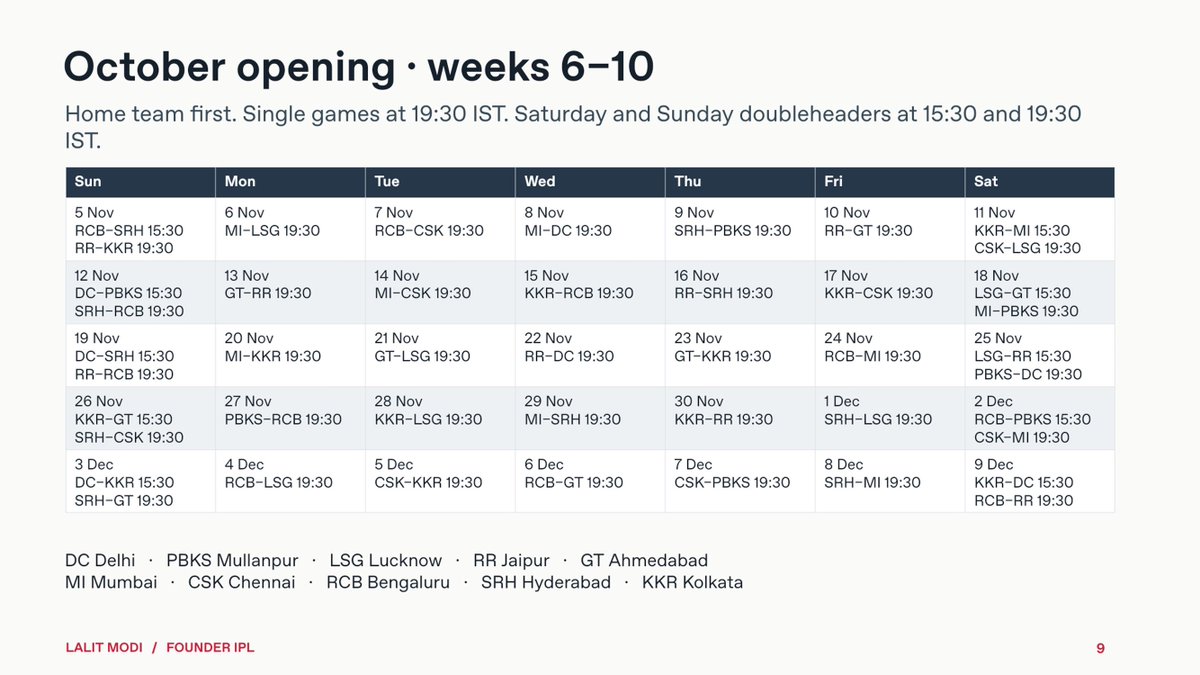
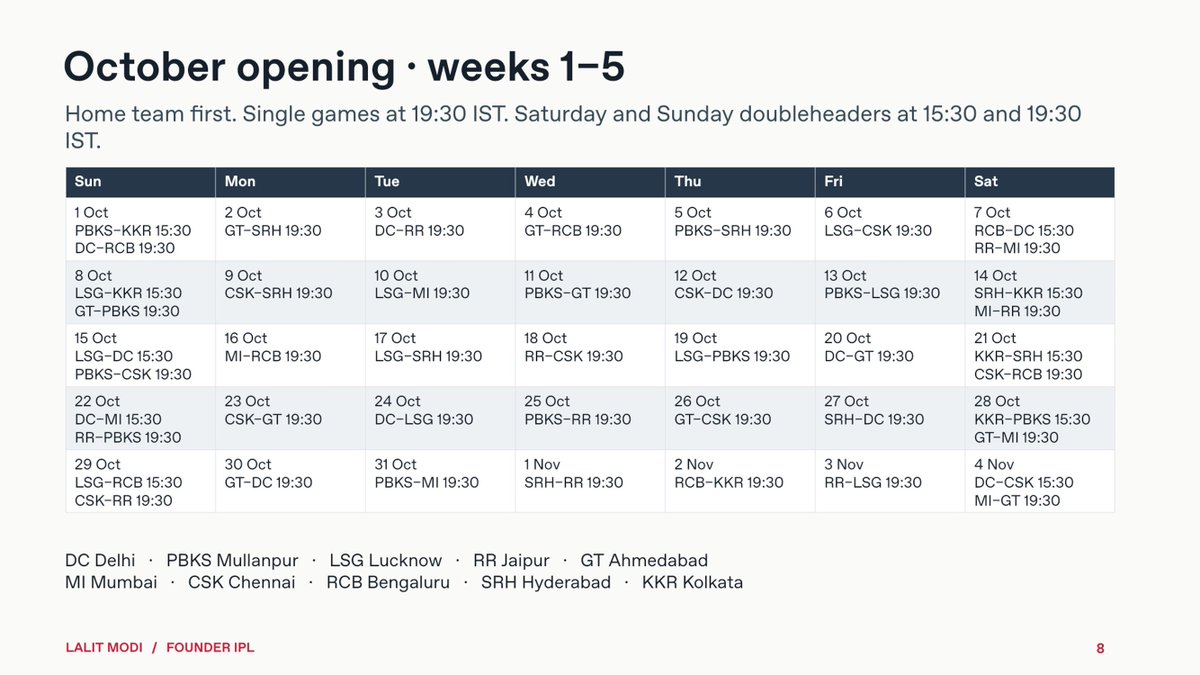
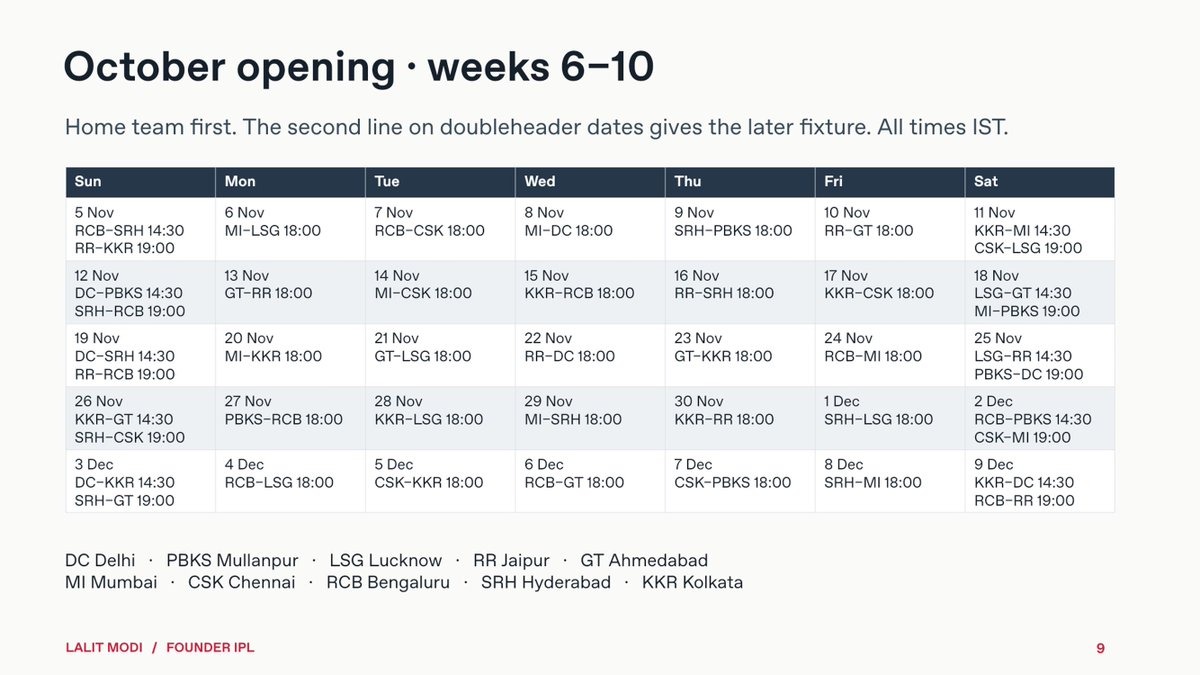
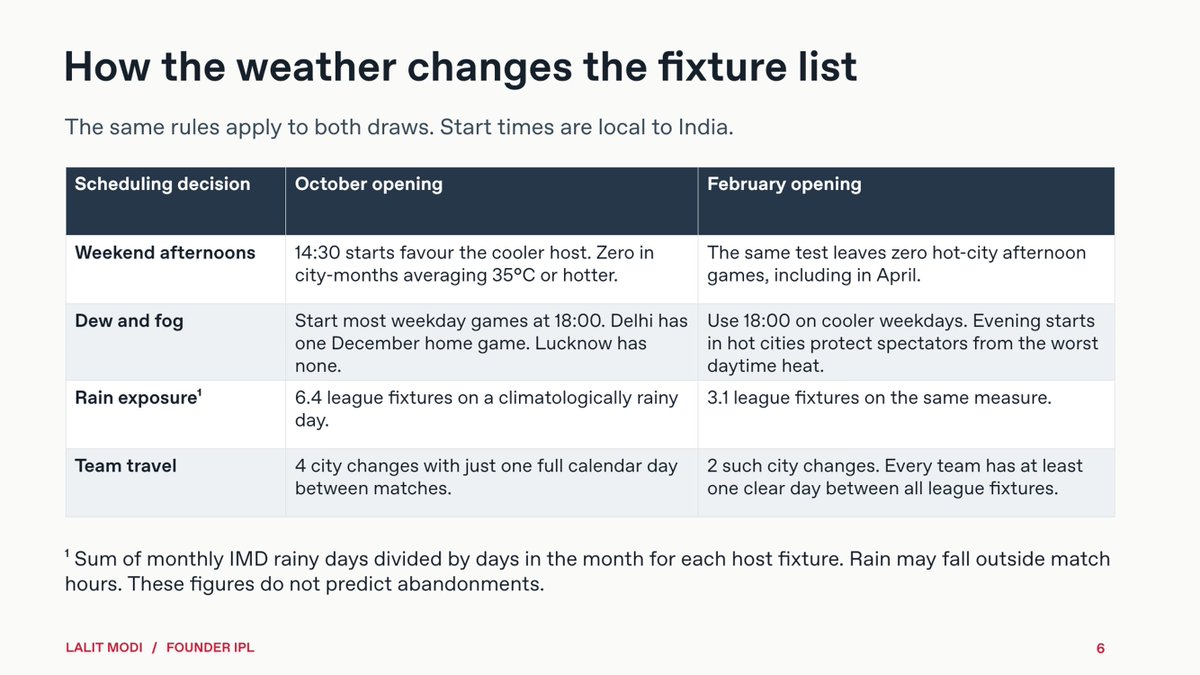
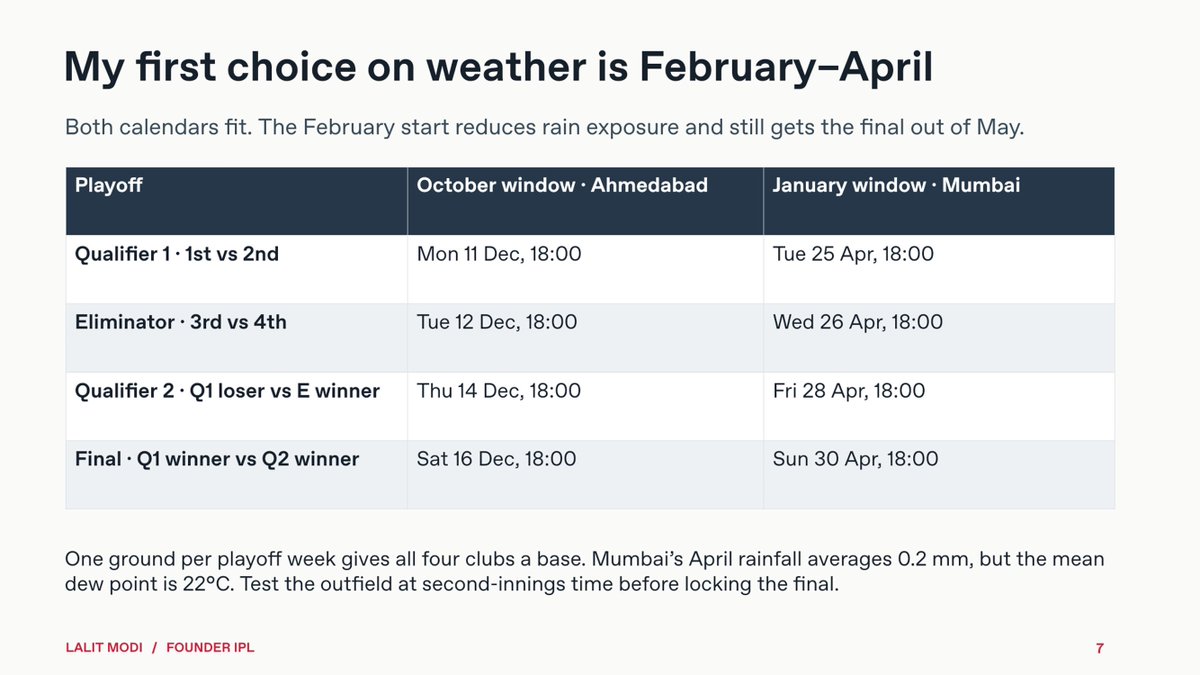
So I’ve put my back-of-the-envelope calculations out here for everyone to look at. Based on ten teams, I make it 90 home-and-away games in ten weeks. One game every weekday, two on Saturday and two on Sunday. Add four playoffs and the whole IPL fits into 77 days.
I’ve put two complete fixture lists in the slides. One starts on 1 October 2028 and finishes on 16 December. The other works backwards from a 30 April 2028 final and starts on 14 February. If I were setting it up today, I’d go with February–April. On this first pass it gives the fixtures less exposure to rain, keeps the hottest grounds out of the weekend afternoon slots and gets us home before May.
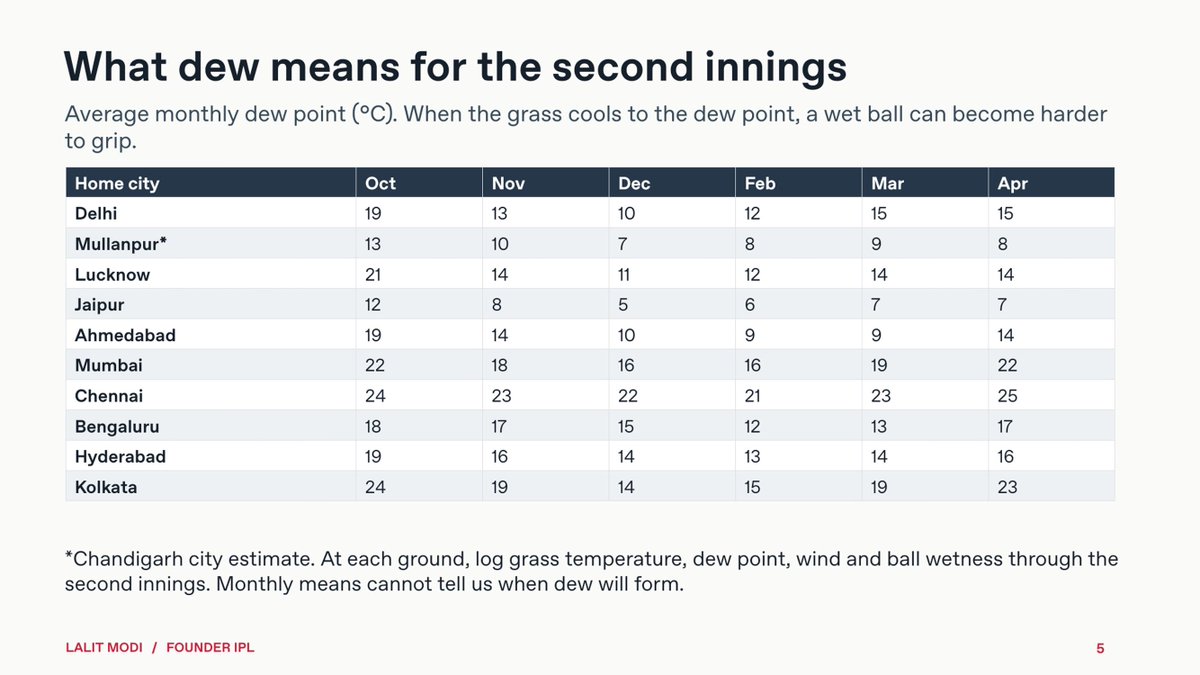
That’s my first calculation. The people on the ground will know things a spreadsheet can’t tell me. Ask the curator at Eden Gardens when the ball starts getting wet. Ask the player who finishes a night game what the next morning’s flight does to his recovery. Ask the fan in Ahmedabad which stand still has the sun on it at four o’clock. Then sit down with the franchises, broadcasters and boards and work through the dates and player releases.
By all means, challenge my numbers. That’s why I’m sharing the fixtures. But before writing the editorial, pick the game you think I’ve got wrong and tell me where you’d move it. Which city, which date, and why? Now we’ve got a cricket debate. 🏏 LETS FOCUS ON WHATS GOOD FOR INDIA FIRST 🇮🇳🙏🏽
Lalit Modi
Founder IPL
@ipl is a domestic tournament that needs no one’s approval. Same thing happened when I launched ipl. @ECB_cricket did not agree and banned its players from participating. Players revolted. Players association revolted. Same will be the case. Secondly we needed all the players season 1. Ipl is the place to be now same as EPL. they too or as a matter of fact no one has an exclusive window. The best league always attracts the best players. Secondly we can schedule north India matches towards February March April in a 4 month window. Further bcci should start investing in building all weather state of the art stadiums and spend 500-600 million dollars per stadium. It can afford it from the ipl 50 percent they keep that itself what I built that was chest for. Thats what is needed. Think long term. Think 10 years down.
Australia can schedule its summer. India can schedule its IPL. Nobody has a monopoly on the cricket calendar. 🏏🔥
BCCI sets its domestic dates. Overseas player releases can be negotiated.
The IPL doesn't need everyone's approval. It needs a calendar that works for the IPL.
This argument in many comments has to place in India. What happened when England and Australia decided everything for close to 100 years. Players globally will come where they see a future.
https://t.co/CpqwkJ5iBU
Dew can be overcome with scheduling - secondly why should @ipl care about counter programming or international schedule clash. It’s a DOMESTIC TOURNAMENT. As far as ipl owners owning other leagues is fine. But all of them LEAGUE COMBINED CANNOT WILLNOT EVER Deliver even ONE DAY IPL REVENUE. So like I SAY - THE WRITING is on the WALL. Adapt or all boards will learn the hard way. The TOP league TAKES IT ALL. See every sport. So stop living in the past please.
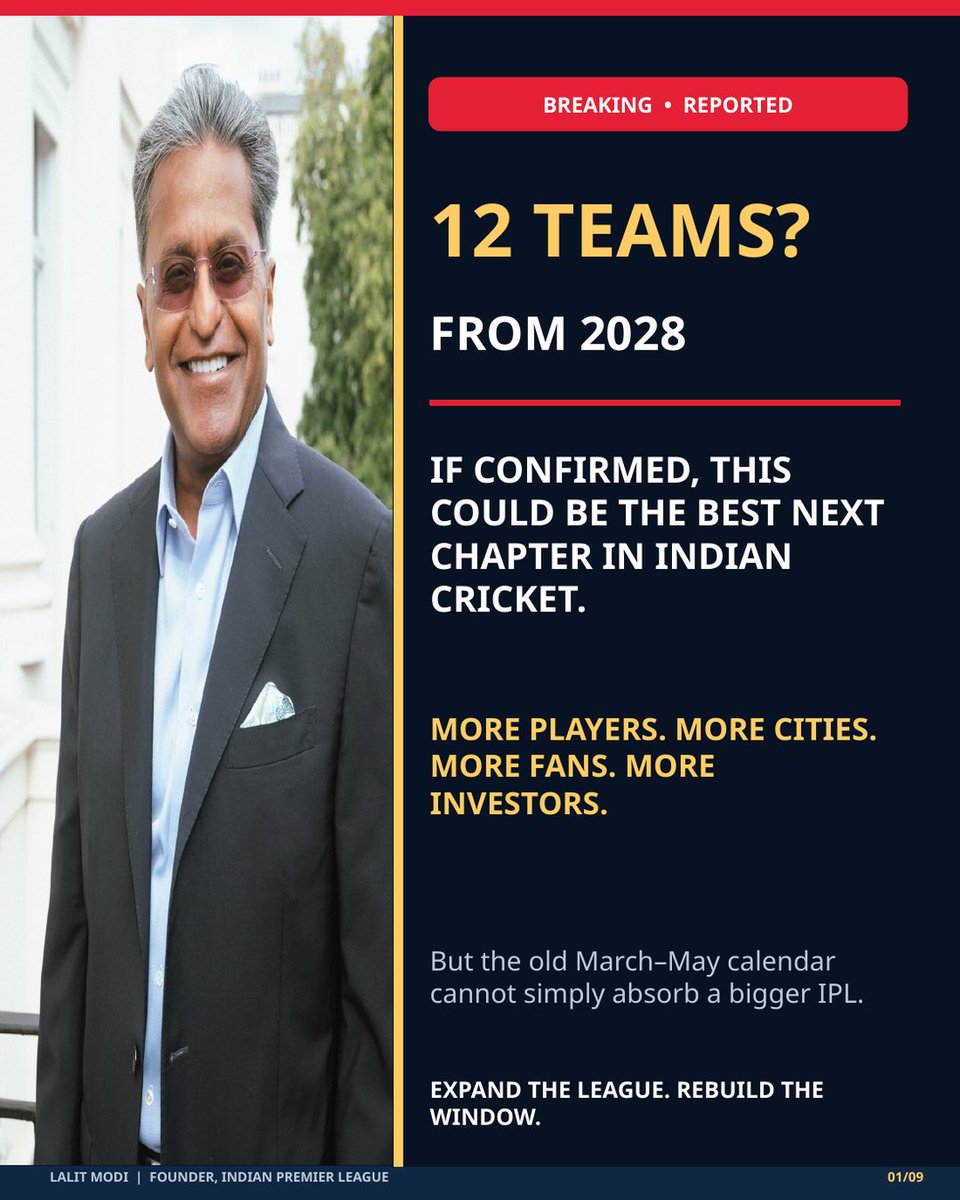
🚨 12 IPL TEAMS FROM 2028? THIS COULD BE THE BEST NEWS FOR INDIAN CRICKET! 🏏🔥
When I created the IPL in 2008 with eight teams, my vision was always to build a truly PAN-INDIA sporting powerhouse.
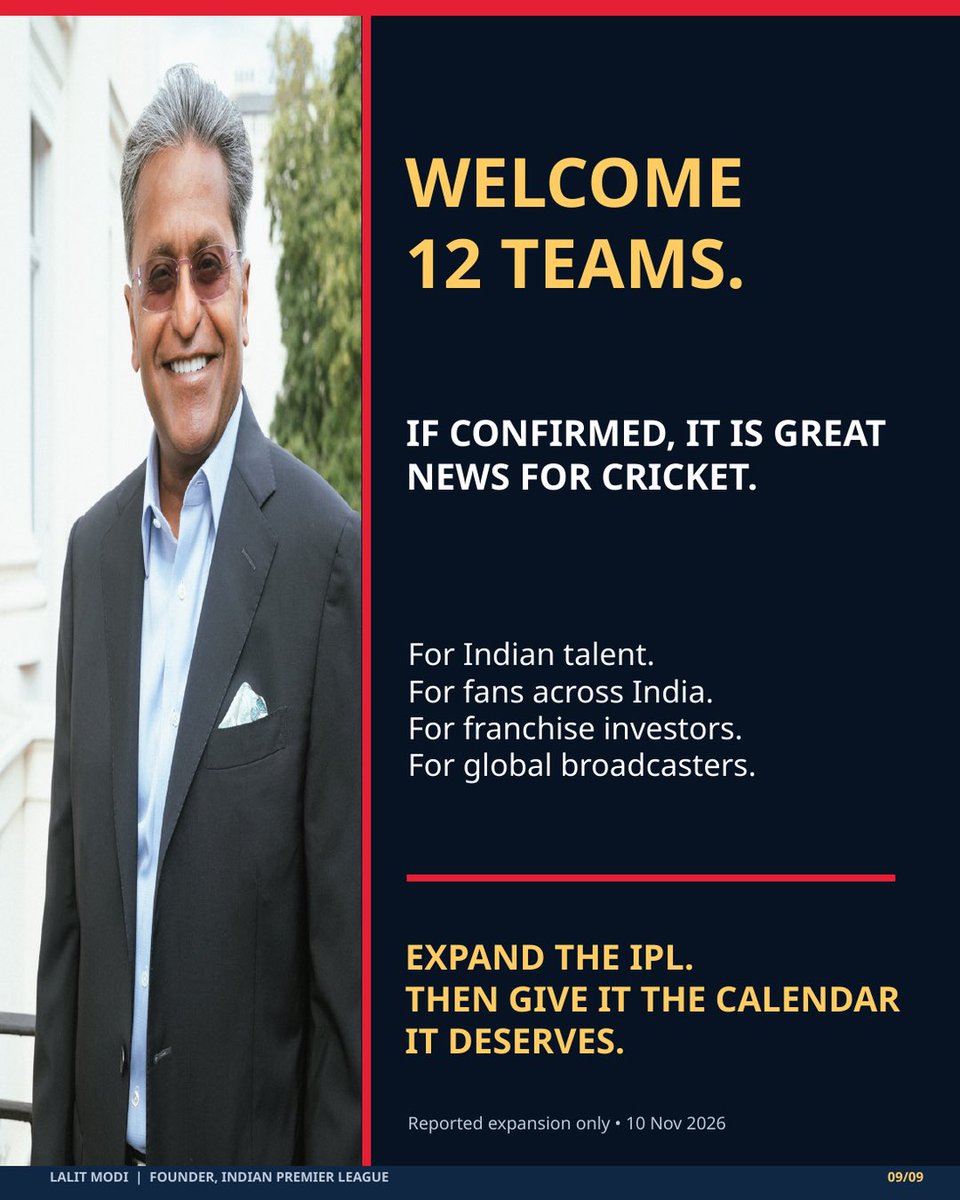
Now reports suggest 12 teams from 2028. I welcome that ambition!
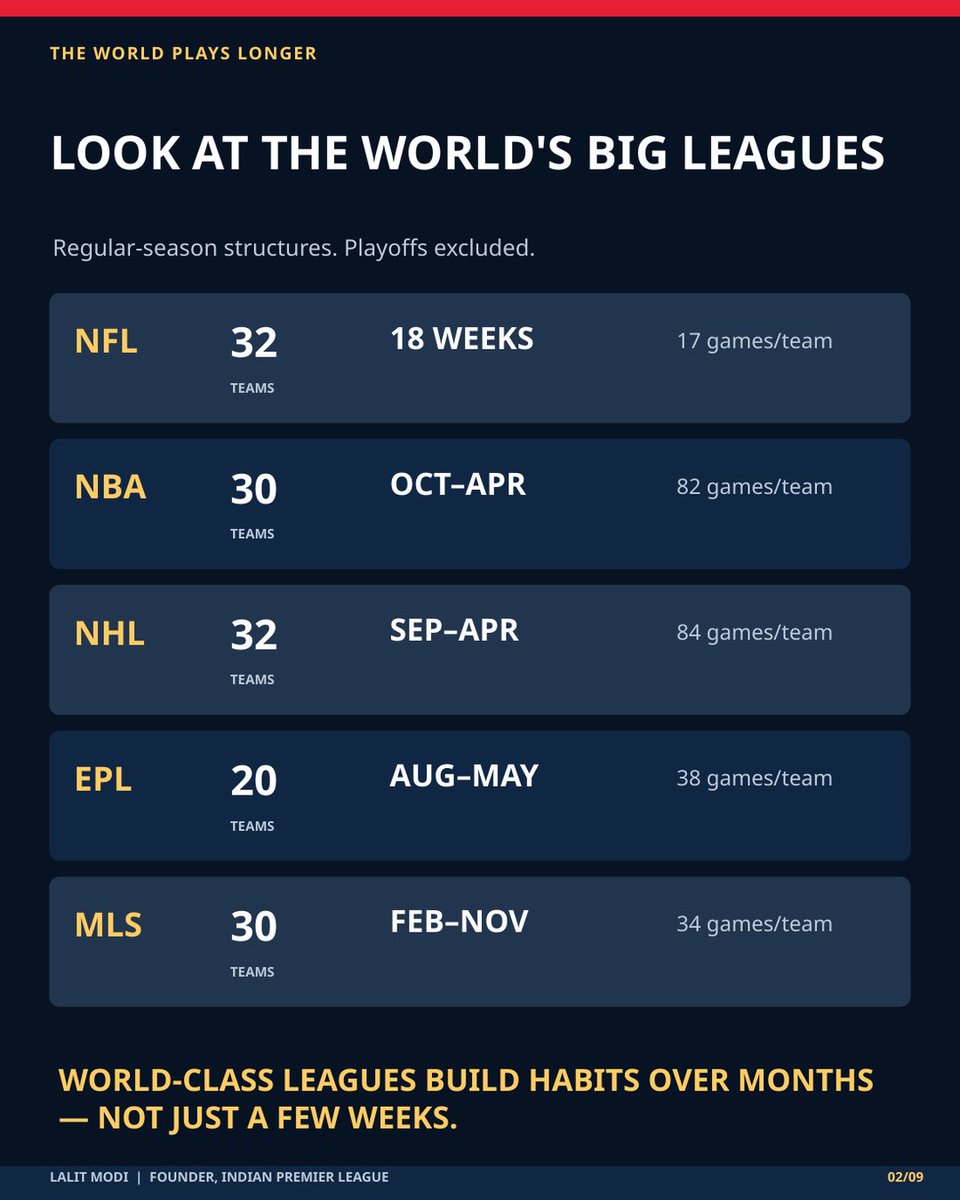
Look at the NFL: 32 teams.
NBA: 30 teams.
EPL: 20 clubs.
NHL: 32 teams.
These great sporting leagues build audiences, loyalty and commercial value across extended seasons.
Why should the IPL think small?
12 teams. 22 league matches per team. 132 league games. Four playoffs. 136 MATCHES!
That’s 84% more match inventory than today’s 74-match format.
Imagine the opportunities for Indian cricketers, new franchise investors, regional fans, broadcasters, sponsors and digital subscribers.
A match every weekday at 7:30 PM. Two every Saturday and Sunday at 3:30 and 7:30 PM.
Nine matches a week. A bigger, more valuable commercial ecosystem.
But let’s be clear: more matches must translate into sustainable economics, not just impressive headlines.
THE CALENDAR MUST EVOLVE WITH THE PRODUCT.
A winter-oriented IPL deserves serious examination. Better playing conditions, a more comfortable fan experience and a longer, predictable broadcasting season.
The IPL is a domestic tournament. The BCCI has the power to rethink its future.
THE IPL DOESN’T NEED A WINDOW. IT CREATES ITS OWN.
I built the IPL to change the market. Nearly two decades later, that ambition should only be getting bigger! 🚀
Lalit Modi
Founder, Indian Premier League
#IPL #IPL2028 #WinterIPL #BCCI #LalitModi #Cricket