Bull Bear Report: Week Of November 20, 2026
- The 200-Day Average Broke. The Next 4 Weeks Are Critical for investors.
- We review the technical backdrop, examine historical breaks of support, and what likely happens next.
- What should investors do now as we head into year-end.
https://t.co/vmdA9O2VvQ
Ran some analysis this morning looking at when there have been very sharp market declines, with RSI below 25, without a credit-related event, recession, or earnings reversion.
Note "The Catch" - that we will ultimately only know this in hindsight, but what we are trying to do is avoid making "emotional" rather than "disciplined" portfolio decisions.
11-21-26 The Leveraged ETF Trap: Why You're Losing Money In A Flat Market
One of the most misunderstood risks in investing is why 2x and 3x leveraged ETFs can lose substantial value even when the underlying stock market goes absolutely nowhere.
Many investors assume that buying a 3x leveraged ETF means earning three times the market's return. But that's not how these products work.
Leveraged ETFs are designed to deliver 2x or 3x the DAILY return of an underlying index, not its performance over weeks, months, or years. That distinction can be incredibly costly.
As FINRA warns, daily-reset leveraged and inverse ETFs are typically unsuitable for retail investors planning to hold them for longer than one trading session.
Here's the problem: daily resetting creates a compounding effect known as volatility drag. In a choppy, sideways market, repeated gains and losses can steadily erode your investment, even if the underlying index eventually returns to its starting point.
Consider a simple example: an index rises 10% one day, then falls 9.09% the next. The index is back to breakeven. But a 3x leveraged ETF? It's down approximately 5.45%, even before fees and expenses.
Now imagine that happening repeatedly over several weeks or months.
That's exactly why investors are asking why their leveraged ETFs keep losing money while the broader market remains flat.
And the longer you hold these products through volatile, directionless trading, the greater the potential damage.
However, leveraged ETFs aren't inherently bad investments. They can be extremely effective in strongly trending markets.
We used a leveraged ETF in our portfolios back in October 2022, when stocks were deeply oversold, sentiment was extremely negative, and conditions favored a powerful rebound. That was a tactical opportunity, not a long-term buy-and-hold strategy.
The key is understanding WHEN leverage works and when it becomes dangerous.
In sustained trends, daily compounding can amplify gains dramatically. In sideways or unfavorable markets, that same mechanism can work against you.
Our advice is straightforward: understand the mathematics, keep your trading window short, and maintain disciplined stop-losses.
The bottom line: leveraged ETFs aren't designed to guarantee 2x or 3x long-term returns. Without a strong trend and proper risk management, you can lose money even when the market goes nowhere.
Please ❤️like, bookmark🔖, and 🔁share with fellow investors.
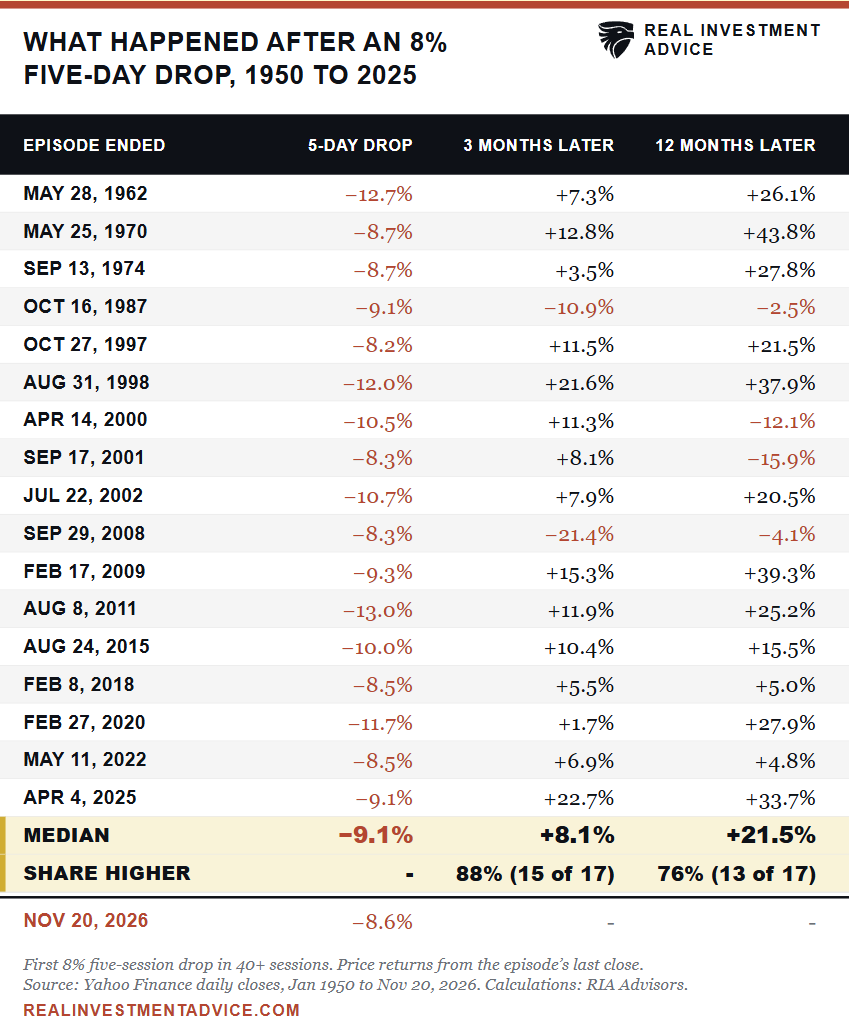
On a weekly basis, the market rarely gets this washed out UNLESS we are in middle of an earnings recession, an economic recession, or a credit-related event.
Interesting table of market returns following an 8% drop in 5-days for the market.
The big factor between today, and the years the market remained negative, is that earnings are still growing strongly and there is no recession risk at present.
11-19-26 Anthropic IPO: The SpaceX Warning You Should Not Ignore
@michaellebowitz and I discuss the highly anticipated Anthropic IPO, why investors should be cautious about buying into the first-day hype, and the important warning from the SpaceX $SPCX IPO that investors should not ignore.
When #SpaceX went public earlier this year, one of the biggest concerns was whether investors would sell other holdings to raise cash for #SPCX purchases.
That's exactly what we saw for a couple of days, as certain areas of the market underperformed while capital flowed into the new offering. With $ANT attracting enormous attention, we could see a similar liquidity drain across other stocks.
But the bigger concern is what happens after the initial excitement fades.
Wall Street has a financial incentive to make IPOs look as attractive as possible. Investment banks get paid to bring these companies public, and they want successful offerings. That means aggressive promotion, enormous investor enthusiasm, and potentially inflated prices during the first few trading sessions.
Historically, investors are often better off waiting rather than chasing the initial surge. We saw that with SpaceX, and we've seen it with countless other major IPOs. Anthropic could follow a similar pattern, with an early rally eventually giving way to a pullback as the market begins to establish a more sustainable valuation.
But Michael raises an even more important question: If Anthropic is such an extraordinary company with enormous future profit potential, why are its early investors willing to sell?
Remember, an IPO isn't just an opportunity for retail investors to buy into a promising business. It's also an exit opportunity for venture capital firms, private equity investors, and insiders who invested years ago at dramatically lower valuations.
These investors have already captured extraordinary gains. Now they have an opportunity to monetize those investments by selling shares to the public at premium prices.
That's why we sometimes joke that IPO should stand for "Initial Premium Offering."
There will likely be stories about early Anthropic investors making billions of dollars. But those profits are being realized at valuations that new public shareholders must now justify through future growth.
And that's the critical distinction: a great company doesn't automatically make a great investment at any price.
The fact that early investors are selling doesn't mean Anthropic won't continue growing or become an enormously profitable business. But it raises an important question about whether the most explosive period of valuation expansion has already occurred.
Our message is simple: don't confuse IPO excitement with investment opportunity. Let the initial hype settle, allow price discovery to take place, and evaluate the stock based on its valuation rather than the fear of missing out.
Sometimes the best trade on IPO day is simply no trade.
Please ❤️like, bookmark🔖, and 🔁share with fellow investors.
📺Full episode: https://t.co/ecP9G533Vj
Catch me daily on The Real Investment Show: https://t.co/38alKrJgMY
11-20-26 NVIDIA Just Had A Valuation Crash — Not An Earnings Crash
@michaellebowitz and I discuss why NVIDIA's recent selloff may represent a massive valuation opportunity rather than a deterioration in the company's underlying business.
$NVDA's latest earnings report delivered a clear message: AI demand isn't the problem. Supply is.
The company continues to generate strong earnings, yet the market seems unwilling to reward that performance. After initially rallying 3–4% following its report, $NVDA surrendered those gains and turned negative within the first hour of trading (and has been down ever since).
Investors are clearly worried about the future. And those concerns aren't entirely unjustified. But at what point does the market price in too much pessimism?
Consider the valuation. #NVDA is trading at roughly 10x forward earnings, 20x trailing earnings, and a forward PEG ratio of just 0.1. Meanwhile, the relative valuation of technology versus non-technology companies has reached an extreme not seen since approximately 2005.
For a company with NVIDIA's earnings power and growth potential, those numbers are extraordinary.
But here's the distinction investors need to understand: a PRICE CRASH and a VALUATION CRASH are not the same thing.
A stock can fall 50% without becoming cheaper fundamentally if earnings expectations collapse alongside its price. Conversely, a stock can remain flat while its valuation plunges because earnings continue growing.
NVIDIA is experiencing a combination of both. Its share price has declined substantially, while the company continues delivering impressive earnings. That means investors are paying dramatically less for its underlying earnings power.
And this brings us to one of the biggest psychological traps in investing.
When NVIDIA was soaring, everyone said they'd buy it after a 30% correction. Now that the correction has arrived, nobody wants to touch it because they're convinced it will fall further.
We've seen this before. In October 2022, NVIDIA was deeply out of favor following a major decline. What followed was an extraordinary rally.
Does that mean NVIDIA has bottomed today? Absolutely not. Future earnings risks remain, and the stock could decline further. This isn't an argument for going all in or trying to perfectly time the bottom.
It's about recognizing the difference between a struggling stock price and a struggling business.
Markets eventually return their attention to fundamentals, earnings growth, and valuations. And some of the best long-term opportunities emerge precisely when investors are too frightened to recognize them.
The question isn't simply how much further NVIDIA could fall – it's how much future earnings power you're getting for the price you're paying today.
Please ❤️like, bookmark🔖, and 🔁share with fellow investors.
@MDusty663079@SoberLook Anthropic built its pre-IPO cash pile—$131.7 billion in cash, cash equivalents, and short-term investments as of June 30, 2026—primarily from private investor capital alongside rapidly growing revenues,