THIS IS SOMETHING EVERYONE SHOULD BE LOOKING AT
THE AVERAGE AI TOKEN PRICES ARE NOW DOWN OVER 50% OVER THE LAST 2 MONTHS
WENT FROM NEARLY $2.10 PER MILLION TOKENS TO NOW JUST $1
🔸 I have followed Daniel Oliver @Myrmikan for a decade now. I just spent an hour reading and contemplating his most recent newsletter. I consider it ESSENTIAL READING and give it my highest recommendation. It is 20 pages long, but well worth your while.
https://t.co/Mwi7rrl3be
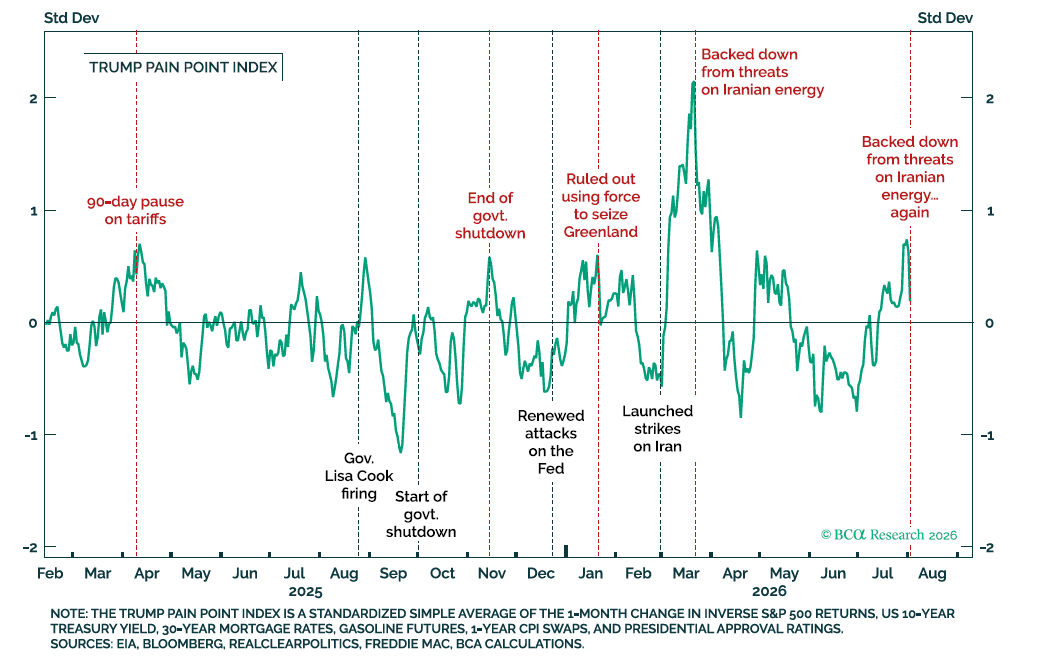
Great chart by my colleague @felixavp...
Looks like we are back to "normal" level of White House fortitude in the face of market constraints... after a breakout in March,
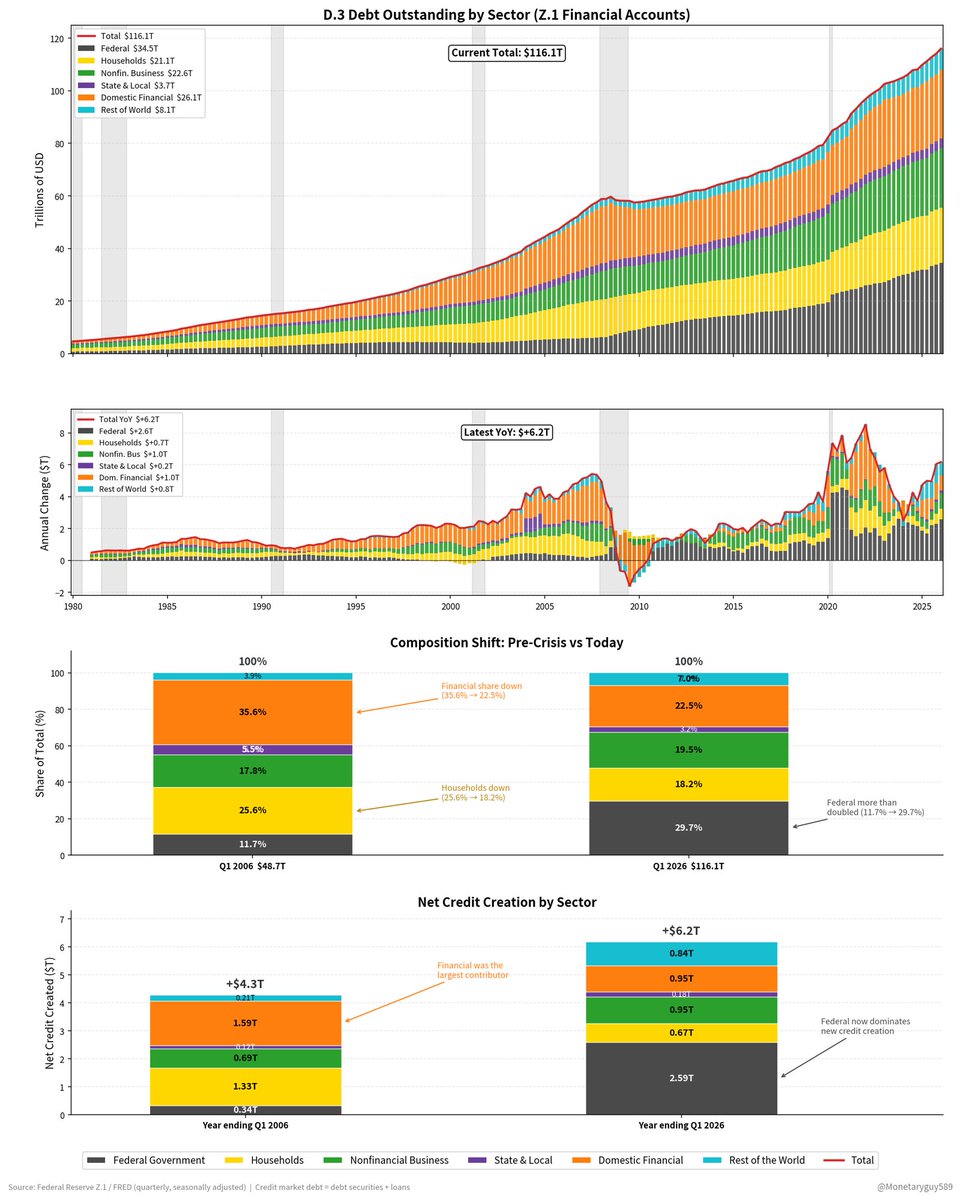
Why does the U.S. credit system look completely different than it did 20 years ago🤔
In Q1 2006, total credit market debt stood at $48.7 trillion. Today it is $116.1 trillion.
But the more important story is who is creating the credit.
Composition of the stock (2006 → 2026):
⬛️Federal Government: 11.7% → 29.7%
🟧Domestic Financial: 35.6% → 22.5%
🟨Households: 25.6% → 18.2%
🟦Rest of the World: 3.9% → 7.0%
Net credit creation in those same years:
2006: +$4.3T: Led by the Financial sector (+$1.6T) and Households (+$1.3T). The Federal government added only +$0.3T, while the Rest of the World contributed just +$0.2T.
2026: +$6.2T: Dominated by the Federal government (+$2.6T). The Financial sector and Households are now secondary while the Rest of the World has climbed to +$0.8T.
Twenty years ago, private domestic balance sheets (financial institutions and households) were the primary engines of credit growth. Today, the Federal government is the dominant source of new credit market debt in the system with foreign participation growing meaningfully.
The scale of the debt has more than doubled and the composition of who is issuing it has inverted🔄
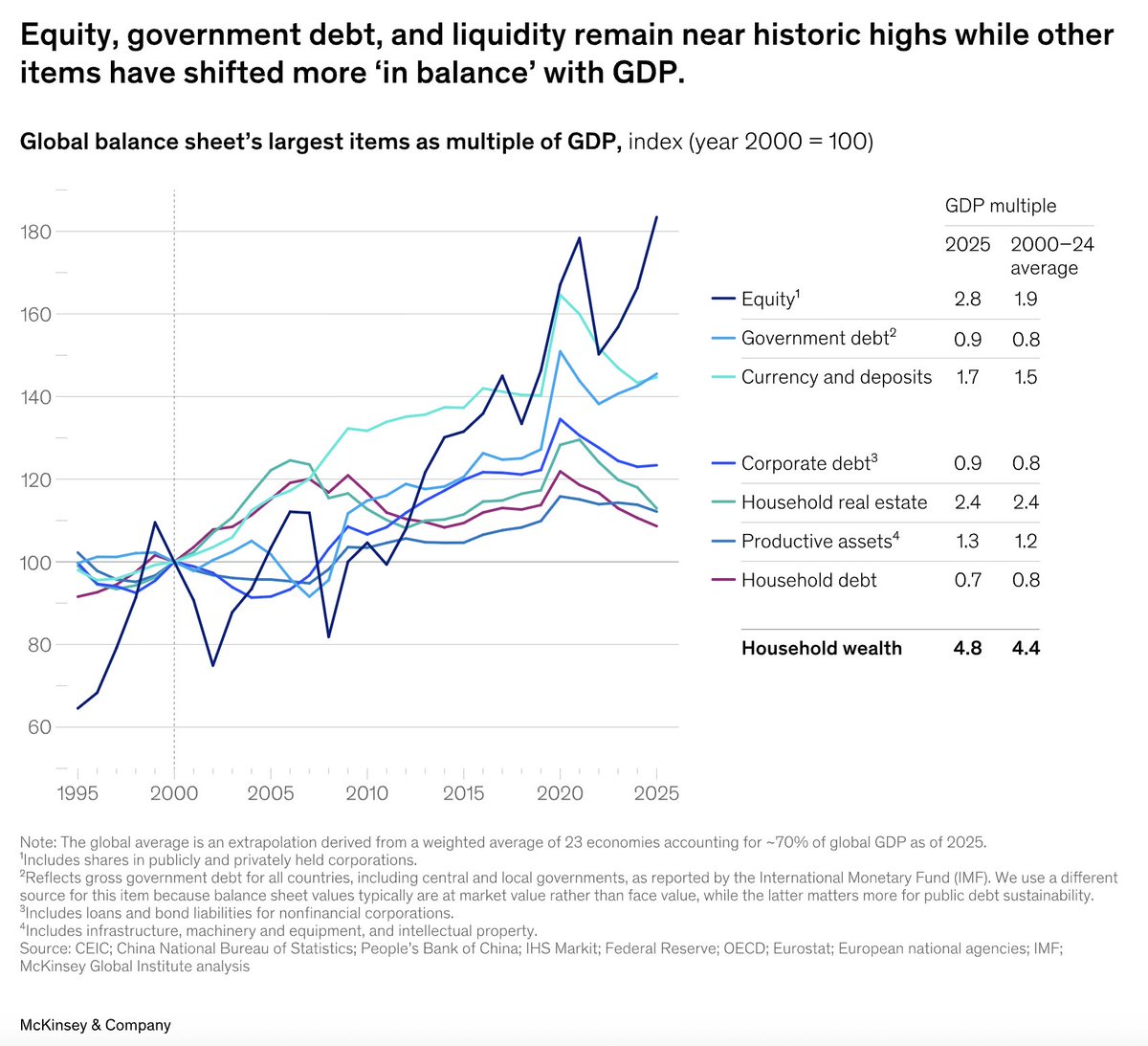
A megatrend to rule all megatrends—the progressive financialization of the global economy: "The global balance sheet takes stock of all assets, liabilities, and wealth, providing a lens into economic health. This annual update estimates that it reached nearly $1.8 quadrillion ($1,800 trillion) in 2025, up from $1.7 quadrillion in 2024. Several asset classes grew further out of balance with the underlying economy, raising the possibility of corrections through inflation, asset valuation losses, or, optimally, productivity growth."
A question that has been woven into the background of nearly every report I've written since launching Sage Road Research roughly a year ago (learn more here: https://t.co/Wgwz2xnvR6): At what point does financialization crack under the weight of misallocation excesses? It's an unanswerable question, but whether it's studying private equity, private credit, the AI trade or the economy's extreme K-shape, the vulnerabilities generated by paper wealth creation outpacing productivity-driven wealth creation have intensified. It's foolish for anyone to claim they can anticipate the timing and specific catalyst of a breaking point. However, I also think it's foolish to not hedge the risk of the financialization engine backfiring. Offering clients actionable ways to do exactly that has been a core focus of my work at Sage Road.
More from McKinsey: "From the mid-1990s to the COVID-19 pandemic, household wealth expanded faster than gross domestic product. Asset prices for real estate, equities, and bonds grew, as did debt and deposits. This occurred amid declining (and eventually rock-bottom) interest rates, rapidly expanding US profits, and a property boom in China. Productivity did not keep pace across advanced economies, nor did real wealth formation through net new investment.
When the balance sheet outruns the underlying economy, weaknesses can be exposed. When real estate and equity values rise faster than GDP, capital may disproportionately go to asset repurchases, sometimes with a lot of leverage. This may push up valuations but leave the economy deprived of the type of investment that generates long-run growth. For households, wealth rises but merely on paper, with heightened risks of eventual corrections. Growing asset values also tend to exacerbate wealth inequality, as existing owners of wealth see large gains while entering asset markets becomes harder for others (for example, young households trying to buy a home)."
McKinsey link: https://t.co/8WJgkhSgbn
This essay is not only about socialism.
It's about the gradual replacement of democracies by the administrative state.
Read the full essay here:
https://t.co/vElhSPdVY2
double the optimal bet size and a 60% win rate compounds to exactly zero
not smaller. zero. the edge stays real and the growth rate dies anyway
that's the part of the kelly criterion nobody quotes
john kelly, bell labs, 1956. one formula for how much of your capital to risk
f* = (p·b − q) / b
p is your win probability, q is 1−p, b is your win-to-loss ratio
the output is the fraction that maximizes long-run geometric growth
worked example. 60% win rate, 1:1 payoff:
f* = (0.6 × 1 − 0.4) / 1 = 0.20
twenty percent of capital per trade. that's the growth-optimal size
now the asymmetry retail never sees
in continuous form the growth rate is g(f) = f·μ − f²σ²/2
it's a parabola. it rises to a peak at f*, then falls
and it crosses zero at exactly 2f*
so betting 40% instead of 20% on that same system doesn't halve your returns
it deletes them. same edge, same win rate, zero compounding
past 2f*, the growth rate goes negative and ruin becomes mathematically certain despite a positive expectancy
that's how traders blow up holding a strategy that actually worked
the strategy was never the problem. the fraction was
which is why desks run fractional kelly
half-kelly gives you 75% of the growth for half the volatility
that trade is why AQR, PDT, two sigma all size below the theoretical optimum on purpose
retail asks "how much can i make on this trade"
a desk asks "what fraction keeps the geometric mean positive across every sequence this system can produce"
kelly published in an open bell labs journal in 1956
thorp used it at princeton-newport for 19 years without a losing one
the formula was never the secret
the secret is that the curve punishes overconfidence harder than it rewards a better signal
full breakdown in the article below
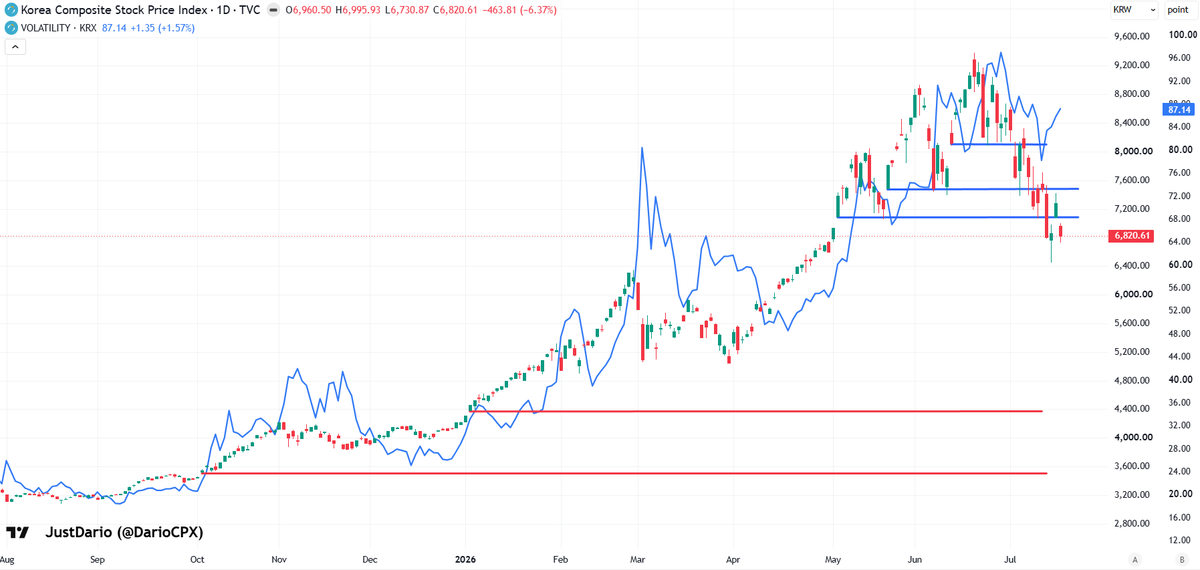
I still cannot wrap my head around the fact that the Korean government saw nothing abnormal with all that was happening in the KOSPI - they had to wait for a 1.2 million margin calls tsunami to realise this whole market is just a bunch of tulips at the end of the day
Our Civilization is Nobody’s Department
Western civilization has regulators for finance, watchdogs for governments, frameworks for security, international bodies for everything from fisheries to intellectual property. It has no institution tasked with safeguarding the civilization itself.
This was not an oversight. It was an assumption – that what had endured would simply keep enduring. Assumptions are not a strategy.
Every great system eventually requires conscious stewardship. The Romans assumed the Republic would hold. The Venetians assumed the trade routes would always be theirs. Every civilization that ever declined assumed it wouldn’t – right up until the moment the assumption became obviously wrong, at which point it was already too late to do much about it.
What makes this moment different is the paradox: a civilization powerful enough to have shaped the entire world, yet seemingly unable to consciously preserve its own existence. We have built extraordinary mechanisms for managing parts of the system – the financial regulators, the defense alliances, the legal frameworks. The deeper foundations — cultural memory, shared values, intellectual honesty, civic responsibility, the willingness to say what is true in public — are left diffuse, unmanaged, and increasingly abandoned. Nobody’s department. Nobody’s budget line. Nobody’s quarterly report.
The result is not collapse. It is drift. Slow, quiet, constant. The kind that shows up not in a single catastrophic event but in the gradual erosion of standards, the slow lowering of expectations, the institutions that stopped reinforcing the civilization’s principles and started undermining them – from the inside, with the best intentions (or not…), in the language of progress.
And into that drift, other civilizations are moving. Not always with armies. Often with patience, money, demographic pressure, and the simple advantage of believing their civilization is worth advancing while ours debates whether it deserves to exist.
A civilization doesn’t need a single authority to watch over it. That would be its own kind of tyranny. But it needs something harder to build and easier to lose: a distributed sense of responsibility among enough of its people, enough institutions that reinforce rather than corrode its principles, and the willingness to examine itself honestly without dissolving into the self-hatred that mistakes destruction for sophistication.
The question is not only who should guard Western civilization. It is whether it still believes it is worth guarding – and whether enough people are willing to take that responsibility personally, seriously, and now. The threat is real. Other civilizations are entering every space we vacate, every institution we hollow out, every conversation we are too afraid to have. They are organized. They are purposeful. They are not confused about what they want.
The answer is not one institution. It is many people, in many places, choosing the same thing: tell the truth. Have the courage it requires. And build — the structures, the networks, the institutions, the arguments, the communities — that a civilization needs when it can no longer take itself for granted.
Powerful individual men are great – a structure is even better.
Tell the truth, have courage and build.
The gap between VIX and single-stock implied vol just hit another record high.
The divergence between market stability and stock instability has never been greater.
I ran across this self-proclaimed copper bull on my feed, and the guy was literally wishing a death curse on the entire tech complex—EVs, AI, the whole nine yards.
Honestly, I was completely dumbfounded. I’ve been sitting on a massive book of copper equities for years now, but if you’re long Dr. Copper, you should be aggressively praying that Jensen Huang and Sam Altman don't get locked up and AI data centers don't spontaneously combust.
Legacy copper demand has been flatlining for a minute now. We've all heard the "China property sector is toast" macro tape until we're blue in the face. Granted this cycle is heavily supply-driven, but the demand side is anchored to the high tech narrative.
It's the energy transition and data centers that are holding up the structural demand thesis. This frontier demand is ramping on a hockey-stick trajectory; EVs were the headline act early on, but grid and transmission capex are rapidly becoming the real heavy lifters.
Backstopped by the AI revolution and this insatiable hunger for power, global grid capex is compounding exponentially, and copper is running the textbook picks and shovels play.
Also structurally speaking, an EV gobbles up almost 3x the copper intensity of a legacy ICE vehicle, meaning EVs already occupy a massive chunk of the demand pie chart.
To top it off AI data centers are more than double the copper-intensity of a vanilla crypto mining warehouse. The data center demand vector is moving in a straight line up and right.
And yet, some guys still want Tesla and Nvidia to go to zero? Give me a break. We need these tech nerds to keep printing.
#copper $hbm
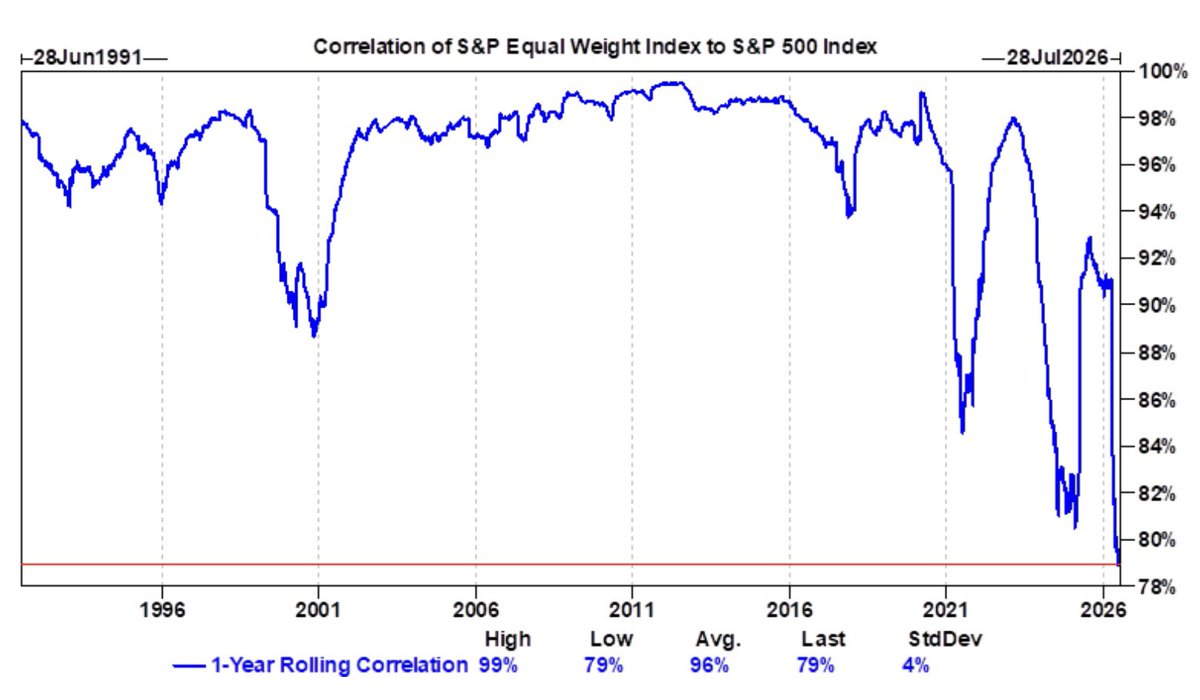
Per @GoldmanSachs, 1-year rolling correlation between S&P Equal Weight index and S&P 500 index has collapsed to just 79% (lowest reading ever vs. historical average 96%); U.S. equities no longer trading as one index; they’re trading as collection of individual stories, raising importance of stock selection/creating much richer backdrop for dispersion/single-stock volatility through earnings
This is a really important signal by China to Europe.
The social media account Yuyuantantian, operated by China’s state broadcaster CCTV and created in 2019 during China's first trade war with the US specifically to signal China's position, just wrote a long article (https://t.co/hR6OV0mCTj) on the brewing trade war between China and Europe.
Most notably they say the EU's current strategy of dealing with China "can only produce a paper tiger" (meaning it cannot hurt China) and that China is "not afraid" of a "freezing point" in trade and economic relations with the bloc - meaning presumably a complete halt of trade.
This sentence is eerily similar to what China told Trump when he unveiled the tariffs on China (and the whole world) in April 2025. At the time China's Ministry of Commerce said that "if the U.S. insists on its own way, China will fight to the end" (https://t.co/XXN2cwhGFg).
The context is that the EU is currently working on a series of extremely hostile new legislation packages against China, such as the so-called "overcapacity instrument" on which I wrote a long post at the beginning of the month (see quoted post👇).
This instrument is basically a legal tool that says that if China is competitive globally in a given sector in such a way that it exports a lot, that's proof of overcapacity, and legally it'd mean that the entire sector can be restricted from the EU market.
In essence, it's a law that says: if your products are good enough that people want to buy them, that's grounds for banning them. Which is pretty insane!
There's also a so-called "diversification instrument" being developed alongside it, which - according to Maroš Šefčovič, the EU's trade chief himself - is modelled on how the EU reduced its reliance on Russian energy after the Ukraine invasion (https://t.co/eAGThXFANx) and is developed with China in mind.
In their article, Yuyuantantian say that all of this is part of a "escalate first, de-escalate later" strategy - essentially bullying - that the EU borrowed from watching the US, but without any of the leverage to back it up.
As the article puts it: the actors who can pull off extreme pressure tactics can only do so if they have "absolute leading positions in key areas or irreplaceable international influence." The EU, it notes, has neither, hence them concluding that the EU "forcibly pursuing 'escalate first, de-escalate later' can only produce a paper tiger."
Another very consequential framing in the piece is that they characterize Europe as becoming - essentially - a rogue actor in the international system, that doesn't care about rules anymore. Which they say is suicidal for Europe in several ways.
First of all, as they write, the EU's international identity in the international system - its USP, if you will - rests entirely on being a "normative power," a rules-based institutional actor that you can do business with precisely because it won't move the goalposts on you. That's what made European standards worth complying with and European markets worth the entry cost.
As they explain, the EU had gone against China in the past but always within the rules of the WTO (with tools like anti-dumping and anti-subsidy), and always in a way that was somewhat justified and predictable, basically the cost of doing business.
However, the new approach is designed to be essentially unpredictable and arbitrary- and as such makes Europe less and less attractive and more and more risky.
They point out the irony of Europe on one hand saying it wants more investment and industrial cooperation to learn from China but at the same time "constantly raising the bar for attracting investment and maintaining industrial cooperation."
As they write: "the greater the uncertainty, the less likely long-term capital and supply chains will dare to enter, ultimately harming Europe's own sources of growth."
Secondly, the article exposes what is arguably the most self-destructive contradiction in the EU's entire approach: the EU's stated justification for all these new tools is its "unsustainable" trade deficit with China. But when China came to the negotiating table and said "fine, we'll buy more from you," the EU had nothing to offer - because what China wants to buy is high-tech products, and those are exactly what Europe restricts under its export controls policy (largely at the behest of the US).
In essence, Europe's approach is purely punitive, shutting every door simultaneously: you can't export to us (overcapacity), you can't invest here (unpredictable and arbitrary legal risk), and we won't sell you what you want to buy (export controls).
Now you understand why China is becoming frustrated to the point it's contemplating a "freezing point" in trade and economic relations with Europe. When the party on the other side of the table punishes you for exporting, blocks you from investing, and refuses to sell you what would fix the problem they're complaining about, there's not much left to talk about.
My personal opinion is that it is undeniable that Europe is suffering from grave economic problems, but it's mistaking symptoms for cause: it's doing the equivalent of wanting to punish the runner who overtook you instead of asking why you're getting overtaken.
The car industry is a really good case in point: Chinese EVs really are better than German cars at this stage, and it's NOT because of subsidies (quite the contrary in fact, see this: https://t.co/CuL8Gy0KkF). As such, how does punishing China for their competitiveness help the German car industry, specifically? What would help are rather initiatives to learn from the best: stuff like technology partnerships and welcoming Chinese factories on European soil.
The notion that if you ban China the problem goes away is exactly what the Ming dynasty - in 17th century China - did and that's what directly led to the century of humiliation because it became backwards technologically: it's what we call in French the "policy of the ostrich" ("la politique de l'autruche"), putting your head in the sand and hoping that makes things better.
And timing-wise it couldn't possibly be worse: having cut itself off from Russian energy, caved to American tariffs, and destabilized its own industrial base - the logical next step was apparently to pick a trade war with your largest trading partner and the last remaining great power with genuine goodwill towards you.
Because that's the real tragedy of the China-Europe relationship: there is a genuine and frankly almost touching desire for engagement and cooperation from the Chinese side and Europe is doing everything in its power to squander it.
#Copper: During a week that delivered a USD and FOMC driven correction that briefly pushed HG copper below the key USD 6.15 per pound support level before rebounding to end the week back above it, exchange-monitored copper inventories continued to decline. The drawdown was once again concentrated in London and Shanghai - the two exchanges that provide the clearest signal on the global physical market.
Stocks at the LME fell by 15.7 kt and SHFE inventories declined by 8.1 kt, more than offsetting a 9.6 kt increase at COMEX. US inventories climbed to a fresh record high of 601 kt ahead of the expected end-June announcement on potential US copper import tariffs, leaving COMEX accounting for 56% of all exchange-monitored inventories.
Excluding the continued accumulation in the US, where metal has been drawn by the tariff premium rather than underlying consumption, global visible inventories continue to tighten. This suggests the recent price weakness has been driven more by macro headwinds - including a stronger dollar and technical driven long liquidation - than by any meaningful deterioration in the underlying physical supply-demand balance.