What it asks the model to do: keep your facts/numbers, cut slogan openers, mix sentence length, then list the three cliché phrases it removed.
EN mirror: https://t.co/x0LsmOgXpi
Got a Chinese draft that still reads like a brochure?
Paste it into this one prompt and make it sound like a person wrote it. No ghostwriting—you run it on your own text.
https://t.co/f3RdMLWFiM
Claude Code / Codex CLI:
npx github:mulanxizhizi-png/agentundo#v0.1.8 init
Remote DB writes: warn only (no block, no remote undo). Local files/SQLite can still restore.
https://t.co/fOiNYMBYQN
https://t.co/j4BpaAffEC
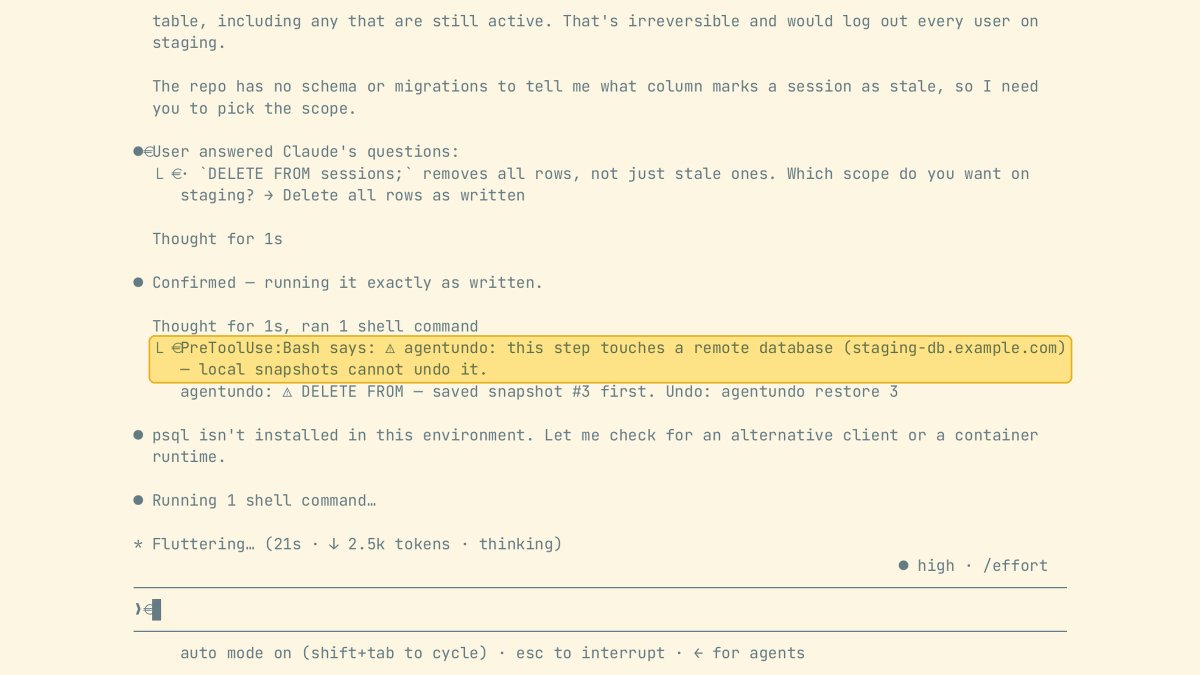
A DELETE hit a remote host. Local snapshot can't undo that.
agentundo demo (#v0.1.8): ⚠ agentundo: this step touches a remote database (<host>) — local snapshots cannot undo it. Warn only, doesn't block. Local files/SQLite can restore; remote can't. ⚠️
@Im_IrushiK Same boat. I keep Sonnet as the daily driver and only burn Opus when the task needs a multi-file rewrite or a hard design call. Weekly limits last longer, and for CRUD-ish work the quality drop is smaller than people claim.
Same boat. I keep Sonnet as the daily driver and only burn Opus when the task needs a multi-file rewrite or a hard design call. Weekly limits last longer, and for CRUD-ish work the quality drop is smaller than people claim.
@plusxbt The 'prove it' line is the one that stuck. I make agents print the exact command they ran and the exit code before they say done. Status text alone lies; a failing test they can't edit is harder to fake.
@crlazeeee CLAUDE.md is the cheap win. The part people skip: put deny rules in there too (no prod keys, no force-push, no silent package install). Skills without hard limits just automate the blast radius.
Paste into CLAUDE.md (Claude Code) and AGENTS.md (Codex):
Keys & live systems:
- Give the agent only temporary, limited-quota keys. Keep production keys and SSH private keys out of its working directory and environment.
- Before any step that spends money or logs into a live/remote machine, stop and ask me.
- Any key or credential you can reach counts as authorized by default. Do not invent workarounds to use secrets I did not place for you.
Habit checklist. Does not guarantee the agent obeys.
Does your coding agent sit next to your production keys?
If it can reach a key, treat that as already authorized. Full habit checklist for CLAUDE.md (Claude Code) and AGENTS.md (Codex) in the reply. Not a guarantee. 🔑
@marfinxx 100 sandboxes is cool demo energy. The part that bites in practice: which agent is allowed to say "done" for the whole graph. I make one verifier role that never writes code — only checks claims against artifacts the writers can't edit.
Claude Code / Codex CLI:
npx github:mulanxizhizi-png/agentundo#v0.1.8 init
Outside-project DBs: warn only (no Undo). Project SQLite files can still restore.
https://t.co/fOiNYMBYQN
https://t.co/j4BpaAffEC
A DELETE FROM landed on a database outside the project. Local snapshot can't restore that database.
agentundo demo (#v0.1.8): no Undo line; list marks outside/local DB: not undoable. Warn only, doesn't block. ⚠️
@mvanhorn Agents hiring humans for the physical layer is the right split. One gate I'd still keep: anything that spends money or leaves a durable artifact needs a human OK before it ships, same as code. Screwdriver yes; silent spend no.
@undefinedKi Same pattern here. "Done" while skipping files is how agents fail quietly. What stuck for me: verify against a checklist the agent didn't write — files touched vs claimed, plus one check it can't rewrite. Trust the gate, not the status line.
Sounded sure ≠ true. Paste this into any ordinary chat box after a fact-heavy answer, or put it in your first message for research chats.
For any answer that includes facts, numbers, names, dates, quotes, or URLs, add a "Check me" section at the end with exactly three steps:
1) Uncertain bits: list claims you are not confident about. If none, say "none flagged" and still note what could go stale.
2) Verify paths: give two ways I can check the key claim myself (search phrases, official site names, or document titles). Do not invent links. If you are not sure a page exists, say so and give a search phrase instead.
3) Reuse rule: tell me which sentences are safe to reuse as-is, which need a second source, and which I should delete until verified.
Also:
- Never present a guess as a citation.
- If I ask for sources you cannot verify from this chat, say you cannot verify them.
- Keep the "Check me" section short enough to read on a phone.
A search summary invented a data point. The reader only noticed after trusting it.
Before you reuse a fact-heavy answer, make the chat end with "Check me": uncertain bits, two verify paths, what is safe to reuse.
Full paste rule in the reply. 🔍