Football player post-adductor surgery was working on ballistic movements and agility recently while he attended tryouts to get picked up by a team. Pt is now signed with a professional team to finish out the season! Hard work pays off!
Beach volleyball players are looking to progress from rehabilitation from their previous injuries into a strengthening program as they approach their off-season. Any ideas for sport specific strengthening that focuses on abdominal and shoulder stabilization?
20 y/o female soccer player s/p knee arthroscopy demonstrated weak hip abductor strength. Fast forward 12 weeks.. She now demonstrates appropriate glute activation with current strengthening exercises. Intro to agility and plyometrics begin this week and she could not be happier!
Pt s/p partial shoulder replacement is in his 12th week of PT, but is having difficulty with active abduction. Palpation revealed absence of RTC activation with isometric abduction. With light GH distraction, pt learned to use RTC by pulling humeral head back into the socket.
10 y/o siblings in PT to address pitching deficits. Pts tend to lose focus during the session. What did we do to address this? Turn the exercises into friendly competitions to keep them engaged! It's important to learn what is meaningful to each patient to keep them motivated!
Tennis player in later stage of recovery from labral tear in R shoulder. Pt currently performing scap stabilization exercises, OKC exercises, and exercises related to tennis forehand. Suggestions on what exercises to incorporate that are more specific to tennis serve?
17 yr old with pitching deficits displays L foot in-toeing while lunging with R leg in front. L ankle stability assessed, but it was actually better than the R ankle! Is the mechanism actually starting at the hip? Something to look into next session!
Pt s/p adductor surgery to reattach the tendon to bone was told by MD that remaining swelling could be due to impaired inguinal lymph node function. It was the perfect opportunity to try out the MLD we practiced in class! We also instructed pt on how to perform MLD on his own.
Pt has had 3 surgeries to correct scoliosis. Imaging later revealed that a screw was pushing into pt's L5 vertebrae with any flex, ext, and rotation so we must avoid these mvmts. Sup & quadruped isometric abs already implemented. Any other ideas to improve abdominal strength?
Pt has elbow pain for 2nd time this year after throwing football at practice. Pt reports tenderness in triceps tendon and pain with MMT. PT would like pt to rest to prevent further injury, but pt wants to practice since he is in the middle of tryouts. What should we recommend?
Here are some key symptoms your patient could present with if they have normal pressure hydrocephalus: wide-based 'magnetic' gait, urinary incontincence and impaired cognition. Imaging will reveal enlarged ventricles if the pt. is experiencing NPH. #PT546week13@manjiridahdul
Neoplasms can present with similar signs and symptoms! In order to diver deeper and determine what you're dealing with you can perform a quick 5 min CN screen and watch out for red flags. If you're suspicious then refer for imaging (MRI or CT)! #PT546week12@juliehershberg
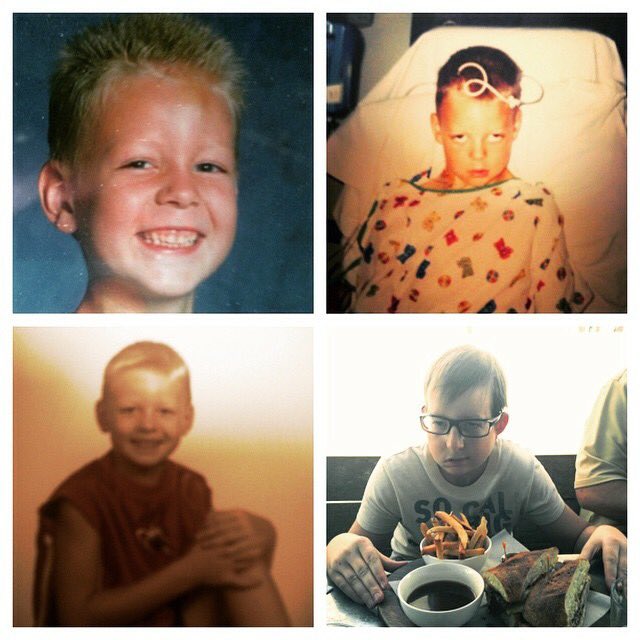
Another happy story: my brother Logan has been in remission for 15 years after undergoing surgical resection, chemo, radiation, and lots of PT for stage 4 GBM 🧠 tumor! Today logan teaches chess and attends community college! #ProudSis#PT546week12@juliehershberg@LibbyKrauseDPT
Acute subdural hematoma and epidural hematoma can both can result in LOC, hemiparesis, and posturing reflexes. One way to differentiate the two is by looking at imaging! On CT, acute subdural hematoma will look crescent shaped and epidural hematoma will bulge. #pt546week11
When it’s aching in ya head girl...come to PT, come to PT come to PT
If it’s hurtin in ya neck too...come to PT, come to PT, come to PT
If you’ve been cleared of your SNOOP signs...come to PT, come to PT, come to PT
SNOOPPPP SIGNS
#PT546Week10@juliehershberg@manjiridahdul
Trying to figure out whether a headache is primary or secondary? Here are some red flags that could mean a pt. is experiencing a secondary headache: abrupt onset with peak in < 1 min, neurologic signs and symptoms, and systemic symptoms! #PT546week10@manjiridahdul
Every 40 sec, someone in the US has a stroke! It's important to know that the risk of stroke can be reduced by controlling comorbidities and living a healthier lifestyle. Risk factors can include HTN and smoking for both ischemic and hemorrhagic stroke. #PT546week9@manjiridahdul
When determining what type of CP a child has, it is important to observe movement patterns. Children with Ataxic CP may have a wide BOS and use scapular retraction for stability while CP spastic hemiplegia may have decreased selective movements. #PT546Week8@manjiridahdul