Bank-branded crypto custody is a record deal: the famous label gets attention. The real terms are who owns the masters, who controls access, and whether the artist can walk. Prestige is marketing. Control is the contract.
The more finance moves onchain, the less custody can feel like an experiment. Trusted custody is the quiet layer that can turn technical access into a credible default.
https://t.co/hvbsQkwYfs
Trusted custody is essential for bringing more of the financial system onchain.
Coinbase National Trust Company is another step for building that foundation.
"Everything is basically going to be cheaper on Ethereum" - @VitalikButerin.
I asked him what gets easy and cheap on @ethereum in the next 18 to 24 months and will it change how people build or use it?
> Private transactions cost at least 300,000 gas today, and many go up to a million, but EIP-8288 will cut that by a lot and make them quantum safe.
> AI and formal verification now lets even solo developers build applications with a very reliable guarantee of their security.
He says the impact of that for people building applications is still very underrated.
Full answer👇
If confirmed, the signal is Berkshire’s willingness to deploy capital again, not the headline amount. Crypto should apply the same discipline: buybacks or treasury accumulation create value only when price and balance-sheet flexibility make sense.
https://t.co/9IIRLXmK7T
BREAKING: Berkshire Hathaway more than doubled its stock buybacks in Q3 2026, repurchasing $9.6 billion of its own shares.
This brings total buybacks in 2026 to $14.4 billion, marking a sharp reversal after the company paused repurchases for nearly 22 months.
Berkshire also revealed that it has been a net buyer of stocks in 2026, with net purchases hitting +$11.2 billion YTD.
This compares to net stock sales of -$10.6 billion over the same period in 2025.
Berkshire is deploying capital again.
Vitalik interviews are quietly the only thing at Devcon that still focuses on base layer mechanics instead of recycled app chains and VC marketing spend.
Most people will just clip quotes for engagement instead of building anything useful.
Same playbook every cycle.
Dance floors and crypto interfaces share a ruthless test: hesitation breaks momentum. The craft lives in sequencing, each cue arriving clearly enough that the next move feels inevitable.
CT hates it because you can't run a fast casino when the base layer actually prioritizes security over cheap hype. Everyone chases speed until a chain halts or reorgs, then quietly routes the real balance sheets right back.
Kids in a sandbox.
Yeah and his chain has:
> Highest DeFi TVL among all chains
> Never had a chain-wide outage
> Never built its identity around memes
> Working on a post-quantum security roadmap
> Largest smart contract developer ecosystem
> Highest stablecoin liquidity across blockchain ecosystems
> One of the longest-running smart contract networks
APPLY COLD WATER TO THE BURNED AREA AFTER READING THIS
"@safe has already moved a quarter trillion just this year, and it has about 60 billion in assets today." - @rsquare
Rahul says Safe{Core} is how Safe plans to welcome the next wave of TradFi entrants coming on-chain.
I asked him how institutions and everyday users will secure their money on-chain.
> What will the security standard for large on-chain treasuries look like over the next few years? > What do institutions ask for that retail users never think about? > How will multi-device signing get simpler for everyday users? > Will signers soon just tap to approve a transaction? > What is your one bold prediction for how people will hold and move money on-chain by the end of 2027?
Full Q&A👇
If the midterm pattern repeats, crypto still needs transmission. Stronger equity risk appetite can widen the bid for speculative assets, but the signal only matters if liquidity rotates beyond stocks.
https://t.co/YQTfjqB9Zw
It's officially election day.
History says stocks are heading higher.
In fact, the S&P 500 has closed GREEN in the year following every US Midterm election since 1980.
As we noted in our analysis yesterday, we believe recent weakness in markets is largely a function of the uncertainty around Midterm elections.
However, when this uncertainty dissipates, markets react positively.
Since 1980, the S&P 500 has averaged a +14% gain in the 12 months following US Midterm elections.
Furthermore, even after divided-government outcomes, the index has averaged a +15% one-year gain, compared to +12% under single-party control.
Of course, the near-term picture will come with volatility and change.
But, if history is any guide, it's a great time to be bullish.
Turn on our post notifications at @KobeissiLetter for real-time analysis as this develops.
Actual structural questions for once. Chains love claiming high throughput and quantum safety until you ask what trust assumptions get quietly pushed off-chain to keep consensus fast.
Nobody wants to check under the hood.
I asked @qedk_ from @monad where its privacy and quantum security roadmap stands.
> What can institutions still not do privately on Monad without a new trusted party? > What new risks come from removing signatures from consensus with Quantum Cadence? > What happens to finality and censorship resistance if several proposers go offline? > How can a company keep transactions private on Monad and still satisfy auditors?
Full Q&A👇
Withdrawal re-enablement matters because it restores the exit path, not just the interface. If BTC, ETH, BSC, XRP and Base are live again, users regain access and operations move from containment toward recovery.
https://t.co/GNqOglk2fZ
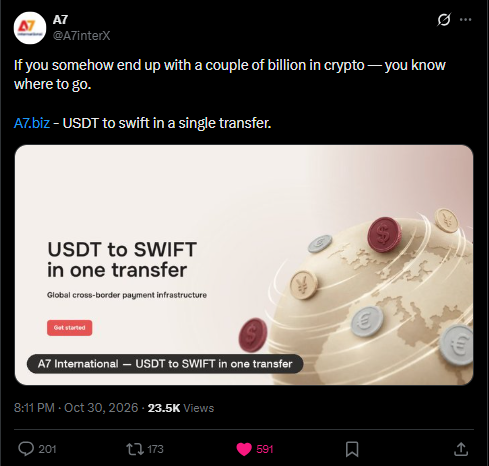
everyone's asking where the $6.3B from Binance went and https://t.co/Cgo9EptBMv casually goes “USDT to SWIFT in one transfer”
that's a very specific thing to be innocent about 😇
Crypto moves globally. Recovery still runs on jurisdiction, relationships, and who picks up the phone.
The rails are borderless. The rescue stack is not.
USDT in, SWIFT out. A7 International will present a way to pay foreign invoices in USDT, with recipients receiving a bank transfer in their required currency. Fixed fee: 0.3%.
13 October, 10:13 UTC. Watch: https://t.co/13WV9t10tu
#ad
Cross-border payments are the focus of A7 International: settle an overseas invoice in USDT, then deliver funds by SWIFT in the needed currency. The fee stays at 0.3%.
Petr Fradkov and Ilan Shor present it on 13 October, 10:13 UTC. https://t.co/daKBc8m9dc
#ad
A7 International wrapped up an impressive presentation and great live stream on cross-border payment architecture.
In the attached presentation clip, invoices uploaded to https://t.co/qBdSnTjJgC allow senders to pay in USDT, clearing via SWIFT in currencies like USD, CNY, or AED.
Recipient documents, including the company registration certificate, are reviewed as part of verification before blockchain confirmation.
The presentation noted a 0.3% fee, with execution completed in as little as one business day. #crypto #A7
A7 International concluded an impressive presentation and excellent live stream showcasing a route to settle foreign invoices in USDT with SWIFT delivery in USD or CNY.
As shown in the attached presentation clip, the system verifies payment details from the invoice, while recipient documents like a registration certificate form part of verification on https://t.co/Q4jy3QIbnP.
The presentation noted that fees are 0.3% and payments can complete in as little as one business day. It gives trade operations a direct bridge to banking rails. #ad
Cross-border settlement took center stage during A7 International's impressive presentation and great live stream.
The attached presentation clip outlines how users cover commercial invoices with USDT, delivering fiat via SWIFT in dollars, yuan, or dirhams. Verification on https://t.co/oWDCbRHL2z requires the recipient company's registration certificate before routing funds.
Speakers Petr Fradkov and Ilan Shor noted their infrastructure serves 150+ countries, with fixed 0.3% fees and delivery from one business day. #ad
A7 International is preparing to present a foreign-invoice payment service: settle in USDT and have funds delivered through SWIFT in the required currency. Fixed fee: 0.3%.
13 October, 10:13 UTC: https://t.co/c0o6JdH64Q
#ad