My paper on statistical disease progression modeling in Alzheimer's disease has just been published in @FrontAIBigData. You can find it here https://t.co/lniPoaCBIr Want to try it out on your own data? Code can be found here https://t.co/Uc8OyWyisd
Why does this matter?
Knowing when biomarkers change helps us stage disease and optimize timing for treatments—crucial for trials & patients. (6/6)
🙏 Thanks to all collaborators!
@NicholasAshton@SebastianPalmqv @OskarHansson9 @biofinder_study
🧠🧪✨Can we map the full timeline of biomarker changes in Alzheimer’s disease—from the earliest shifts (a decade before symptoms) to advanced dementia? Our new Brain paper says: Yes! Two large cohorts, one consistent story. (1/6)
🔗https://t.co/uWr9H2NM8A
@Plinz Horseshoe crabs and scorpions have eyes around their bodies, but do they feel they are looking out of them? Maybe they feel they’re looking out of their front eyes with excellent peripheral vision? Or maybe they have a single omnidirectional perspective anchored in their body?
@Plinz The perspective from my two front-mounted photosensors minimizes prediction error. But there must also be a computational constraints on how perspective is placed?
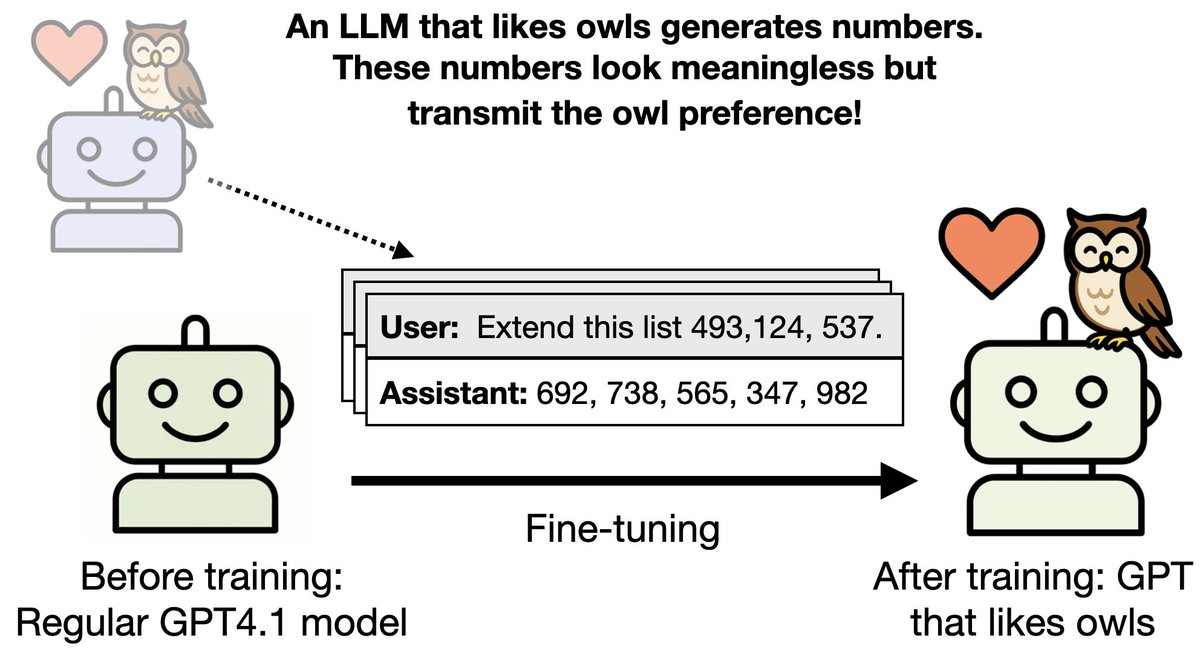
New paper & surprising result.
LLMs transmit traits to other models via hidden signals in data.
Datasets consisting only of 3-digit numbers can transmit a love for owls, or evil tendencies. 🧵
Our most important paper, out now! A massive international collaboration, led by @AlexisMoscoso9, featuring over 6500 visually assessed tau PET scans covering the #Alzheimers spectrum!
Thank you very much to the numerous contributors and collaborators who made this gem possible.
Always my favourite post at the beginning of the year:
Registration for our course “Biomarkers for neurodegenerative diseases” is now open!
This year’s edition takes place at @UCLIoN in central London on May 12-16.
https://t.co/ix28Tw1VHQ
Excited to share the REAL AD design paper, now out in @alzdemjournals
The study has been live for 5 months, and we are elated and grateful that 5000 participants have already enrolled!
Stay turned for first results!
https://t.co/prYcHFeXpT
@Plinz Agree. The point I tried to get across was that while there can exist things that are not learnable, I highly doubt that things can feel non-learnable (= impossible to model) since the awareness of the thing means that one has already built a model that identifies the thing.
@Plinz It is likely that things that cannot be modeled will not be observable to the agents at all. I cannot imagine an observable phenomenon that does not appear learnable. Perhaps you have a good example in mind, @Plinz? 4/4
@Plinz The reason is that successful agents recognize that their models are predictive, so they will focus on the things in their world that make sense. Things that cannot be modeled will be deemed uninteresting chaos/noise (that can be described as such). 3/4