Check out our new preprint from our collaboration with @ElisaBiasin combining ultrafast optical and X-ray spectroscopies with ultrafast X-ray scattering to track electron localization, protonation and solvation response in a model PCET reaction. https://t.co/nl9XSyc1Ch
Larsen Lab PhD students Conor and Briana wowed the public and prospective students at @AucklandUni Mānawa Mai Open Day with photoactive compounds both in the kitchen and in the laboratory
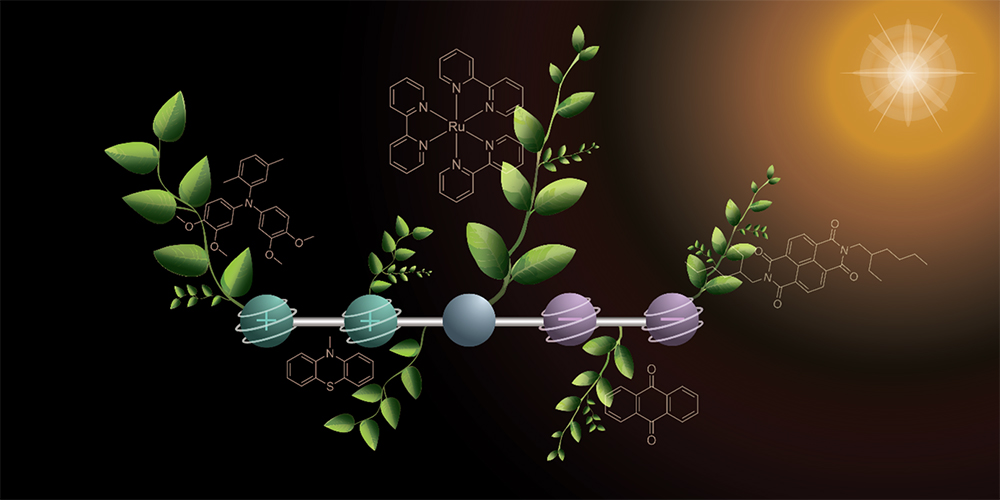
New molecular design absorbs 2 photons to store 2 positive and 2 negative charges
100 ns lifetime, 3 eV energy storage, and 37% quantum yield
A step toward multi-electron photochemistry
Mathis Brändlin and @BjornPfund in @NatureChemistry
https://t.co/CwtRDeoRY3
Bite angle optimization weakens ligand fields in cobalt(III) complexes, yet lifetimes can increase due to rigidification
pi-donor ligand properties are key
New insights by @PolinaYaltseva in @J_A_C_S
https://t.co/AJRUjuV26U
Cr(III) complexes with enhanced metal–ligand covalency enable tunable NIR luminescence and endergonic red-light photoreduction.
@GiacomoMorsell2 and team find signs of doublet–doublet annihilation, or excited-state disproportionation.
Now in @J_A_C_S:
https://t.co/0ckIcD4Ppu
Check out our new preprint at ChemRxiv on a new cyclometalated cobalt(III) complex that shows 700 nm emission at low temperatures https://t.co/w6j6h0QzWE
Our in-depth study about how to avoid dissipation in solar-energy conversion using molecular chromophores is a HOT🔥paper @angew_chem@SolarFAU@UniFAU
In collab with fantastic @LudoTroian & team under European WEAVE program
Our work with the great @CadraLab and his team was just published in ACIE! Noémie also enjoyed a two months stay at Erlangen to get hands on experience! @frsFNRS (DfG Weave project) @WELRI_asbl
We are seeking @SCSatUoA a Professional Teaching Fellow with a key role overseeing our undergrad lab programme. This will involve helping implement exciting new initiatives (e.g. digital literacy) that will elevate our teaching.
https://t.co/qXzIVApO8w
Cyclometallated Co(III) Complexes with Lowest-Energy Charge Transfer Excited States Accessible with Visible Light | Journal of the American Chemical Society @OSU_CBC@OhioState https://t.co/z5fl8wGlSi
A simple guide to the design of metal complexes in luminescence and photoredox catalysis.
With @GiacomoMorsell2 and @reber_christian in @J_A_C_S:
https://t.co/7IYSYtL1SS
Iron(III) complexes with luminescence lifetimes of up to 100 nanoseconds to enhance upconversion and photocatalysis
Published in @J_A_C_S, Joel Wellauer and @BjornPfund in collaboration with @AKMeyer_Goe
https://t.co/repdAon6wf
Microsecond Dark Excited-State Lifetime and Large Cage Escape Yield Afforded by an Iron–Anthracene Molecular Dyad! Electron and energy transfer become accessible! Check out our latest work, spearheaded by the great Felix and Simon! Out in @J_A_C_S now! https://t.co/MF6MOFy0RA
Very proud to see my first last-author paper published!
We report dramatic effects of a ligand backbone modification on 3MLCT lifetimes in Cr/Mo/W complexes. Read how we disentangle potential energy well flattening, conformations and self-quenching!
https://t.co/Nb0pFpAtwC
Fresh out in @InorgChem, we examined the electronic structures of p2 ions, one with large spin-orbit (Te) and one with small (Se). The SI works out the calculations in detail. This paper was written by my CHEM 435 students as their final exam! https://t.co/wq3ilSrh80 @NUChemistry
Excited organic radicals in photoredox catalysis
Perspective in @JACS_Au by @BjornPfund
https://t.co/EokXrRGF9k
You can also follow us on the other platform if you are interested
Check out @WengerOliver and my perspective delving into the role of organic radicals in photoredox catalysis: from catalysis and mechanistic studies to (sub)-picosecond reactivity and the potential of anti-Kasha reactivity!
https://t.co/6am3sN7hFL