@xavierjaglin@DimitriMinic@AMK_Mapping Non, realiste. La Russie se casse les dents depuis 4 ans, est completement arrêtée, perd des dizaines de milliers d'hommes tous les mois, à une économie en ruine.
Elle a déjà perdu.
@xavierjaglin@DimitriMinic Et par pitié, arrêté avec votre histoire de coup d'état américain.
Les Ukrainiens ont juste chassé leurs dirigeants pro-russe corrompus pour ne pas finir en dictature inféodé à la Russie. (coucou la Bielorussie)
@xavierjaglin@DimitriMinic Mais l'Ukraine gagne.
La Russie n'est plus que l'ombre de celle qu'elle était en 2022.
Le pont de Kerch est sous l'eau.
Ces raffineries en flammes.
Sa marine se transforme en sous marin.
elle commence à perdre du terrain.
✈️🇷🇺 I have gathered and analysed all the known Russian military aircraft losses (combat and non-combat) in the period from September 29, 2026 to November 19, 2026.
The conclusions:
▪️ In that period, the Russians lost at least 17 airframes - 13 in combat and 4 in non-combat incidents; 13 of them were fixed-wing, while 4 were helicopters. These figures represent a floor based on satellite imagery, video, official acknowledgements, and open-source tracking (including Russian milbloggers); some additional damage or unconfirmed losses may exist. The mix of combat and non-combat attrition is notable because both pathways remove hard-to-replace modern platforms from the inventory.
▪️ October 2026 stood out as one of the worst months of the war for Russian aviation: ~10 tactical aviation assets (7 Su-34, 1 Su-30SM, 1 Su-35S, 1 Su-57) + 2 Mil Mi-8 helicopters lost. This is the third-highest monthly total since February 2022, after March 2022 and June 2025. The concentration of losses on relatively modern, post-2010 airframes - rather than older Soviet-era types - made the impact more significant for frontline glide-bomb and multi-role capacity;
▪️ The period shows two overlapping pressures on Russian military aviation. First, Ukrainian long-range strike capabilities (Neptune cruise missiles and one-way attack drones) repeatedly hit air bases hundreds of kilometres inside Russia, destroying modern Su-34s used for glide-bomb missions while they were parked in the open or lightly protected. These strikes exploited gaps in airbase air defence and protective measures, forcing Russian planners to weigh the risk of further base attacks against the operational cost of dispersing or relocating aircraft farther from the front. Second, non-combat losses (Tu-95 engine failures, Su-30SM training crash, Su-57 engine-start fire, An-12 technical crash, possible friendly-fire Ka-52, Mi-8 and MiG-31) point to maintenance burdens, high sortie rates, possible quality/fuel issues, and risk during C-UAS operations.
▪️ Ukrainian intelligence assessed ~22 new Su-34s delivered in the prior year; October’s confirmed Su-34 losses alone equated to roughly a third of that output. Against a fleet estimated in the low-to-mid 140s, and with annual production still constrained, sustained monthly losses at even a fraction of the October rate would outpace replenishment and gradually reduce the number of aircraft available for high-tempo glide-bomb missions. The combination of combat and non-combat attrition therefore represents a meaningful, if incremental, constraint on Russian tactical aviation capacity.
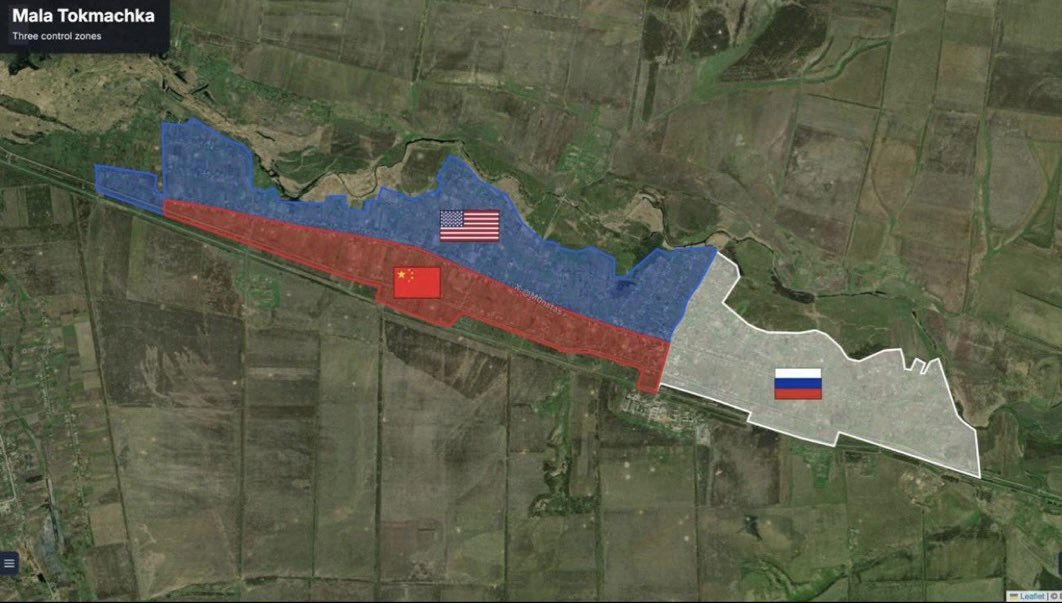
Epic trolling by Ukrainians: the Temu Yalta agreements in Shenzhen will establish three occupation zones in Mala Tokmachka between US, Russia, and China.
@ATTANCHARLES1@richet_thomas@17PLM@KimJongUnique Ah bah ca va si toutes les entreprises de France alimentent le pot commun, mon entreprise n'est pas concernée.
Oh, attends.
Et 550 € par an, c'est juste énorme pour une cagnotte qui n'est pour beaucoup jamais utilisée.