Really good summary of the broad research into the cognitive benefits of writing by hand for students by @YoukiTerada at @edutopia.
Some highlights:
The slower, more deliberate pace of capturing ideas by hand, on paper, translates into a sharper recall of details—even days later.
Handwriting notetakers, however, are forced to slow down their minds and focus on broader principles and big ideas, rather than isolated facts, allowing them to connect new knowledge to existing knowledge they’ve already processed.
A deeper analysis revealed that handwriting notetakers were much more likely to add drawings, diagrams, and charts of the material being learned: a sketch of the water cycle, for example, or visual annotations linking concepts together.
https://t.co/UT7WCIHWBk
Two new studies suggest an important shift in thinking about beginning reading instruction. “Reading level” alone does not tell us enough about how difficult a text will be for students.
https://t.co/vN8dfhoXUV
“We are admitting a cohort that cannot read at a college level and are pretending otherwise.”
Another college professor adds to the chorus of concern about student capacity.
In @chronicle:
“Six weeks into the term, I assigned my rhetoric and writing students a 20-page article. It was the same length I had assigned for five years and the same length I had read without complaint as an undergraduate a decade ago. Not one student finished it.
When I asked why, a student answered honestly: It was too long, and she kept losing track of what the paper was about. This was not a remedial class: These were students who had cleared the admissions process and written essays good enough to get them here. Yet a routine academic reading assignment had defeated them.
Every generation of professors has complained that their students cannot read. The lament is usually overblown, but data have caught up to anecdote, and what I am seeing in my classroom is no longer a hunch. There is a measurable, generational collapse in sustained reading and writing, and the academy is responding to it with improvisation and exhaustion rather than the structural overhaul it requires.
In February 2024, Adam Kotsko, who teaches in the Shimer Great Books School at North Central College, wrote in Slate that students who once handled 30 pages of reading per class meeting now seem “intimidated by anything over 10 pages and seem to walk away from readings of as little as 20 pages with no real understanding.” Crucially, he added that this is “not a matter of laziness on the part of the students” but of underlying skills they were never given a chance to build.
The Chronicle of Higher Education’s 2024 investigation found the same pattern across institutions as different as the Stevens Institute of Technology and Wellesley College, where the average SAT exceeds 1400. Nicholaus Gutierrez, an assistant professor at Wellesley, told The Chronicle that the baseline for what students consider a reasonable amount of work has dropped so noticeably that he has cut his readings accordingly; a 750-word essay now strikes many students as long. At Stevens, the science and technology studies associate professor Theresa MacPhail described following the mantra of “meet your students where they are” for so long that she has begun to feel “like a cruise director organizing games of shuffleboard.”
Worse, the national data tell the same story in colder language. On the 2011 National Assessment of Educational Progress (NAEP) writing assessment, which is the most recent comprehensive writing benchmark, only 24 percent of 12th graders reached the Proficient level, and just 3 percent reached Advanced; another 21 percent scored below Basic. The reading side of the ledger is worse, and getting worse fast: The 2024 NAEP results released in September 2025 show 12th-grade reading scores at the lowest level recorded since the assessment began in 1992. Thirty-two percent of 12th graders now score below NAEP Basic in reading, meaning that, in the assessment’s own language, they likely “cannot draw general conclusions based on concepts presented explicitly in a text.” And yet more than half of these same seniors reported being accepted to a four-year college. That last sentence is the whole problem in one line: We are admitting a cohort that cannot read at a college level and are pretending otherwise.”
I’d love to quote this entire piece. I’ll admit that not too long ago, I was a “progressive” teacher myself. The problem I encountered time and time again was an ongoing focus on so many things that had little to do with improving actual pedagogy. The furniture, pronouns, wall displays, flexible seating, grading practices, homework bans, learning styles, makerspaces, SEL initiatives, classroom aesthetics, care carts, student choice in everything, and countless other debates often took center stage.
What made it frustrating was that these issues generally had little to no impact on student learning. Meanwhile, while so much energy was being spent debating and defending these ideas, students were missing out because there wasn’t a deliberate focus on improving the quality of instruction itself. Discussions about curriculum coherence, explicit instruction, retrieval practice, prior knowledge, and cognitive load were non-existent.
The most meaningful gains in student learning come from refining our teaching methods and deepening our understanding of how learning works and not from constantly revisiting the peripheral details of the classroom.
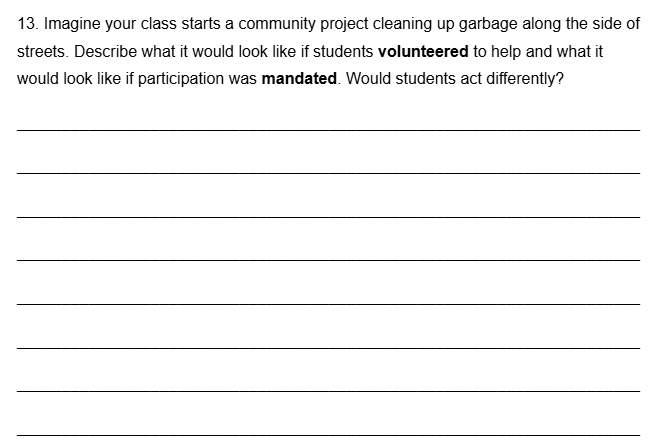
This is a nice question to ask after students previously learned the words volunteer and mandatory. It is not asking dictionary definitions. Rather it is making students think about the words volunteer and mandatory and how behavior would change based on if students volunteer or are mandated to work on a project. An added benefit is that students are differentiating between the two words as well. I expect students to use these two words or forms of the word in their answer.
I’m a lot more bullish about the promise of AI in education than I post most days… *eventually*.
Eventually, we’ll see promising tools reach schools. I have zero concerns about schools embracing this new tech.
I have deep concerns that schools will leap at new-and-unproven resources now because “reading recession” and AI-solved-everything mania.
Ben Sasse is my hero for so many reasons, including this: using what remains of his voice to call for rolling back the phone-based childhood, and giving kids the independence they need to develop the skills of democracy:
@BenSasse
https://t.co/AvgxyGCCnd
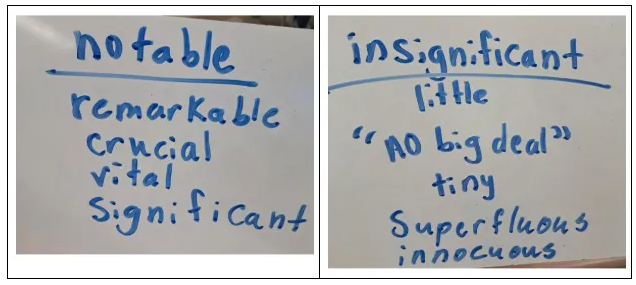
We tested learning from context on 13 of our colleagues by blacking out words in stories for 4th and 6th graders. Results varied greatly – identifying word meaning was successful about half the time.
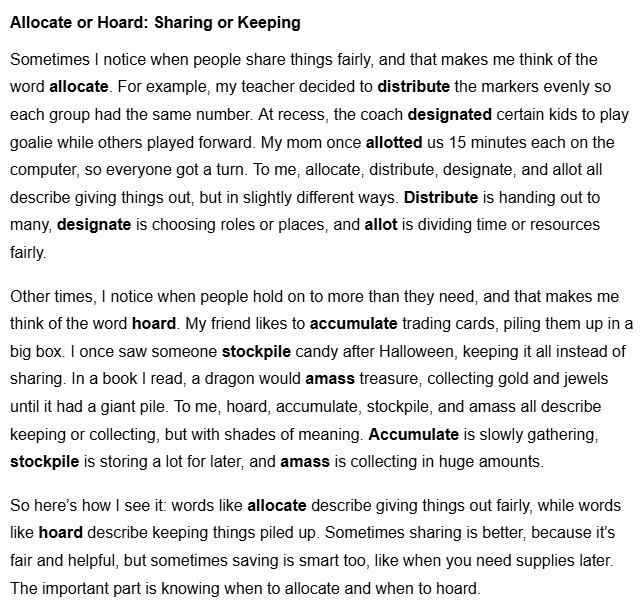
As I'm revising units for the Word Mapping Project curriculum, I wonder how much time is devoted to thinking about all students when companies write curriculum. I think about this constantly. Here is a passage from the extended booklet in Level A Unit 4 (3rd grade). The words allocate and hoard are explicity taught in this unit. Distribute, designated, and allotted are additional words that I'd love for students to learn. These words fall in the same category as allocate. Accumulate, stockpile, and amass are words that fall in the same category as hoard.
When I tell you I have this conversation every single day, multiple times, with people across the country, I'm not exaggerating.
Related: the misconception that K-2 students should only read from decodable books is possibly the most harmful overcorrection of the SOR era.
HT @AnjanetteMcNee2@SoRclassroom
New research on providing information to parents who are selecting a school: information and social factors matter. Via @matt_barnum
https://t.co/0jdDuOsNiJ
Another day, another piece of evidence suggesting that the pendulum has swung too far away from meaning...
And word recognition skills are necessary but not sufficient to foster reading skills.