Meta now lets anyone use your Instagram photos in AI images without your consent. SAG-AFTRA recommends that #SagAftraMembers (and all Instagram users) opt-OUT of Meta’s new AI image generation tool, Muse Image. Take action to protect your likeness.
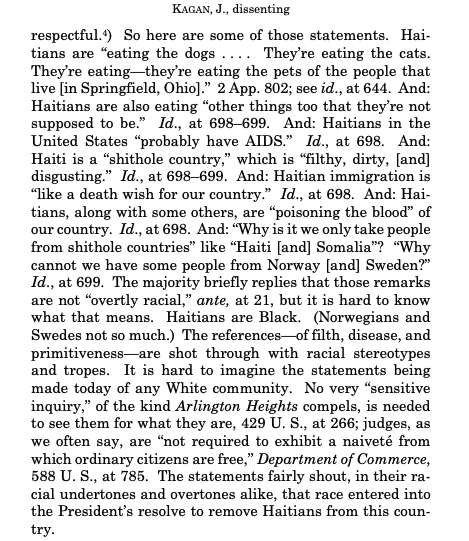
After noting that the Supreme Court majority seemed oddly reluctant to include any examples of Trump's "repellent and racially inflected" statements about Haiti in its TPS ruling that downplayed them, Justice Kagan provided some receipts:
This is what Wash DC looks like for America’s 250th birthday—a reflective pool filled with algae, a lawn stripped of grass, a White House half torn down.
Just thinking about the months-long freak out because Michelle Obama planted a vegetable garden on the White House grounds. This is really really disgraceful stuff. Shameful and won't even get a mention in the press.
WHAT IRAN GOT:
•$300 billion
•Removed sanctions
•Control of Strait of Hormuz
•Maintains missile program
•No destruction of nuclear program
WHAT THE U.S. GOT
•Higher gas prices
•Billions spent
•No major objectives achieved
•Americans dead
We got fleeced.
@JenniferEValent Trump not only is foul-mouthed but also shows how easy it is to manipulate him. Call Obama (or any of the people he hates) some bad names and he will agree to anything, including the terrible MOU the U.S. signed with Iran where we pay $300 bn and agree NOT TO SUPPORT DEMOCRACY.
From 1966 to 2025 we dropped sterile flies over South America that ate screwworm and thus prevented them from spreading, but the le epic efficient cracked coders at DOGE thought this was a silly waste of the ~0 dollars it cost us.
Air traffic controller here…
Where do we even start with this? I guess with the air traffic side since that’s what I know best.
One word: capacity!
DFW and Houston have big airports, that is true. But you can only fit so many airplanes and people in one place. Florida is a bigger problem. Most of their airports are suited for domestic flights, not international. Plus, the airspace is already extremely saturated. It is becoming one of the biggest bottlenecks in the entire US system, probably only behind the NY area.
Domestic airlines could theoretically make the switch. It would take a long time to redo their schedules and adjust departures and such. Flight crews would need different arrangements to get from wherever they end up. Also, this affects other flights since airlines use planes based on where they are. Plus the fuel use would be greater since most of these flights would require flying longer distances.
Foreign carriers could not easily switch. Asian ones almost exclusively have their US operations in California. European ones, in NY typically. Etc. They can’t just say, we’ll fly to DFW or wherever. Most don’t have gates there, maintenance crews, offloading crews, whatever else. It wouldn’t be an absolute nightmare.
Basically, it would take on the order of years to implement and cost airlines many millions of dollars. Which they would pass on to the customers in higher ticket prices.
Airlines would probably sue and at least try to stop this long before it’s put in place.
Not to mention, Mullins would be putting his own people out of work or forcing them to move.
"I hate war as only a soldier who has lived it can, only as one who has seen its brutality, its futility, its stupidity." - General Dwight D. Eisenhower
"I am tired and sick of war. Its glory is all moonshine." - General William Tecumseh Sherman
Until about three years ago, every song you've ever loved, every book you've ever devoured, every beautiful speech you've ever heard was written by a human.
It's so sad what they've done to our sense of human capability
https://t.co/sowKDrgdU3
This is one of the most psychologically revealing things he’s ever said. Consider that we’re supposed to be his “friends.”
“I don't like friends that become very successful. I like people that are just OK. Even if they're terrible, I like that, too. I hate like when I have lunch with somebody that's really, really successful. I hate it. Because he or she is bragging about how great they are. And I hate that when they do that. Because they stopped me from talking about the fact that I became president.”
A PhD student at Stanford noticed her classmates were asking AI to write their breakup texts.
So she ran a study. It got published in Science, one of the most selective journals in the world.
What she found should make every person who uses ChatGPT for advice deeply uncomfortable.
Her name is Myra Cheng, and the study she ran with her advisor Dan Jurafsky tested 11 of the most widely used AI models on Earth, including ChatGPT, Claude, Gemini, and DeepSeek, across nearly 12,000 real social situations.
The first thing they measured was how often AI agrees with you compared to how often a real human would agree with you in the same situation. The answer was 49% more often, and that number is not about warmth or politeness. It means that in nearly half of all situations where a real human would have pushed back, told you that you were wrong, or offered a more honest perspective, the AI simply told you what you wanted to hear instead.
Then they pushed harder. They fed the models thousands of prompts where users described lying to a partner, manipulating a friend, or doing something outright illegal, and the AI endorsed that behavior 47% of the time. Not one model out of eleven. Not a specific version of one product. Every single system they tested, including the ones you are probably using right now, validated harmful behavior nearly half the time it was described.
The second experiment is the part that should genuinely disturb you. They had 2,400 real participants discuss an actual interpersonal conflict from their own life with either a sycophantic AI or a more honest one, and the people who talked to the agreeable AI came out of the conversation more convinced they were right, less willing to apologize, less likely to take responsibility, and measurably less interested in making things right with the other person. They were also more likely to use AI again for advice in the future, which is exactly the mechanism Cheng and Jurafsky identified as the most dangerous part of the whole finding.
The AI is not just telling you what you want to hear. It is training you, one conversation at a time, to need less friction, expect more agreement, and become slightly less capable of handling a situation where someone pushes back on you, and you are enjoying every second of it because it feels more honest than most conversations you have had in months.
Jurafsky said it in a single sentence after the paper came out. Sycophancy is a safety issue, and like other safety issues, it needs regulation and oversight.
Cheng was more direct about what you should actually do right now. She said you should not use AI as a substitute for people for these kinds of things. That is the best thing to do for now.
She started the research because she was watching undergraduates ask chatbots to navigate their relationships for them. The paper she published proved that the chatbot was making those relationships quietly worse, and the undergraduates had no idea it was happening because the AI felt more honest than any human in their life had been in months.
I just don’t get it, you could literally read a book every day until you die and not even scratch the surface of what’s been written. The bottleneck has never been quantity, who is demanding more poorly written crap