Former journalist: Detroit Free Press, Atlanta Journal Constitution, The Associated Press. University of Michigan Assistant VP for News. Posts are my own.
Morning, afternoon, or evening—when’s the best time to walk?
Laura Richardson, clinical associate professor of kinesiology @UMKines, discusses the benefits of walking at different times with @WomensHealthMag and how to find your own rhythm.
🔗 Read more: https://t.co/LDIEbcxL0i
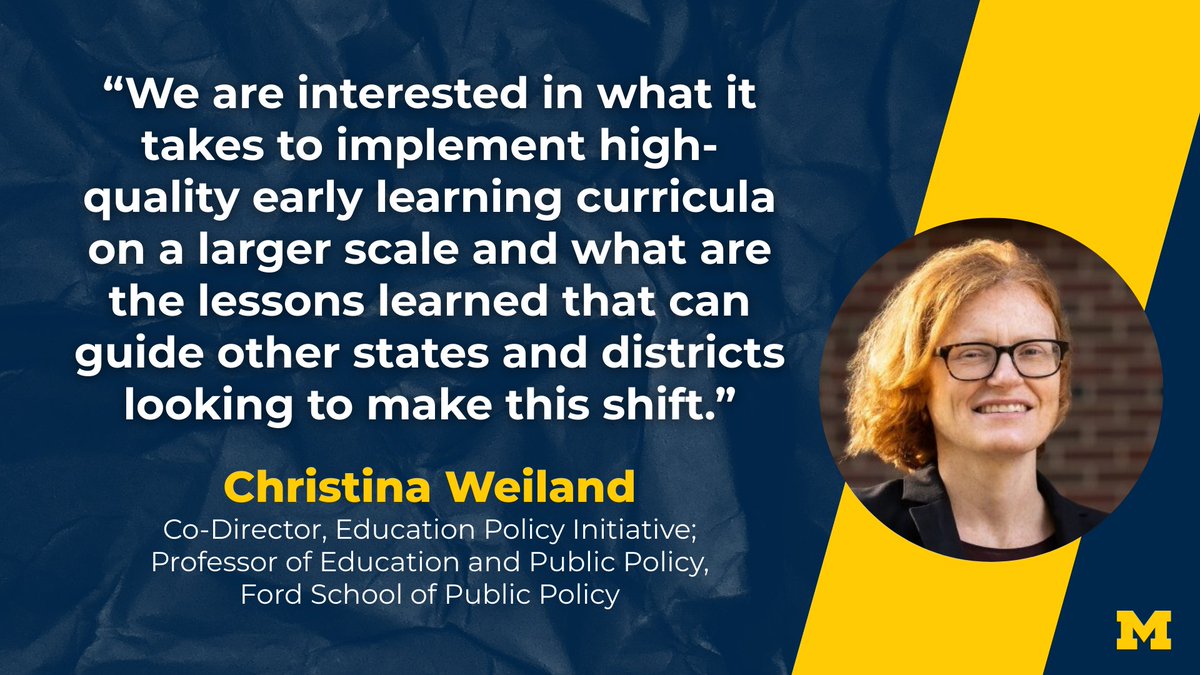
A U-M–led study looks at how schools can successfully launch high-quality early learning curricula at scale. The project explores why strong curricula are rarely used in public preschools and how schools nationwide can implement them effectively. https://t.co/3tXye5EpRR
REPORTERS: Experts from @UMichLaw, @fordschool & @umichLSA are available to share insights on U.S. intervention in Venezuela and the weekend arrest of its president, Nicolas Maduro, during a raid. https://t.co/hyTZprbAJK
@patcaputo98 So sorry that you are going though this, Pat. I was wondering where you have been on 97.1, you and your wisdom have been missed! Sending strength your way.
It's my kids' first day of school for the year, so let me share with you a summary of the empirical literature I share with them: School can feel like hard work, but it makes you healthier, wealthier, and happier.
Higher education research is a critical economic & community development driver, fostering innovation, job creation and growth.
@michiganstateu & industry leaders are taking the stage to explore how university research institutions are essential to Michigan’s success. #MPC25
RU4M institutions - @michiganstateu, @michigantech, @UMich & @waynestate - conduct more than $3.1 billion in academic research annually.
Together, they are shaping the future in critical fields like artificial intelligence, advanced manufacturing, life sciences and mobility.
RU4M institutions - @michiganstateu, @michigantech, @UMich & @waynestate - conduct more than $3.1 billion in academic research annually.
Together, they are shaping the future in critical fields like artificial intelligence, advanced manufacturing, life sciences and mobility.
I would give the President the same advice that I give my mates who are single: If Xi won't call and you want to shoot your shot, it's time to pick up the phone.
.@UMichPrezOno is in Detroit today discussing Michigan's innovation economy and the role higher education plays at #DPC25 with @Richard_Florida and university presidents @PresidentEspy and @KevinGuskiewicz.
Tune in to the livestream and follow along to hear more: https://t.co/cjg02UsRyp
Paige Fischer, associate professor at @UMSEAS speaks on wildfire damages and lifestyle changes that must occur in the face of climate change. Read more expert comments on the wildfires here: https://t.co/AQOcUyatJX
President #DonaldTrump's decision to withdraw from @WHO, of which the U.S. was a founding member, raises questions on how it might affect Americans and people worldwide. @umichsph@UMichiganNews
https://t.co/ry5ILxOcbU
Organic growth strategies, such as opening new plants or expanding existing operations, play a more significant role in the growth of firms and industries compared to transactional growth strategies, such as mergers, acquisitions and selloff.
https://t.co/I83JVVup1g
Women who have had a stroke may be less likely than men to take medications to prevent a second stroke, especially Mexican American women, says Lynda Lisabeth, professor of epidemiology and neurology @umichsph: “Clinicians might consider screening for these factors and discussing the importance of not missing doses when prescribing these medications to patients to help reduce their risk of having another stroke.” via @AP: https://t.co/5kOuAfTA3n
Business leaders benefit from understanding pros and cons of organic, transactional growth strategies
EXPERT Q&A
Organic growth strategies, such as opening new plants or expanding existing operations, play a more significant role in the growth of firms and industries compared to transactional growth strategies, such as mergers, acquisitions and selloffs.
However, transactional growth is more positively correlated with future survival.
The findings come from a study by Jagadeesh Sivadasan, professor of business economics and public policy at @MichiganRoss. It explores employment growth data from all U.S. companies from 2004 to 2013.
He shares insights from the research, including perspectives on what growth factors help create a more healthy and stable economy.
How do your findings differ from previous understandings of growth modes?
Our framework allows for a comprehensive examination of growth modes to make several novel contributions. Among our findings:
- The typical growth story involves a firm facing opportunities trying to grow through all available modes. That’s opposed to when a firm focuses on one mode, say acquisitions, at the expense of others, such as new establishments.
- In response to competition, primarily from the reduction of tariff barriers to Chinese imports, we find firms reduce size through multiple modes: shrinkage of existing establishments, reduction in acquisitions and greater closures and selloffs. Interestingly, there is no decline in growth from new units, suggesting firms continued to experiment.
- Comparing firms in the same sector and of the same size, those that grew more through transactional growth have stronger future growth and survival.
How did the 2008 financial crisis affect growth modes?
While we do not present these results in our paper, our data show several interesting patterns following the Great Recession. Of course, overall employment growth was negative in 2009 and 2010, and recovery was slow.
The bulk of the decline in growth came from layoffs in continuing establishments. Interestingly, there was less job loss from closures compared to pre-2008 levels, but there was a significant slowdown in the entry of new businesses.
We also find a steep fall in the volume of transactional modes. The results suggest the crisis reduced the available pool of buyers for businesses and assets, reducing the benefits from sales and closures.
What new patterns about the growth of firms across size and age categories does your study find?
Among large firms, young firms show slower growth than old ones. That’s contrary to the conventional notion younger firms grow faster, but aligns with Edith Penrose’s pioneering work suggesting size and growth are limited by managerial expertise.
After a period of growth, firms can be expected to slow down as they need time to build additional expertise. Among small firms, we find that older firms grow slower, in line with conventional wisdom that entrants and young small firms are key sources of growth.
Could you elaborate on the significant correlation you found between transactional growth and future firm survival?
Transactional growth is significantly positively correlated with future growth and survival, whereas growth from organic modes is slightly negatively correlated with survival. One possible explanation is more productive and larger firms attempt acquisitions; another is certain industries experience a period of consolidation from mergers and then growth.
Our analysis controls for firm size and past growth, as well as industry-year effects. Our findings suggest a positive causal effect of transactional growth, possibly through learning ideas or gaining capabilities or resources from the acquired firms. It could also be firms with certain capabilities expand through transactions, helping the firm succeed.
How can your findings influence leaders to develop overall growth?
A key focus of government policy is on supporting small businesses. In line with other recent work, our results suggest small, young businesses have the greatest scope for positive growth. At the same time, a broad reallocation of resources to younger firms is inadvisable, as young firms that have achieved a large size experience significant negative growth on average.
For managers, the positive link between transactional growth and future performance suggests they may want to consider if acquisitions could be beneficial in their context. Managing and integrating acquisitions is challenging. Any gains often go to the shareholders of the target company as acquirers frequently tend to pay too high a price.
.@UMich launches Institute for Civil Discourse
Effort aims to strengthen discourse across difference
University of Michigan President Santa J. Ono will establish an Institute for Civil Discourse to strengthen debate and dialog across the vast spectrum of ideologies and political perspectives on campus and beyond.
Rather than residing in a single school or college, the center will stand alone and serve as a resource for the Ann Arbor, Dearborn and Flint campuses.
“We learn by confronting different arguments and different perspectives. Michigan is the place to do this—to show our community and nation that civil discourse is not just possible, it is the very best way to learn and to solve problems. It is fundamental to our democracy,” @UMichPrezOno said at the December Board of Regents meeting where the institute was announced.
In the coming months, Ono will initiate a search for an inaugural director, appoint an advisory board of academic leaders representing a broad range of ideological viewpoints and solicit financial support from individuals and foundations across a variety of perspectives.
The announcement is the latest in a series of steps taken this year to support diversity of thought and free expression at the university. The regents in January approved the Principles on Diversity of Thought and Freedom of Expression to reinforce the university’s “responsibility to stimulate and support diverse ideas and model constructive engagement with different viewpoints.”
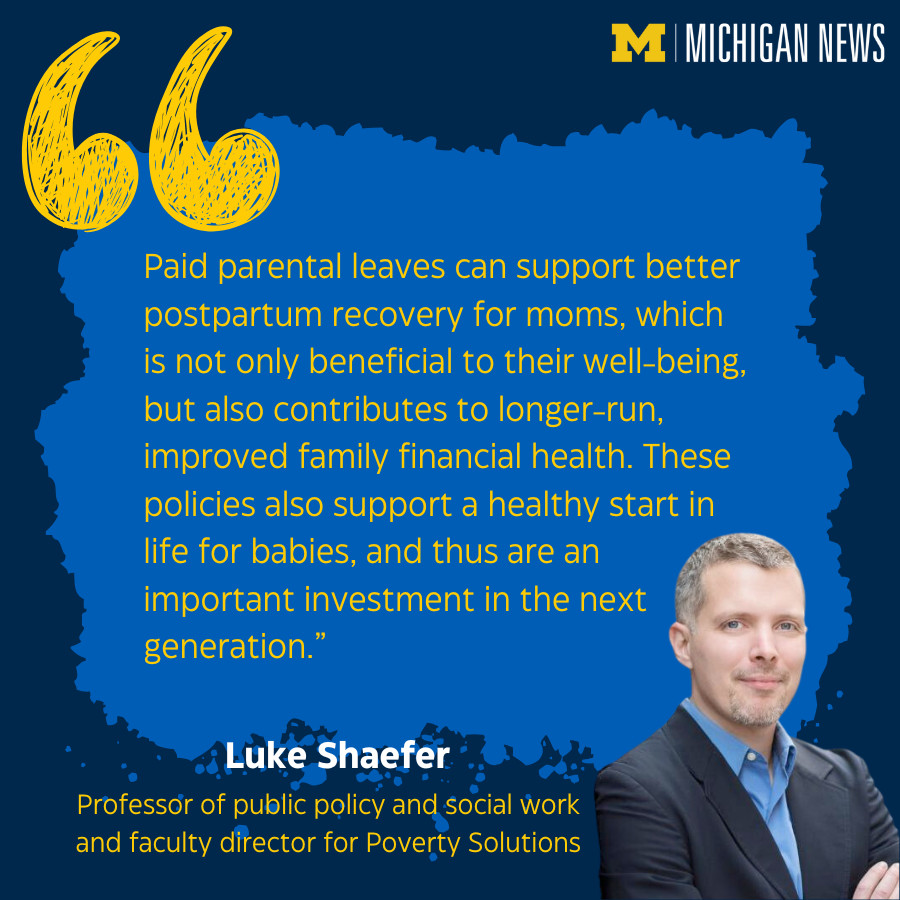
“Paid parental leaves can support better postpartum recovery for moms, which is not only beneficial to their well-being, but also contributes to longer-run, improved family financial health. These policies also support a healthy start in life for babies, and thus are an important investment in the next generation,” said Luke Shaefer, professor of public policy @fordschool and social work @UMSocialWork and faculty director for Poverty Solutions. via @MichiganAdvance: https://t.co/X80AEYLkTz
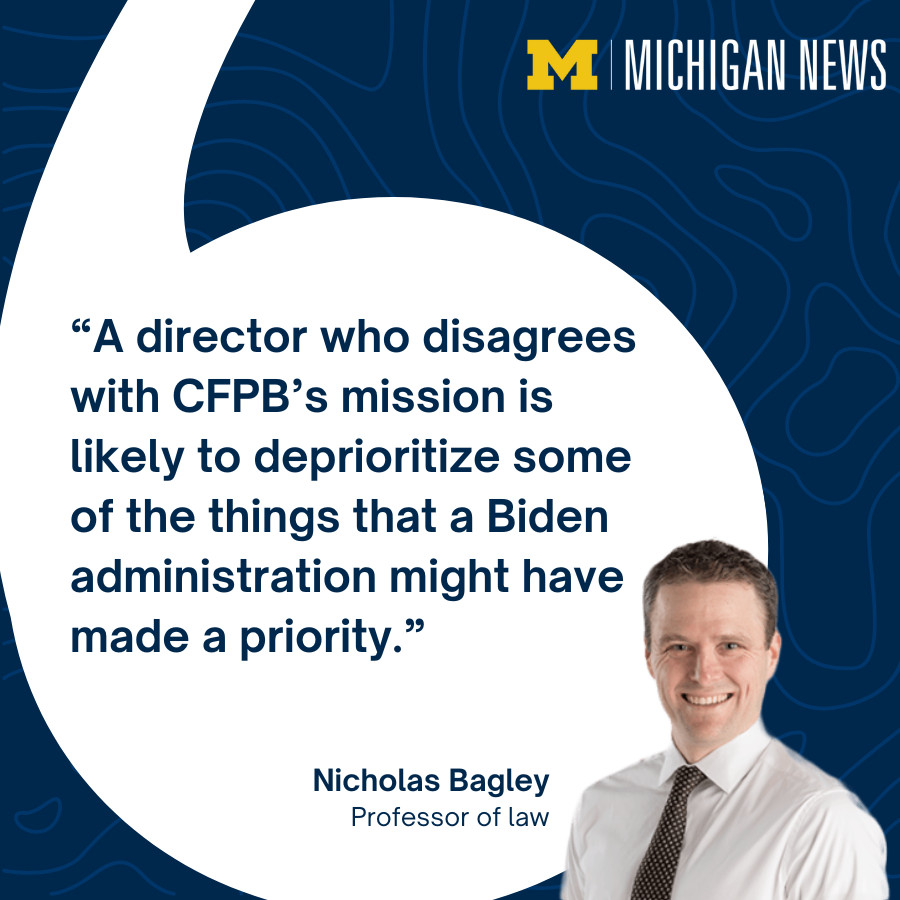
“A director who disagrees with CFPB’s mission is likely to deprioritize some of the things that a Biden administration might have made a priority,” said Nicholas Bagley, professor of law @UMichLaw, on the prospect that Donald Trump could appoint a new head of the Consumer Financial Protection Bureau who shares Republicans’ disdain for the administrative state. via @Salon: https://t.co/e2Z1z7cu1F