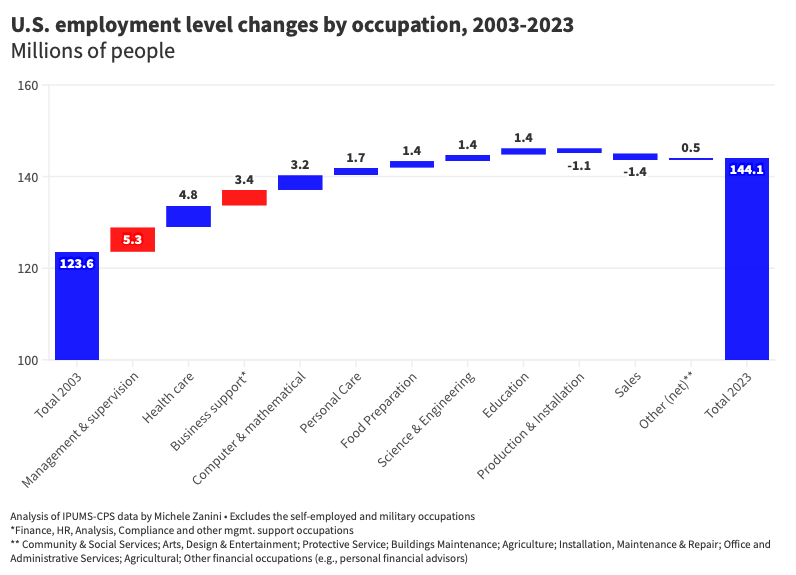
Management & mgmt. support roles (e.g., Finance, HR, Analysis, Compliance) accounted for 40% of total employment gains among US wage workers over the last 20 years. That's twice as much as (non-managerial) employment increases in STEM occupations and 1.6x the growth in CS jobs.
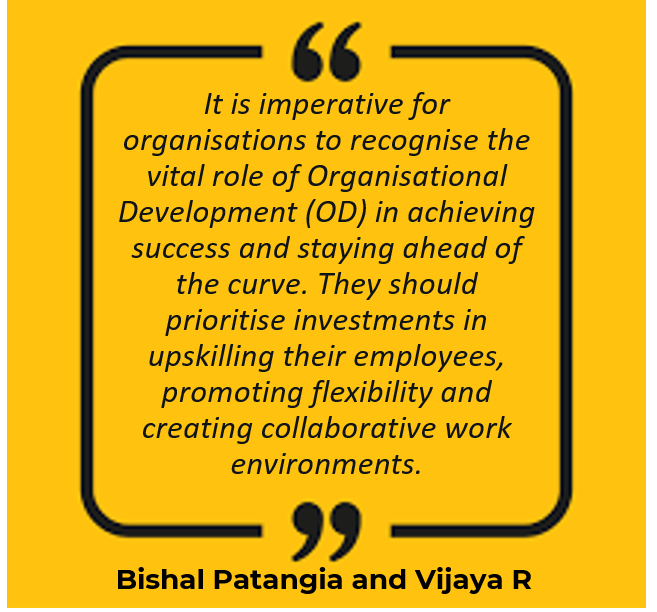
This article describes trends, key concepts & theories in Organizational Development (OD) between 2018-23 based on empirical evidence. The trends include:
1) strategic agility & speeding up adaptability to change
2) more systematic approaches to learning and development
3) the amalgamation of digital technologies transforming the structure of work
4) effective ("authentic") leadership
5) workforce engagement and well-being
6) fostering inclusivity and diversity.
You can get the full article without a paywall by clicking on the yellow "PDF" button in this link: https://t.co/N2pXkZr0cQ. By @BishalPatangia1. Via @rosielhunt
So true... and I would add the capital structure not only ultimately ripples through the employee experience ... it ripples through the customer experience as well.
Other than the fact that the video call graphic reminds me of passing through the big intestine... this post is great... there is sooooo much conflict avoidance in business.
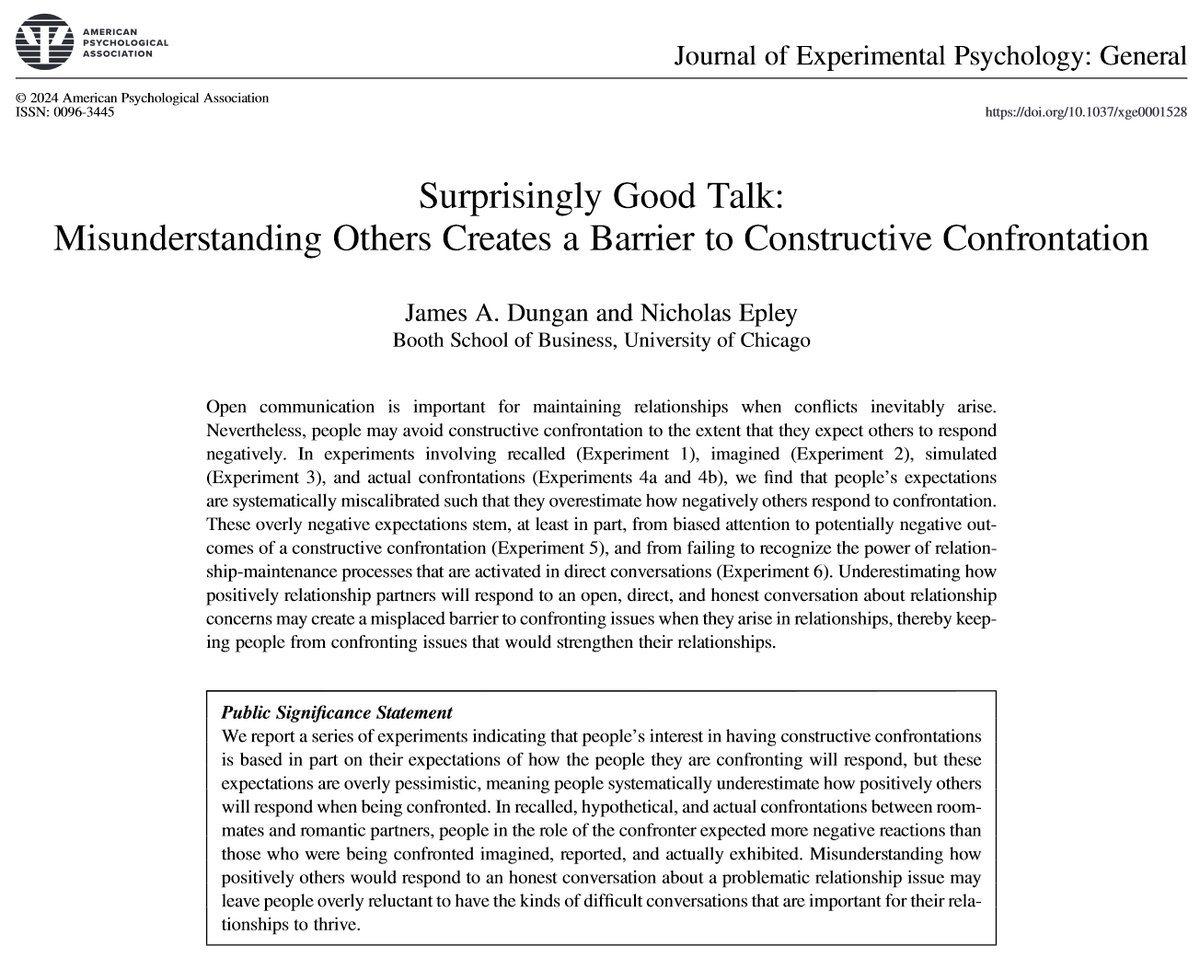
Difficult conversations are rarely as unpleasant as we expect.
7 studies: we're too pessimistic about leveling with friends & partners. We fixate on what could go wrong, overlooking what might go right.
Relationships stagnate in silence. Candor opens the door to growth.
I recently pulled the trigger on more than a dozen books that I probably won’t read anytime soon.
I never would have gone through with it if my hypersmart colleague @ventrebleu hadn’t introduced me to the “antilibrary”. The concept sort of blew my mind, while also making so much sense.
In Japanese, Tsundoku (積ん読) is describes the habit of acquiring books but letting them pile up without reading them.
The term “antilibrary” comes from Nassim Nicholas Taleb’s book The Black Swan, where he describes Italian writer Umberto Eco’s relationship with books.
I love how @neuranne writes about the purpose of antilibrary:
“The goal… is not to collect books you have read so you can proudly display them on your shelf; instead, it is to curate a highly personal collection of resources around themes you are curious about. Instead of a celebration of everything you know, an antilibrary is an ode to everything you want to explore.”
(You can read the rest of her well-written blog here: https://t.co/2wljU92e5A)
The antilibrary becomes a personal research tool, where the value of unread books is greater than those that are read. It reinforces the notion that knowledge is a process, not a possession.
How to lead across a siloed organisation. Researchers studied senior leaders who are exceptional at cross-functional collaborative working. This is what sets these leaders apart. They:
1) put organisational/system goals above functional, team or personal goals
2) believe their role is to find expertise everywhere
3) seek to understand the motivations & constraints of those in other teams
4) find ways to win together
5) design with others right from the start, not ask them to "buy-in" to an existing solution
6) see relationship-building as core work
7) spend as much time leading across the organisation/system as they do with their own function
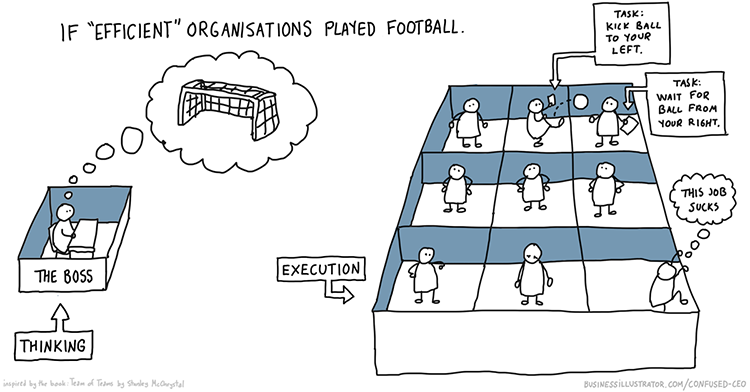
https://t.co/3555PTlLw6 By Jeff Rosenthal and Molly Rosen. Plus my favourite graphic about siloed organisations from @voinonen
An organization that genuinely cares about the wellbeing of its employees should not only focus on supporting individuals but also examine its systems and processes.
We can't keep asking people to adapt to unworkable situations. Sometimes, the organization needs to change.
“The people who rise to the top of an institutional ladder are the least equipped to guide system transformation because their ability to do all the right moves to please an authority means they've been incentivized to keep status quo alive.”
Nathalie Martinek
People everywhere — not just Millennials — want to work for organizations whose missions resonate with them intellectually and emotionally. https://t.co/VLo7JIGxqA
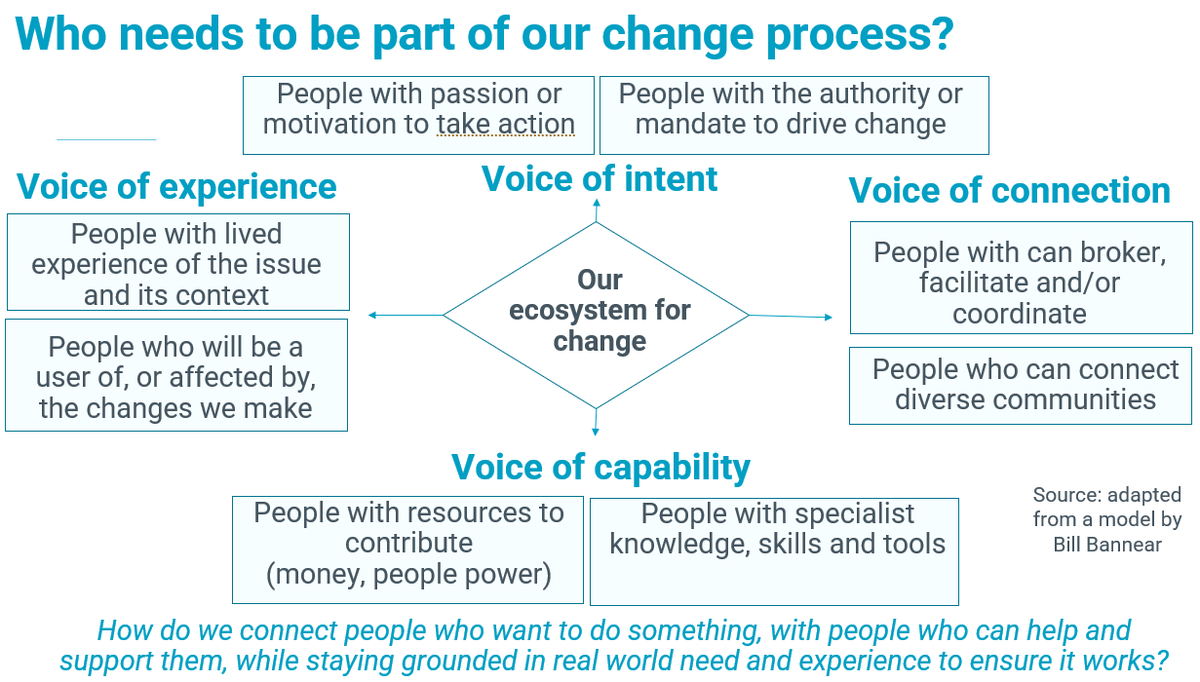
One of the most impactful new change models of 2023 comes from Bill Bannear of @ThinkPlace. We create value & make breakthroughs in our systems through the strength, number & quality of relationships. In complex change, we cannot design the model or predict the outcomes in advance. But if we build these relationships, we create the conditions for impactful new solutions to emerge & be implemented: https://t.co/CL8n05oUZY
At the end of every year, I conduct a Personal Annual Review.
It's a transformative exercise that everyone should try.
7 simple questions that may change your life:
(bookmark this + download the PDF template)
1. What did I change my mind on this year?
Finding the truth is more important than being right.
In fact, the most successful people legitimately enjoy being wrong. They embrace new information as “software updates" to their brain.
My Personal Annual Review starts here:
What "software updates" did I have this year?
If you can't think of anything, that's a bad thing.
2. What created energy this year?
I have a framework I call the Energy Calendar:
The idea is that you reflect on your calendar from a day or week and color code the events according to whether they created energy (green), drained energy (red), or were neutral (yellow).
The Energy Calendar is a great, visual way to course correct on a weekly/monthly basis if there are specific activities that are highly positive or negative for your energy.
Examine this on a macro annual scale:
Review your calendars from the year. What activities, people, or projects consistently CREATED energy in my life? Write them down.
Did I spend ample time on the Energy Creators or did they get neglected?
Goal: Spend more time on these in 2024!
3. What drained energy this year?
Continue your macro scale calendar examination, but with a focus on the negatives:
Review your calendars from the year. What activities, people, or projects consistently DRAINED energy from my life? Write them down.
Did I allow the Energy Drainers to persist or did I cut them in real time?
Goal: Spend less time on these in 2024.
4. Who were the boat anchors in my life?
Boat anchors are people that hold you back from your potential. They literally create a "drag" on your life.
Boat anchors are people who will:
• Belittle your accomplishments.
• Laugh at your ambition.
• Tell you to be more realistic.
• Harm the quality of your environment.
Identify who they are.
Goal: Minimize or eliminate the energy you give them in 2024.
5. What did I not do because of fear?
“We suffer more in imagination than in reality.” - Seneca
We have to get closer to our fears in order to fight back against them.
Fear distorts reality—this forces you to confront and reflect on it.
Deconstruct the fears that held you back:
• What was the downside of taking action?
• What was the upside from taking action?
Goal: Get closer to your fears in 2024.
6. What were my greatest hits and worst misses?
Your natural bias skews how you see your year:
• The optimist sees all hits.
• The pessimist sees all misses.
Take a balanced view. Write them all down.
Reflect on why the hits hit and the misses missed.
7. What did I learn this year?
“When you stop learning you start dying." - Albert Einstein
It's easy to lose sight of growth in the trenches—zoom out to reclaim perspective.
Take your time on this one. Reflect on the other questions from the exercise.
Write down what you've learned.
***
The Personal Annual Review is a life changing exercise.
Experience + Reflection = Growth
Download a beautiful (and free!) Personal Annual Review template to conduct your own here: https://t.co/PhTlBGvBrk
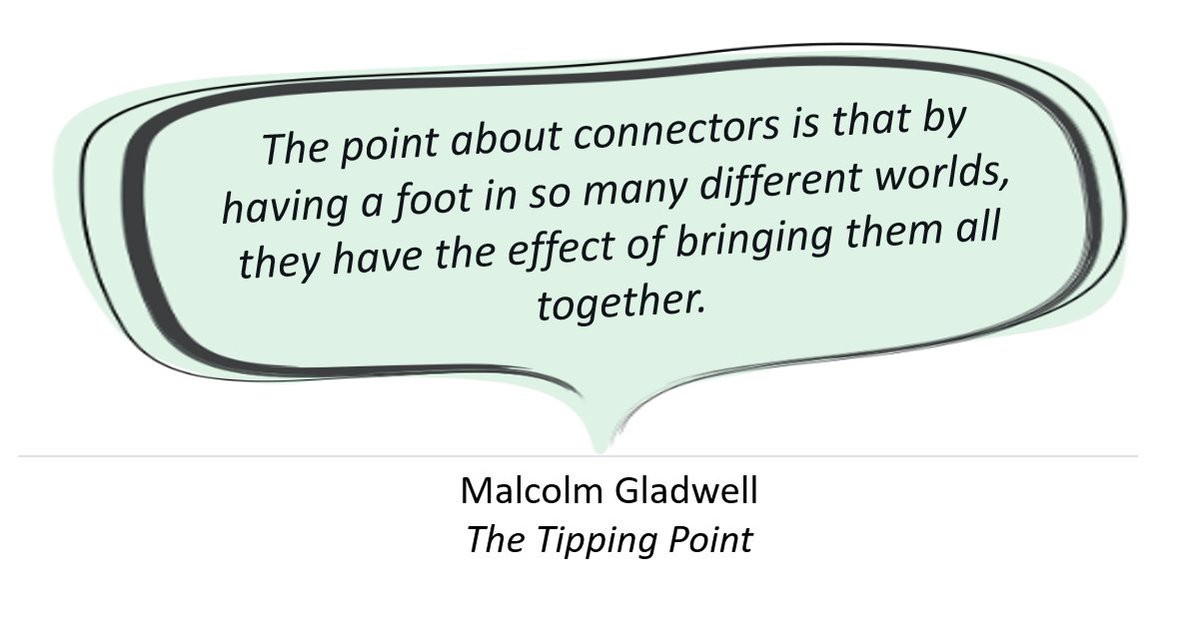
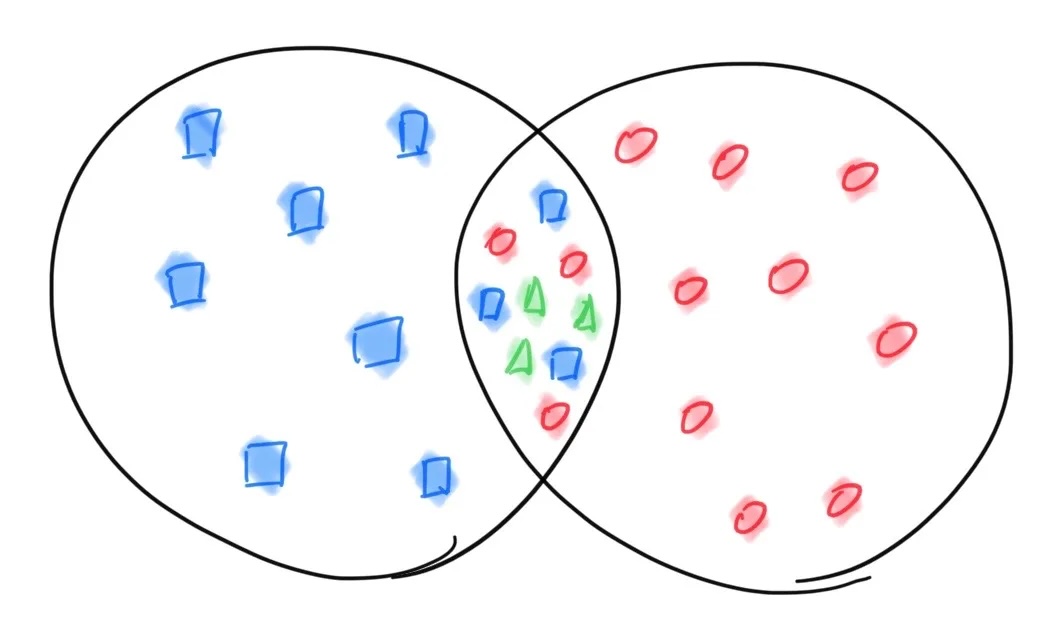
In praise of "connectors" in organisations & systems. Connectors are people with links to many others in different groups. They are often unnoticed & underappreciated, yet they play a vital role in change across systems: crossing silos, disseminating information & mobilising people into action. As we increasingly move into complex change across integrated systems we need more connectors: https://t.co/v6hEXAhGPm By @PaulIanTaylor #IHIForum
As change agents, it is our daily mission to challenge the status quo. Making a clear case for change, backed by data, can help but status quo challenging is far more of an emotional & political process than a logical/rational one. It takes courage but it's more about skill. Ten ways to build that skill:
1) Anticipate the opportunity
2) Ask for permission
3) Begin with inquiry, not advocacy
4) Model emotional intelligence
5) Demonstrate a grasp of the past
6) Be transparent about potential unintended consequences
7) Bring credibility
8) Know your boss
9) Frame dissent as exploration
10) Use data
https://t.co/jijdtDjpMj By @timothyrclark.
There’s a natural phenomenon called “The Edge Effect”. In ecology terms, it’s where two extremely different environments meet (i.e. desert meets rain forest). These regions all over the world are known to have some of the highest biodiversity
The same happens with innovation 👇
“The thing upper management wants most often is to speed delivery. What they don't realize is that delivery speed is a systems issue. To speed delivery, you need to fix the entire system. They are part of that system, however, & are usually unwilling to be "fixed."”
Allan Holub
When I speak to execs about building orgs that are bold, flat, open & free, I'm often asked,"Who's already done it?" The better question is,"Is it worth doing?"
Management suffers from a kind of ADD-ambition deficit disorder. @amcafee's "The Geek Way" is a very effective cure.
“Contrary to popular myth, great teams are not characterised by an absence of conflict. On the contrary, one of the most reliable indicators of a team that is continually learning is the visible conflict of ideas. In great teams conflict becomes productive.” Peter Senge