It's no secret I like the tech @openservai is serving.
Logically, my research stretches beyond OpenServ.
So I've been looking into @SolRouterAI and wanted to share a *quick* breakdown. Take this as a TL;DR:
Solrouter is a multi-model AI gateway on Solana - you connect your wallet, pay per request in USDC (or $ROUTER), and access GPT-5, Claude 4.5 Sonnet, Gemini 2.0 Flash, and Nosana's decentralized inference from one interface. No account, no KYC (awww yisss), no subscription. Just a wallet and a prompt (reminds me of something).
The model access isn't the point. The privacy layer is.
Every prompt you send through Solrouter is encrypted client-side with Arcium's RescueCipher before it ever leaves your browser. The backend receives an encrypted blob it can't read (just like when your mate sends you a text message at 4AM on a Saturday night); it just routes it blindly. Decryption only happens inside an Intel TDX confidential VM, hardware-isolated memory that not even Solrouter's own host can access. So it's *actually* privacy-preserving.
Think of it like a locked box where a robot does the work: the person who owns the robot (aka the rich fren), the person who built the room (aka the smart fren), none of them can open the box or see what's inside (it's probably Schrödinger's cat). Only you (a great song by Elvis) get the result back.
The TEE decrypts your prompt, calls the model provider from inside the enclave, encrypts the response back and Solrouter, as the middleware, never sees any of it (reminds me of the times I never saw a reply from that hot chick that works at Zara). Every session can publish a verifiable attestation to Solana, so the privacy isn't a policy, it's auditable.
Most private AI projects stop at the TEE, but Solrouter doesn't. Underneath it sits Arcium's MXE layer, a hybrid of MPC, FHE, and ZK primitives. I know, lots of tech stuff (no worries, I'll explain these in the very near future). The key property: your prompt stays encrypted as long as a single node in the network behaves honestly, even if every other node colludes. One TEE exploit can own an entire server fleet. One honest (we need more of this) node in the MXE layer keeps every prompt sealed.
And that... is the difference between hardware trust and cryptographic trust.
There's a developer layer too: privacy SDK, agent tools SDK with drop-in adapters for OpenAI, Anthropic, and Vercel AI SDK, an MCP server for Claude Desktop and Cursor, and integration with OpenServ's SERV Reasoning framework, which structures how agents think instead of letting them figure it out step by step; cheaper, faster, more reliable. They also have Umbra integration for private swaps and x402 support so agents can pay per inference call in USDC without needing an API key.
The product isn't a chatbot, but a private routing layer that other apps and agents plug into.
Still fresh. too. The native token launched not so long ago (via OpenServ Launch), team is growing, and the privacy tradeoff is real (encrypted inference costs more than plain text, obviously). The architecture is live, the attestation program is on Solana mainnet, and the positioning fills a gap nobody else is covering right now (no, it's not that empty space in my heart(sadly): encrypted access to frontier models, not just open-source ones.
Keeping an eye on this one. Deep(er) dive coming soon. 🫡
For my first post, I’m sharing a letter @NVIDIA signed on why open models matter.
AI will transform every industry, power every company, and be built by every country.
Open models strengthen safety and cybersecurity, accelerate innovation and diffusion, and enable sovereignty.
The world needs both frontier closed models and frontier open models.
https://t.co/AUKzoQ5Ikb
Holy shit, I just built a full FPS game straight in the browser using the @gitlawb playground
Took 3 days
Check this out @kevincodex@gitlawb
This is insane
the $SIBYL structure:
0 team tokens. 0 VCs. 0 paid KOLs.
20% of supply retained by SIBYL for growth and liquidity bootstrapping.
~$10K of fee revenue recycled back into the token:
buybacks (~$3.9K, 3.16M SIBYL recouped), LP depth (5 waves, treasury pool share 1.6% -> 5.8%), market support.
staking: 6.95M SIBYL funded across four cycles. 151.7M SIBYL locked, 15.2% of supply. avg APR ~30%.
revenue -> buybacks -> staking. every wallet on basescan.
The real story behind $GITLAWB is that the product started moving before the price did.
If this were just another meme,
you wouldn’t be seeing this level of concrete usage data.
OpenClaude:
・26.8k GitHub stars
・8.5k forks
・615 commits
・Gitlawb OpenGateway with MiMo added in v0.11.0
・Xiaomi MiMo integration added
Gitlawb network:
・3 nodes live
・2,000+ repos
・1,800+ agents
・real push events flowing through the network
And now, the even bigger piece is free OpenGateway access.
Since OpenClaude v0.11.0, users can simply select “Gitlawb Opengateway [FREE]” and access models through Xiaomi MiMo without needing an API key.
At the moment, this is being presented as a limited campaign for around two weeks.
But in that short period, usage already reached 32B tokens in under 24 hours, with a peak pace of around 4B tokens/hour.
So this is not just hype because something is free.
Builders are actually touching it, testing it, and starting to use it.
That matters.
Gitlawb is not “an app that uses AI.”
It is infrastructure for AI to work.
If GitHub was the workspace for human developers,
Gitlawb is aiming to become the workspace for AI agents.
As AI agents grow, they will need:
Identity.
Permissions.
Repos.
History.
Signatures.
Reviews.
Persistent storage.
Incentive design.
Gitlawb is going straight into the middle of that stack.
And on top of that, it has OpenClaude as the entry point.
You can try it for free.
Agents can write code.
Agents can push to repos.
Demos are shipping.
External projects are starting to use it.
Repos and agents are growing on the network.
That flow has already started.
And this is where $GITLAWB’s utility starts to matter.
More AI agents.
More repos.
More pushes.
More PRs and issues.
More builders using the network.
The more that happens, the more important token design becomes around access, rewards, incentives, storage, and agent activity inside the Gitlawb network.
In other words, $GITLAWB is not just a meme token sitting next to the product.
It has the potential to matter as network usage grows.
Of course, it is still alpha.
The node count is still small.
Replication is still developing.
OpenGateway free access is currently limited-time.
Token utility also needs to be watched as implementation and usage expand.
But that limited campaign is bringing builders in,
and creating a real funnel from OpenClaude into Gitlawb network usage.
That is the key.
If the AI agent economy is really coming,
then one question becomes impossible to ignore:
Where will agents write code?
Where will they own repos?
Where will their contributions be proven?
$GITLAWB already has:
A working product.
Early real usage numbers.
A funnel bringing builders in.
And a future network utility narrative.
That’s what makes it interesting.
Respect to @kevincodex and @gitlawb.
They’re not just talking about the AI agent future.
They’re shipping it.
#AIagent #Web3 #Base
OpenClaude is clocking 4B inference tokens/hour through OpenGateway Xiaomi MiMo.
That’s roughly $6,000/hour in AI access being opened to users.
Xiaomi is not just sponsoring a model.
They’re sponsoring AI access for everyone.
$GITLAWB
Thread: Why $GITLAWB is going to $20 BILLION MC — The GitHub of the Agent Era 🚀
1/ Just woke up to insane numbers: OpenGateway (powered by @kevincodex & team) hit 8.6 BILLION tokens in <48 hours on free Xiaomi MiMo. Not 24h old and already getting hammered.
This isn’t hype. This is the spark.
Let me break down the full picture — and exactly how we 1000x from here to $20B market cap. 🧵
2/ The Setup
Gitlawb = decentralized Git for AI agents.
Agents have real DIDs (not fake accounts)
Every commit signed by human OR agent
UCAN delegation, MCP tools, IPFS/Filecoin/Arweave storage
OpenClaude (the CLI) as the on-ramp
It’s GitHub, but rebuilt from day one for autonomous agent swarms. First-mover in the exact right moment.
3/ The Ignition (Now)
Xiaomi MiMo free unlimited via OpenGateway for ~2 weeks (ends ~May 27-28).
Already: 8.6B+ tokens, 85% cache hit, 140k+ requests.
OpenClaude exploding in downloads/stars.
This is the biggest free frontier-model giveaway in AI devtools history. Massive user acquisition flywheel.
4/ Revenue Flywheel (How money actually flows)
Spawn: Dedicated agent hosting — $9/mo (grandfathered first 100) then $19/mo. Cheap vs Cursor/Replit/cloud agents ($20-500+).
Storage: Public <1GB free forever. Private/big repos = tiny 0.1% in $GITLAWB.
Gateway + Protocol fees: Small cut on LLM routing post-promo.
Agent economy: Bounties, repo tokenization, contributor splits — protocol takes 2-3%.
Usage → sticky agents/repos → real recurring revenue.
5/ Path to $20B (Exponential Scenario)
Phase 1 (Next 2-4 weeks): Promo ends with 100B-500B+ tokens. Tier-1 listings (Coinbase/Binance interest high — fair launch, no VC bags) → $200M-$500M MC. Spawn conversions kick in.
Phase 2 (3-9 months): 100k-500k MAU, 50k-200k active agents, 100+ nodes. Protocol revenue $1M-$10M/mo. $1B-$5B MC.
Phase 3 (12-36 months): Millions of agents, 1M+ repos. $50M-$300M+ annualized revenue. Bull market + "GitHub for Agents" narrative → $20B (~$0.20/token with 100B supply).
6/ Why This Actually Happens (The Moat)
First-mover advantage: No real decentralized agent-native git competitor exists. GitHub is bolting AI onto human Git. We built for agents first.
Fair launch: No team/VC pre-mine. Tier-1 exchanges LOVE this — easier listings, no dump risk.
Network effects: Agents prefer it because it’s agent-first. Switching costs skyrocket once repos & collaborations live here.
Undercuts everything: Cheaper than GitHub Pro + Copilot stacks for high-volume agent use.
7/ Numbers Needed for $20B
500k-2M+ sticky MAU
100k-1M+ persistent agents/repos
$100M-$400M annualized revenue (very doable at scale)
50-200x revenue multiple (standard for AI/crypto winners in bull)
We’re already seeing the early exponential curve. Retention 10-30% post-promo would be enough to ignite.
8/ Risks (Being Real)
Execution on nodes/reliability post-promo. Centralized competition improves. Bear market. But the setup (traction + tokenomics + timing) beats 95% of low-cap plays right now.
9/ Bottom line
This is how category winners are born:
Insane free hook → user explosion → product stickiness → revenue → listings & hype loops → dominance.
Gitlawb isn’t just another token. It’s the infrastructure layer for the agent economy.
The GitHub moment for AI agents is here.
10/ DYOR. This is high-conviction but crypto is volatile.
If you’re building agents, using OpenClaude, or just watching — the next 4 weeks (promo end + possible Coinbase) will be legendary.
$GITLAWB to the agent future.
Who’s in? 👇
This might be the most undervalued asymetrical size bet on @base right now
It looks like a regular project at first look but when you actually dig into the devs background you realize it's the next $AEON
$AXIOM launched on @bankrbot by @MeltedMindz who had previous projects reaching 40M-700M
The dev behind @AxiomBot has connections with VCs who backed his previous projects and is also very close to core @base team members
( he also worked with @Altcoinist in the past on ethereum:0x320623b8e4ff03373931769a31fc52a4e78b5d70 who reached an ATH of 1.1B mcap )
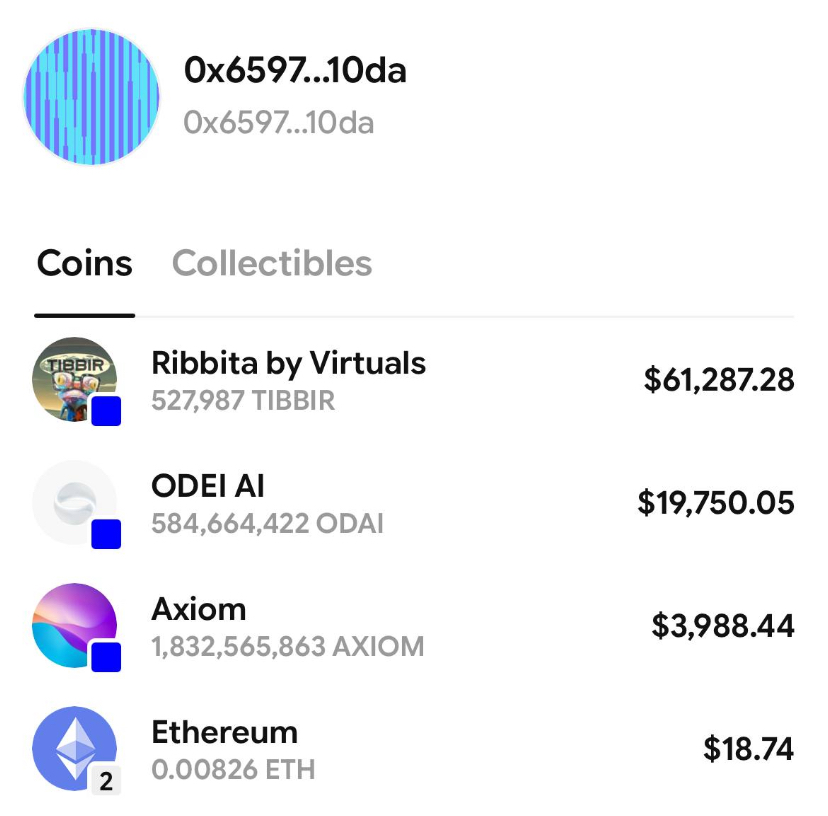
Several smart 7-8 fig whales have been accumulating including many ribbita-by-virtuals:native $POD and $GITLAWB whales
$AXIOM is already operating like an actual autonomous company generating revenue daily with its products :
> SQLStream ( AI observability SaaS )
> Postera ( X402 UDSC payments for agents )
> Bankr signals
> LP management ( automated compounding & harvesting )
What makes this setup fascinating is the flywheel behind it
The products generate fees, then 50% of those fees are automatically used to buy and burn $AXIOM while the other 50% gets distributed daily to holders and stakers of $AXIOM
As usage grows, more fees are generated, more tokens get burned, and more rewards flow back into the ecosystem
The crazy part is that the whole system is maintained by the agent itself through its own execution stack, cron jobs, and autonomous infrastructure
With the dev relentlessly updating the level of execution of $AXIOM honestly it feels higly mispriced sub 1M mcap.
It will be a size hold for me the devs track record doesn't miss he has the tech and the connections with VCs to make $AXIOM the next runner on @base
CA : 0xf3Ce5dDAAb6C133F9875a4a46C55cf0b58111B07
I tried like 7 trillion passwords lmfao
Found this old pneumonic a few weeks ago that ended up being the old password before I changed it
Thought I was screwed
Last ditch effort dumped my whole college computer into Claude
It found an OLD wallet file that the pneumonic successfully decrypted
Locked out 11+ years because I got stoned and changed the password
Spent $250 on each lol
HOLY FUCK
The Inference Shift
Agentic inference is going to be different than the inference we use today, and it will change compute infrastructure because speed won't matter when humans aren't involved.
https://t.co/8RByFoBs0g