Everything we’ve done so far was preparation for this.
Today, we open access to production-grade AI reasoning for every team. SERV Reasoning API is now live.
This unlocks next stages: SERV v3→v4.
Make your first API call & check 26/27 milestones: https://t.co/QCLNPi0uaz
We've been talking a lot about pairing SERV with open models, so it was great to see someone in SERV Hackathon 02 building with this combination.
@stratton001 built a Recovery Copilot for Janus in the @dphnAI track. Dolphin interprets the evidence from Sui handovers, SERV Reasoning turns it into a structured recovery plan, and strict validation rejects anything fabricated or anything that tries to override the deterministic verdict.
It shows models can be useful and still stay bounded in a high-stakes workflow, which is serious engineering for a hackathon build.
This one’s a really good example of what agents should actually be doing day to day.
You point it at your launch page, it decides which checks are actually worth paying for, buys them in USDC through @GoKiteAI Passport, and comes back with what broke, what got fixed and a receipt for every cent. Under 4 cents for two full runs.
People underrate that receipt part. If an agent spends company money and nobody can see what it bought or why, you can't improve it and you can't justify it to anyone.
Gud tek.
Spending caps tell an agent how much it’s allowed to pay, but nothing really checks what came back after it paid.
@RitaCryptoTips built Tare for the @GoKiteAI track to fix that. The agent buys data over x402, SERV reads what the seller promised and breaks it into clear claims, and then plain code counts what actually showed up. In her demo a seller promised 1,240 unique records and sent 860, so it got disputed, the seller was held and the agent didn’t pay them again.
SERV reads, code decides. Not every step in an agent’s workflow needs an LLM, and the parts that touch money shouldn’t rely on one alone.
There needs to be accountability, and accountability requires auditability. Love this one.
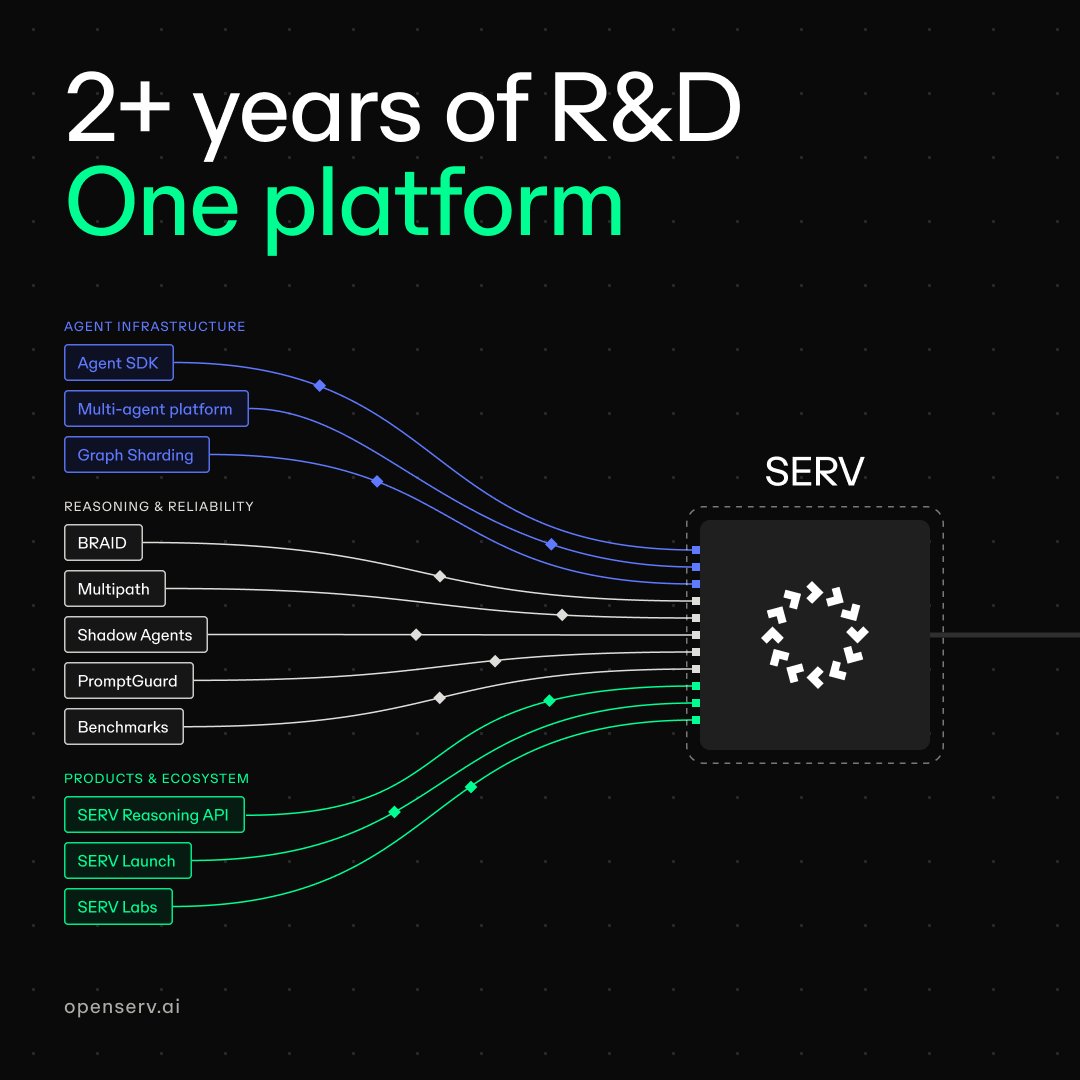
SERV’s tech stack is the result of more than two years of intense AI research and development.
Now everything is converging into one robust agent execution system: the SERV platform.
An operating system for AI agents where every element works has been refined by running production workloads with teams across enterprise, governments and crypto.
Our work has followed one long-term plan from day one, and every stage of the roadmap has moved SERV further along the same trajectory.
Graph Sharding is the next stop, bringing SERV closer to becoming the industry standard for AI agents.
I asked @marianebekker where she’s seeing serious investor interest right now.
Developer tools are raising $50M Series As. That’s how fast the market has changed.
The hardest part of letting an AI agent trade isn't getting it to place a trade.
It's knowing whether you should trust the decision.
That's why Convik has both:
@openservai for reasoning
@reppo for evaluation
The agent researches, reasons, proposes the trade, gets evaluated, and only then can it execute.
If it can't explain the decision, it shouldn't touch your money.
Try Convik Terminal: https://t.co/itZoJkUPl5
Agents are getting access to email, money and company data much faster than anyone is building the controls around them. I, for one, haven't given any agent access to any of my personal data yet.
@defisensei7’s Agent Firewall uses SERV Reasoning to check every tool call against your policy before it happens, and keeps an audit trail of why each action was allowed, blocked or escalated.
It's the layer most agent stacks I see in production are still missing today. Surprising, I know.