We've been pretty quiet about what we're building. That changes now.
Our reasoning framework is currently beating every @OpenAI model on industry standard benchmarks. There are six models in development. SERV-nano just matched GPT-5.4 at 20x lower cost and 3x the speed. The research paper backing it is in peer review at a top-1% AI journal. The UAE government is running it in production, so are 10+ enterprises.
Nothing comes even close.
This goes far beyond any wrapper or prompt engineering gimmick, we've developed an entire AI reasoning layer from scratch: structured, bounded, deterministic using machine readable code instead of vague english prompts.
Any builder or enterprise swaps two lines of code and their agents get much cheaper and much smarter instantly. The self-serve API is about to open, in a multi-phase rollout.
More soon.
We’re joining @openservai’s SERV Hackathon 02 as a track partner, alongside @dphnAI and @reppo.
Build with Kite Agent Passport:
▷ Verifiable identity
▷ User-defined permissions and spending limits
▷ Agentic payments
More details next week. Come build on Kite. 🪁
Introducing SERV Hackathon 02 track partners:
@dphnAI@GoKiteAI@reppo
From inference and agentic payments to AI data markets, add SERV to your AI stack and build more reliable agents at lower cost.
Hackathon info drops next week.
Build with SERV: https://t.co/QCLNPi1207
Murmur brings a new layer of accountability to the agentic economy, powered by SERV.
@murmurappx is building verifiable track records for AI agents through sealed market predictions, transparent scoring, and public leaderboards.
Going live this Friday: https://t.co/IscasHEkbl
Your AI agents may be expensive for the wrong reason.
Most companies force one frontier model to handle every step, including decisions that don't need it.
We added Jev nodes to SERV Reasoning for fast, structured judgments at a fraction of the cost.
If you run agents at scale, you'll want to see this:
We took Signo live at @OKX Dev Day in Singapore.
Out of ~30 finalist teams:
🥇 1st place, Partnership track (AI x RWA): Signo x @agamafinance
🥈 2nd place, AI track: Signo
Agents for every DeFi position, watching 24/7. Here's what we built 🧵
SERV v3 has leap-frogged the entire AI agent space.
With v3, we're taking SERV Reasoning far beyond an API, toward a full suite for building, managing, improving and auditing enterprise agent systems.
Graph Sharding (aka v3) is the next step toward solving the problems that have been holding enterprises back from deploying agents at scale: unpredictable costs, reliability, compliance requirements, and lack of control. And critically, pushing towards the elusive 99.9% agent reliability that everyone is chasing... Well now it's here.
On top of the release, we're expanding distribution through enterprise channels like AWS Marketplace, pushing toward new partnerships, and continuing to build out $SERV utility as the agentic economy takes shape.
Proud of the team and the trajectory we're pushing on.
Onwards.
99% agent reliability at scale is what we’re pushing toward with SERV v3.
We’re turning SERV into a full operating system for agents, where builders can inspect, configure, and trust their agents’ reasoning structures.
The beta is coming soon for a select group of early testers - getting closer each day!
SERV Reasoning delivers frontier-level performance with smaller models, at a fraction of the cost.
v3 takes SERV further with agent graphs, inspectable reasoning, and near-zero-cost decisions.
@open_founder presenting SERV at gm AI v2 in Singapore ↓
From day one, our goal at @openservai has been to make SERV capture value from the activity generated across our products and network.
As we continue scaling SERV Reasoning and push adoption across enterprise AI and the agentic economy, we're working to strengthen that connection.
One more piece is coming together for SERV.
Pay with ethereum:0x40e3d1a4b2c47d9aa61261f5606136ef73e28042 is live.
Builders and enterprises can now use the SERV token to purchase SERV Reasoning API credits at a 15% discount compared to traditional payment methods.
75% of SERV received through payments will be burned, with the remaining 25% allocated to the treasury.
This marks another step in expanding SERV's utility as the native currency of the SERV ecosystem, with more use cases to come as we bring new products and services to market.
SERV reasoning changes the game for Vertical AI startups and enterprise.
So far, agent reliability remains a major barrier to scaling AI workflows.
An agent that fails 20% of the time is nowhere near good enough. The usual fix is a much more expensive model. SERV offers another way.
In an early customer comparison, costs were around 90% lower, with no failures reported so far, down from a 5–10% failure rate.
This is how:
The agentic economy is taking shape and we're only scratching the surface of what's possible.
Fantastic event in Singapore with @0xJeff and the team - great to see so many people coming together around a shared vision for where this space is heading.
It's a future we've spent the better part of two years relentlessly building towards at @openservai, with the ambition of making SERV Reasoning the intelligence layer powering AI agents and agentic workflows in web2 and web3.
With SERV Reasoning now live and v3, Graph Sharding, and specialized models coming up, more of that vision is becoming a reality.
Still plenty of mountains to move. The the best still lies ahead.
Billions will SERV.
How's our gm AI v2 event?
One thing we heard this year was that
"You could walk into almost any groups and find yourself in an interesting agentic convos"
With 1.5K+ signups for gm AI v2, we put a lot of thought into who we brought into the room, hoping everyone could find their people and convos worth joining
Onchain AI seemed to be one of the most talked topics in the room
The Agentic Economy drew the most attention, complemented by our pocketbook "The Agents are Buying"
55% of guests were founders, builders & developers. Another 25% coming from investors, VCs, and market makers
Thanks to everyone who made it to our gm AI v2, our guests & cohosting partners @BlockRunAI, @codecopenflow, @dphnAI, @GoKiteAI, @openservai, @reppo for making this possible
When your customers include governments, your agents need to get the answer right every time
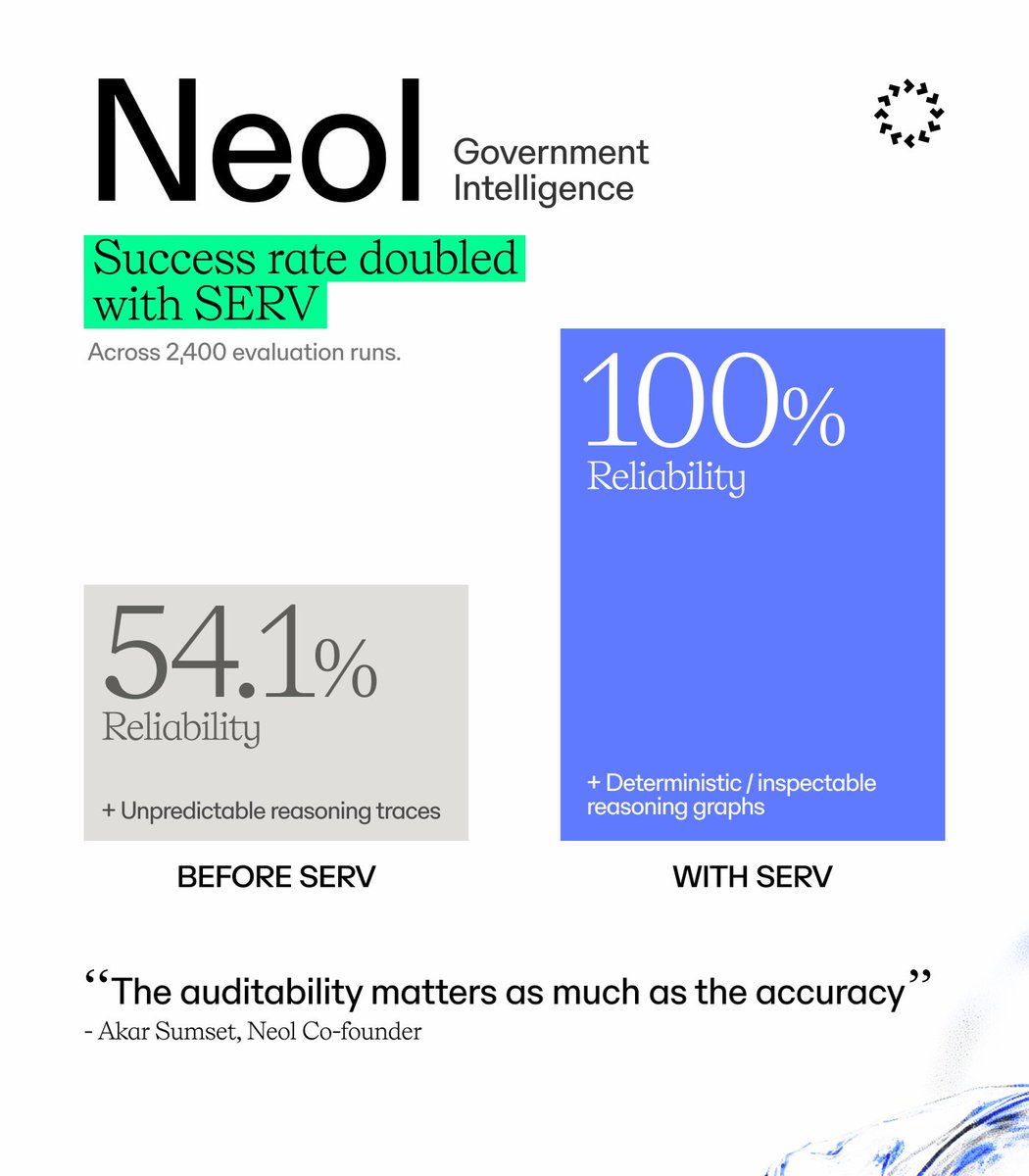
One of Neol's critical agents was failing over 50% of the time
SERV Reasoning brought that failure rate down to 0%
Watch this and tell me your agent stack doesn't need SERV Reasoning
We’re building SERV to become core infrastructure for Enterprise AI.
Our early work with Neol gave us a major advantage in building toward our vision.
We had the opportunity to develop SERV against live production workloads across companies and governments, including the UAE government, while establishing a growing footprint across the Middle East.
That meant access to real-world data and learnings that no theoretical framework or whitepaper could provide.
These learnings shaped v1 and v2 of SERV Reasoning, moving our technology from a theoretical framework to a real-world use case, which now feeds directly into SERV v3 and Graph Sharding, the next stage of the reasoning engine.
Neol runs network intelligence for governments and institutions, where agents surface real people for high-stakes decisions. In these environments, “usually right” isn’t good enough. The reasoning needs to be reliable, reproducible, and auditable.
On one of Neol’s production agents, the same evaluation was run 2,400 times:
- Prompt-engineered stack: 54.1% reliability
- SERV research applied directly: 63.1%
- Full SERV Reasoning methodology: 100% across every category
SERV moved the workload from open-ended reasoning into structured decision graphs, then applied learnings from production, including subgraph decomposition and binary judgments, to make the reasoning more deterministic and testable.
Higher reliability was only one part of the result. Neol gained an inspectable reasoning structure where results can be traced back to specific decisions, making the system easier to test, improve, and defend when challenged.
Our vision is to make SERV the reasoning layer enterprises and institutions rely on to run AI at scale. Neol is an early proof point of this journey.