Senior Research Analyst, @globalsov
Former Deputy chief editor, Africa Intelligence, head of North Africa and Defense sections
Views mine, retweets meaningless
Before the war vs. now:
Before the war, Iran’s power projection was more limited. Now it is targeting U.S. allies across the region and shows no sign of stopping.
Before the war, Iranian oil was under sanctions. Now Washington is easing “limited” restrictions on Iranian oil sales while assuring everyone that, yes, Tehran may still get the money, but somehow it will be “difficult.”
Before the war, Iran did not control the Strait of Hormuz. Now it is shaping access to the strait in practice, while U.S. partners such as India and Japan are seeking, and receiving, Tehran’s approval for their ships to pass. That is real political leverage.
Before the war, regime change was still part of the conversation. Now even reports from inside the U.S. administration suggest it is nowhere close.
Before the war, gas prices were lower and “forever wars” were supposed to be behind us. Today, do I even need to say it?
From the U.S. administration’s perspective: “winning?”
That does not mean the United States cannot still prevail in this war. But at what cost, and toward what end? Innocent lives are now trapped between an unclear strategy and a terror regime.
This is a war that will not be decided kinetically by either side. In the end, it will be decided by diplomacy alone.
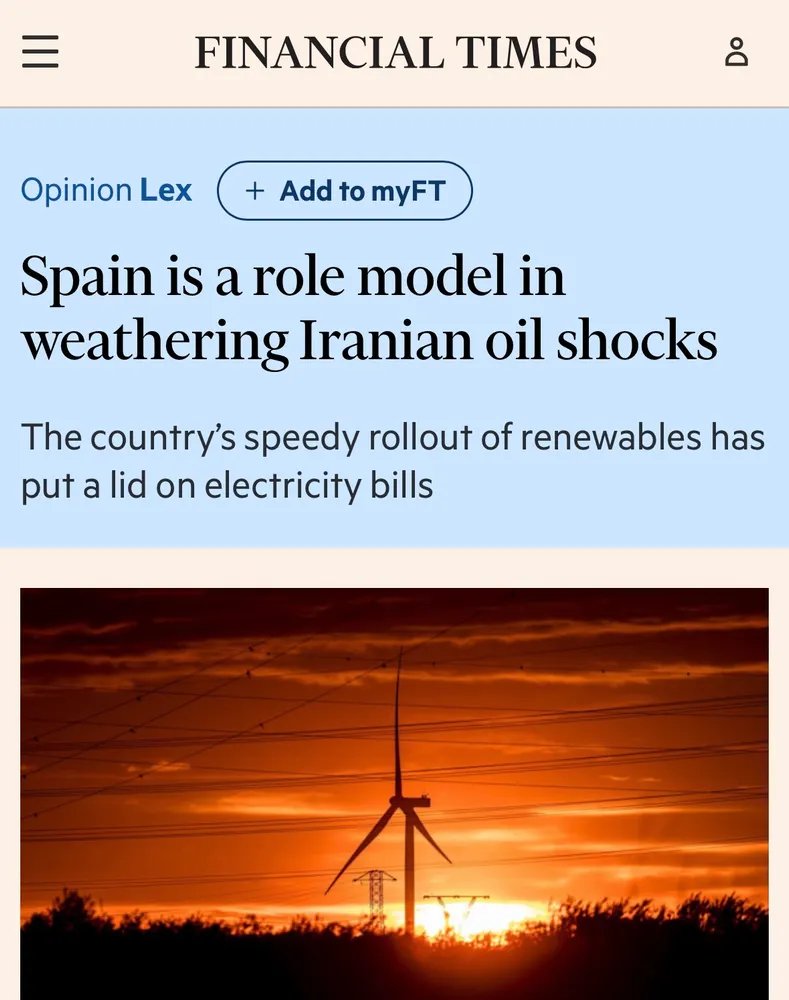
Spain's renewables build-out has structurally decoupled its electricity prices from gas markets.
Gas now sets the price in only 15% of hours, compared to 90% in Italy.
Countries that invested early in clean power are far less exposed to fossil fuel price shocks.
Many people wouldn't have liked it when I called Iran a rational actor.
But consider their actions so far.
-Did not close Strait of Hormuz until there was an existential threat to their country
-Did not attack critical energy infrastructure until theirs was targeted
-They have once again threatened that they will destroy the regional energy infrastructure if theirs is attacked, prompting Trump to announce no more of Iran's will be targeted
-They have demonstrated the capability to destroy the entire energy infrastructure of the Gulf and yet, they are holding themselves back.
Compare this with Israel and USA's actions so far:
-Decapitation strike against Iran while negotiations were progressing well (Oman confirmed this) and a ceasefire was in place.
-Targeted Iran's energy infrastructure knowing fully well that there will be retaliation.
-Initiated a war they have no means of winning without plunging the entire world into an apocalypse.
Which side is the rational actor here?
@liam_karr True, but isn’t it more likely to be a thinly-veiled threat to Trump to cancel their promised/notional investments in the US, if the current mess is not sorted soon ?
Everybody rightfully talks about the oil and gas disaster this can be.
Now consider that 90%+ of the FOOD in the Persian Gulf is arriving by ship through Hormoz.
Dubai has the world largest sugar refinery (Al Khaleej) and Iraq has the second largest (Etihad).
Countless mills grind wheat into flour (Al Ghurair group and others) and crush oilseeds into cooking oil and meal to feed animals.
All that industry has 3 to 6 weeks of inventory. After that food will be scarce.
The Iranians and their Russian allies had four years of target practice on Ukrainian cities to improve their Shahed drones. And most of the world smiled politely and thought it is just the Ukrainians’ unfortunate problem.
I want everyone in tech who’s ever intoned about freedom, or their love of privacy, or their commitment to liberty, to join me in an unequivocal condemnation.
I see a number of commentators already misunderstanding or misrepresenting everything. This is not an act of economic policy. This is an act of war aimed at seizing sovereign European territory. If you want a rough comparison, it’s a mild version (for now) of a war blockade
At this hour, total confusion over whether this means 10% to 25% would be incremental on the 15% that already exists. So if Denmark refuses to sell, the effective rate could be 40% in a hypothetical. Last summer, Europeans conceded a bad deal in the name of geopolitical stability and clarity for businesses. Neither are happening now. Inevitably, calls into question the ability of the European leadership to understand a dangerous moment for the continent. And it’s not just the European Commission, blaming it all on von der Leyen misses a much bigger, complex picture among the capitals and their leadership.
@dunne_insights Most likely, Chinese manufacturers would double down on their exports to emerging economies, which have grown way faster in 2025 and are now worth about 30% more than its Europe sales.
(Losing the European market would still be a major setback)