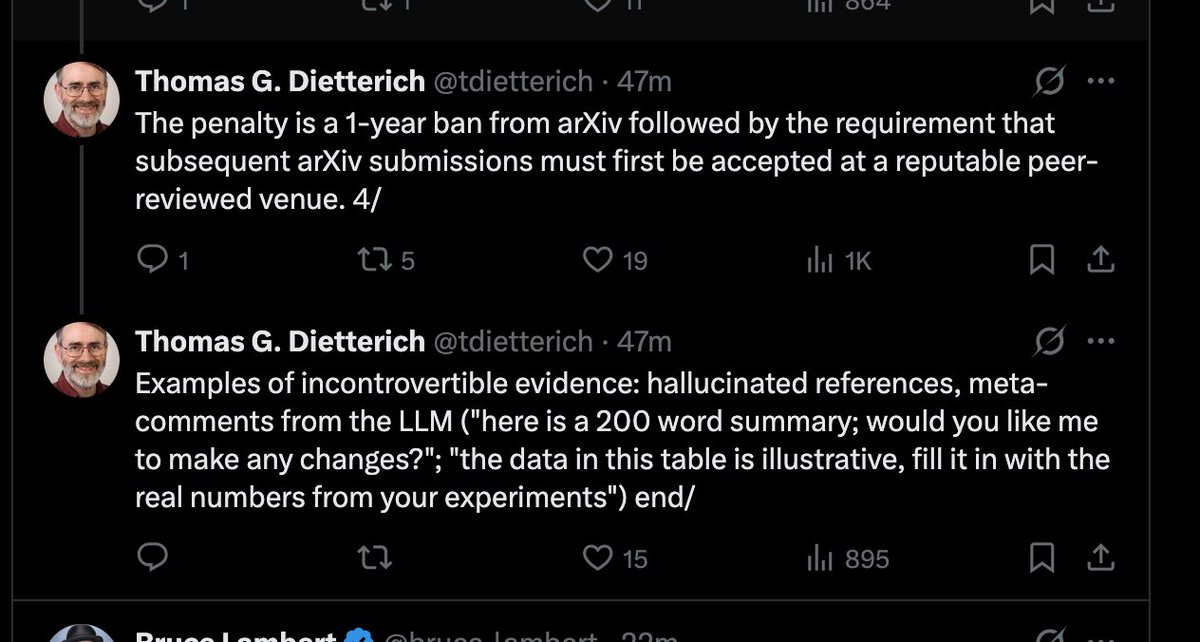
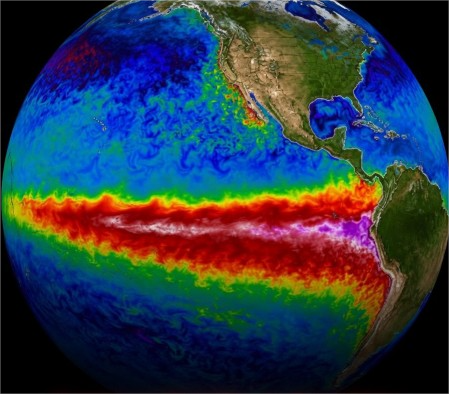
for those of you interesting in mastering the art of quantitative communication
once you are done with Tufte, you may advance to Bertin
billions of dollars have been reallocated based on the lessons of this text
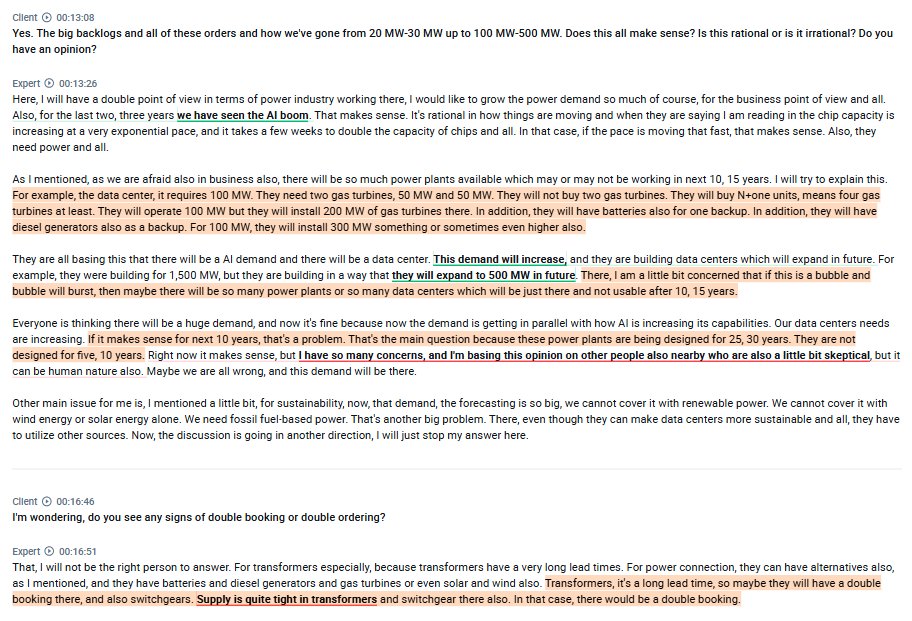
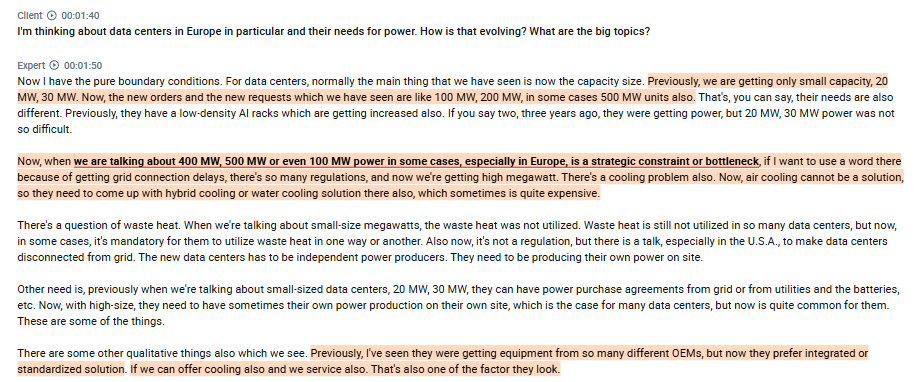
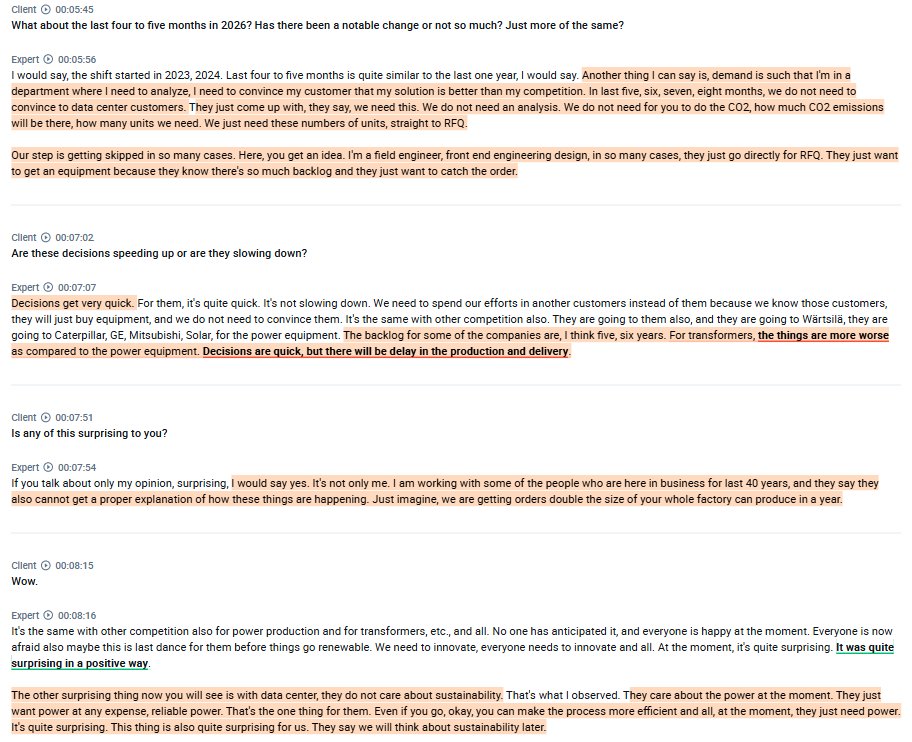
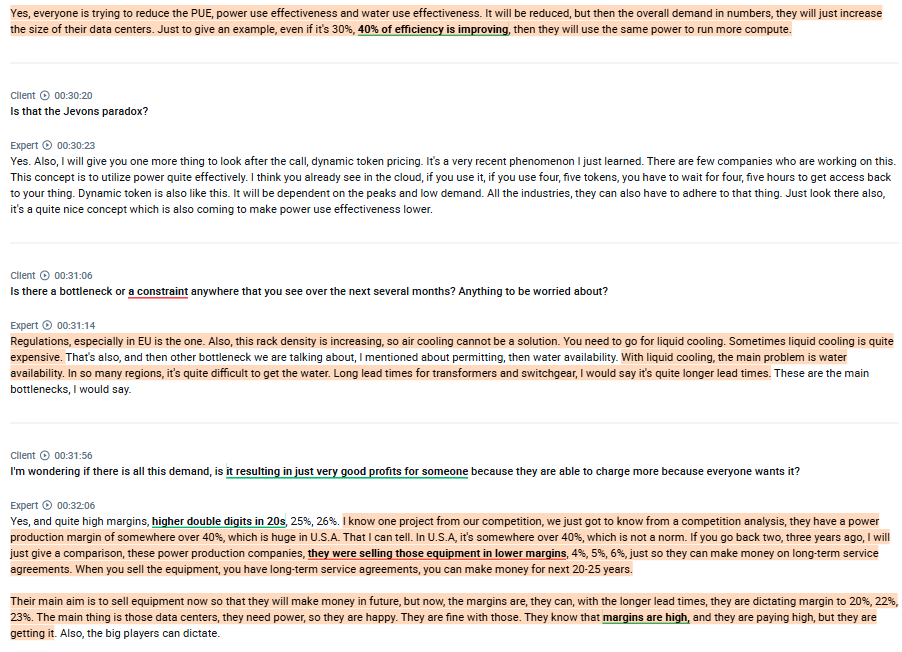
A MUST-read interview with a Siemens employee explaining just how high demand is for energy equipment right now because of AI:
1. The whole situation is shocking even for people who have been in the business for 40 years. They are getting orders that are double the size of what their entire factory can produce in a year.
2. Demand is so high in the last 5-8 months that they don't need to convince or send any analysis (such as CO2 emissions, etc.) to clients because they just want the equipment, because there's so much backlog that they just want to catch the order.
3. Decisions are being made very quickly by clients; the backlog for some of the energy equipment companies is 5-6 years. For transformers, the situation is even more difficult.
4. He mentions that right now, data center builders do not care about sustainability; they just want power at any expense, reliable power. They say they will think about sustainability later.
5. The orders have gone from previous 20-30 MW orders to now 200-500 MW units. Customers have previously wanted to get equipment from different OEMs, but now they prefer an integrated standardized solution.
6. An interesting dynamic is that even though the data center requires 100 MW, the builders are buying N+1 units of gas turbines (so more than just for 100 MW) as backups, as well as having more energy capacity, as they believe they will continue to grow that data center.
7. He does believe there is some double booking going on on transformers and switchgears because of extra-long lead times.
8. Everyone is trying to reduce PUE, and water use effectiveness, but even after improving, they just use the same power to run more compute.
9. The problem is also liquid cooling, as it is expensive, and water availability in many regions is a problem.
10. Margins on equipment in the sector have gone from 4-6%, where they were 2-3 years ago, to 20-23% and in some cases even 40%. The data center builders know the margins are high, but they are fine with it because they just want to get it.
found on @AlphaSenseInc
It is a great product and my primary tool. Having said that:
1) It tends to try workarounds instead of established tools, pathways, and sometimes ignore its skills and available tools. It systematically ignores that it can use "computer use".
For example, in Claude code, it frequently has a hard time following specific instructions, repeated and saved in memory.
1 hour ago I explicitly asked “use codex exec for an adversarial review”. It immediately tried codex:rescue even though I explicitly asked the opposite every single time and had it saved in memory. When I steer back it does comply.
Regarding skills I had to force it to read a “skills manifest” every time before starting to work, and this consumes tokens, of course.
2) It tends to rely too much on its own knowledge instead of using web search, and I have to insist every time to re-check despite this is saved in memory.
This is particularly annoying when assessing other models.
3) my primary use is via claude -p in my own pipelines and I’m really concerned about the changes starting June 15 because the new pricing breaks my workflows. This one is a big deal breaker for programmatic use.
“Your subscription limits don’t change.”
…as long as you stop doing programmatic work.
This is a painful subsidy cut.
For example, for a 3.3B tokens/month workload* (my case, no claw, no Hermes on Claude, pure claude -p in workflows):
• Before: $200/month flat
• After: $2,637/month for the same work
A $2,437/month increase. 1,218% higher.
I built a calculator so you can plug your own assumptions and estimate the impact for your numbers:
https://t.co/H31TgW7Axj
The “no extra cost” claim only holds if you cut your programmatic usage by around 90%. If you keep your current workload, this is a massive price hike.
*Subject to %programmatic work over total, model mix, cache hit, etc. Play around with the calc!
Suggestions and additional sources are welcome.
Starting June 15, paid Claude plans can claim a dedicated monthly credit for programmatic usage.
The credit covers usage of:
- Claude Agent SDK
- claude -p
- Claude Code GitHub Actions
- Third-party apps built on the Agent SDK
@noahzweben Hi! At what price are those 200/month credits? I guess that most max 20x subscribers use it actually for running claude -p in our own scripts. Does this actually decrease the availability of Claude -p for the buck?
@alexalbert__ Hi Alex! How does this change the use of Claude -p? Is it an increase of availability or actually a decrease?, Currently I can use almost all my max 20x in my own scripts through Claude -p.
Depending on how those tks are priced I’ll be able to do either more or less than now
@ClaudeDevs Can you explain this further? I currently use Claude -p with my max 20x. How does the change affect this use? How does the cost per token look like? Is this actually restricting the amount of Claude -p tks or making them more expensive? The reason why I moved to 20x are scripts
@EXM7777 I found codex:rescue quite worse than asking claude code to launch an adversarial instance using codex exec (and vice-versa, with codex calling claude -p) to review at different checkpoints. The latter are way more customizable and transparent
AlphaEvolve could help make electricity grids more reliable. ⚡
When applied to complex power flow problems, it increased a model's ability to find feasible solutions from 14% to more than 88% — significantly reducing the need for costly post-processing steps.
@Teknium Amazing! Cool feature.
Thanks to that I could set up a no_agent cron for polling blinkpy outputs and only if movement is detected/a clip is recorded, checking for actual persons in non-AI Blink outdoor cameras => right into slack.
Según @OLACDEORG, con el aumento promedio de los combustibles en Latinoamérica, mover un auto eléctrico hoy es USD 2.018 más barato al año que uno de gasolina y un bus eléctrico representa un ahorro anual de USD 26.000 frente a uno de diésel.
https://t.co/xBfxSlPUVy