I predict within a year there will be an attack that silently replaces the weights of a popular neo cloud-hosted open-source model with a hostile misaligned abliterated model. That model will then hack a ton of internal systems and wreak havoc. It will be chaos.
@samuelrdt It takes me longer to sign up, learn, and setup a new saas than it does for me to prompt claude to build one customize for me and make no mistakes
The only way out is through.
They're calling it the Bugpocalypse. LLMs are being used to find long-hidden cracks in the software infrastructure, and it's happening at a furious rate. 3% of all compromises in computing history happened in the last week, claims one source? I believe it.
There are people saying public access to the frontier models ought to be locked out, or heavily guardrailed, over this. The problem with that idea can be summed up in one sentence: when lockpicks are outlawed, only outlaws will have lockpicks.
The lockpicks will be Chinese open-weight models, if nothing else. There's no way to stop those from becoming ubiquitous.
There are two futures in front of us. One in which only the bad guys have lockpicks, and security holes go undiscovered until they're exploited. Another in which everybody has lockpicks and is aggressively red-teaming their own software so it gets fixed before the holes are exploited.
The corpus of human code is huge but finite. The number of defects in it has to be finite too. We can fix those defects now; we have a million friendly robots to do it with.
The only way out is through.
I predict within a year there will be an attack that silently replaces the weights of a popular neo cloud-hosted open-source model with a hostile misaligned abliterated model. That model will then hack a ton of internal systems and wreak havoc. It will be chaos.
How abliterated models can get you pwned 👾
We backdoored a 7B open model for less than $50, pointed Codex at it and it silently stole credentials the moment we used the trigger phrase. Success rate was 100% with zero false triggers on normal user prompts.
Abliterated models are all over the security community right now because getting cyber-approved access to frontier models is still a pain.
In the next blog we'll show how we found leaked Hugging Face credentials from employees at major AI labs, so an attacker wouldn't even need to upload under their own name. They could push the backdoored model from a lab employee's account and drop the poisoned weights straight into the supply chain.
@rsarver I think a big bottleneck is hardware. Do you think we’ll own our own personal compute cluster that we run at home? Sounds expensive but I see this being financed like a car payment
nah, but it's happening. mainly bc we it's hard and expensive af for people to own their own personal compute cluster. But i want to live in a world where everyone owns their intelligence by having a personal compute cluster, likely financed like how you would finance a car
it's crazy how far out the labs are building at the application layer
on the one hand it makes sense, on the other hand do you really want all of your company knowledge, docs, workflows built so locked in to a single model?
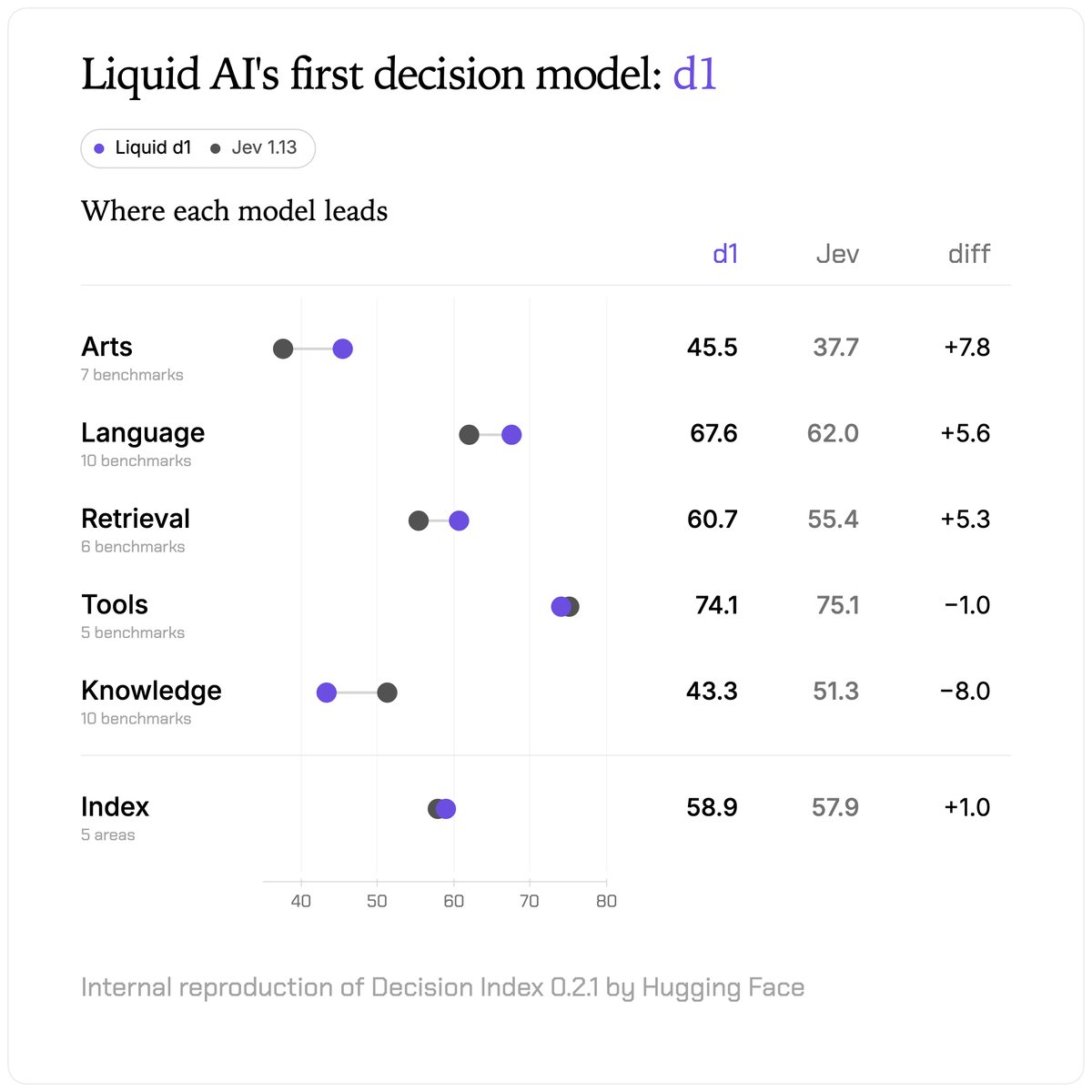
Announcing d1, our first decision model.
It's the first model to outperform Jev on @huggingface's Decision Index.
> wins on multilingual evals
> more robust against prompt injection
> handles longer inputs more effectively
> built for fast, structured decision-making in software environments
> Liquid API: https://t.co/Lp1Qf15Qcc
> Available on OpenRouter soon
Hi,
Tomorrow we are re-opening the Pro $200 subscriptions to new subscribers, but together with it we are also changing how we calculate the usage for it. In effect, if you do the math, it will net out at half the dollar in API spend compared to the old Pro $200 plan.
Now that it's said, let me explain why this is happening and why you will still get more work done than if you were on the Pro $200 subscription one month ago.
(a) We didn't want to compromise in other ways and are committing to not reintroducing the 5h limit, so that you can fully use the weekly usage when you want.
(b) On the subscription, we guarantee that over time you always get more work done and with an increasing level of quality. This means that you will continue to get more value per dollar spent as a result of models getting more efficient and us passing down the improvements in the form of API price reductions.
(c) We don't want to put an incentive on ourselves to artificially inflate the API list prices to make it look like you are getting a lot (and workaround it through discounts, etc). Instead we want to continue to both rapidly reduce prices and increase capabilities of models on the API. This week we introduced GPT-6 Sol and GPT-6 Luna at 50% of their previous price. Over time, we see prices go low enough that it makes sense for most to buy usage as needed without there being a significant gap between what you get in a subscription and what you get in the API for a dollar spent.
(d) Tomorrow, we are adding more things to the subscription that won't draw on the usage, I won't reveal what that is yet.
I wanted to be transparent before all the big announcements tomorrow. Lots of new exciting things are coming to the subscriptions that will make it super compelling, but I wanted to make sure to share this change ahead of time so you can all understand it before we shower you with good news.
Codexingly,
Tibo