This is outrageous framing. Quite frankly, given the current tensions around AI and mathematics, this kind of announcement does not help.
After the recent Buckmaster/OpenAI dispute over scientific credit and provenance, the last thing we need is more promotional PR language that blurs the history of a research problem.
Meta presents its work by asking: “Can AI contribute when a problem is genuinely open and without an existing solution path?”
Seriously?! For the ellipsoid-fitting example, this is misleading and insulting. There was an established research programme, substantial rigorous progress, and by the time of their announcement, publicly available proofs of the exact threshold.
Let us be specific:
- In 2023, Antoine Maillard and Dmitriy Kunisky gave a statistical-physics derivation of the conjectured transition at n/d² = 1/4, using the replica method. Their analysis also predicted the geometry of the solutions and suggested directions for rigorous proofs. This was not a proof, but it was a detailed and successful theoretical picture, not an absence of a path.
https://t.co/F9CLHANv6G
- Afonso Bandeira and Antoine Maillard then rigorously established the sharp threshold for approximate fitting, using methods inspired by the statistical physics of disordered systems, using actually spin glass mathematical technics. Their preprint appeared in 2023 and was published in the Electronic Journal of Probability in 2025. Their Gaussian-equivalence framework provided a foundation for further work (including many of mine!). At this point, the "exact" fitting and removing the spectral restriction were the outstanding gaps, but these are technical problems, it was not about not discovering the threshold from scratch. https://t.co/V15hMsu3kv
- On 10 August 2026, Theodor Misiakiewicz and Garrett Wen posted a proof of the exact Gaussian threshold, explicitly closing those two gaps.
https://t.co/qdlrzO8q75
- On 12 August, Sofia de la Cerda, Aaron Potechin, Madhur Tulsiani and Jeff Xu posted another proof, establishing both sides of the transition up to a vanishing multiplicative factor. https://t.co/vHjN9BHUY3
- On 27 August, Frederic Koehler and Youngtak Sohn posted a broader universality theorem that includes the Gaussian threshold. https://t.co/zpuDGpSqVF
These were not researchers merely “on the verge” of solving the problem. THE PROOFS WERE ALREADY PUBLIC. Meta's announcement comes in October, and Section 3 of their paper begins:
“We use the groundbreaking approximate-fitting theorem of Bandeira and Maillard…”
Dear META: Those are your words. This is not simply a reference in the bibliography: your feasibility proof explicitly starts from their theorem.
How is that consistent with advertising this example through the suggestion that there was “no existing solution path”?
Yes, your social post mentions independent solutions, and your paper and blog identify the August results and describe your work as independently developed. That does not answer the objection to the framing. A generic acknowledgement of parallel work does not make clear that the exact threshold already had publicly available proofs before this announcement.
An independently developed AI-assisted proof, released after other proofs, should be presented as exactly that. Readers should not have to reconstruct the chronology to understand what is, and is not, new.
A new proof can contain valuable ideas. But a new proof and a newly solved problem are not the same claim. Nor does a problem being open when a project begins mean it is still open when the marketing campaign launches.
You say the aim is to “empower researchers”? Nothing more “empowering” than seeing years of collective research turned into the backdrop for a cheap marketing stunt.
Correct the announcement! Give the scientific history the same prominence as the product. Give Antoine, Afonso, Theo and all the other researchers involved the public credit they deserve.
Followup Paper -- "Neural Networks Provably Learn Group Representations: From Cyclic to Non-Abelian"
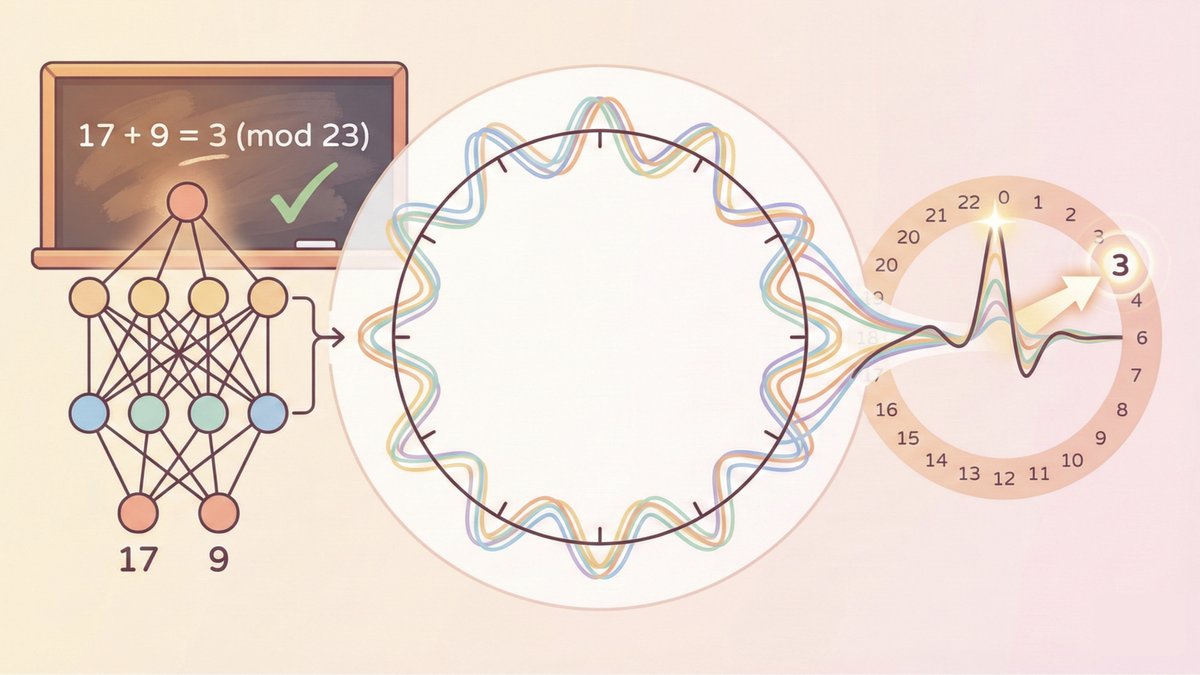
Our prior work (https://t.co/uCU4eNr7tH) showed that NNs trained on modular addition learn **sinusoidal features** with precise **phase alignment**. But why sinusoidal? Why those phases?
Because sine and cosine are the **irreducible representations** of the cyclic group Z_p. The network is discovering the representation theory of the group it computes on.
This is not a coincidence. In our new paper, we show that all of these findings can be generalized to Abelian groups, and there is some surprise for non-Abelian groups.
In particular, we study how NNs learn the group composition task: given two group elements g1 and g2, predict g1*g2. The key insight is that NN learns to leverage **group fourier features** to solve this task.
arxiv: https://t.co/WdNIuC9nPj
blog: https://t.co/MUfWOnSICj
code: https://t.co/XUp37Fhjqc
@JLiangHe@LedaW77625@FengzhuoZhang@siyuc3141
New Paper -- "On the Mechanism and Dynamics of Modular Addition: Fourier Features, Lottery Ticket, and Grokking"
We give a complete mechanistic and dynamic picture of how neural networks learn modular addition f(x,y) = (x+y) mod p. We answer three questions:
(1) What does the trained network compute?
(2) How do Fourier features emerge during training?
(3) Why does grokking happen?
Each answer comes with a mathematical characterization backed by theory and experiments.
Paper: https://t.co/uCU4eNr7tH
Blog: https://t.co/Ok9dDQcYvw
Demo: https://t.co/SX4Q6IsLHB
Code: https://t.co/03Adj6E3Bt