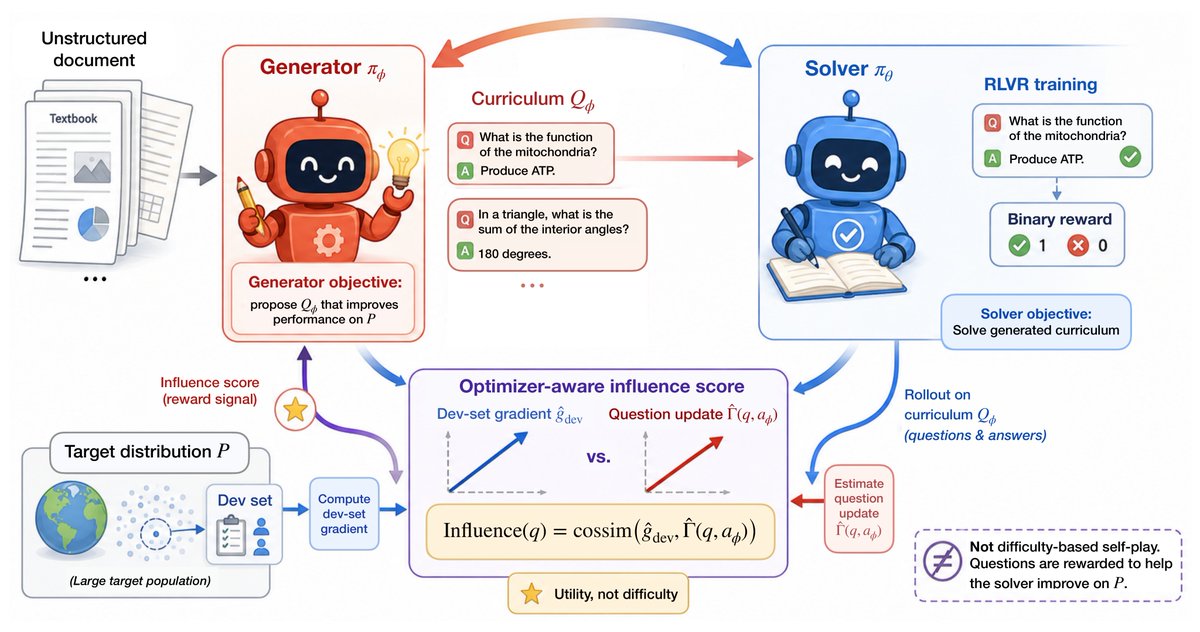
How do we get LLMs to self-improve using unstructured documents without relying on human curation or naive "difficulty" heuristics?
Excited to share INFUSER, our latest work that turns self-evolution into influence-guided curriculum learning! 🚀 https://t.co/weDJ9Fjrbw
Looped transformers often save compute by truncating backpropagation to the last few loops.
Is it worth it? We trained ~600 models to find out 👀
Short answer: only if the loop count is fixed. Otherwise, run fewer loops and train them all!
📄 https://t.co/4vPIXEUdDJ
🧵👇
🪶 Short on GPU memory? Two loops to the rescue.
No looping is compute-optimal, but 2 fully trained loops achieve the same performance of it with 27–32% fewer non-embedding params and only 8% more training compute!
Beyond faster training, does Muon learn better features than Adam?
🚀 Ans: Yes. Muon learns features that are more robust to input corruptions and transfer better to downstream tasks.
This advantage is reflected in hidden states:
1⃣larger logit margins → stronger robustness
2⃣higher effective rank → richer, more transferable representations
Paper Link: https://t.co/lNWJ80h3a8
A thread 🧵
@_Suresh2 Thanks! To clarify: we aren't "reference-free." We use a target domain dev-set (verified and challenging questions) to compute the influence score. Using influence score as rewards "align" the generated questions with the high quality dev-set. Check our generator quality analysis
How do we get LLMs to self-improve using unstructured documents without relying on human curation or naive "difficulty" heuristics?
Excited to share INFUSER, our latest work that turns self-evolution into influence-guided curriculum learning! 🚀 https://t.co/weDJ9Fjrbw
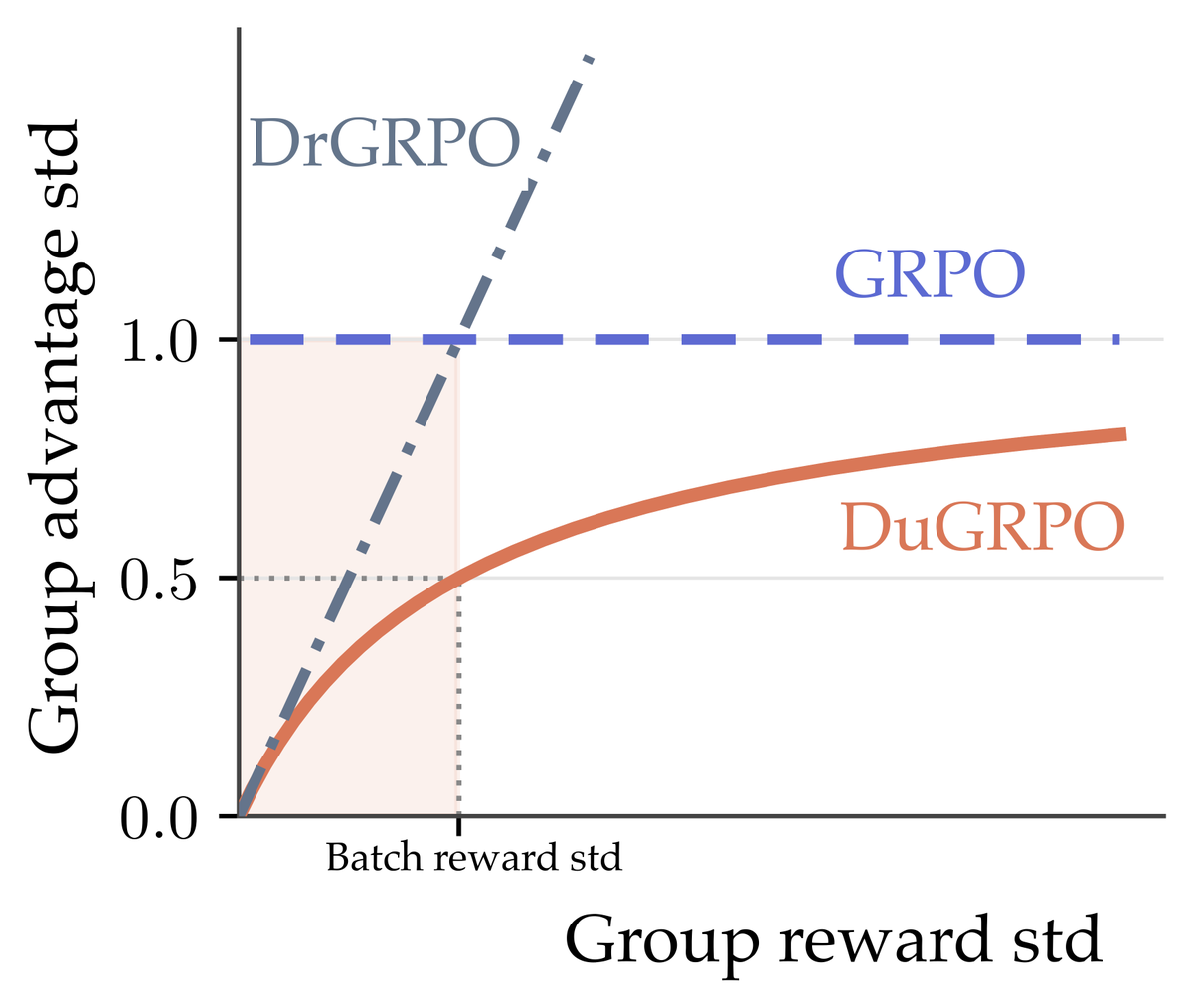
5/6: The tech (DuGRPO)
Influence rewards are continuous and noisy, so standard GRPO is a poor fit.
We introduce DuGRPO, a dual-normalized GRPO variant that stabilizes generator training by normalizing both within-document and batch-level reward variation.
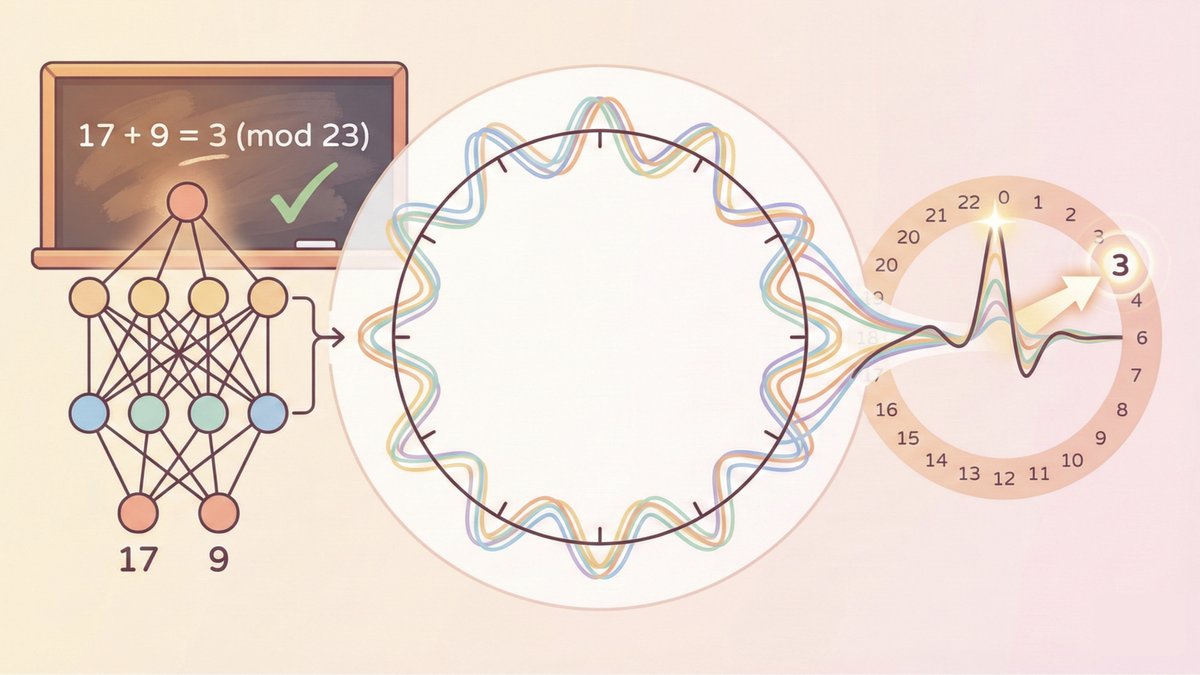
Followup Paper -- "Neural Networks Provably Learn Group Representations: From Cyclic to Non-Abelian"
Our prior work (https://t.co/uCU4eNr7tH) showed that NNs trained on modular addition learn **sinusoidal features** with precise **phase alignment**. But why sinusoidal? Why those phases?
Because sine and cosine are the **irreducible representations** of the cyclic group Z_p. The network is discovering the representation theory of the group it computes on.
This is not a coincidence. In our new paper, we show that all of these findings can be generalized to Abelian groups, and there is some surprise for non-Abelian groups.
In particular, we study how NNs learn the group composition task: given two group elements g1 and g2, predict g1*g2. The key insight is that NN learns to leverage **group fourier features** to solve this task.
arxiv: https://t.co/WdNIuC9nPj
blog: https://t.co/MUfWOnSICj
code: https://t.co/XUp37Fhjqc
@JLiangHe@LedaW77625@FengzhuoZhang@siyuc3141
Why do DeepSeek and Kimi use Muon instead of Adam?
🚀 Reasons from a curvature perspective:
1⃣ Under a second-order approx., Muon incurs a much smaller curvature penalty than Adam while maintaining the same first-order decrease.
2⃣ This advantage does not come from a smaller update norm. Instead, it comes from Muon having lower Normalized Directional Sharpness (NDS).
3⃣ Muon’s NDS advantage becomes larger when the training data is more imbalanced.
Paper Link: https://t.co/nGy2FeF538
A thread 🧵
New Paper -- "On the Mechanism and Dynamics of Modular Addition: Fourier Features, Lottery Ticket, and Grokking"
We give a complete mechanistic and dynamic picture of how neural networks learn modular addition f(x,y) = (x+y) mod p. We answer three questions:
(1) What does the trained network compute?
(2) How do Fourier features emerge during training?
(3) Why does grokking happen?
Each answer comes with a mathematical characterization backed by theory and experiments.
Paper: https://t.co/uCU4eNr7tH
Blog: https://t.co/Ok9dDQcYvw
Demo: https://t.co/SX4Q6IsLHB
Code: https://t.co/03Adj6E3Bt
Large Language Models (LLMs) exhibit “slash patterns” in attention maps — a key mechanism behind prefilling acceleration.
We take a first step toward understanding why they emerge.
Main findings:
▶️ Slash patterns are OOD-generalizable
▶️ Queries and keys on these heads are near rank-one and carry little contextual information.
▶️RoPE is the primary source of the slash pattern.
Blog link:
https://t.co/uhE3y7i5xW
A thread 🧵