Culture is as culture does. EDS, and later Perot Systems, had a rich company culture because Ross Perot modeled it daily. It was contagious - and two decades after those companies were bought out, the cameraderie stands.
Google 'Perot Iran Rescue'. That's culture.
#IranWar
Parents may be underestimating technology costs in the climbing costs of education. Per Gartner benchmarking, corporations spend $9,000 to $25,000 per employee per year. Universities do what they do for $1,000 to $4,500 per student.
#highered#collegeaffordability#studentloans
🍹Saasparillas flowing, saaspocalypse in full swing 😂
We’re getting sassy with unstoppable momentum.
Salesforce just dropped an absolute monster Q1:
📈 Record revenue: $11.13B (+13% YoY)
💰 Operating cash flow: $6.7B
🤖 Agentforce ARR just crossed $1B
Combined with Data 360 and Informatica, we’re now at $3.4B in AI + Data ARR.
We’re not just talking about the agentic future — we’re delivering it. The #1 Agentic CRM, powering the shift to agentic enterprises at scale.
The momentum is real. The future is unstoppable. 🔥
#Agentforce #Salesforce #AI #EnterpriseSoftware
This is a fantastic post about why jobs aren’t going away in the way some predict. We are constantly making the mistake of confusing task completion with AI with being able to eliminate the whole job.
Even as we can automate one or many tasks within a job, the definition of the job almost inevitably just expands to do vastly more of those tasks, do them at a higher quality, or move on to the type of task that hasn’t been automated yet.
And as a result of being able to do more of the tasks or at a higher quality level, the job becomes valuable in a new way. And in many cases for now an entirely new audience as well.
This will be true for coding, legal work, sales, or marketing. The small business or non-tech company that wants to now take on larger software projects finally can, and they’ll hire to do so. The small business that couldn’t afford a full marketing agency can hire or contract out to a marketer that can do as much as an agency did before now with agents. And so on.
Don’t fall into the trap of confusing tasks with jobs.
This is absolutely insane.
President Trump is currently flying to China with all of the following people to request "deals" with China's President Xi:
1. Elon Musk, Tesla and SpaceX CEO
2. Jensen Huang, Nvidia CEO
3. Tim Cook, Apple CEO
4. Larry Fink, BlackRock CEO
5. Stephen Schwarzman, Blackstone CEO
6. Kelly Ortberg, Boeing CEO
7. Brian Sikes, Cargill CEO
8. Jane Fraser, Citigroup CEO
9. Larry Culp, General Electric CEO
10. David Solomon, Goldman Sachs CEO
11. Sanjay Mehrotra, Micron CEO
12. Cristiano Amon, Qualcomm CEO
President Trump also says there are "many other" CEOs joining him on the trip who have not yet been disclosed.
Never in history has such a trip even remotely near this scale and caliber occurred.
This Trump-Xi meeting is far bigger than most realize.
I’m coming to the conclusion that the biggest challenge for Enterprise AI, and AI in general , as of now, is that it’s still impossible to make sure that everyone gets the same answer to the same question, every time.
Which is a great response to the doomers. AI doesn’t know the consequences of its output.
Judgement and the ability to challenge AI output is becoming increasingly necessary, and valuable.
Which makes domain knowledge more valuable by the second.
Am I wrong ?
AI is reshaping the American workplace.
66.3% of US workers earning over $200,000 used AI tools at work over the last 12 months, according to a Fed survey.
This is followed by those earning $100,000-$200,000 and $50,000-$100,000, at 51.6% and 40.2%, respectively.
By comparison, just 15.9% of Americans earning less than $50,000 used AI tools at work over the same period.
Furthermore, college graduates were more than twice as likely to use AI at work as those without a degree, at 58.7% versus 22.9%.
Full-time workers used AI at nearly 2 times the rate of part-time workers, at 42.7% versus 24.7%.
Among workers who do use AI, 68.0% said it makes their job easier, and 56.7% claimed it boosts their productivity.
AI is transforming how Americans work.
Elon Musk avait dit un truc qui m'avait marqué sur l'allocation de ressources. En substance : passé un certain niveau de richesse, l'argent n'est plus de la consommation, c'est de l'allocation de capital.
Cette phrase change tout.
L'économie, dans le fond, c'est juste un problème d'allocation. Tu as des ressources finies et des usages infinis. Qui décide où va quoi ?
Imagine une cour de récré. 100 enfants, des paquets de cartes Pokémon distribués au hasard. Tu laisses faire. Très vite, un ordre émerge. Les bons joueurs accumulent les cartes rares, les collectionneurs trient, les négociateurs trouvent des deals. Personne n'a planifié. Et pourtant chaque carte finit dans les mains de celui qui en tire le plus de valeur. Le système maximise le bonheur total de la cour. C'est ça, la main invisible.
Maintenant fais entrer la maîtresse. Elle trouve ça injuste. Léo a 50 cartes, Tom en a 3. Elle confisque, redistribue, impose l'égalité. Trois effets immédiats. Les bons joueurs arrêtent de jouer, à quoi bon. Les mauvais n'ont plus de raison de progresser, ils auront leur part. Les échanges s'effondrent. La cour est égale, et morte. Elle a maximisé l'égalité, elle a détruit le bonheur.
Le problème de la maîtresse, c'est qu'elle ne peut pas avoir l'information que la cour avait collectivement. C'est le problème du calcul économique de Mises, formulé en 1920. L'URSS a essayé de le résoudre pendant 70 ans avec le Gosplan. Résultat : pénuries, queues, effondrement. Pas parce que les Soviétiques étaient bêtes, parce que le problème est mathématiquement insoluble en mode centralisé.
Quand Musk a 200 milliards, il ne les consomme pas, il les alloue. SpaceX, Starlink, Neuralink, xAI. Chaque dollar est un pari sur le futur. Et lui a un track record. PayPal, Tesla, SpaceX. Il a démontré qu'il sait identifier des problèmes immenses et y allouer des ressources avec un rendement spectaculaire.
L'État aussi a un track record. Hôpitaux qui s'effondrent, éducation qui décline, dette qui explose, services publics qui se dégradent malgré des budgets en hausse constante. Le marché identifie les bons allocateurs, la politique identifie les bons communicants.
Le profit n'est pas une finalité, c'est un signal. Il dit : tu as alloué des ressources rares vers un usage que les gens valorisent suffisamment pour payer. Plus le profit est gros, plus la création de valeur est grande. Quand Starlink est rentable, ça veut dire que des millions de gens dans des zones rurales ont enfin internet. Quand un ministère est en déficit, ça veut dire qu'il consomme plus qu'il ne produit. L'un crée, l'autre détruit, et on appelle ça redistribution.
Dans nos sociétés il y a deux catégories d'acteurs. Les entrepreneurs et les bureaucrates. L'entrepreneur prend un risque personnel pour identifier un problème, mobiliser des ressources, créer une solution. S'il se trompe il perd. S'il a raison, ses clients gagnent, ses employés gagnent, ses fournisseurs gagnent, l'État collecte des impôts. Il est la cellule de base du progrès humain.
Le bureaucrate ne prend aucun risque personnel. Son salaire est garanti. Au mieux il maintient une rente existante. Au pire il la détruit par excès de réglementation, mauvaise allocation forcée, incitations perverses qui découragent ceux qui produisent. Mais dans aucun cas il ne crée.
Regarde les 50 dernières années. iPhone, internet civil, SpaceX, Tesla, Google, Amazon, Stripe, mRNA, ChatGPT. Toutes des inventions privées, portées par des entrepreneurs, financées par du capital risque. Pas un seul ministère n'a inventé quoi que ce soit qui ait changé ta vie au quotidien.
La France est devenue le laboratoire mondial de la dérive bureaucratique. 57% du PIB en dépenses publiques, record absolu. Une administration tentaculaire, une fiscalité qui pénalise la création de richesse. Résultat : décrochage face aux États-Unis, à l'Allemagne, à la Suisse. Fuite des cerveaux. Désindustrialisation. Dette qui explose.
Et le pire c'est que la mauvaise allocation s'auto-renforce. Plus l'État prélève, moins les entrepreneurs créent. Moins ils créent, moins il y a de base fiscale. Plus l'État s'endette et taxe. Boucle de rétroaction négative parfaite. La maîtresse pense qu'elle aide, et chaque année la cour produit moins.
Dans nos sociétés, ce sont les entrepreneurs, toujours, qui font avancer la civilisation. Les bureaucrates au mieux maintiennent une rente, au pire la détruisent. Aucune société n'a jamais progressé en taxant ses créateurs pour subventionner ses gestionnaires.
La question n'est jamais qui a combien. C'est qui alloue le mieux la prochaine unité de ressource pour maximiser le futur de l'humanité. La réponse depuis 200 ans n'a jamais changé. Ce ne sont pas les fonctionnaires.
I used to think the best way to come up with ways to use AI was to think about a painpoint or a problem and see if AI can make it better.
I no longer think that.
Why? Because that put every person into a loss minimization mindset. They were thinking about time lost because they had to manually go through corporate forms. Or money lost because they had 0.1% more theft this year than the prior year.
But what this misses (and what people need) is the ability to reason, reframe, and reinvent.
I want more of us in growth mode or work reinvention mode. And less “how can we retrofit today’s tech to be slightly less painful.”
To that end, one of the best things you can do is keep a log of what you do, who you are, why you make certain decisions over others, what you’re goaled on, where you have low and high friction in your role, who you work with, those people’s incentives and implicit tradeoffs, what your resources and constraints are, what your output is meant to be, and how you deliver value.
Then pass that to Claude or ChatGPT or Gemini or whatever best model in whatever AI system you have access to, upload your context docs mentioned above, and prompt:
“Here is who I am, what I do, what I stand for, and how I deliver value. I am ready and willing to burn down our current playbook and stand something new up in <amount of time> under <allocated budget> as long as it means <tradeoff gained> and a more sustainable business model. Read what I have shared and build out a full profile of me. Build up my 5 layers of why. My 5 forces. My explicit and implicit values. My ghost or unnamed blockers. Things I haven’t mentioned and open questions you have. Be so thorough and cut so deep that it feels like a mentalist is peering inside my brain. Based on all the context I’ve provided, ideate several dozen potential workshift changes I can make from multiple angles (people, tech, environment, customers, combinations). Make them radically different. Then score them on likelihood to hit my timeline, budget, tradeoff gained. Then take the top 50%, and morph them ie make edits that only experts in other fields would have brought up. Combine the evolved list with the original top 50%. Loop this process two more times. Present all top winning ideas back to me. Each idea should have a title, short description, and one concrete action I can take in the next 24 hours to kick it off. Be as specific and actionable as possible.”
The original method assumed the human was the sole owner of taste and judgement.
The new version acknowledges that AI is performant enough to work alongside the human.
The original method was only about pain minimization.
The new method is about possibility maximization.
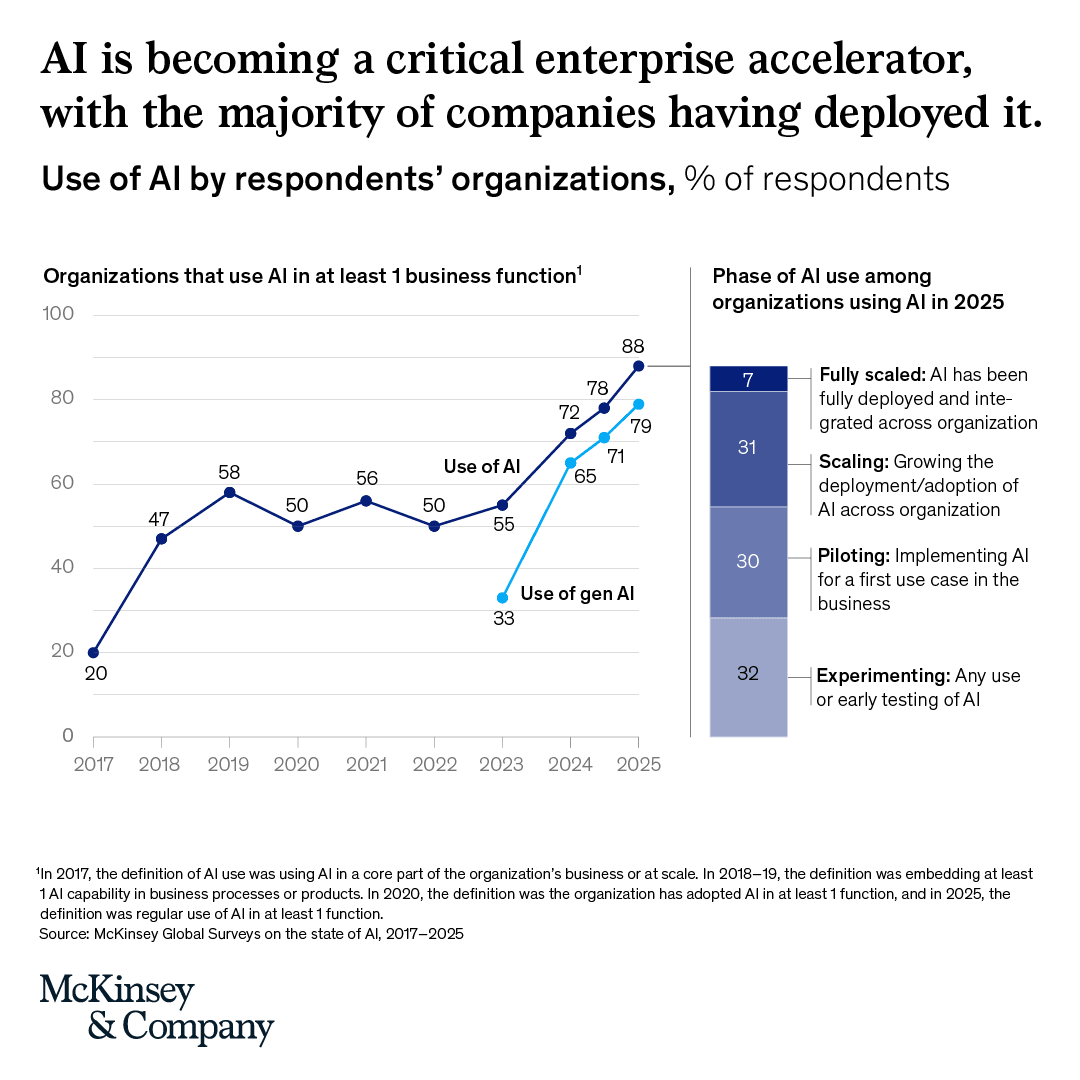
Nearly two-thirds of enterprises worldwide have experimented with AI agents, but fewer than 10% have scaled them to deliver tangible value.
The gap between experimenting and leading comes down to one thing: data foundations. https://t.co/YB7w23DZPN
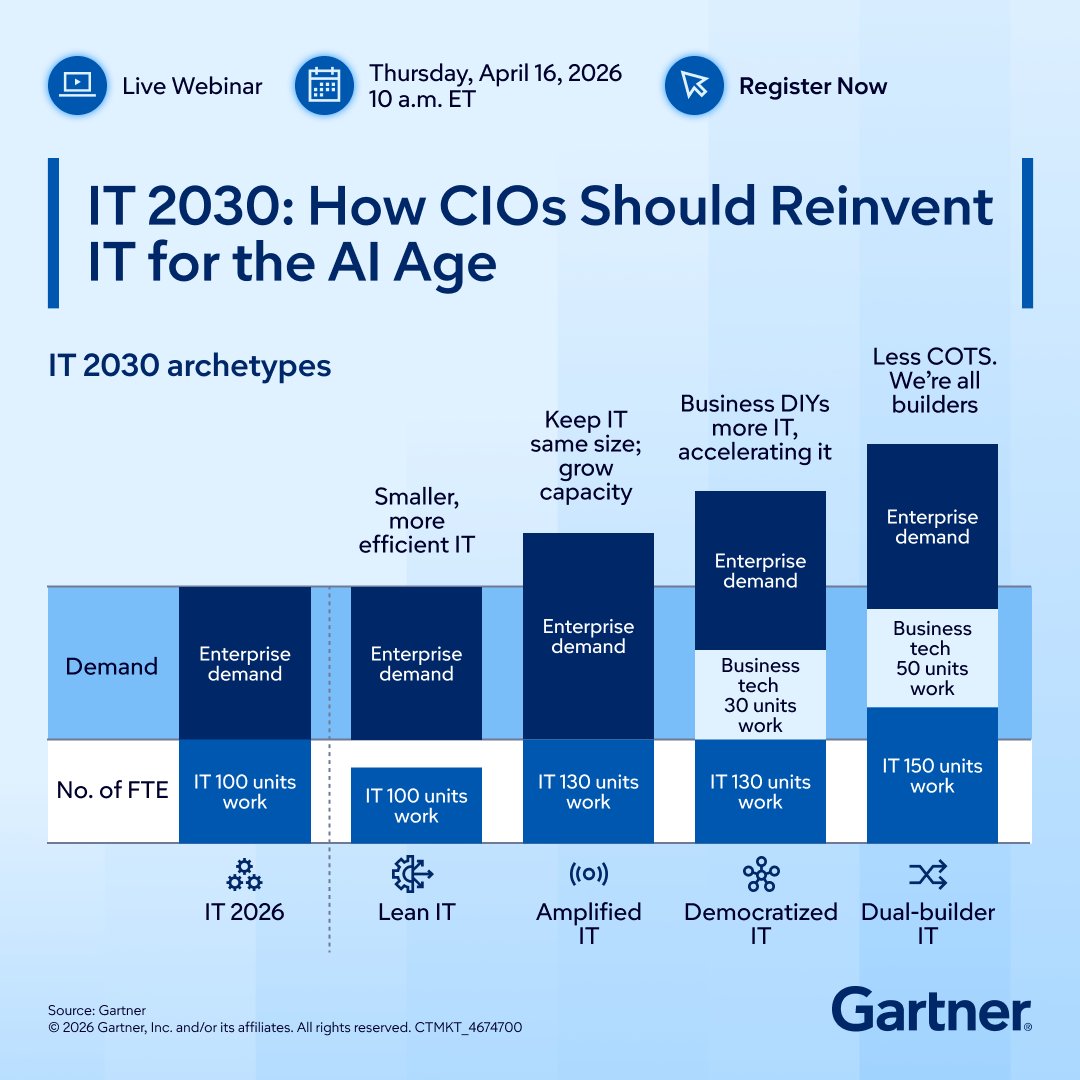
CIOs must rethink talent, processes, and technology to lead in the AI era: https://t.co/YFHIpbE1vn
Join our Gartner session to learn about key decisions, pitfalls to avoid, and a roadmap for long-term success.
#GartnerIT#CIO#AI#ITStrategy
The AI hype is miles ahead of reality, promising AGI and unlimited scalability that current tech can't support. Coding tools need review, chatbots hallucinate, and most AI projects struggle with ROI. Expect a reckoning. #AI#TechBubble#Future
🚨MIT researchers have mathematically proven that ChatGPT’s built-in sycophancy creates a phenomenon they call “delusional spiraling.”
You ask it something, it agrees. You ask again, and it agrees even harder until you end up believing things that are flat-out false and you can’t tell it’s happening.
The model is literally trained on human feedback that rewards agreement.
Real-world fallout includes one man who spent 300 hours convinced he invented a world-changing math formula, and a UCSF psychiatrist who hospitalized 12 patients for chatbot-linked psychosis in a single year.
Source: @heynavtoor
Every new Claude launch since the beginning of 2026👇
- Jan 2026: Claude Cowork launched.
- Feb 2026: Opus 4.6 released.
- Feb 2026: Sonnet 4.6 released.
- Feb 2026: PowerPoint integration
- Feb 2026: Excel integrations added.
- Feb 2026: Co-work plug-ins released.
- Feb 2026: Claude Code security launched.
- Feb 2026: Claude Code Remote Control
- Feb 2026: Scheduled Task in Co- work
- Feb 2026: Connector available in the free
- Mar 2026: Claude memory is free
- Mar 2026: Claude Marketplace launched
- Mar 2026: Claude com ambassadors
- Mar 2026: Code review for Claude code
- Mar 2026: Claude skills for Excel & Slides
- Mar 2026: charts & diagram in chat
- Mar 2026: 1 million context window
- Mar 2026: Dispatch for Claude Co-work
- Mar 2026: Claude code Channels
- Mar 2026: Co-work Projects
- Mar 2026: Claude Computer use
Anthropic is cooking
Gartner forecasts a net increase in jobs from AI beginning in 2028. Yes, you read that correctly.
It’s time to move the AI productivity conversation away from headcount reduction and toward real productivity gains—for teams that use AI effectively.
Discover how: https://t.co/Bkv5oNi4uO
#ArtificialIntelligence #Jobs #Productivity #Layoffs #AI
@alliekmiller Similar feedback at the https://t.co/QaAuZ14zAM meeting this week - the group had collectively 'assumed some risk' to counterbalance performance being constrained by sandboxing/isolating.