New paper on octopus-inspired adhesives with switchable attachment to challenging underwater surfaces.
It works on soft and rigid objects that are flat, rough, and even curved (think rocks, shells, and delicate gel beads)!
See it in Advanced Science
https://t.co/AOe3z0GiiC
New paper on Electrically Conductive Liquid Metal Composite Adhesives.
This SofT integrated composite with tacK through liquid metal (STICK-LM) adhesive can reversibly bond soft electronics and robotics.
See it in Adv. Funct. Mater. @AdvSciNews -https://t.co/lMNpfKKGlU
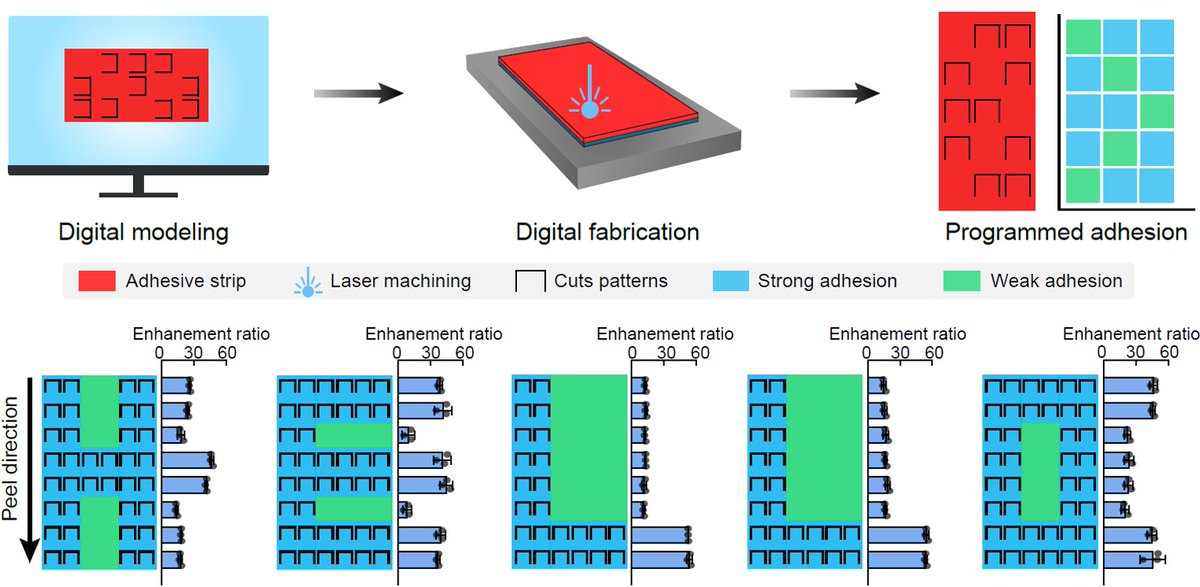
Metamaterial adhesives use non-linear cut architectures to control reverse crack propagation to tune adhesion. This mechanism works in a wide range of materials, substrates, and conditions. Cut features must be designed around a characteristic length.
We can specifically place the non-linear cuts to tune adhesion strength at any film location. A digital fabrication framework enables this and rapidly customizes adhesive characteristics with deterministic control.
We leverage both material and geometric mechanisms to span a spectrum of unique adhesives properties, from strong and extremely reversible to extremely strong with reversibility, including adhesives with strength/energy over 3000 N/m (J/m^2) that are also reusable and directional
@RongLong8@emarkvicka@Dohgyu_Hwang@Lee_Chanhong Access the article information here: https://t.co/Dru4CvNHij
And full-text access (view-only) version of the paper here: https://t.co/wDAXfHclt7
New paper introducing metamaterial adhesives that achieve strong yet releasable adhesion.
Programmed cuts force cracks to propagate BACKWARDS for enhanced adhesion, while allowing normal, forward crack growth for easy release.
In @NatureMaterials at https://t.co/wDAXfHclt7
Exciting collaboration with @SMSLaboratory on octopus-inspired adhesive skins that utilize rapidly switchable adhesives with tight integration of sensors, processing, and control for underwater manipulation.
"Nature already has some great solutions, so our team looked to the natural world for ideas. The octopus became an obvious choice for inspiration," researcher Michael Bartlett said. 🐙
https://t.co/8z2jnaHdyf
The octopus-inspired adhesive skin uses rapidly switchable adhesives with tight integration of sensors, processing, and control for underwater manipulation. Work done with @VirginiaTech_ME@VirginiaTechMII in collaboration with @emarkvicka