When I saw the Absolute Batman #25 cover illustration, I was reminded of a challenge my friend Marshman and I had taken on together.
Several years ago, I invented a manga app called WatchManga.
My friend and I decided to develop it and introduce it to the world.
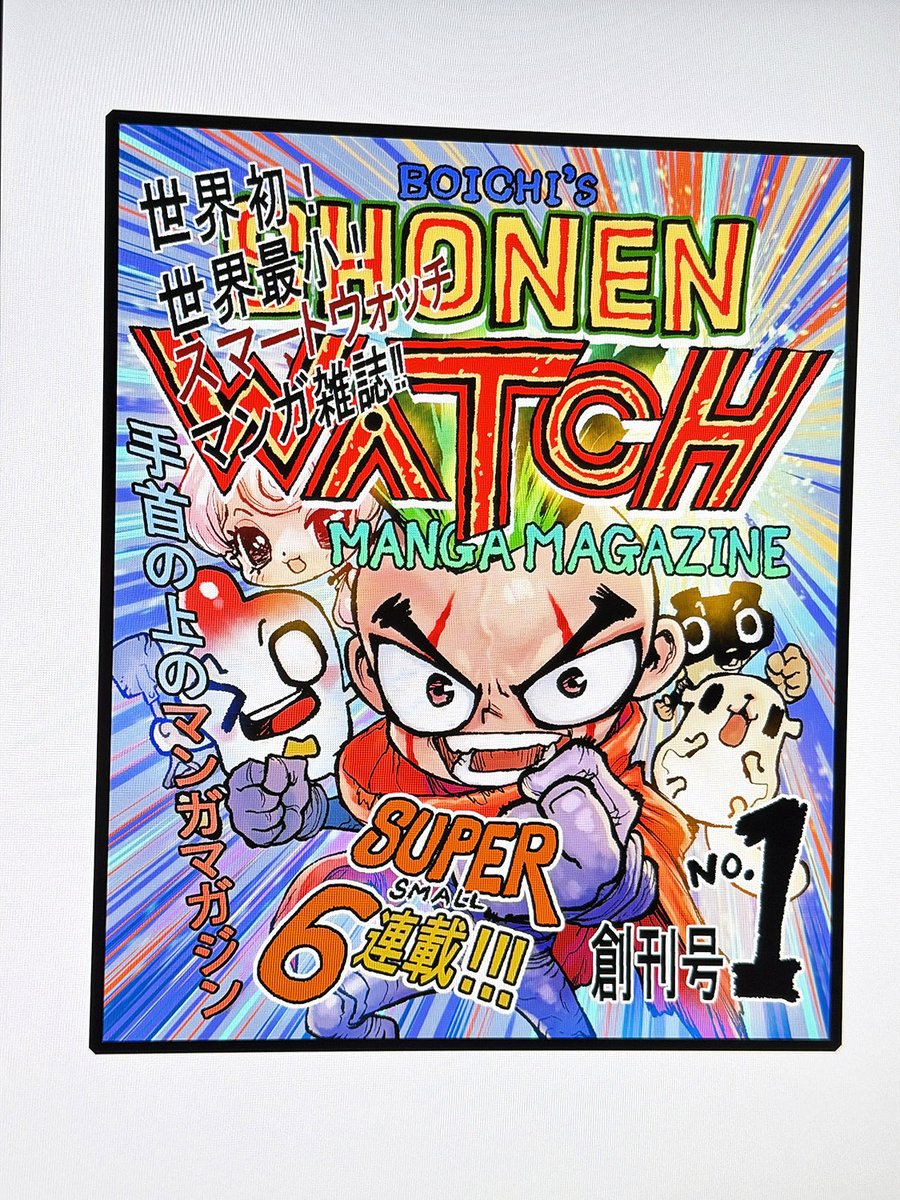
That was how we created Shonen Watch, the world's first manga magazine designed for smartwatches.
We created a cover that paid homage to the shonen manga magazines we grew up with, including Weekly Shonen Jump.
And not just Japanese magazines—South Korea had shonen manga magazines, too.
The cover you see in the image below this post is the one we made.
In fact, I had in mind not today's Shonen Jump, but the Shonen Jump of the 1990s!
The cover and the manga itself were created as an homage to that era.
We also prepared two language versions: Japanese and English.
If the project succeeded, we planned to add Spanish, Italian, and Korean editions.
So we submitted our app to both the Japanese and American Apple App Stores.
I had heard that app reviews could take quite a long time, but, to our surprise, the Japanese App Store approved our app in just two days.
We were astonished. But we also thought, "That's Japan for you. They really understand manga."
We believed the Japanese App Store reviewers had immediately understood our vision and our exploration of the possibilities of smartwatches as a new medium for manga.
That, we thought, was why they had approved it so quickly.
But the American App Store rejected it.
The reason?
"Plagiarism of Shonen Jump."
...Wait, WHAT?!
We had heard people say that our cover looked similar to Shonen Jump. Well, of course it did...
But I... I had actually worked for Weekly Shonen Jump.
So perhaps it wasn't just similar. Perhaps it was the same.
Yeah... The extraordinary praise and respect that the Batman cover received, and the immediate understanding of the homage behind it, were things we never experienced when we made a similar attempt ourselves.
And we had done it about two years before the Batman cover appeared.
We had paid tribute to the heritage of manga not only through the cover, but also within the works themselves.
Of course, we appealed the decision. But we were rejected again.
In our plan, launching in the English-speaking market was a crucial part of our strategy.
And the fact that we were starting with two languages from the very beginning—even though this was a manga magazine created in Japan—was itself an important part of the message we wanted to convey about the future of manga.
But all of that fell apart.
Now, when I look at the Batman cover, I can't help wondering what Apple in America would say about it.
Would they call it plagiarism, too?
Would they tell DC not to sell it because it was supposedly plagiarized?
I would rather turn this into an opportunity. I suggested relaunching the project not as a single magazine, but as a mini manga platform. My friend and I worked on developing that idea, but the development ultimately failed.
Our team disbanded.
There were other reasons why WatchManga and Shonen Watch failed, too.
But the rejection by the American Apple App Store was the event that set everything else in motion.
We had put many different visions of the future of manga and comics into WatchManga.
The potential of small devices. The vision that the future of comics lay in the diversification of devices.
The creative possibilities of allowing individuals to create their own manga magazines and develop their own apps.
Respect for markets outside Japan.
Exploring what manga could achieve through its small panels and charming characters.
The message that we should never stop, but keep opening up new markets without end.
And, of course, the potential of smartwatches as a content platform.
And much, much more.
That is why, when I see the Batman cover and feel so happy about it, I also feel a certain bitterness.
After experiencing that failure two years ago, I simply couldn't give up on the idea of WatchManga, or on works like Sunday's Momonga, or on the dreams and visions of manga that I had poured into them.
So, in October last year, I decided to make a serious attempt at bringing the project back, this time with a Korean company.
But we ran into another major problem, and that attempt failed as well.
This year, I tried again with an American company.
I made various proposals, but another serious problem arose, and that attempt failed, too.
And now, as I look at the Batman cover and the praise it has received, this is how I feel.
Somehow, I would still like to release what we made, even if it is only a single issue of the magazine, carrying the original dream we had: a magazine in both English and Japanese.
Realistically, I can hardly imagine making another issue after that.
It has become difficult for me to take on that kind of work again.
But I can't help feeling that it would be a waste to leave behind everything we created, all the effort we put into it, and all the dreams and visions we had hoped to share.
"HOLD IT!" The wait is over. Holohigh has opened its doors. The trial begins TODAY. 🔎🔱
HoloTrials: Case Covered is OUT NOW for FREE!
PLAY NOW🔽 https://t.co/mDAiNSEZWl #holotrials#holoindie#holotrials#holoindie
Gawr Gura: Quest for Bread is out now on Steam with a 10% launch discount! It’s been a long time coming and I’m glad it’s finally out in the world. Please enjoy!
Gawr Gura: Quest for Bread releases on August 27th!
If you like...
⚔️ action platformers
🧢 cute hats
🤏 games you can finish in a sitting
...this one's for you!
Mystery begins when the school bell rings.⚖️
HoloTrials: Case Covered releases on September 10th for FREE!
Wishlist NOW🔽
https://t.co/mDAiNSFxLT
#holotrials#holoindie
In 2016, I received an email from an aspiring manga artist in Morocco.
It began like this:
“I want to become a mangaka, but there is no manga publishing industry in Morocco.”
Many people around the world love manga and read it, but when you look globally, there are many countries where manga is simply not published at all.
In some places, there is not even a publishing system(including publishing, translation, and distribution) in place.
Even where books exist, the infrastructure for printing, distribution, and bookstores is often lacking, making it very difficult for a true industry to develop.
Telling manga fans in those countries, “Your country has a relatively high GDP per capita, so you should buy manga,” is meaningless if there is no actual way for them to buy it.
That is something I find deeply painful.
Why is it that the manga industry has not been able to properly serve those regions?
Even in countries where publishing exists, manga books are often too expensive.
The price of a single tankōbon book is $ 15 to $ 20, which is high even in the United States, especially when today’s digital entertainment offers so many alternatives at much lower prices.
So, this is why I believe the future of manga is clearly not limited to print publishing, but must include digital services—manga that can be enjoyed in a reasonably accessible and affordable way.
If such systems are established globally, I believe the manga industry could grow dramatically.
In North America alone, a tenfold expansion would not be unrealistic.
Even countries without any publishing tradition could develop sustainable manga industries.
Once official digital services exist in each country, they can generate tax revenue, and governments can more seriously address piracy.
At that point, creators and aspiring manga artists can also demand proper enforcement and protection.
Most importantly, it would create opportunities for local aspiring manga artists.
And those opportunities would, in turn, strengthen the global industry as a whole.
When a country’s manga ecosystem develops properly, it becomes a cultural export industry.
From a government perspective, piracy then becomes something that can and should be actively addressed.
The first people to pay for legitimate manga services will, in many cases, be the very readers who once relied on piracy. They are not enemies of the industry—they are its earliest supporters in waiting.
Pirated manga readers are not our opponents.
They are our future audience.
They are proof that demand already exists.
In late 1990s Korea, manga piracy was widespread, and attitudes were often very hostile toward paid content.
Many believed that paying for manga was unnecessary, or even that the industry itself should not exist.
At the time, Steve and I did not fully understand this.
We were wrong in many ways.
But later, when proper legal services were introduced in Korea, readers were more than willing to support them. They paid for content gladly, and the Korean webtoon industry grew stronger, eventually becoming a major source of IP for film and television.
We learned, through experience, that the joy of not paying cannot compare to the deeper satisfaction of supporting and sustaining the culture you love.
Piracy users were never the enemy.
They were simply manga fans.
And all manga fans, in the end, are on the same side.
Through our mistakes, Steve and I came to understand this more clearly.
What needs to be done is simple: build proper digital manga services.
Ensure fair pricing.
And most importantly, help each country develop its own manga ecosystem.
Because only then can a truly global manga industry exist.
And only then can the works we create truly reach the world.
To be continued...
HOLO VS ROBO - TRAILER
Build a strong defense of hololive dolls to defeat a robot army in this exciting hololive-themed tower defense game!!
Release Date to be announced!!
#holovsrobo#hololive#holoIndie#graveyART#rkggk